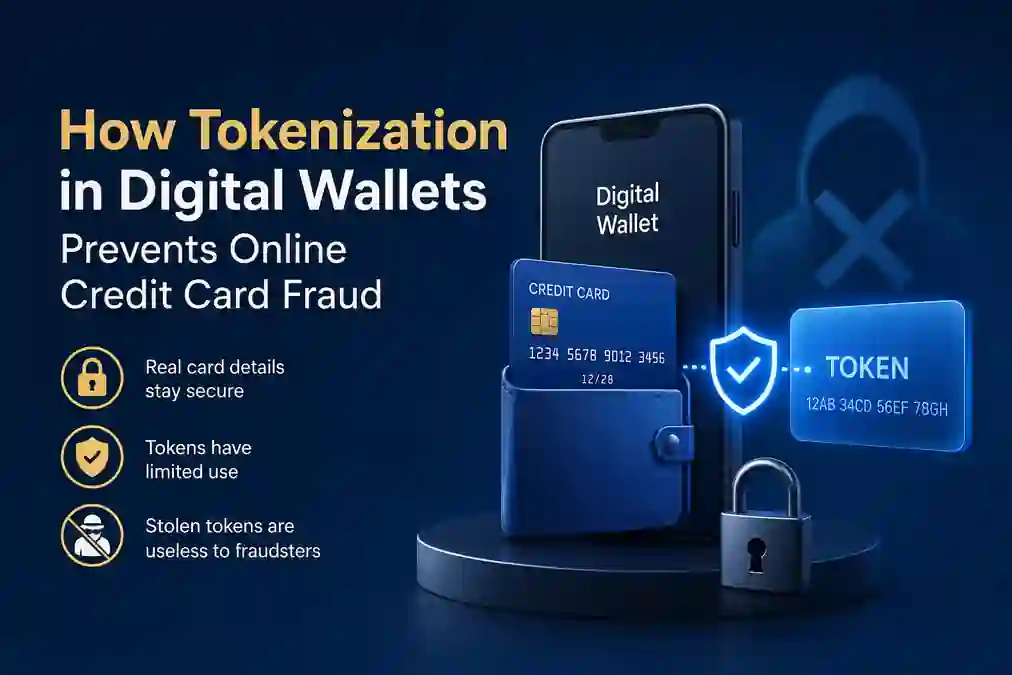
How Tokenization in Digital Wallets Prevents Online Credit Card Fraud
FRENOVARA
Beyond The Headline
If you have ever paid online with a digital wallet, you may have wondered how your card can be used without repeatedly giving an online store your actual card number.
The answer is payment tokenization.
Tokenization replaces the card’s primary account number (PAN) with a payment token that can be restricted to a particular use, merchant, device or payment environment. This means a digital-wallet transaction can be completed without exposing the underlying card number to every party involved in the payment.
That matters because stealing a tokenized payment credential can be considerably less useful to a fraudster than obtaining the underlying card details.
What Is a Digital Wallet? How It Works,
How tokenization changes an online card payment
| Traditional card payment | Tokenized digital-wallet payment |
|---|---|
| Relies on the underlying card number | Uses a payment token |
| Card credentials can be valuable if exposed | Token can be restricted to its intended use |
| Greater exposure of sensitive payment data | Reduces exposure of the underlying PAN |
| Stolen card data may be reused elsewhere | Token restrictions can limit reuse |
| Security depends on several controls | Tokenization works alongside authentication and fraud controls |
In simple terms: tokenization doesn’t make online fraud impossible. It makes stolen payment credentials less valuable and gives the payment ecosystem another layer of control.
Top 7 B2B Digital Wallet Platforms for Cross-Border Merchant Payments in 2026
What Is Tokenization in a Digital Wallet?
Tokenization is the process of replacing a sensitive payment credential with a different value that can be used within a payment system.
In card payments, the sensitive credential is usually the Primary Account Number, or PAN—the number printed on a conventional payment card.
EMVCo describes payment tokenization as replacing the PAN with a unique alternative value whose use can be defined by where and how it is allowed to operate.
Think of it this way.
Imagine that you need to give a hotel permission to charge your bank account. Instead of handing over your complete banking credentials, you receive a specially controlled payment pass that represents your account.
The hotel can use the pass for its intended purpose, but it doesn’t automatically receive the underlying account information.
A payment token works on a similar principle.
The token represents the card account without being the same thing as the card number.
Digital Wallet vs Traditional Bank Account: Which is Safer?
Why Card Numbers Are Such Valuable Targets
Online shopping creates a particular security challenge because the physical card isn’t present.
A customer can make a purchase from a laptop or smartphone thousands of kilometres away from the merchant.
That makes card-not-present fraud an important problem for the payments industry.
If criminals obtain usable card credentials, they may attempt to make purchases without possessing the physical card.
This is why modern payment security increasingly focuses on reducing the amount of sensitive card information exposed during digital transactions.
EMVCo identifies payment tokenization as one technology designed to replace the PAN and help secure digital and online payments.
But tokenization is not the same as simply hiding the card number.
The important difference is what happens to the replacement credential.
Razorpay Vulcan: How AI Is Changing Digital Payments
How Tokenization Protects a Digital Wallet Transaction
When a card is provisioned into a compatible digital-wallet environment, the payment ecosystem can use a token rather than simply passing the original card number through the transaction.
The process can be simplified into four stages:
1. The customer adds a card
A consumer adds an eligible debit or credit card to a digital wallet.
2. The payment ecosystem verifies the card
The relevant issuer, network and tokenization infrastructure participate in provisioning and validating the payment credential.
3. A token represents the card
The payment token becomes the credential used within the supported payment environment.
4. The merchant receives the payment information needed to complete the transaction
The merchant can process the transaction without needing the underlying card number in the same form.
EMVCo’s payment-tokenization framework is designed to allow the token to travel through the payment process from the point of purchase through the acquiring and payment-network environment to authorization.
This separation is fundamental to the security model.
Nigeria Digital Banking 2026: The Future of Banking and Fintech
The Most Important Protection: A Token Can Have Limits
This is where tokenization becomes more interesting than simply replacing one number with another.
Payment tokens can be configured with controls governing where or how they can be used.
EMVCo specifically describes tokens that can be constrained by factors such as merchant, device or transaction scenario.
That creates a powerful security advantage.
Suppose a fraudster obtains a payment credential associated with a particular environment.
The credential isn’t necessarily equivalent to possessing the customer’s original card number.
Its usefulness can depend on the conditions under which the token was created.
That’s the basic security idea:
Real card → controlled token → authorized transaction
rather than:
Real card → exposed card number → potentially reusable credential
This doesn’t eliminate risk, but it can substantially reduce the value of compromised payment information.
Future of Digital Wallets in Africa: AI and Fintech
What Happens If a Merchant’s Database Is Hacked?
This is one of the biggest reasons tokenization matters to online businesses.
Imagine an e-commerce company maintaining a database containing sensitive card information.
If attackers gain access to that database, the stolen information could become a valuable target.
Now imagine the payment environment uses tokens instead of requiring the merchant to retain the underlying card numbers.
The breach can still be serious.
Customer information may still be exposed. Accounts may still be compromised. Attackers may still attempt other forms of fraud.
But the payment credentials themselves can be less useful to criminals when the underlying PAN is not unnecessarily exposed.
Visa says its tokenization technology is designed to replace sensitive card details with secure tokens to reduce fraud and protect account data.
Digital Wallets in Nigeria: How OPay, PalmPay and Fintechs Compete
E-commerce Payments in Africa: The Future of Digital Commerce
This is an important distinction:
Tokenization doesn’t make a hacked company safe. It can make stolen payment data less useful.
Tokenization Is Not Encryption
These two technologies are often mentioned together, but they aren’t identical.
Tokenization
Replaces sensitive information with a substitute payment credential.
Encryption
Transforms information into protected data that requires the appropriate method or key to recover.
A payment system can use multiple security technologies at the same time.
In fact, modern payment security isn’t built around one magic technology.
It is built from layers.
E-commerce Payments in Africa: Fintechs and Payment Infrastructure
A modern online payment can involve:
- Tokenization
- Encryption
- Authentication
- Device security
- Fraud monitoring
- Risk scoring
- EMV 3-D Secure
- Network-level controls
EMVCo describes EMV 3-D Secure as a technology that helps merchants and card issuers combat card-not-present fraud in e-commerce.
Tokenization therefore shouldn’t be viewed as a replacement for fraud detection.
It is one part of a much larger security system.
How Flutterwave Became Africa’s Most Valuable Fintech Company and Changed Digital Payments Forever
Tokenization Can Also Improve the Shopping Experience
Security normally sounds like something that should make a checkout process slower.
Tokenization can produce the opposite effect.
Digital wallets allow customers to authenticate through their device rather than repeatedly typing card details into every checkout page.
EMVCo says its Secure Remote Commerce technology is designed to reduce dependence on consumers manually entering sensitive information during online checkout.
That creates an important commercial benefit:
Better security can coexist with less friction.
For an online merchant, that matters because every additional checkout step can become another opportunity for a customer to abandon a purchase.
The Future of Cashless Payments: Are Digital Wallets Replacing Cash?
Tokenization Is Becoming a Major Part of E-Commerce
This isn’t a niche technology waiting for widespread adoption.
It is already becoming part of mainstream payment infrastructure.
Mastercard reported in June 2026 that three in five Mastercard e-commerce transactions in Europe were tokenized, with its merchant-tokenization service live across 45 European countries and territories. The company is targeting 100% e-commerce tokenization by 2030.
Visa is also continuing to expand tokenized payments. In April 2026, Visa reported that tokenization had produced a 35% reduction in e-commerce fraud rates compared with non-tokenized transactions, alongside a nearly five-percentage-point increase in authorization rates in its cited network data.
Those are Visa’s network-level figures, not a guarantee for every merchant, but they illustrate why payment networks are investing heavily in the technology.
Digital Wallets for Businesses: Why Merchants Are Adopting Them
Are Digital Wallets Safe? Everything You Need to Know About Mobile Payment Security
What Does Tokenization Mean for Online Merchants?
For merchants, tokenization can change the way payment security is managed.
Instead of thinking:
“How do we protect every card number in our system?”
the architecture can increasingly move toward:
“How do we process payments without unnecessarily handling the underlying card number?”
That can reduce the amount of sensitive payment data exposed to the merchant environment.
It can also provide other potential benefits.
Reduced data exposure
The merchant doesn’t necessarily need to handle the underlying PAN for every tokenized transaction.
Better payment security
A controlled token can be less useful to attackers than a conventional card number.
Potentially higher authorization rates
Visa reports higher authorization performance for tokenized transactions in its network data.
Better customer experience
Digital wallets can reduce manual card entry during checkout.
Stronger foundation for recurring commerce
Tokenized credentials can help businesses manage stored payment credentials within supported payment ecosystems.
Why Digital Wallets May Replace Debit Cards Sooner Than You Think
The Rise of Social Commerce in Africa: How Social Media Is Transforming Online Shopping
Why Tokenization Matters to WooCommerce Stores
This technology is particularly relevant to the millions of businesses selling online.
A WooCommerce merchant, for example, may accept payments through a payment gateway that supports tokenization.
The merchant’s checkout can then participate in a payment flow where the underlying card number isn’t unnecessarily exposed throughout the merchant’s systems.
That matters even more as small businesses become targets for cybercrime.
A small online retailer may not have the same cybersecurity resources as a global bank.
Using payment infrastructure that minimizes the amount of sensitive card information the merchant handles can therefore be an important part of a broader security strategy.
Related Frenovara Article
How WooCommerce Powers Millions of Online Businesses
The growth of e-commerce makes secure payment infrastructure increasingly important to online merchants.
What Tokenization Cannot Prevent
This is where many explanations of payment tokenization become misleading.
Tokenization is not a complete fraud-prevention system.
A criminal doesn’t necessarily need to steal a card number to commit fraud.
They can target the customer instead.
For example:
- Phishing
- Account takeover
- Social engineering
- Stolen passwords
- Fake websites
- Malware
- SIM-related attacks
- Compromised devices
- Fraudulent wallet provisioning
Visa’s 2026 security outlook also highlights the growing sophistication of AI-powered identity attacks, showing why payment security is becoming broader than protecting card numbers alone.
So the real lesson is:
Tokenization closes one important door. It doesn’t eliminate every door criminals can use.
What Happens If Someone Steals a Token?
A common misconception is that a token is automatically worthless if stolen.
That’s too simplistic.
The security value comes from the way the token is provisioned, controlled and validated.
Depending on the implementation, a token may be constrained by its intended environment.
Additional security technologies can also be used to validate transactions.
That means a criminal who obtains payment information may still face additional barriers before successfully completing a fraudulent transaction.
This is why tokenization should be viewed as risk reduction, rather than an absolute guarantee.
Tokenization vs Traditional Card Payments
The difference becomes clearer when we look at the basic security model.
Traditional model
Customer card → Card number → Merchant/payment environment → Authorization
Tokenized model
Customer card → Token → Merchant/payment environment → Token validation → Authorization
The second model attempts to reduce unnecessary exposure of the underlying card credential.
That’s the real innovation.
The payment still needs to be deposited into the same financial account. The difference is the credentials used to represent that account during the transaction.
Why This Matters for Digital Wallets
Digital wallets are changing the role of the smartphone in online payments.
A phone is no longer simply a device for browsing a store.
It can become a secure payment environment containing:
- Payment credentials
- Device authentication
- Tokenized cards
- Biometric authentication
- Transaction security mechanisms
EMVCo’s mobile-payment framework covers mobile devices, including smartphones, tablets and wearables, for secure card-based payments.
That means the wallet is increasingly becoming an identity and payment layer, rather than simply an app that stores cards.
The Bigger Business Story Behind Tokenization
There is a deeper reason payment companies are pushing tokenization.
Trust has become part of the economics of digital commerce.
Consumers are more willing to shop online when they trust the payment process.
Merchants want more approved transactions.
Banks want fewer fraudulent transactions.
Payment networks want their infrastructure to remain secure.
Digital-wallet providers want consumers to keep using their platforms.
Tokenization sits at the intersection of all these interests.
It can help reduce exposure to sensitive credentials while supporting faster, more convenient digital payments.
Mastercard’s 2026 payments outlook similarly places tokenization alongside fraud prevention, digital wallets and other technologies shaping the next generation of commerce.
The Future: Your Card Number May Matter Less Than Your Digital Credential
For decades, the 16-digit card number was the fundamental identity of a payment card.
The digital-payment ecosystem is moving toward something different.
The customer still owns the underlying card account.
But the transaction can increasingly rely on a controlled digital credential rather than repeatedly exposing the underlying card number.
That shift has implications far beyond Apple Pay or Google Pay.
It affects:
- E-commerce
- Banking
- Fintech
- Subscription businesses
- Marketplaces
- Digital wallets
- Payment gateways
- WooCommerce stores
- Mobile commerce
And as payment networks expand tokenization, the technology is becoming part of the basic infrastructure behind online commerce.
Frequently Asked Questions
Does tokenization completely prevent online credit card fraud?
No. Tokenization reduces exposure to sensitive card credentials and can make compromised payment information less useful, but it cannot prevent phishing, account takeover, identity fraud, device compromise or every other form of payment fraud.
What is a payment token?
A payment token is an alternative credential that represents a card account without exposing the underlying primary account number in the same way. EMVCo says payment tokens can be constrained by where and how they are used.
Is tokenization safer than storing card numbers?
Generally, tokenization can reduce the exposure of sensitive card information because merchants can use tokens rather than directly handling the underlying PAN in the same way.
The overall security still depends on the payment provider, merchant infrastructure and other security controls.
Do digital wallets use tokenization?
Yes. Tokenization is a core technology used in modern digital-payment ecosystems. Payment networks such as Visa and Mastercard provide tokenization infrastructure for digital payments.
Can hackers steal a payment token?
A token can potentially be compromised, but its usefulness may be limited by the restrictions and controls associated with it. Tokenization is designed to reduce the value of compromised payment credentials rather than guarantee that every token is unusable to an attacker.
What is the difference between tokenization and encryption?
Tokenization replaces sensitive information with a substitute credential, while encryption transforms information into protected data that can be recovered using the appropriate cryptographic mechanism. They can be used together.
Does tokenization make online checkout faster?
It can reduce the need for customers to repeatedly enter card information. Digital-payment and Secure Remote Commerce technologies are designed in part to reduce manual entry and checkout friction.
Why is tokenization important for online businesses?
It can reduce sensitive payment-data exposure, strengthen payment security and, in some implementations, support better authorization and checkout experiences.
Conclusion: Tokenization Is Changing What a Payment Credential Looks Like
The most important thing about tokenization isn’t the mysterious-looking replacement number.
It’s the change in security architecture behind the payment.
Instead of making the customer’s actual card number the credential that repeatedly moves through digital commerce, tokenization allows the ecosystem to use a controlled alternative.
That can make stolen payment information less valuable, reduce unnecessary exposure of card data and support a smoother checkout experience.
But tokenization isn’t a silver bullet.
The future of payment security will depend on layers: tokenization, authentication, encryption, fraud detection, device security and smarter identity verification working together.
For consumers, that can mean safer and easier digital payments.
For merchants, it can mean less exposure to sensitive payment data and potentially better transaction performance.
And for digital-wallet providers, it represents something even bigger:
a future where the most important payment credential is no longer the card number printed on the card.
Related Frenovara Articles
- What Is a Digital Wallet? How It Works and Why Millions Use It
- Top 10 Digital Wallets in the World (2026)
- How Fintech Is Powering Online Shopping
- Top 7 B2B Digital Wallet Platforms for Cross-Border Merchant Payments
- How WooCommerce Powers Millions of Online Businesses
FRENOVARA — Beyond The Headline