FRENOVARA
Beyond The Headline
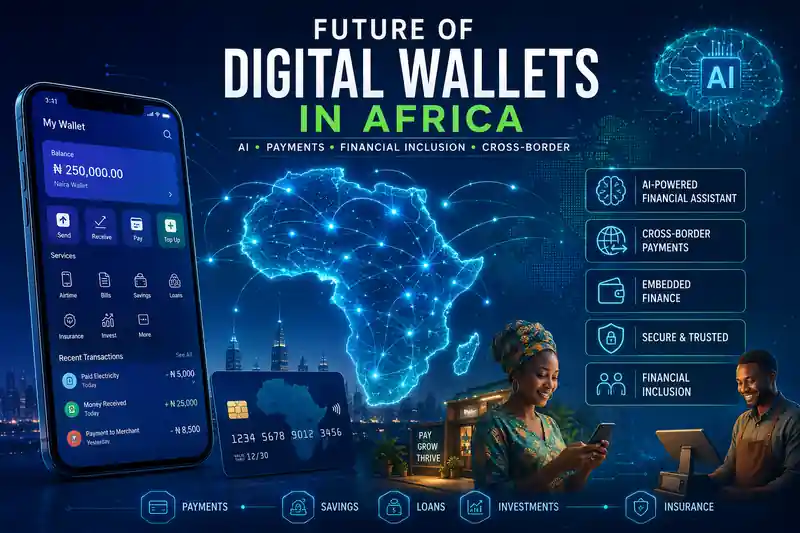
The Future of Digital Wallets in Africa: AI, Cross-Border Payments and the Next Fintech Revolution
The future of digital wallets in Africa, AI, and fintech could look very different from today’s payment applications.
The first generation of mobile financial services focused on a relatively simple problem: helping people move money.
The next generation could do much more.
Digital wallets could become financial assistants.
They could connect consumers to credit, savings, insurance and investments.
They could help businesses manage cash flow.
They could facilitate cross-border payments.
They could use artificial intelligence to identify fraud and personalise financial services.
They could also become embedded inside applications people already use for shopping, transportation, communication and business.
That evolution is already beginning.
Across Africa, fintech companies are moving beyond basic payments into more complex financial services, including credit, insurance and international transactions. The Financial Times recently cited Boston Consulting Group projections that Africa’s fintech revenues could reach $65 billion by 2030.
Nigeria is also preparing for this next phase.
The Central Bank of Nigeria launched Payments System Vision 2028 in June 2026, with interoperability, security, inclusion, innovation, trust and collaboration among its guiding principles. The framework also places emphasis on stronger cross-border integration.
The direction is clear.
Africa’s digital-wallet revolution is moving from access toward intelligence, integration and scale.
We have recently published an article on The Future of AI-Powered Businesses in Africa: Jobs and Investment. A must-read for you to widen your knowledge.
AI Could Turn the Wallet Into a Financial Assistant
One of the biggest changes could come from artificial intelligence.
Today’s wallet generally waits for the user to initiate an action.
The customer opens the application.
They select a service.
They enter an amount.
They confirm the transaction.
An AI-powered financial platform could become more proactive.
It could analyse spending patterns.
It could identify unusual transactions.
It could remind customers about recurring payments.
It could help businesses understand cash-flow patterns.
It could answer financial questions.
Eventually, it could even execute certain approved tasks on behalf of users.
That would change the role of the wallet.
Instead of being simply a digital container for financial activity, it could become an intelligent interface between the customer and the financial system.
Read Related Article: AI in African Businesses: 8 Industries AI Will Transform
AI Will Make Fraud Detection More Sophisticated
The growth of digital payments creates an obvious challenge.
More transactions create more opportunities for fraud.
Traditional rule-based systems can identify known patterns, but sophisticated fraud can change quickly.
Artificial intelligence can analyse large amounts of transaction data and identify patterns that may be difficult to detect manually.
For example, a system could consider:
- Transaction frequency
- Device behaviour
- Location patterns
- Account history
- Transaction amounts
- Login behaviour
- Merchant activity
A suspicious combination could trigger additional verification.
This does not mean AI will eliminate fraud.
Instead, it could help financial institutions and fintech companies respond faster.
Research published in 2026 on Nigerian financial services also points toward AI-enabled accounting systems and natural-language processing as tools that can strengthen fraud detection and continuous auditing.
The challenge will be making these systems accurate without unfairly blocking legitimate customers.
This is the more reason we published article on: How AI Is Changing African Businesses and Industries
The Next Wallet Could Understand Your Financial Behaviour
Personalisation could become another major advantage.
Imagine a digital wallet that understands how a customer normally manages money.
It could identify recurring expenses.
It could recognise changes in spending.
It could provide relevant financial information.
For a small business, the system could identify periods when cash flow is usually tight.
It could also help the business understand which payments are coming in and going out.
However, this requires responsible data management.
Customers need to know how their information is being used.
Financial institutions also need strong privacy and security controls.
The value of personalised finance will therefore depend heavily on trust.
Embedded Finance Could Make Wallets Less Visible
Another major development is embedded finance.
Instead of opening a separate financial application, customers increasingly encounter financial services inside other platforms.
An online marketplace can offer payment services.
A transport platform can provide a wallet.
An e-commerce company can offer instalment financing.
A business-management application can provide banking.
A social platform could eventually support commerce and payments.
In this model, the customer may not even think about the financial technology powering the transaction.
The financial service becomes part of the product.
That could create enormous opportunities for fintech infrastructure companies.
Instead of competing only for consumers’ attention, they can provide the technology behind thousands of businesses. Read a related article: Africa Energy Economy: The Future of Energy and Investment
Cross-Border Payments Could Become Africa’s Biggest Fintech Opportunity
Africa’s borders create a major problem for businesses and consumers.
A company in Nigeria may want to sell to customers in Ghana.
A freelancer in Kenya may work for a company in South Africa.
A Nigerian business may purchase goods from another African market.
A family member may need to send money across borders.
Traditional international transfers can be expensive, slow or complicated.
The next generation of digital wallets could simplify these transactions.
Nigeria’s Payments System Vision 2028 explicitly prioritises stronger interoperability and expansion into regional and international jurisdictions. The CBN says the framework is intended to position Nigeria to participate more effectively in intra-African trade and the global payments ecosystem.
That creates an enormous opportunity.
If African wallets become more interoperable, sending money between African markets could eventually become much easier.
Stablecoins Could Also Influence Cross-Border Payments
Another development that deserves attention is the growing use of stablecoins.
Stablecoins are digital assets designed to maintain a relatively stable value, often by referencing a fiat currency such as the US dollar.
They are increasingly being discussed in the context of cross-border payments.
Reuters reported in June 2026, citing the IMF, that Nigerians were increasingly using dollar-pegged stablecoins for cross-border transfers. The IMF estimated that Nigeria received around $59 billion in crypto inflows between July 2023 and June 2024, representing a large share of stablecoin activity in Sub-Saharan Africa.
The development demonstrates the demand for alternatives that can move value across borders quickly.
Nevertheless, stablecoins also create regulatory and monetary-policy questions.
Their growth does not automatically mean they will replace conventional payment systems.
Instead, they may become another component of a broader digital-finance ecosystem.
Digital Identity Will Become More Important
A digital wallet needs to know who is using it.
That makes identity infrastructure critical.
As financial services become increasingly digital, identity verification will need to become faster while remaining secure.
Digital identity can help with:
- Account opening
- Customer verification
- Fraud prevention
- Credit assessment
- Regulatory compliance
- Cross-border transactions
However, identity systems also create privacy concerns.
A future digital financial system cannot simply collect more information.
It must protect that information.
The balance between convenience, security and privacy will therefore become increasingly important.
Open Banking Could Change How Fintechs Compete
The future may also involve more financial-data connectivity.
Open banking can allow customers and authorised financial-service providers to access financial information through standardised systems and permissions.
This can make it easier for customers to use different financial products.
It can also help fintech companies build more useful services.
For example, a customer could potentially connect accounts from different financial institutions to one financial-management platform.
A business could see its financial position across multiple providers.
This could reduce the importance of individual financial silos.
Instead of every company trying to keep customers entirely inside its own ecosystem, interoperability could allow different services to work together.
That would fundamentally change fintech competition.
Financial Inclusion Will Remain a Major Opportunity
Despite the rapid growth of fintech, millions of Africans still face barriers to formal financial services.
The challenge is particularly important in rural and underserved communities.
A digital wallet can help reduce some barriers, but technology alone is not enough.
Customers need:
- Affordable connectivity
- Reliable networks
- Simple interfaces
- Accessible agents
- Financial literacy
- Consumer protection
- Secure identity systems
The CBN’s Payments System Vision 2028 specifically identifies financial inclusion as one of its central objectives.
That means the future of African fintech will not be measured only by transaction value.
It will also be measured by how many people and businesses can participate in the digital economy.
The Agent Network Will Not Disappear
It might seem that smartphones will eventually eliminate the need for physical financial agents.
That is unlikely to happen quickly.
Agents remain valuable because they provide human assistance.
They can help customers who are less comfortable with technology.
They can serve communities with limited access to bank branches.
They can also support cash-in and cash-out services.
The future may therefore combine physical and digital finance.
A customer could interact with an agent today and use a mobile wallet tomorrow.
The agent becomes part of the digital financial infrastructure rather than a competitor to it.
That’s why we explained extensively in The Rise of AI Agents: How Autonomous AI Will Transform Business.
Digital Wallets Could Become Credit Platforms
Payments generate data.
That data could become valuable for responsible credit assessment.
Consider a small business that receives hundreds of transactions each month.
Its payment history could reveal important information about its business activity.
A fintech company could potentially use this information, alongside other appropriate data and risk controls, to evaluate financial products.
That could make credit more accessible to businesses that lack extensive traditional banking histories.
However, credit decisions based on algorithms must be carefully managed.
Poor data can produce poor decisions.
Biased models can exclude legitimate customers.
Therefore, responsible lending will need to remain central to fintech expansion.
The Future Wallet Could Become an Investment Gateway
Digital wallets may also move deeper into savings and investments.
A customer who already trusts a financial application with everyday payments may be more willing to use it for other financial activities.
The platform could eventually provide access to:
- Savings products
- Investment products
- Insurance
- Retirement services
- Government securities
- Other regulated financial products
This creates another ecosystem opportunity.
The wallet becomes the starting point.
The broader financial relationship becomes the destination.
AI Agents Could Eventually Transact on Behalf of Users
The most futuristic development may involve autonomous AI agents.
An AI agent can be designed to interpret goals, use software tools and take actions within defined permissions.
That raises an important question:
What happens when software can make financial transactions on behalf of a human?
Imagine telling an AI agent:
“Find the best price for this business software and purchase it if the cost stays below my approved budget.”
The agent could potentially search providers, compare prices and initiate a payment.
This concept is already receiving attention in research around machine-mediated finance.
A 2026 paper on agent-to-agent finance describes emerging infrastructure for AI agents to identify counterparties, negotiate services and potentially initiate payments, while highlighting the need for identity, authorisation, verification and accountability.
This is still an emerging area.
However, the implications for digital wallets are significant.
A wallet could eventually hold not only money for humans, but controlled financial permissions for AI agents.
Check out some of our related articles:
- ChatGPT vs Claude vs Gemini: Which AI Assistant Is Best in 2026?
- The Rise of AI Agents: How Autonomous AI Will Transform Business
- The Untold Story of Anthropic: How Claude Is Competing with ChatGPT
- How NVIDIA Became the World’s Most Valuable AI Company
- The Untold Story of OpenAI: How ChatGPT Changed Artificial Intelligence
The Challenge of Autonomous Finance
Giving an AI system the ability to move money introduces new risks.
What happens if an agent misunderstands an instruction?
What happens if an account is compromised?
What happens if an AI system is manipulated?
What happens if a fraudulent merchant tricks an agent?
These questions make bounded autonomy essential.
AI agents should not necessarily have unrestricted access to money.
Instead, users could define limits.
For example:
- Maximum transaction amount
- Approved merchants
- Approved categories
- Daily spending limits
- Confirmation requirements
- Time-based permissions
The wallet could become the control layer that determines what an AI agent is allowed to do.
That could create a completely new category of fintech infrastructure.
AI Revolution 2026: How AI Is Changing Business Part 1
Cybersecurity Will Become a Board-Level Issue
As digital finance becomes more sophisticated, cybersecurity cannot remain only a technical concern.
It becomes a business issue.
A successful attack can affect customers, merchants, regulators and investors.
Fintech companies therefore need to treat security as part of their core product.
The CBN’s Payments System Vision 2028 places security and trust among its guiding principles, reflecting the importance of resilient payment infrastructure.
The companies that make security invisible to customers while maintaining strong protection could gain a major competitive advantage.
Interoperability Could Transform the African Market
One of the biggest obstacles to pan-African fintech is fragmentation.
Different countries have different:
- Regulations
- Currencies
- Payment networks
- Identity systems
- Banking structures
- Consumer behaviours
A wallet that works perfectly in one country may not operate the same way in another.
Greater interoperability could reduce these barriers.
That is why cross-border payment infrastructure matters.
The objective should not necessarily be to create one African wallet.
Instead, the continent could develop systems that allow different regulated wallets and payment platforms to communicate more effectively.
That could create a much larger digital financial market.
See how the: Africa Energy Sector: How Oil, Gas and Renewables Are Reshaping Markets and how Nigeria Economy 2026: Key Changes Businesses Need to Know
Fintech Will Become More Invisible
The next generation of fintech may be less visible to consumers.
Today, people know the names of their payment applications.
Tomorrow, financial services could be embedded into the products they already use.
A customer buys something online.
Payment happens automatically.
A business receives money.
Accounting updates automatically.
An AI system detects unusual activity.
A cross-border payment is converted and settled.
The customer may never think about the infrastructure behind the process.
This is one of the defining characteristics of mature financial technology.
The best technology often becomes invisible.
Article: How Flutterwave Became Africa’s Most Valuable Fintech Company and Changed Digital Payments Forever
What This Means for Nigerian Fintech Companies
Nigerian fintech companies have an opportunity to expand beyond the domestic market.
They can build products for African commerce.
They can create infrastructure for cross-border payments.
They can provide financial technology to businesses across the continent.
They can integrate AI into fraud prevention and financial management.
They can build APIs that allow other companies to embed financial services.
However, expansion will require discipline.
Different African markets have different regulations.
A product designed for Nigeria cannot simply be copied into another country without adaptation.
The winners will need local knowledge as well as technology.
What Consumers Should Expect
For consumers, the next decade could bring more convenient financial services.
Payments could become faster.
Financial products could become more personalised.
Cross-border transfers could become easier.
Fraud detection could become more intelligent.
Digital identity could make onboarding faster.
AI assistants could simplify financial management.
At the same time, consumers will need to become more financially and digitally literate.
Convenience creates responsibility.
People will need to understand how their data is used.
They will need to protect their accounts.
They will need to recognise scams.
They will need to understand the financial products being offered to them.
What Businesses Should Expect
Businesses may experience an even bigger transformation.
A digital wallet could become a central part of business operations.
It could connect:
Sales – Payments – Banking – Accounting – Credit – Payroll – Suppliers
AI could then analyse the information flowing through these systems.
That could help businesses identify cash-flow problems, automate routine processes and make better financial decisions.
For small businesses, this could be particularly significant.
Financial technology could reduce the administrative burden associated with managing a company.
The Biggest Opportunity May Be Africa’s Small Businesses
Africa’s small-business sector is enormous.
Yet many small businesses still face challenges around payments, credit, accounting and financial management.
That creates an opportunity for fintech companies.
Instead of building products only for large corporations, they can create digital financial infrastructure specifically for entrepreneurs.
The winning platform may therefore be the one that understands the daily reality of an African business owner.
Not just the technology.
Not just the payment.
The entire business.
What Could Stop the Revolution?
The opportunity is enormous, but several obstacles remain.
Infrastructure
Poor connectivity can disrupt digital transactions.
Regulation
Unclear or fragmented rules can slow expansion.
Cybersecurity
Fraud and cyberattacks can damage trust.
Digital literacy
Some customers may struggle to use advanced financial services.
Affordability
Data and transaction costs can affect adoption.
Trust
Customers need confidence that their money and data are safe.
Interoperability
Fragmented payment systems can make cross-border expansion difficult.
These challenges will determine how quickly Africa’s fintech ecosystem develops.
The New Fintech Competition Will Be About Infrastructure
The first fintech competition was largely about applications.
The next competition will increasingly be about infrastructure.
Who can provide the best payment rails?
Who can connect businesses across borders?
Who can build secure APIs?
Who can provide reliable identity?
Who can detect fraud?
Who can embed financial services into other platforms?
Who can make AI-powered financial services safe?
These questions will shape the next generation of African fintech.
Nigeria Has an Opportunity to Lead
Nigeria already has several advantages.
It has a large consumer market.
It has a strong fintech community.
It has sophisticated payment infrastructure.
It has entrepreneurs building financial technology at scale.
It also has a regulator actively developing a long-term payment-system strategy.
The CBN’s Payments System Vision 2028 explicitly aims for a secure, inclusive, innovative and interoperable payment ecosystem integrated with regional and global financial markets.
If implementation matches ambition, Nigeria could strengthen its position as one of Africa’s most important fintech markets.
Conclusion: The Digital Wallet Is Only the Beginning
The future of digital wallets in Africa will not be defined by who has the most attractive application.
It will be defined by what these platforms become.
A wallet could become a financial assistant.
It could become a business operating system.
It could become a gateway to investment.
It could become a cross-border payment tool.
It could become an embedded financial layer inside other digital products.
Eventually, it could even become the permission and settlement infrastructure through which autonomous AI agents conduct approved financial activities.
That future will require more than innovation.
It will require trust.
It will require strong regulation.
It will require cybersecurity.
It will require interoperability.
It will require responsible AI.
And it will require infrastructure capable of supporting millions of consumers and businesses.
Nigeria is already moving in that direction.
The CBN’s Payments System Vision 2028 places interoperability, security, inclusion, innovation, trust and collaboration at the centre of the country’s next payment-system phase.
Across the continent, fintech companies are also moving beyond basic payments into credit, insurance, international transactions and other financial services.
The opportunity is therefore much bigger than digital wallets.
It is about building a digital financial economy for Africa.
For Nigerian entrepreneurs, that means new businesses can emerge around payments, AI, identity, cybersecurity, financial infrastructure and cross-border commerce.
For established fintech companies, it means the competition is becoming deeper.
For consumers, it means financial services could become faster, more accessible and more personalised.
But the biggest winners will likely be the companies that solve real problems while earning and protecting customer trust.
The digital wallet started by helping people move money.
Its next chapter could help people manage, grow and automate money.
And that may be the beginning of Africa’s next major fintech revolution.
FRENOVARA — Beyond The Headline
Internal Linking Opportunities
Part 3 should connect naturally with Frenovara’s existing topical clusters, especially:
- AI Agents: link where the article discusses autonomous AI agents and machine-mediated finance.
- The Future of AI Agents: link where AI-powered financial assistants are introduced.
- AI-Powered Businesses in Africa: link where AI and African entrepreneurship intersect.
- Africa’s fintech ecosystem: link around the broader African fintech opportunity.
- Nigeria Economy 2026: link where digital finance is discussed as part of economic transformation.
- Africa Energy Economy: use only if discussing how digital finance can support investment and infrastructure; otherwise omit.
- Digital payments/fintech comparison articles: link where consumer and business fintech platforms are discussed.
The internal links should be inserted inside relevant sentences, not as a generic “Related Articles” block.
Image SEO
Suggested filename:
Alt text:
Image caption:
The next generation of African digital wallets could combine AI, payments, financial services and cross-border commerce.
Image title:
Image description:
A futuristic African digital-finance ecosystem showing AI-powered digital wallets, mobile payments, cross-border transactions and fintech infrastructure.
FRENOVARA — Beyond The Headline