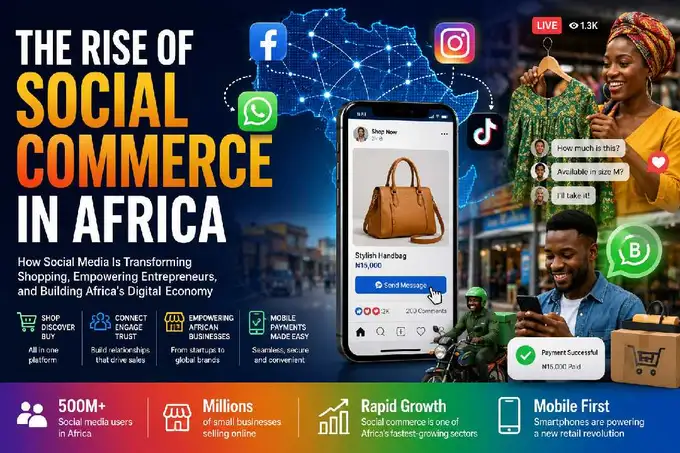
The Rise of Social Commerce in Africa

Africa’s digital economy is evolving at an extraordinary pace.
For years, online shopping revolved around traditional e-commerce websites where customers visited dedicated online stores to browse products and complete purchases.
Today, however, a new model is rapidly changing how Africans discover, evaluate, and buy products.
That model is social commerce.
Instead of visiting standalone online stores, millions of consumers now purchase products directly through social media platforms.
Whether buying clothing on Instagram, ordering food through WhatsApp, discovering beauty products on TikTok, or purchasing electronics via Facebook Marketplace, shopping has become deeply integrated into everyday social interactions.
Across Africa, social commerce is no longer an emerging trend.
It is becoming one of the fastest-growing segments of digital commerce. How Google Pay Became a Global Digital Wallet and Changed Digital Payments Forever
Its growth is transforming entrepreneurship, empowering small businesses, creating new employment opportunities, and changing how brands connect with customers.
What Is Social Commerce?
Social commerce refers to the buying and selling of products and services directly through social media platforms.
Unlike traditional e-commerce, where customers visit dedicated online stores, social commerce allows transactions to begin and often finish within social networking platforms.
The shopping journey may include:
- Product discovery.
- Customer interaction.
- Reviews and recommendations.
- Messaging sellers.
- Payment arrangements.
- Delivery coordination.
all without leaving the social platform.
The shopping experience becomes more conversational, interactive, and community-driven.
Why Social Commerce Is Growing So Quickly
Several factors explain the rapid expansion of social commerce across Africa.
Smartphone Adoption
Millions of Africans now own smartphones.
Affordable Android devices have dramatically expanded internet access across urban and rural communities.
As smartphone penetration increases, more consumers spend significant time on social media.
Digital Wallet vs Mobile Banking: What’s the Difference and Which One Should You Use?
Where attention goes, commerce naturally follows.
Affordable Internet Access
Mobile internet has become increasingly accessible.
Although affordability remains a challenge in some regions, expanding broadband infrastructure continues bringing millions of new users online every year.
This growing digital population creates enormous opportunities for businesses.
Social Media Dominance
Platforms such as:
- Facebook.
- Instagram.
- WhatsApp.
- TikTok.
- X (formerly Twitter).
have become daily communication tools for millions of Africans.
Businesses increasingly recognise that customers already spend hours on these platforms.
Rather than forcing consumers to visit separate websites, brands simply bring shopping directly into existing conversations.
Facebook Marketplace Changed Everything
One of the earliest catalysts for African social commerce was Facebook Marketplace.
It enabled individuals and businesses to:
- List products.
- Reach local buyers.
- Negotiate prices.
- Arrange deliveries.
For many small businesses, Facebook Marketplace removed the need to build expensive websites.
Entrepreneurs could immediately access large audiences using only smartphones.
Today, countless African businesses continue relying heavily on Facebook Marketplace to generate sales. Digital Wallet vs Mobile Banking: What’s the Difference and Which One Should You Use?
WhatsApp Became Africa’s Digital Storefront
Few platforms have influenced African commerce as significantly as WhatsApp.
Originally designed for messaging, WhatsApp gradually evolved into one of Africa’s most powerful business tools.
Through WhatsApp Business, entrepreneurs can:
- Showcase products.
- Answer customer enquiries.
- Send catalogues.
- Receive orders.
- Coordinate deliveries.
- Provide after-sales support.
For many informal businesses, WhatsApp functions as an entire online store.
What Is a Digital Wallet? How It Works and Why Millions Use It in the Digital Economy
Its simplicity makes it especially attractive to small enterprises with limited technical resources.
Instagram Turned Visual Content into Sales
Fashion, beauty, lifestyle, and luxury brands have particularly benefited from Instagram.
Consumers increasingly discover products through:
- Photos.
- Short videos.
- Stories.
- Influencer recommendations.
- Live sessions.
Rather than interrupting entertainment, brands integrate products naturally into visual storytelling. Top 10 Digital Wallets in the World (2026)
This approach creates stronger emotional connections while increasing purchase intentions.
Small Businesses Are Winning
Perhaps the greatest beneficiaries of social commerce are small businesses.
Traditional retail often requires:
- Physical shops.
- Expensive advertising.
- Large inventories.
- Significant startup capital.
Social commerce lowers these barriers.
Entrepreneurs can begin selling with:
- Smartphones.
- Internet connections.
- Quality products.
- Consistent content.
This accessibility has enabled thousands of African entrepreneurs to launch businesses with relatively modest investment.
Consumers Trust Human Interaction
Unlike traditional e-commerce websites, social commerce feels personal.
Customers can:
- Chat directly with sellers.
- Request additional product photos.
- Ask questions.
- Negotiate prices.
- Read customer comments.
- Watch product demonstrations.
These interactions often increase consumer confidence. How Fintech Is Powering Online Shopping: The Technology Behind Faster, Safer, and Smarter E-commerce
Trust remains one of the strongest drivers behind social commerce adoption across Africa.
Influencers Are Becoming Africa’s New Salespeople
One of the biggest drivers of social commerce is influencer marketing.
Across Africa, social media personalities have become trusted voices within their communities.
Rather than relying solely on traditional advertising, brands increasingly collaborate with:
- Content creators.
- Lifestyle influencers.
- Fashion bloggers.
- Tech reviewers.
- Food creators.
- Fitness coaches.
- Beauty experts.
- Entertainment personalities.
Consumers often trust recommendations from people they follow more than conventional advertisements.
How WooCommerce Powers Millions of Online Businesses
This trust translates directly into sales.
In many cases, products sell out within hours after being featured by popular creators.
Live Shopping Is Gaining Momentum
Live commerce is gradually becoming one of Africa’s fastest-growing digital retail experiences.
During live sessions, sellers demonstrate products while interacting directly with viewers.
Customers can:
- Ask questions.
- Request demonstrations.
- Compare products.
- Negotiate prices.
- Place orders instantly.
This combines entertainment with shopping.
The experience feels more personal than browsing static online stores.
How Amazon Makes Billions: The Business Model Explained
As internet quality improves across Africa, live shopping is expected to expand significantly.
The Economic Impact of Social Commerce
Social commerce is contributing to Africa’s broader digital economy in several important ways. The Future of E-commerce in Africa
Job Creation
The industry supports employment across multiple sectors.
Opportunities have expanded for:
- Digital marketers.
- Content creators.
- Photographers.
- Graphic designers.
- Delivery riders.
- Customer service representatives.
- Social media managers.
- Small business owners.
Every successful online business often creates additional economic activity beyond the original entrepreneur. Best Payment Gateways for African E-commerce Businesses in 2026
Empowering Small Businesses
Many African entrepreneurs previously lacked resources to establish physical retail stores.
Social commerce removes many traditional barriers.
Businesses can now reach national and even international customers without opening expensive retail outlets. Top Fintech Founders in Africa and Their Impact
This has enabled thousands of young entrepreneurs to build profitable businesses from home.
Supporting Women Entrepreneurs
Women-owned businesses have particularly benefited from social commerce.
Many female entrepreneurs successfully operate businesses selling:
- Fashion.
- Cosmetics.
- Hair products.
- Food.
- Accessories.
- Handmade products.
Flexible online selling allows many women to balance business with family responsibilities while generating independent income.
Artificial Intelligence Is Changing Social Selling
Artificial Intelligence is becoming increasingly important across social commerce. How African SMEs Are Using AI to Compete with Global Businesses
Many businesses now use AI to:
- Generate marketing content.
- Create product descriptions.
- Recommend products.
- Improve customer service.
- Analyse customer behaviour.
- Automate advertising campaigns.
Chatbots now answer customer enquiries twenty-four hours a day.
Recommendation engines personalise shopping experiences based on customer preferences. Why Africa’s Digital Banks Are Winning the Future of Finance
AI enables even small businesses to compete more effectively with larger companies.
Payments Are Becoming Easier
Successful social commerce depends on efficient payment systems.
Fortunately, Africa’s fintech ecosystem has made digital payments far more accessible.
Businesses now accept payments through:
- Bank transfers.
- Digital wallets.
- Payment links.
- QR codes.
- Mobile money.
- POS terminals.
Companies such as Flutterwave, Paystack, Moniepoint, OPay, PalmPay, and numerous other fintech providers have simplified digital commerce across the continent.
Why Digital Payments Continue to Transform Nigeria’s Economy in 2026
Improved payment infrastructure has significantly accelerated social commerce adoption.
Logistics Still Remains a Challenge
Despite remarkable growth, logistics continues presenting challenges. Top Logistics Startups in Africa
Businesses frequently encounter issues including:
- High delivery costs.
- Delayed shipments.
- Rural accessibility.
- Address verification.
- Inventory management.
Many entrepreneurs overcome these obstacles through partnerships with:
- Courier companies.
- Ride-hailing delivery services.
- Independent logistics providers.
- Local dispatch riders.
As logistics infrastructure improves, customer satisfaction is expected to increase further. Top Retail Technology Companies in Africa
Customer Trust Must Be Earned
Trust remains one of the biggest challenges in African social commerce.
Consumers increasingly worry about:
- Online scams.
- Fake products.
- Non-delivery.
- Poor product quality.
- Fraudulent sellers.
Successful businesses address these concerns by focusing on:
- Transparent communication.
- Customer reviews.
- High-quality products.
- Reliable delivery.
- Responsive customer support.
Brands that consistently build trust often enjoy higher repeat purchases and stronger referrals. How 5G Will Transform African Businesses: The Next Digital Revolution
Investors See Huge Potential
Investors increasingly recognise Africa’s social commerce opportunity.
Several factors continue attracting investment:
- Rapid urbanisation.
- Growing smartphone adoption.
- Expanding middle class.
- Increasing internet penetration.
- Young digital population.
- Rising fintech innovation.
Many venture capital firms believe Africa could become one of the world’s fastest-growing digital commerce markets over the next decade. How African Startups Are Attracting Billions in Global Investment
As a result, funding continues flowing into startups operating across social commerce, payments, logistics, and digital marketing.
The Future of Social Commerce in Africa
Africa’s social commerce revolution is still in its early stages.
Over the next decade, the industry is expected to become one of the continent’s most significant economic growth drivers.
Several trends will shape its future.
Artificial Intelligence
Artificial Intelligence will increasingly support businesses by providing:
- Personalized product recommendations.
- AI-generated marketing content.
- Customer behaviour analysis.
- Smart chatbots.
- Automated customer service.
- Predictive inventory management.
Even small businesses will gain access to tools previously available only to large corporations.
Integrated Shopping Experiences
Social media platforms are gradually transforming into complete shopping ecosystems.
Consumers will increasingly be able to:
- Discover products.
- Watch demonstrations.
- Chat with sellers.
- Make payments.
- Track deliveries.
all without leaving the same application.
This seamless experience will continue driving adoption.
Cross-Border Social Commerce
The African Continental Free Trade Area (AfCFTA) presents enormous opportunities for digital businesses.
Social commerce could allow entrepreneurs in one African country to sell directly to customers across multiple markets.
Improved payment infrastructure and logistics networks will make regional commerce significantly easier.
Stronger Digital Payments
Fintech companies will continue simplifying transactions.
Consumers are likely to experience:
- Faster settlements.
- Lower transfer costs.
- Better fraud protection.
- Easier international payments.
- Improved financial accessibility.
These improvements will remove barriers that previously limited online commerce.
Five Lessons Entrepreneurs Can Learn
Africa’s social commerce boom offers valuable business lessons.
1. Go Where Customers Already Spend Time
Businesses no longer need customers to visit expensive websites first.
Customers already spend hours every day on social media.
Meeting consumers where they already interact creates stronger engagement.
2. Build Relationships Before Selling
Social commerce succeeds because it feels personal.
Businesses that educate, entertain, and engage audiences often outperform those focused solely on selling.
Trust creates long-term customers.
3. Consistency Beats Perfection
Many successful African brands began with:
- Smartphones.
- Small inventories.
- Limited budgets.
Consistent posting, customer service, and product quality gradually built loyal communities.
4. Customer Experience Drives Referrals
Satisfied customers naturally become marketers.
Positive experiences generate:
- Reviews.
- Recommendations.
- Shares.
- Repeat purchases.
- Word-of-mouth advertising.
Excellent customer service often becomes the cheapest marketing strategy.
5. Keep Innovating
Social media platforms evolve constantly.
Businesses must continue adapting by:
- Learning new technologies.
- Experimenting with content.
- Understanding customer behaviour.
- Embracing emerging tools.
Innovation remains a competitive advantage.
Frequently Asked Questions (FAQs)
What Is Social Commerce?
Social commerce refers to buying and selling products directly through social media platforms such as Facebook, Instagram, WhatsApp, TikTok, and similar digital communities.
How Is Social Commerce Different from Traditional E-commerce?
Traditional e-commerce usually requires customers to visit dedicated online stores.
Social commerce allows product discovery, customer interaction, and purchasing directly within social media platforms.
Which Social Platforms Drive Social Commerce in Africa?
Popular platforms include:
- Facebook.
- Instagram.
- WhatsApp.
- TikTok.
- X (formerly Twitter).
Many businesses combine several platforms to maximize visibility.
Why Is Social Commerce Growing So Fast?
Several factors contribute:
- Smartphone adoption.
- Affordable internet.
- Fintech innovation.
- Growing digital literacy.
- Young population.
- Increased social media usage.
These trends continue expanding digital commerce across Africa.
Is Social Commerce Safe?
Social commerce can be safe when consumers:
- Buy from verified sellers.
- Confirm business credibility.
- Read customer reviews.
- Use secure payment methods.
- Avoid suspicious offers.
Businesses that prioritize transparency generally build stronger customer trust.
Africa’s Next Retail Revolution
Social commerce is changing more than shopping.
It is reshaping entrepreneurship itself.
Young Africans no longer require expensive retail stores to build successful businesses.
Instead, smartphones, creativity, quality products, and strong customer relationships increasingly determine business success.
The barriers to entry continue falling.
Innovation continues rising.
Consumers continue embracing digital lifestyles.
Together, these forces are creating one of Africa’s most exciting economic transformations.
Beyond the Headlines
Social commerce represents far more than selling products on Facebook or Instagram.
It reflects a deeper shift in how Africans communicate, build trust, and conduct business.
The continent’s entrepreneurs have demonstrated remarkable adaptability by transforming everyday social interactions into thriving digital marketplaces.
As artificial intelligence, digital payments, logistics, and mobile connectivity continue improving, social commerce will likely become one of Africa’s most influential economic sectors.
For businesses willing to embrace innovation, the opportunity extends far beyond online sales.
It offers the chance to build communities, create lasting brands, and participate in shaping Africa’s digital future.
The next generation of African business leaders may not begin with shopping malls.
They may begin with a single smartphone and a social media account.
WordPress SEO Tags
Social Commerce in Africa, African Social Commerce, Social Commerce, African E-commerce, Social Media Shopping, Facebook Marketplace, Instagram Shopping, WhatsApp Business, TikTok Shop, Mobile Commerce Africa, Online Shopping Africa, Digital Commerce, African SMEs, Fintech Africa, Digital Payments, Mobile Payments, African Entrepreneurs, E-commerce Trends, Online Retail Africa, Frenovara
SEO Image Filename
the-rise-of-social-commerce-in-africa-frenovara.webp
SEO Image Title
The Rise of Social Commerce in Africa
SEO Image Alt Text
African entrepreneurs using smartphones to sell products through Facebook, Instagram, WhatsApp and TikTok, illustrating the rise of social commerce in Africa