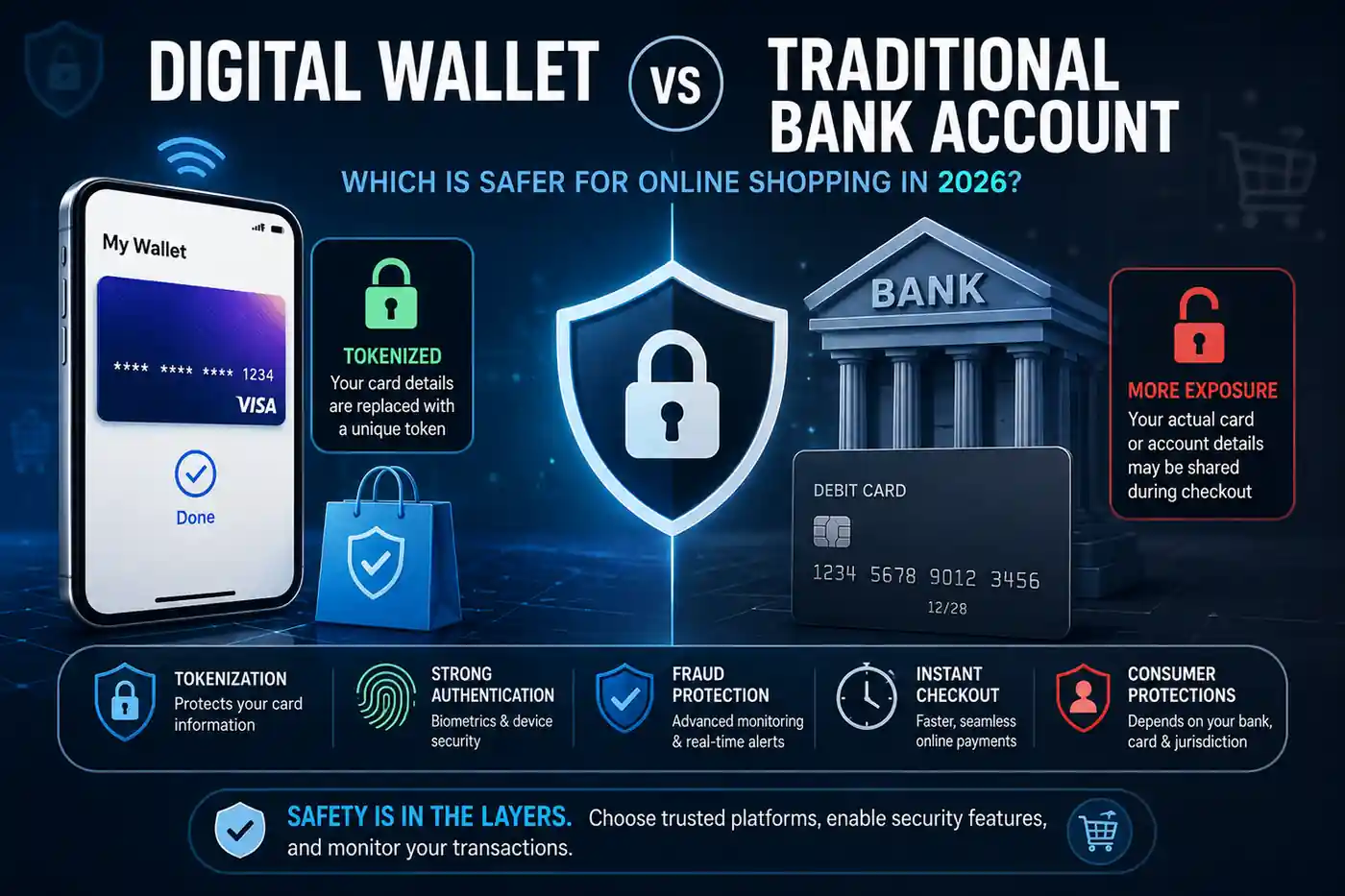
Digital Wallet vs Traditional Bank Account: Which Is Safer for Online Shopping in 2026?
Online shopping has become faster and more convenient, but it has also created a bigger question for consumers: what is the safest way to pay online?
A digital wallet can reduce the amount of sensitive card information exposed to an online merchant, while a traditional bank account provides direct access to funds and established fraud and unauthorized-transfer protections. The safer choice depends on how the payment method is funded, what security technology is used, and what happens if a transaction goes wrong.
Digital wallet vs traditional bank account: quick answer
| Security factor | Digital wallet | Traditional bank account |
|---|---|---|
| Card-number exposure | Usually reduced through payment tokenization | May be exposed when using a debit card directly |
| Device authentication | Often supports biometrics, passcodes or device security | Depends on bank and payment method |
| Tokenization | Common in modern card-based wallets | Not necessarily used when paying directly from an account |
| Fraud monitoring | Wallet, issuer and payment network may contribute | Primarily bank/payment-provider systems |
| Unauthorized transaction protection | Depends on wallet, funding source and provider | Bank-account protections can apply depending on transaction type |
| Online checkout | Fast and often designed to reduce exposed payment data | Secure, but direct card entry can expose more payment credentials |
| Best use | Fast, security-focused online checkout | Banking, transfers, deposits and broader financial services |
Bottom line: For many online card purchases, a reputable digital wallet can provide an additional security layer because tokenization can prevent the merchant from receiving the underlying card number. However, a digital wallet is not automatically safer in every situation. Your funding source, account security, merchant reputation and available dispute protections still matter.
What Is a Digital Wallet?
A digital wallet is a software-based payment system that allows consumers to store and use payment credentials through a smartphone, browser, wearable device or other connected platform.
Depending on the wallet, users may store:
- Credit cards
- Debit cards
- Bank-linked payment methods
- Loyalty cards
- Transit credentials
- Digital identity credentials
- Other payment information
For online shopping, one of the biggest security advantages is that the merchant may not need to receive the consumer’s actual card number.
Modern payment tokenization replaces the primary account number, or PAN, with a unique payment token. EMVCo says these tokens can be constrained to a particular merchant, device or transaction scenario, reducing the usefulness of stolen payment information.
That distinction is important.
If a criminal steals a traditional card number, the number itself may potentially be useful for unauthorized purchases. A properly implemented payment token is designed to have more limited value if compromised.
What Is a Traditional Bank Account?
A traditional bank account is an account provided by a regulated financial institution for holding, receiving and transferring money.
Common examples include:
- Checking accounts in the US
- Current accounts in the UK
- Savings accounts
- Business bank accounts
- Other deposit accounts
A bank account is not itself normally an online checkout technology. Consumers generally access the money in the account through a debit card, bank transfer, payment service or another payment instrument.
This is why comparing a digital wallet vs traditional bank account requires some clarification.
A wallet and a bank account often perform different jobs.
A wallet can act as a secure interface for making a payment, while the underlying funds may still come from a credit card, debit card or bank account.
For example:
Bank account → debit card → digital wallet → online merchant
In this scenario, the digital wallet does not replace the bank. It adds another layer between the payment credential and the merchant.
Why Digital Wallets Can Be Safer for Online Shopping
The biggest security advantage of digital wallets is not simply convenience.
It is reducing exposure of sensitive payment credentials.
1. Tokenization can hide your card number
Payment tokenization replaces sensitive card information with an alternative value.
EMVCo describes payment tokenization as replacing the primary account number with a unique alternative value that can be restricted according to how and where it is used.
Consider two checkout experiences.
Direct card checkout:
You enter your card number → merchant receives payment credentials → payment is processed.
Tokenized wallet checkout:
You authenticate your wallet → wallet supplies a payment token → merchant processes the token → payment network and issuer handle authorization.
The second model can reduce the value of payment data exposed during the transaction.
This does not make fraud impossible. It means that compromising one layer does not necessarily expose the same credential that would be used for every other transaction.
2. Digital wallets can use device authentication
Many modern wallets require users to authenticate before completing a payment.
Depending on the device and wallet, this may involve:
- Fingerprint recognition
- Facial recognition
- Device passcodes
- Screen locks
- Other device-based authentication
This can make it more difficult for someone who obtains payment credentials to immediately use them.
However, consumers should remember that biometric authentication protects access to the device and wallet. It does not automatically protect against every type of scam.
A user can still be tricked into authorizing a fraudulent transaction.
3. Tokenization reduces the value of stolen payment data
Traditional card numbers are valuable targets because they can potentially be reused.
Tokenized payment credentials are designed to be more restricted.
EMVCo specifically notes that payment tokens can be constrained to a merchant, device or payment scenario, reducing the risk associated with compromised payment information.
This is one reason tokenization has become an important part of modern e-commerce payment security.
4. Wallets can work alongside additional authentication
Digital wallets do not necessarily operate alone.
Modern online payments can combine:
- Payment tokenization
- Device authentication
- Fraud detection
- Risk analysis
- EMV 3-D Secure
- Card issuer authorization
EMV 3-D Secure is designed to add authentication to online card transactions and reduce the risk of e-commerce fraud.
EMVCo also describes how payment-token data can be used alongside 3-D Secure to support issuer decision-making during e-commerce authentication.
The result is a layered security model rather than a single security mechanism.
Where Traditional Bank Accounts Have an Advantage
Digital wallets have important security features, but traditional bank accounts should not be dismissed.
Banks have established systems for detecting suspicious activity and handling unauthorized transactions.
In the United States, Regulation E provides protections for certain unauthorized electronic fund transfers. The exact level of consumer liability depends on circumstances, including how quickly the consumer reports the problem.
The CFPB explains that prompt reporting can limit a consumer’s liability for certain unauthorized debit-card or electronic transfers.
That means the security question isn’t simply:
“Is a wallet safer than a bank?”
A better question is:
“Which payment route gives me the strongest combination of technical security and consumer protection for this particular purchase?”
Digital Wallet vs Traditional Bank Account: Fraud Protection Compared
Fraud protection can vary considerably depending on the payment method.
Digital wallets
A wallet may provide:
- Tokenized card credentials
- Device authentication
- Transaction alerts
- Fraud monitoring
- Additional authentication
- Reduced exposure of the underlying card number
But the actual dispute and refund process can depend on the wallet provider, card issuer, bank, merchant and payment network.
Traditional bank accounts
Bank accounts can provide:
- Transaction monitoring
- Account alerts
- Unauthorized-transfer protections
- Dispute processes
- Card controls
- Account freezes or blocks
The exact protection depends on the transaction type and jurisdiction.
In the US, federal rules can provide important protections for certain unauthorized electronic fund transfers, but consumers need to report problems promptly.
What About Credit Cards?
This is where online shoppers need to be especially careful.
A comparison between a digital wallet and a bank account can overlook the fact that the funding source matters.
The FTC recommends using credit cards for online shopping when possible because they can provide strong dispute protections if something goes wrong with a purchase.
For example, if an online retailer charges you for merchandise you never receive, a credit-card dispute may provide a route to challenge the transaction.
The FTC also advises consumers to research unfamiliar sellers, review refund policies and avoid payment methods that make it difficult to recover money after a scam.
Therefore, this:
Digital wallet + credit card
may offer a very different risk profile from:
Digital wallet + debit card
or:
Direct debit-card checkout
The wallet provides one layer of security, while the underlying payment method determines another layer of protection.
Is a Digital Wallet Safer Than Paying Directly With a Debit Card?
For many online purchases, a reputable tokenized digital wallet can offer a security advantage over manually entering a debit-card number.
The reason is straightforward.
When a wallet uses payment tokenization, the merchant can receive a token instead of the underlying primary account number. EMVCo says this reduces the value of compromised payment information and can limit how a token is used.
But there are important exceptions.
If the consumer:
- Uses an untrusted wallet
- Installs a malicious application
- Gives a scammer access to the device
- Approves a fraudulent payment
- Reuses weak passwords
- Ignores security alerts
the wallet cannot eliminate the underlying risk.
Technology can reduce exposure. It cannot eliminate human deception.
What About Privacy?
Security and privacy are related but not identical.
A digital wallet can reduce the amount of payment information that a merchant directly receives, but the wallet provider and other parties involved in the payment ecosystem may still process transaction or device information.
The CFPB has highlighted privacy concerns surrounding digital payments and has examined how existing financial privacy and consumer-protection laws apply to newer payment mechanisms.
Consumers should therefore review:
- The wallet’s privacy policy
- Data-sharing practices
- Account permissions
- Device permissions
- Transaction notifications
- Security settings
A payment method can be technically secure while still collecting more data than a consumer expects.
Digital Wallet vs Traditional Bank Account for US Shoppers
US consumers benefit from a mature electronic-payment ecosystem, but protections differ depending on whether a transaction involves a credit card, debit card, bank transfer or another payment mechanism.
For certain unauthorized electronic fund transfers, Regulation E provides consumer protections with liability rules that depend on factors such as when the consumer reports the unauthorized activity.
The FTC also recommends credit cards for online shopping because they provide dispute rights in situations such as receiving the wrong merchandise or not receiving merchandise at all.
For US shoppers, a strong online-shopping setup can therefore be:
Reputable digital wallet + credit card + device authentication + transaction alerts
rather than simply relying on a wallet by itself.
Digital Wallet vs Traditional Bank Account for UK Shoppers
UK consumers also need to distinguish between the wallet technology and the underlying payment method.
For example, if a purchase is made with a card through a digital wallet, the relevant refund, chargeback and consumer-credit protections can depend on the underlying card and transaction.
The UK’s Financial Conduct Authority explains that card payments may qualify for chargeback, while certain credit-card purchases between £100 and £30,000 can potentially qualify for protection under Section 75 of the Consumer Credit Act, subject to the applicable conditions.
This makes the funding source important when evaluating online payment safety.
When a Traditional Bank Account May Be the Better Choice
A bank account may be preferable when you need to:
- Receive salary or business payments
- Hold substantial funds
- Make bank transfers
- Pay recurring bills
- Manage savings
- Maintain a primary financial relationship
- Access banking services that a wallet does not provide
A digital wallet is primarily a payment interface. It is not necessarily a substitute for a full-service bank.
Consumers should also avoid assuming that every digital payment application has the same protections.
What Is a Digital Wallet? How It Works, Benefits and Security
In 2025, for example, the CFPB announced an enforcement action involving Cash App’s operator over alleged weaknesses in fraud handling and dispute investigations.
The lesson is important: the words “digital payment” or “digital wallet” do not automatically guarantee superior consumer protection.
The Biggest Security Mistakes Online Shoppers Still Make
Even the strongest payment infrastructure can be undermined by poor security habits.
Using the same password everywhere
If a criminal obtains your password from another breached service, they may attempt to access your wallet or other accounts.
Use a unique, strong password and enable multifactor authentication where available.
Shopping through suspicious links
A legitimate-looking payment page can still belong to a scammer.
The FTC warns that scammers frequently create fake shopping sites and advertisements designed to look legitimate.
Approving unexpected authentication requests
Never approve a payment or authentication request simply because it appears on your phone.
Ask yourself:
Did I initiate this purchase?
If not, stop.
Ignoring transaction alerts
Transaction notifications can help consumers identify suspicious activity quickly.
The sooner an unauthorized transaction is identified and reported, the more options the consumer may have.
Assuming HTTPS means a website is trustworthy
An HTTPS connection encrypts communication, but it does not prove that the website itself is legitimate.
The FTC specifically warns that scammers can use encrypted websites too.
How to Make Online Shopping Safer in 2026
Consumers can significantly reduce payment risk by combining technology with good habits.
1. Use a reputable digital wallet
Choose established payment services supported by your bank, card issuer and device.
2. Prefer tokenized payments
Where available, use payment methods that replace exposed card credentials with payment tokens.
3. Use a credit card for higher-risk online purchases
For eligible transactions, credit cards can provide valuable dispute protections.
4. Enable biometric authentication
Use fingerprint or facial authentication where supported.
5. Turn on transaction notifications
Immediate alerts can help identify suspicious transactions quickly.
6. Keep your phone and wallet application updated
Security updates can address vulnerabilities in operating systems and applications.
7. Research unfamiliar merchants
Search for the retailer’s name along with terms such as “review,” “complaint” or “scam.”
The FTC recommends researching unfamiliar sellers before making purchases.
Top 20 Biggest E-commerce Companies in the World: The Global Giants Dominating Online Shopping
8. Keep records
Save receipts, order confirmations, merchant information and payment records.
These records can become important if you need to request a refund or dispute a transaction.
Digital Wallet vs Traditional Bank Account: Which Is Safer?
For online shopping specifically, a reputable digital wallet can be safer than manually entering a card number because tokenization can reduce exposure of the underlying payment credentials.
But that does not mean digital wallets are universally safer than traditional bank accounts.
The strongest approach is to combine multiple layers of protection:
Tokenization + secure device authentication + trusted merchant + strong payment protections + transaction monitoring
The underlying funding source also matters.
A tokenized wallet connected to a credit card can provide a different combination of security and dispute protections than a wallet connected to a debit card or bank balance.
Digital Wallets for Businesses: Why Merchants Are Adopting Them
Why Digital Wallets May Replace Debit Cards Sooner Than You Think
The best payment method therefore depends on the purchase, the merchant, the payment source and the protections available in your country.
The Future of Digital Payment Security
Payment security is continuing to evolve beyond simple passwords and card numbers.
In 2026, the payments industry is also exploring digital payment credentials, stronger authentication and security approaches for emerging forms of commerce.
EMVCo is developing a Digital Payment Credential framework designed to support secure, privacy-conscious and interoperable authentication for card-based payments.
The organization is also examining how its specifications can support agentic payments, where AI systems may eventually initiate transactions on behalf of consumers.
This makes payment security increasingly dependent on layered identity, authentication and transaction controls.
The future of online checkout is unlikely to be about choosing between convenience and security.
Razorpay Vulcan: How AI Is Changing Digital Payments.
Instead, the goal is to make secure payments nearly invisible to the consumer.
Frequently Asked Questions
Is a digital wallet safer than a traditional bank account?
For online shopping, a reputable digital wallet can provide additional security because tokenization may prevent merchants from receiving the underlying card number. However, a bank account provides important protections for certain unauthorized transactions, and the overall safety depends on the funding source and provider.
Does a digital wallet protect my card number?
When payment tokenization is used, the merchant can receive a payment token instead of the underlying primary account number. EMVCo says tokens can be constrained to particular merchants, devices or transaction scenarios.
Is it safer to use Apple Pay or Google Wallet than entering a card number?
A properly implemented wallet can reduce exposure of the underlying card number through tokenization and may use device authentication. However, security also depends on the device, wallet account, card issuer, merchant and transaction.
Can digital wallets be hacked?
No payment system is completely immune to attacks. Digital wallets can reduce some risks by limiting exposed payment credentials, but criminals may still target user accounts, devices, merchants or social-engineering weaknesses.
Should I use a credit card or debit card with a digital wallet?
For online shopping, a credit card may provide stronger purchase-dispute protections in some circumstances. In the US, the FTC recommends credit cards for online purchases where possible.
What should I do if I notice an unauthorized transaction?
Contact the relevant bank, card issuer or payment provider immediately. Reporting unauthorized activity quickly can be important for preserving applicable consumer protections. US consumers should also understand the reporting timelines under Regulation E where applicable.
Final Verdict
The digital wallet vs traditional bank account debate is not really a competition between two identical financial products.
A traditional bank account is designed to hold and manage money. A digital wallet is designed to make payments easier and, in many cases, more secure by adding technologies such as tokenization and device authentication.
For everyday online shopping in 2026, a reputable, tokenized digital wallet can be one of the safer ways to pay, particularly when it is linked to a credit card and protected with strong device security.
But consumers should never treat a wallet as a guarantee against fraud.
The safest online-shopping strategy is layered:
Use a trusted merchant – use a tokenized wallet – authenticate securely – use a payment method with strong dispute protections – monitor transactions – report suspicious activity quickly.
That combination gives consumers something more valuable than convenience alone: reduced payment-data exposure without giving up important financial protections.