FRENOVARA
Beyond The Headlines
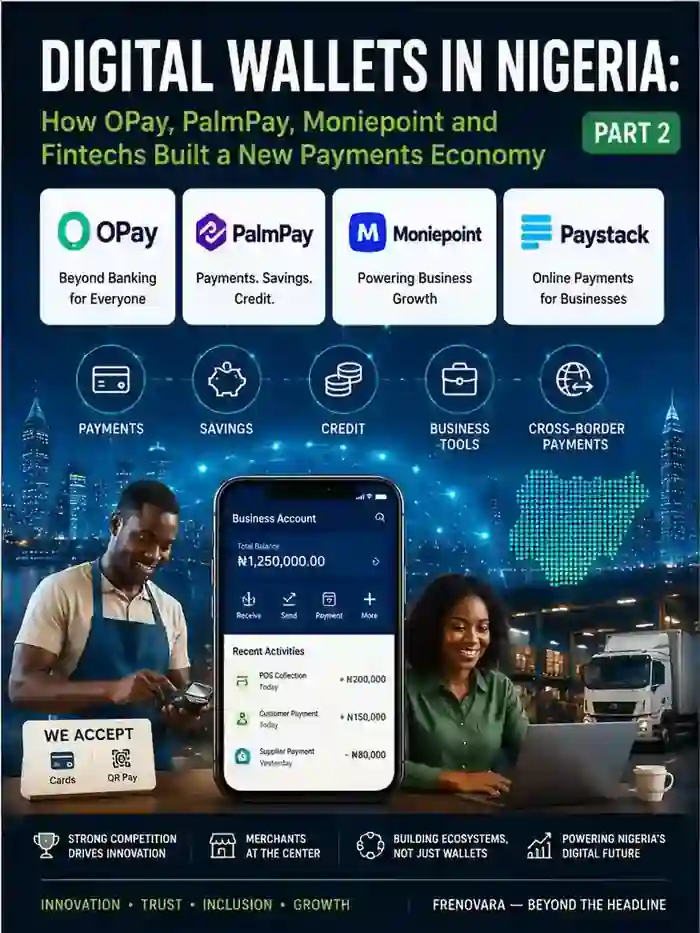
Digital Wallets in Nigeria: How OPay, PalmPay, Moniepoint and Other Fintechs Built a New Payments Economy
Digital wallets in Nigeria have developed from simple money-transfer tools into an important part of the country’s wider financial ecosystem.
The companies competing in this market are not all following the same strategy.
Some have focused heavily on consumers.
Others have built their businesses around merchants and small businesses.
Some specialise in payment processing.
Others combine payments with banking, credit and business-management services.
That difference is important because Nigeria’s fintech market is no longer simply about building another payment application.
The competition is increasingly about owning the customer relationship.
A company that starts with payments can later introduce savings.
A merchant platform can add banking.
A payment processor can provide commerce tools.
A financial platform can add credit.
Over time, these businesses can become much larger ecosystems.
Nigeria’s Central Bank describes the country as one of Africa’s leading fintech ecosystems, supported by digital-payment infrastructure, regulatory reforms and an expanding innovation community. Its 2026 fintech report says nearly 11 billion transactions were processed electronically in 2024, up from about 5 billion in 2022.
The size of that market explains why fintech competition in Nigeria has become so intense.
The Business Model Behind Digital Wallets
At first glance, a digital-wallet business looks straightforward.
Customers download an application.
They create an account.
They deposit or receive money.
They send money or make payments.
The company earns revenue from transactions and other financial services.
In reality, the economics are more complicated.
A fintech company has to acquire customers.
It needs reliable infrastructure.
It has to maintain security.
It needs regulatory compliance.
It needs customer support.
It may need agents and merchant networks.
It must also keep customers active.
That creates an important principle:
Scale matters enormously in payments.
A company processing millions of transactions can potentially build a stronger business than one processing only a small number, assuming it can maintain healthy economics.
That is why fintech companies often invest heavily in customer acquisition and distribution.
Related Articles:
How Moniepoint Makes Money: Inside Its Billion-Dollar Business Model
Why Africa’s Digital Banks Are Winning the Future of Finance
How African Startups Are Attracting Billions in Global Investment
How Flutterwave Became Africa’s Most Valuable Fintech Company
OPay and the Consumer Wallet Strategy
OPay is one of the most recognisable names in Nigeria’s mobile-money market.
The Central Bank’s current payment-service-provider list places OPay Digital Services in the Mobile Money Operator licence category.
This regulatory classification is important because it shows that OPay operates within the formal payments infrastructure overseen by the country’s financial regulator.
The company’s model has historically placed strong emphasis on mobile financial services.
For consumers, a wallet can provide access to services such as:
- Money transfers
- Payments
- Airtime purchases
- Bill payments
- Other financial services
The strategic advantage is frequency.
A financial application becomes more valuable when customers use it repeatedly.
A person who opens an application only once every few months is less valuable than a customer who uses it every day.
Consequently, fintech companies have strong incentives to make their wallets useful for multiple everyday activities.
The more financial activities a customer completes within an ecosystem, the stronger the relationship becomes.
Read Related Articles:
OPay: How Nigeria’s Fintech Giant Is Revolutionizing Digital Banking and Financial Inclusion
The Future of OPay: What’s Next for One of Africa’s Biggest Fintech Companies?
Top 10 Things You Didn’t Know About OPay
Why Are Investors Choosing OPay for Their Portfolios?
The Rise of OPay: A Journey Across Nigeria and Africa
PalmPay and the Expansion of Digital Finance
PalmPay is another major participant in Nigeria’s mobile-money ecosystem.
Like OPay, PalmPay appears in the CBN’s Mobile Money Operator licence category.
Its position in the market demonstrates another important characteristic of Nigerian fintech.
Competition does not happen only between traditional banks and fintech companies.
Fintech companies also compete against one another.
They compete for users.
They compete for merchants.
They compete for agents.
They compete for transaction volume.
They compete for trust.
They compete for attention on consumers’ smartphones.
This competition can create pressure to improve user experience.
However, it can also make customer acquisition expensive.
The companies that ultimately succeed will need to demonstrate that their customers generate sustainable economic value.
Moniepoint Took a Different Route
Moniepoint provides an interesting contrast.
While consumer wallets are an important part of Nigeria’s fintech story, businesses represent an enormous market.
Small and medium-sized businesses need more than a wallet.
They need ways to collect money.
They need business accounts.
They need payment terminals.
They may need credit.
They need tools for managing expenses.
They may need payroll and other business-management services.
Related Articles:
Moniepoint Charges Explained: POS, Transfers, Withdrawals and Fees (2026 Guide)
How to Open a Moniepoint Business Account: Step-by-Step Guide for Entrepreneurs (2026)
Who Owns Moniepoint? Meet the Founders Behind Nigeria’s Fintech Giant
The company’s official website describes Moniepoint as an all-in-one financial platform providing payments, banking, credit, cross-border and business-management tools. It says the platform serves 20 million businesses and individuals each month and processes more than $250 billion in digital-payment transaction value annually through its subsidiaries.
That is a different approach from simply competing for consumer wallet downloads.
Why Merchant Payments Matter So Much
Merchants sit at the centre of the digital-payment ecosystem.
Every time a customer pays a business, the payment creates an economic event.
The merchant needs to receive the money.
The payment provider processes the transaction.
The financial institution settles the funds.
The customer receives confirmation.
A successful merchant network can therefore create enormous transaction volume.
Moniepoint’s payments platform illustrates this strategy.
The company provides businesses with online checkout options, POS terminals and business bank accounts for receiving payments.
The strategic value goes beyond the payment itself.
Once a company provides the merchant with a POS terminal, payment account and financial-management tools, it develops a much deeper relationship with that business.
The merchant may then use additional services from the same provider.
This is one reason merchant fintech has become such an important part of Nigeria’s digital-finance market.
The POS Network Is a Competitive Weapon
Nigeria’s POS economy has helped fintech companies reach customers beyond traditional bank branches.
A POS terminal can become a physical distribution point for digital financial services.
The agent or merchant interacts with customers.
The fintech company provides the underlying technology and infrastructure.
The customer gains access to financial services.
The CBN’s published payment statistics show the scale of the country’s POS ecosystem, while its regulatory framework includes specific authorisations for payment terminal service providers and super-agents.
This means distribution is not merely a marketing issue.
It is part of the infrastructure of fintech.
A company with a strong merchant and agent network can potentially reach customers who may never download a financial application themselves.
That makes physical distribution and digital infrastructure work together.
Paystack Built Around Online Business Payments
Not every fintech needs to operate a consumer wallet.
Paystack demonstrates another model.
The company focuses heavily on helping businesses accept digital payments.
Its official platform provides businesses with tools for online payments, payment pages, commerce and integrations. Paystack says more than 40,000 businesses trust its platform.
This model is particularly important as Nigerian businesses move online.
An online retailer needs a way to accept payment.
A service provider needs to invoice customers.
A creator may need to sell products.
A software company may need recurring payments.
A school may need to collect fees.
A business may need to accept payments from customers outside Nigeria.
The payment processor becomes the infrastructure connecting those businesses to their customers.
Flutterwave Represents the Payment Infrastructure Layer
Flutterwave provides another example of how Nigeria’s fintech ecosystem has diversified.
The CBN places Flutterwave Technology Solutions in the Switching and Processing licence category.
This illustrates an important difference between consumer-facing fintech platforms and payment infrastructure companies.
A consumer wallet interacts directly with an individual.
A payment processor can operate behind the scenes, connecting businesses, banks and payment channels.
The customer may never know which infrastructure company processed the payment.
Yet the technology can still be critical to the transaction.
This creates multiple layers within the digital-payments ecosystem.
Nigeria Has More Than a Handful of Fintech Companies
It is easy to think of Nigeria’s fintech market as a competition between a few famous brands.
The actual ecosystem is much larger.
The CBN’s current payment-service-provider directory includes mobile-money operators, switching and processing companies, payment solution service providers, payment-terminal service providers and super-agents.
Among the listed switching and processing companies are Flutterwave, Interswitch, Paystack, Remita and TeamApt.
The payment-solution ecosystem includes many more companies serving specialised parts of the market.
That diversity matters.
It means Nigeria’s fintech economy is developing an extensive technology supply chain.
Some companies face consumers.
Others serve businesses.
Others provide infrastructure.
Others provide identity, payment terminals, aggregation, settlement or specialised financial technology.
The Race Is Moving From Wallets to Ecosystems
The most important strategic shift is happening here.
A fintech company does not necessarily want to remain a payment company forever.
Payments can become the starting point.
A customer uses the platform to transfer money.
Then the company offers savings.
Later, it provides credit.
A merchant accepts payments.
Then the company provides a business account.
Later, it offers expense management.
Eventually, it may offer payroll, insurance or investment products.
This is the ecosystem model.
The company attempts to increase the number of financial relationships it has with each customer.
That can improve customer retention.
It can also increase revenue opportunities.
Why Customer Acquisition Is So Important
Fintech businesses live in a highly competitive environment.
Getting a customer to download an application is not enough.
The customer must actually use it.
This creates several important metrics for fintech companies.
Customer acquisition cost
How much does the company spend to acquire a customer?
Customer activity
How frequently does that customer transact?
Customer retention
Does the customer continue using the platform?
Transaction value
How much money flows through the platform?
Revenue per customer
How much does the company earn from each active customer?
Customer lifetime value
How much economic value can a customer generate over the entire relationship?
These metrics help determine whether rapid growth is actually sustainable.
A company can have millions of registered users and still struggle if too few users remain active or generate enough revenue.
The Challenge of Building a Profitable Fintech
Growth can be expensive.
Fintech companies may spend money on:
- Technology
- Marketing
- Customer acquisition
- Agents
- Merchant incentives
- Compliance
- Security
- Customer support
- Infrastructure
- Regulatory requirements
This creates a difficult balancing act.
Companies need enough scale to compete.
But they also need sustainable economics.
The Nigerian fintech market is therefore entering a more mature phase.
The question is increasingly shifting from:
“How fast can this company grow?”
to:
“How efficiently can this company grow?”
That distinction could shape the next wave of fintech consolidation.
Regulation Is Changing the Competitive Environment
Nigeria’s fintech industry is operating under increasingly detailed regulatory requirements.
The CBN has introduced measures involving payment-terminal geo-tagging, ISO 20022 migration and transaction-monitoring requirements. It has also directed licensed payment solution providers and switching and processing operators to integrate with the Nigeria Revenue Service’s Transaction Monitoring System.
For fintech companies, compliance is becoming a strategic capability.
A business that cannot meet regulatory requirements can face serious operational consequences.
At the same time, stronger regulation can increase confidence in the sector.
Consumers need to know that financial platforms are accountable.
Businesses need reliable payment infrastructure.
Investors need greater clarity.
Regulation can therefore become both a constraint and a competitive advantage.
Security Could Decide Which Platforms Survive
Fintech is ultimately a trust business.
Customers are handing companies access to their money.
Merchants are relying on platforms to receive revenue.
Businesses need confidence that transactions will settle correctly.
That makes security fundamental.
A major security incident can damage customer confidence quickly.
Fintech companies therefore need to invest in:
- Fraud detection
- Identity verification
- Account security
- Transaction monitoring
- Customer education
- Data protection
- Incident response
The CBN’s current regulatory direction reflects this growing emphasis on payment integrity and fraud prevention.
The platforms that combine convenience with strong security could have a major advantage.
AI Could Change the Fintech Competition
The next stage of competition will increasingly involve artificial intelligence.
AI can analyse transactions.
It can identify unusual behaviour.
It can help customer-service teams.
It can personalise financial products.
It can help businesses understand cash flow.
It can automate compliance processes.
For digital-wallet companies, fraud detection may be particularly valuable.
A system could analyse patterns across millions of transactions and identify behaviour that deserves additional review.
AI could also help fintech companies personalise their products.
Instead of giving every customer the same financial experience, platforms could potentially use data to provide more relevant recommendations.
However, financial AI must be carefully controlled.
An incorrect automated decision can have serious consequences.
Human oversight and regulatory compliance will remain important.
Cross-Border Payments Could Be the Next Major Battlefield
Nigeria’s fintech opportunity does not end at its borders.
African businesses increasingly need to sell to customers in other countries.
Freelancers work with international clients.
Businesses import products.
Exporters receive foreign payments.
Families send money across borders.
This creates demand for faster and more affordable cross-border financial infrastructure.
The CBN has identified cross-border integration as part of the broader direction of Nigeria’s payments ecosystem, while the African fintech market continues to develop around regional payment connectivity.
For fintech companies, this could become a major growth area.
The company that can make cross-border African payments feel almost as simple as domestic payments could unlock a huge market.
What Makes Nigeria’s Fintech Market Different?
Nigeria combines several factors that make its market unusual.
It has a large population.
It has a huge entrepreneurial community.
It has widespread mobile-phone usage.
It has a rapidly developing digital economy.
It has a sophisticated real-time payments infrastructure.
It has a large informal economy.
It also has strong competition among fintech companies.
The CBN describes Nigeria’s instant-payment infrastructure as one of the most mature and widely adopted real-time payment systems globally.
That infrastructure gives fintech companies a foundation on which to build.
The next challenge is turning that infrastructure into increasingly sophisticated financial products.
The Battle for the Small Business Owner
One of the most important competitions may not be visible in consumer advertising.
It is happening between fintech companies trying to become the primary financial platform for small businesses.
A small business owner may need:
Payments – Banking – Credit – Payroll – Accounting – Expenses – Insurance
If one fintech company can provide most of these services, it becomes difficult for a competitor to replace it.
This is why merchant fintech is becoming so strategically important.
The payment transaction becomes the entry point.
The wider business relationship becomes the prize.
What the Future Fintech Leader Will Look Like
The leading fintech company of the future may not look like a traditional wallet.
It may combine:
Digital payments
Banking
Credit
Business management
AI
Cross-border payments
Commerce
Data
The result could be a financial operating system for consumers and businesses.
This is already visible in parts of the market.
Moniepoint, for example, combines payments with banking, credit, cross-border and business-management tools.
Other companies are building different combinations.
The market is therefore gradually moving from isolated financial products toward broader ecosystems.
The Competition Will Not Be Won by Downloads Alone
Millions of downloads may generate headlines.
They do not necessarily guarantee a sustainable business.
The long-term winners will need:
- Active customers
- Reliable infrastructure
- Strong merchant networks
- Sustainable revenue
- Effective risk management
- Regulatory compliance
- Strong security
- High customer trust
- Useful financial products
This is where Nigeria’s fintech market is becoming more mature.
Growth remains important.
But quality of growth matters increasingly more.
Conclusion: Nigeria’s Fintech Battle Is Becoming a Battle for Financial Ecosystems
The story of digital wallets in Nigeria has moved far beyond sending and receiving money.
OPay and PalmPay demonstrate the importance of consumer-focused mobile financial services.
Moniepoint demonstrates the power of merchant and business-focused financial platforms.
Paystack demonstrates the value of online payment infrastructure.
Flutterwave illustrates the importance of payment processing and broader financial connectivity.
The CBN’s licensing structure confirms how diverse the Nigerian payments ecosystem has become.
Yet these companies are competing in a market that is still evolving.
The next stage will involve more than transaction volume.
It will involve ecosystems.
Fintech companies will attempt to become the platforms through which consumers and businesses conduct an increasing share of their financial lives.
Payments may remain the foundation.
But banking, credit, commerce, AI, business management and cross-border services could determine how valuable those platforms ultimately become.
For consumers, this competition could mean better services and greater choice.
For businesses, it could mean access to financial tools that were previously difficult to obtain.
For investors, it creates opportunities across payments, infrastructure, software and financial services.
For entrepreneurs, it creates a market filled with unresolved problems.
And for Nigeria, it reinforces a larger transformation already underway:
the country’s financial system is becoming increasingly digital, interconnected and technology-driven.
The biggest fintech winners may therefore not simply own a wallet.
They may own the financial ecosystem surrounding the wallet.
FRENOVARA — Beyond The Headline
Part 3
The Future of Digital Wallets in Africa: AI, Cross-Border Payments and the Next Fintech Revolution
The final part will examine the next stage of the sector: AI-powered wallets, embedded finance, African cross-border payments, digital identity, financial inclusion, regulation, cybersecurity and the opportunities that could define the next decade of African fintech.