Digital Wallets in Africa: How Mobile Money and Fintech Are Changing the Way Nigerians Pay — Part 1
FRENOVARA
Beyond The Headlines
Digital wallets in Africa are becoming an increasingly important part of everyday financial life.
For many Nigerians, sending money no longer requires visiting a bank branch.
Paying a merchant no longer necessarily requires cash.
Receiving money from a customer can happen within seconds.
A small business can accept digital payments through a phone or payment terminal.
A customer can transfer money, pay a bill or purchase a service without physically handling cash.
This transformation is being driven by several technologies working together.
Mobile banking has expanded.
Instant transfers have become normal.
Mobile money operators have grown.
Fintech companies have introduced new financial products.
Payment infrastructure has improved.
At the same time, consumers have become more comfortable managing money through smartphones and other digital channels.
The result is a financial ecosystem that looks very different from the one many Nigerians knew only a few years ago.
Nigeria’s Central Bank says the country’s payment landscape has experienced a significant shift toward electronic transactions. Its published data show that NIBSS Instant Payment, internet transfers, mobile payments, POS transactions and mobile money have all become important parts of the country’s payment system.
The bigger story, however, is not simply that Nigerians are using digital payments more often.
It is that digital wallets are changing what a financial account can do.
What Is a Digital Wallet?
A digital wallet is a technology-based system that allows users to store, manage or move money electronically.
The exact structure can vary.
A wallet may be connected to a bank account.
It may operate through a mobile money account.
It may be embedded inside a fintech application.
It may also be connected to cards, merchant services or other financial products.
The basic idea is simple.
Instead of relying entirely on physical cash, users can access financial services through a digital interface.
That interface may allow someone to:
- Send money
- Receive money
- Pay merchants
- Buy airtime
- Pay bills
- Receive salaries
- Transfer money between accounts
- Access financial services
- Manage business payments
However, modern digital wallets are becoming much more than simple payment tools.
They are gradually becoming gateways into broader financial ecosystems.
That is where fintech companies see their biggest opportunity.
Why Digital Wallets Are Growing Across Africa
Africa has conditions that make mobile-based financial services particularly valuable.
Large populations have historically had limited access to traditional banking infrastructure.
Bank branches are not equally distributed.
Some communities are far from financial institutions.
Small businesses may also find traditional banking products difficult to access.
Mobile phones can reduce some of these barriers. What do you think about Digital Wallet vs Mobile Banking: What’s the Difference and Which One Should You Use?
A person may not live close to a bank branch, but they may have access to a mobile phone.
That creates an opportunity to bring financial services closer to the customer.
The scale of mobile money across Sub-Saharan Africa demonstrates how significant this transformation has become.
According to the GSMA, the region had more than 1.1 billion registered mobile-money accounts, with transactions worth about $1.1 trillion in 2024. Sub-Saharan Africa accounted for nearly 65% of global mobile-money transaction value.
Those figures show why Africa is often described as the centre of the global mobile-money revolution.
The technology is not merely replacing cash.
It is creating new ways for people and businesses to participate in the formal digital economy.
You can know much How Google Pay Became a Global Digital Wallet and Changed Digital Payments Forever
Nigeria Is Becoming a Major Digital Payments Market
Nigeria’s size makes its fintech development particularly important.
The country has a large population, a huge informal economy, a growing technology sector and an increasingly digital consumer base.
These factors create fertile ground for fintech companies.
The CBN’s latest fintech report says close to 11 billion electronic transactions were processed in Nigeria during 2024, compared with about 5 billion in 2022. The report also states that more than 25% of Nigeria’s electronic transactions are processed through real-time payment channels and the NIBSS Instant Payment platform.
This represents a significant change in consumer behaviour.
People are becoming accustomed to instant transfers.
Businesses are becoming accustomed to digital collections.
Customers increasingly expect payments to happen immediately.
That expectation is changing the competitive environment.
A financial service that takes hours to complete can feel outdated when another service completes the same task in seconds.
We recently published Top 10 Digital Wallets in the World (2026) showcases the payment platforms that are redefining how billions of people shop, transfer money, and manage their finances.
The Rise of Instant Payments
One of the most important pieces of Nigeria’s digital-finance infrastructure is the NIBSS Instant Payment system.
Instant payments allow funds to move electronically between participating institutions without requiring customers to wait for traditional settlement processes.
The CBN reported that NIP transaction volume reached more than 5.6 billion transactions in the first half of 2024, with a value of approximately ₦476.89 trillion.
This infrastructure has helped make instant transfers part of everyday Nigerian life.
Someone can send money to a relative.
A customer can pay a merchant.
A business can receive payment from another company.
A freelancer can receive money from a client.
A retailer can collect money from a customer.
All of these transactions can occur without physical cash changing hands.
The significance goes beyond convenience.
Instant payments make digital commerce easier to operate.
Mobile Money Is Different From Mobile Banking
The terms mobile money and mobile banking are sometimes used interchangeably, but they are not exactly the same.
Mobile banking typically refers to services provided by a bank through digital channels.
Customers may use an app or USSD service to access an existing bank account.
Mobile money, on the other hand, operates through a mobile-based financial account that can provide payment and other financial services.
Mobile money has played a particularly important role in financial inclusion across Africa.
It can reach customers who may not have access to traditional banking services.
That makes it especially useful in areas where physical banking infrastructure is limited.
The CBN’s payment statistics separately track mobile money operators and mobile-app transfers, reflecting the different roles these channels play in Nigeria’s payment ecosystem.
Why Nigerians Are Moving Toward Digital Payments
There is no single reason for the growth of digital payments.
Several factors are working together.
Convenience
People can make payments without carrying large amounts of cash.
Speed
Instant transfers can move money within seconds.
Accessibility
Mobile-based services can reach customers outside traditional banking locations.
Business needs
Merchants increasingly need convenient ways to receive payments which is the more reason why you should read our article on: Digital Wallets for Businesses: Why Merchants Are Adopting Them
E-Commerce
Online businesses require digital payment options. Have you asked yourself this question: How Amazon Makes Billions: The Business Model Explained on Frenovara
Financial inclusion
Digital services can bring financial tools closer to underserved communities.
Changing consumer behaviour
Younger consumers are increasingly comfortable using mobile applications for everyday activities.
Together, these factors create a strong environment for digital-wallet adoption.
Read: The Future of OPay: What’s Next for One of Africa’s Biggest Fintech Companies?
Digital Wallets Are Becoming Business Tools
One of the most important developments is the growing role of digital wallets in business.
A wallet is no longer simply something an individual uses to send ₦5,000 to a friend.
Businesses can use digital financial platforms for everyday operations.
A retailer can accept customer payments.
A small business can pay suppliers.
A company can distribute salaries.
A merchant can manage transactions.
An entrepreneur can monitor incoming payments.
A business can connect payment activity with other financial services.
The GSMA notes that mobile money is increasingly embedded in enterprise operations, including digital payroll, working-capital management, supply-chain financing, retail and e-commerce.
This is an important development.
Once a payment platform becomes part of a company’s daily operations, switching providers becomes more complicated.
That gives fintech companies an opportunity to build deeper relationships with businesses.
The Informal Economy Is a Huge Opportunity
Nigeria’s informal economy represents one of the biggest opportunities for digital wallets.
Millions of small businesses operate outside the structures associated with large corporations.
Many merchants need simple financial tools.
They need to collect payments.
They need to send money.
They need to pay suppliers.
They need to track business activity.
They may also need access to credit, savings or insurance.
Traditional financial products may not always fit their circumstances.
Digital platforms can potentially offer more flexible alternatives.
A merchant who starts by accepting digital payments may eventually use the same platform for additional financial services.
That creates a pathway from payments to broader financial inclusion.
POS Agents Are Part of the Digital Wallet Revolution
Nigeria’s payment ecosystem is not entirely digital in the sense of being smartphone-only.
Physical agents remain important.
POS operators have become familiar figures in many Nigerian communities.
They provide services such as withdrawals, transfers and other payment-related transactions.
The CBN recorded more than 2.9 million POS terminals deployed by the end of the first half of 2024, while POS transaction volume reached more than 6.3 billion during that period.
This shows an important characteristic of Nigeria’s fintech market.
Digital finance does not always mean removing human intermediaries.
Instead, technology can connect physical agents with digital financial infrastructure.
An agent can become the bridge between a customer and the digital financial system.
That is particularly valuable where smartphone ownership, internet access or digital confidence is limited.
Related Articles:
- Why Kuda Bank Is Winning Millions of Customers: The Digital Banking Revolution in Nigeria
- How Flutterwave Expanded Across Africa and the Global Market: The Growth Story Behind Africa’s Fintech Giant
- Moniepoint Charges Explained: POS, Transfers, Withdrawals and Fees (2026 Guide)
- Why Digital Payments Continue to Transform Nigeria’s Economy in 2026
Digital Wallets Can Expand Financial Inclusion
Financial inclusion is one of the strongest arguments for digital wallets.
A person does not necessarily need to live close to a bank branch to participate in digital finance.
A mobile phone can provide access to payment services.
A local agent can provide physical support.
A fintech application can provide additional services.
This combination can reduce some of the barriers associated with traditional banking.
However, access alone is not enough.
Customers also need reliable infrastructure.
They need affordable services.
They need protection against fraud.
They need confidence that their money is safe.
They need clear processes for resolving disputes.
That means the future of digital wallets depends heavily on trust.
Security Is Becoming More Important
The growth of digital payments also creates new risks.
Fraudsters can target digital accounts.
Stolen phones can create security problems.
Phishing attacks can trick customers into revealing information.
Social engineering can lead users to authorise fraudulent transactions.
As transaction volumes increase, the potential value available to criminals also increases.
Nigeria’s regulators are responding.
The CBN announced new instant-payment rules in March 2026 requiring stronger fraud monitoring and identity verification. The new framework also includes customer controls over instant payments and tighter security measures for mobile banking applications. The measures took effect from July 1, 2026.
This demonstrates an important reality.
The digital-wallet industry cannot grow sustainably without stronger security.
Convenience and security must develop together.
Regulation Will Shape Nigeria’s Digital Wallet Market
The growth of fintech has created a need for stronger regulatory structures.
Payment companies operate in a financial environment where consumer protection is critical.
The CBN maintains categories for licensed payment service providers, including mobile money operators and switching and processing companies. Its published list includes operators such as OPay and PalmPay among licensed mobile money operators, while companies including Flutterwave, Paystack and Interswitch appear in the switching and processing category.
This regulatory structure matters for customers.
It helps distinguish licensed financial service providers from unregulated operators.
It also gives regulators a framework for monitoring the industry.
For fintech companies, regulation can create additional compliance costs.
However, clear rules can also increase trust and encourage responsible investment.
Nigeria’s Payments System Is Moving Toward Interoperability
Another important development is the CBN’s Payments System Vision 2028.
The framework was officially launched in June 2026 and is built around six principles:
- Interoperability
- Security
- Inclusion
- Innovation
- Trust
- Collaboration
The CBN says the vision aims to create a secure, inclusive and innovative payments ecosystem while strengthening interoperability and cross-border integration.
This direction could have major implications for digital wallets.
Consumers increasingly want financial services that work together.
They do not necessarily care which technology provider processes a transaction.
They care that the payment succeeds.
Interoperability can therefore reduce friction across the financial ecosystem.
The Digital Wallet Is Becoming a Financial Platform
The most important shift may be the evolution of the wallet itself.
A basic wallet allows someone to store and transfer money.
A modern fintech platform can go much further.
It can combine:
Payments + savings + credit + insurance + investments + business tools + data
This is sometimes called an ecosystem model.
The company does not make money from one transaction alone.
Instead, it develops multiple relationships with the customer.
For example, a merchant may begin by accepting payments.
Later, the same merchant could use the platform for:
- Business banking
- Working-capital financing
- Payroll
- Expense management
- Savings
- Insurance
- Accounting
- Inventory services
The payment relationship becomes the foundation for a broader financial relationship.
That is why digital wallets are strategically important to fintech companies.
What Digital Wallets Mean for Nigerian Consumers
For consumers, the transformation is already visible.
Money can move faster.
Payments can happen remotely.
Businesses can sell online.
Families can transfer money across cities.
Customers can pay for services without visiting a bank.
Small merchants can accept electronic payments.
The financial experience is becoming increasingly mobile.
Yet consumers also face new responsibilities.
They need to protect passwords.
They need to verify payment requests.
They need to avoid sharing authentication information.
They need to understand fees.
They need to know how to report fraudulent transactions.
Digital financial literacy is therefore becoming just as important as access.
What This Means for Nigerian Businesses
Businesses should not view digital wallets simply as another payment option.
They are becoming part of the wider infrastructure of commerce.
A business that accepts digital payments can potentially serve customers more efficiently.
It can create transaction records.
It can connect payments with accounting systems.
It can potentially use transaction history to understand customer behaviour.
As fintech platforms expand, these capabilities could become increasingly sophisticated.
The businesses that integrate digital payments into their operations early may have an advantage over those still relying heavily on manual processes.
Africa’s Digital Wallet Story Is Bigger Than Nigeria
Nigeria is an important market, but the broader African story is even larger.
Different countries have developed different mobile-money ecosystems.
Kenya is widely associated with mobile-money innovation.
Ghana has developed a strong digital-payment market.
Tanzania and Senegal have significant mobile-money activity.
Côte d’Ivoire has also experienced substantial adoption.
The GSMA’s research across African markets shows that mobile money has moved beyond basic transfers into areas such as merchant payments, agriculture, enterprise services and financial resilience.
This means Africa is not simply adopting digital finance.
It is developing new financial models around mobile technology.
The Next Stage Will Be More Competitive
As digital wallets become more popular, competition will increase.
Companies will compete on:
- Transaction costs
- Reliability
- Security
- Customer service
- Merchant acceptance
- Credit products
- Savings products
- Business services
- User experience
- Cross-border payments
That competition should benefit consumers if it leads to better products and lower friction.
However, the market may also become more concentrated as successful platforms gain larger customer bases.
Scale will matter.
Trust will matter.
Technology will matter.
Regulatory compliance will matter.
And access to capital will matter.
The Future of Digital Wallets Is Not Just About Payments
The next generation of digital wallets will likely become much more intelligent.
Artificial intelligence could help detect fraud.
Data analytics could personalise financial products.
Automated systems could help businesses manage cash flow.
Digital wallets could become embedded inside e-commerce platforms.
Cross-border payment infrastructure could make African trade easier.
Fintech platforms could connect payments with credit, savings and investment products.
This is where the digital-wallet story connects with the wider AI and African-business transformation we have explored in previous Frenovara articles.
The wallet could become the financial intelligence layer connecting customers, merchants and businesses.
Conclusion: Nigeria Is Moving Toward a Digital Financial Economy
The rise of digital wallets in Africa represents one of the most significant changes in the continent’s financial system.
In Nigeria, the transformation is being driven by instant payments, mobile money, fintech companies, POS networks, smartphones and changing consumer expectations.
The numbers show that this is no longer a niche technology.
Nigeria processed billions of electronic transactions in 2024, while mobile money and other digital payment channels continued to expand.
At the same time, regulators are building new frameworks around security, interoperability, inclusion and innovation.
The CBN’s Payments System Vision 2028 shows that Nigeria wants its payment infrastructure to become more integrated with regional and global markets.
The next phase will therefore be about much more than transferring money.
Digital wallets could become platforms through which Nigerians save, borrow, invest, pay, sell and manage businesses.
That creates enormous opportunities for fintech companies.
It also creates new responsibilities around security, privacy, consumer protection and financial literacy.
For Nigerian consumers and businesses, one thing is becoming increasingly clear:
The future of money is becoming digital.
And the companies that control the infrastructure behind that future could become some of Africa’s most important financial businesses.
FRENOVARA — Beyond The Headlines
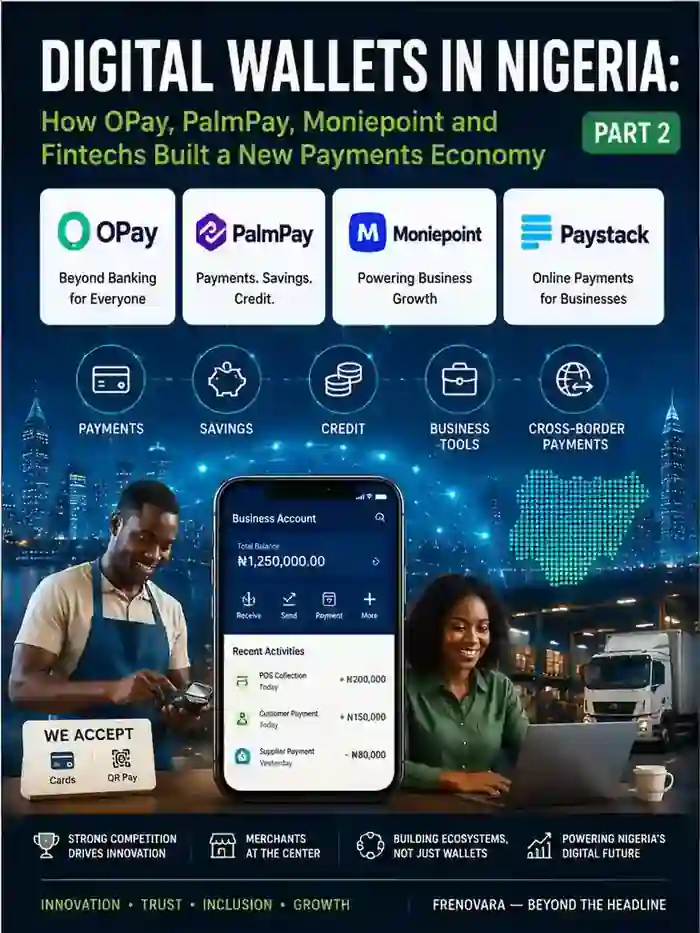
Part 2 will examine the companies competing in Nigeria’s digital-finance ecosystem, how their business models work, how they make money, why agent networks matter and how fintech companies are competing for consumers and merchants.
Part 3
The Future of Digital Wallets in Africa: AI, Cross-Border Payments and the Next Fintech Revolution
Part 3 will explore where the sector goes next, including AI-powered wallets, embedded finance, cross-border African payments, digital identity, financial inclusion, regulation and the opportunities likely to shape the next decade.