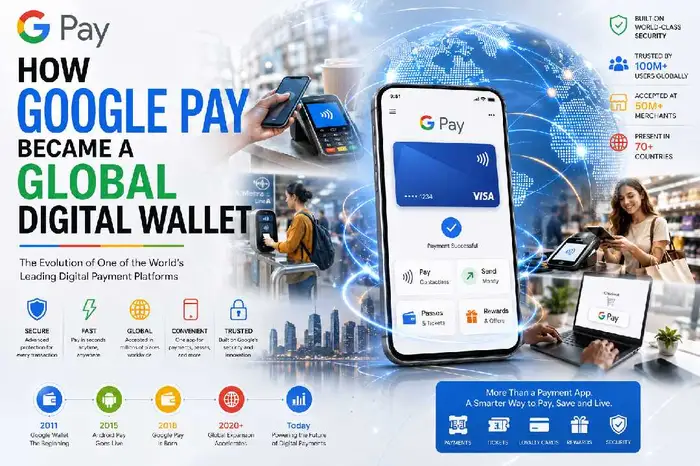
How Google Pay Became a Global Digital Wallet

Money has changed.
Not the currency itself.
But the way people move it.
Only a few years ago, paying for groceries, booking flights, buying coffee, or shopping online usually required physical cash or a plastic debit card.
Today, millions of people complete these same transactions by simply tapping their smartphones.
Among the companies responsible for this transformation is Google.
Through Google Pay, the technology giant has built one of the world’s most widely recognised digital payment platforms, serving millions of consumers and businesses across numerous countries.
Google Pay is more than a payment application.
It represents Google’s long-term ambition to become an essential part of everyday financial life by combining payments, digital identity, security, and financial technology into one seamless ecosystem.
Digital Wallet vs Mobile Banking: What’s the Difference and Which One Should You Use?
Its journey demonstrates how technology companies increasingly influence the future of global finance.
Before Google Pay
Google’s interest in digital payments did not begin with Google Pay.
The company had experimented with payment technologies for several years before launching its current platform.
One of its earliest initiatives was Google Wallet.
Introduced during the rapid rise of smartphones, Google Wallet aimed to simplify mobile payments using Near Field Communication (NFC) technology.
Although innovative, widespread adoption remained limited.
Several challenges slowed growth, including:
- Limited merchant acceptance.
- Low consumer awareness.
- Hardware compatibility issues.
- Competition from traditional payment methods.
Rather than abandoning the idea, Google continued improving its payment strategy.
Those lessons eventually laid the foundation for Google Pay.
The Birth of Google Pay
In 2018, Google consolidated several payment services under a single brand.
Google Pay combined:
- Android Pay.
- Google Wallet’s payment capabilities.
The objective was straightforward.
Create one unified payment platform capable of serving consumers across both online and offline environments.
Instead of maintaining multiple payment brands, Google introduced a simpler experience that focused on:
- Faster payments.
- Greater security.
- Better user experience.
- Wider merchant acceptance.
The strategy proved far more scalable than previous attempts.
What Exactly Is Google Pay?
Google Pay is a digital wallet and payment platform that allows users to make electronic payments using smartphones, smartwatches, tablets, and other compatible devices.
Rather than carrying physical payment cards, users can securely store payment credentials digitally.
Top 10 Digital Wallets in the World (2026)
Google Pay supports various financial activities including:
- Contactless in-store payments.
- Online purchases.
- In-app transactions.
- Peer-to-peer transfers (where supported).
- Transit payments.
- Loyalty cards.
- Gift cards.
- Event tickets.
This versatility has helped position Google Pay as more than just a payment application.
It functions as a broader digital wallet.
Why Consumers Quickly Adopted Google Pay
Several factors contributed to Google Pay’s rapid adoption.
Simplicity
Consumers appreciate convenience.
Paying by simply unlocking a phone and tapping a payment terminal feels significantly easier than searching for physical cards.
Speed
Transactions often complete within seconds.
This reduces checkout times for both businesses and customers.
Integration
Google Pay integrates seamlessly with Android devices and Google’s wider ecosystem.
Users already familiar with Google services experience very little learning curve.
Security
Google invested heavily in protecting user information.
Rather than transmitting actual card numbers, Google Pay uses tokenisation technology.
This creates unique digital tokens that help reduce fraud risks during transactions.
The Technology Behind Google Pay
Several technologies power Google Pay.
Near Field Communication (NFC)
NFC enables contactless payments by allowing smartphones to communicate securely with payment terminals over short distances.
This technology powers tap-to-pay functionality.
Tokenisation
Instead of exposing customers’ real card numbers, Google Pay generates secure payment tokens.
Even if transaction data were intercepted, the actual banking information remains protected.
Biometric Authentication
Many users authorise payments through:
- Fingerprint recognition.
- Facial recognition.
- Device PINs.
These authentication methods add additional security layers.
Cloud Infrastructure
Google’s cloud capabilities allow transactions to remain fast, scalable, and reliable across multiple countries.
Its global technology infrastructure supports millions of payment requests daily.
Global Expansion Begins
Google never intended Google Pay to remain limited to one country.
As smartphone adoption accelerated worldwide, opportunities expanded rapidly.
The company gradually introduced Google Pay into markets across:
- North America.
- Europe.
- Asia.
- Latin America.
- Selected African markets.
Each new market required partnerships with:
- Banks.
- Payment processors.
- Card networks.
- Regulatory authorities.
- Merchants.
This partnership strategy allowed Google Pay to scale while complying with local financial regulations.
Partnerships That Powered Growth
Unlike traditional banks, Google did not attempt to replace existing financial institutions.
Instead, it collaborated with them.
Google Pay established partnerships with:
- Visa.
- Mastercard.
- American Express.
- Numerous commercial banks.
- Payment service providers.
- Retail merchants.
These collaborations enabled customers to continue using their existing bank accounts while benefiting from Google’s payment technology.
This cooperative approach significantly accelerated adoption.
How Google Pay Makes Money
Many people assume Google Pay is simply a free payment application.
While consumers rarely pay to use it, Google Pay plays an important role within Google’s broader business ecosystem. What Is a Digital Wallet? How It Works and Why Millions Use It in the Digital Economy
Rather than relying on a single revenue stream, Google benefits from several indirect and strategic sources of income.
Payment Processing Partnerships
Google collaborates with banks, payment processors, and financial institutions rather than replacing them.
Although the exact commercial arrangements vary between countries and partners, Google earns revenue through enterprise partnerships, payment infrastructure, and related commercial agreements that support the platform.
Google Play Store Transactions
One of Google Pay’s biggest strengths is its integration with Google’s digital ecosystem.
Millions of users purchase:
- Mobile applications.
- Games.
- Movies.
- Books.
- Digital subscriptions.
Google Pay simplifies these transactions, making it easier for users to spend within Google’s ecosystem.
This contributes significantly to Google’s broader digital commerce revenue.
Merchant Services
Businesses benefit from Google Pay because customers complete purchases more quickly.
Faster checkouts often translate into higher conversion rates.
As merchant adoption expands, Google strengthens relationships with businesses while creating opportunities for future commercial services. How Fintech Is Powering Online Shopping
Customer Retention
Google Pay encourages users to remain within Google’s ecosystem.
A customer using:
- Android.
- Gmail.
- Google Maps.
- Google Chrome.
- Google Search.
- Google Pay.
is more likely to continue using Google’s products than switching to competing ecosystems.
This customer loyalty creates long-term commercial value.
Why Businesses Accept Google Pay
Businesses increasingly embrace digital wallets because customers demand convenience.
Google Pay offers several advantages for merchants.
Faster Checkout
Customers simply unlock their devices and tap payment terminals.
This reduces waiting time.
Reduced Cash Handling
Accepting digital payments decreases dependence on physical cash.
Businesses spend less time managing cash collections and bank deposits.
Improved Customer Experience
Consumers increasingly expect multiple payment options.
Businesses offering Google Pay often provide a smoother shopping experience.
Enhanced Security
Tokenisation reduces exposure of sensitive payment information.
This helps reduce certain forms of payment fraud.
Competing with Apple Pay and Samsung Wallet
Google Pay operates within one of the world’s most competitive payment industries.
Its primary competitors include:
- Apple Pay.
- Samsung Wallet.
- PayPal.
- Various regional digital wallet providers.
Each platform offers similar payment functionality.
However, Google Pay benefits from Android’s enormous global market share.
Because Android powers billions of smartphones worldwide, Google Pay enjoys access to one of the world’s largest mobile ecosystems.
This gives Google significant long-term growth opportunities.
Artificial Intelligence Is Strengthening Google Pay
Artificial Intelligence has become increasingly important across Google’s products.
Google Pay also benefits from these capabilities.
AI assists with:
- Fraud detection.
- Suspicious transaction monitoring.
- Payment risk analysis.
- Customer support automation.
- Personalised financial insights.
- Security improvements.
Machine learning continuously analyses transaction patterns to identify unusual behaviour while improving payment reliability.
As AI evolves, Google Pay will likely become even smarter.
Security Remains a Competitive Advantage
Financial services depend on trust.
Google understands this reality.
Several technologies help protect users.
Tokenisation
Actual payment card numbers remain hidden during transactions.
Instead, temporary digital payment tokens are transmitted.
Device Authentication
Payments generally require:
- Fingerprint verification.
- Facial recognition.
- Screen lock authentication.
Only authorised users can complete transactions.
Encryption
Google encrypts payment information throughout transaction processing.
This significantly reduces security risks.
Continuous Monitoring
Google’s systems continuously monitor payment activity for suspicious behaviour.
Potential fraud attempts can be detected quickly before significant losses occur.
Challenges Facing Google Pay
Despite its global success, Google Pay still faces several challenges.
Regulatory Requirements
Every country has different financial regulations.
Expanding internationally requires compliance with numerous legal frameworks.
Competition
Digital payment providers continue entering the market.
Competition remains intense across both developed and emerging economies.
Consumer Trust
Although adoption continues increasing, some users still hesitate to trust fully digital financial services.
Education remains important.
Merchant Infrastructure
Not every business supports contactless payments.
Expansion depends partly on merchants upgrading payment terminals.
Why Google Pay Matters Beyond Payments
Google Pay is about more than processing transactions.
It forms part of Google’s broader strategy to connect commerce, identity, artificial intelligence, cloud computing, and mobile technology.
As digital economies continue expanding, payment platforms increasingly become gateways to broader financial ecosystems.
Google Pay positions Google to participate directly in that future.
The Future of Google Pay
Google Pay has already transformed how millions of people make payments.
Yet its journey is only beginning.
As financial technology continues evolving, Google is gradually positioning Google Pay as more than a payment application.
The platform is becoming an intelligent financial companion capable of integrating payments, digital identity, artificial intelligence, and financial management into one ecosystem.
Several trends are expected to shape its future.
Artificial Intelligence
Artificial Intelligence will continue improving the Google Pay experience.
Future AI capabilities may include:
- Smarter fraud detection.
- Personalized spending insights.
- Automatic expense categorization.
- Intelligent budgeting recommendations.
- Predictive financial alerts.
- Enhanced customer support.
Rather than simply processing payments, Google Pay could increasingly help users make better financial decisions.
Digital Identity
Many governments and technology companies are investing heavily in digital identity systems.
Google Pay is already capable of storing:
- Payment cards.
- Transit passes.
- Loyalty cards.
- Event tickets.
Future developments may include:
- Digital driver’s licenses.
- National identity cards.
- Health credentials.
- Educational certifications.
This would transform Google Pay into a complete digital wallet rather than merely a payment platform.
Stronger Integration Across Google’s Ecosystem
Google already operates one of the world’s largest digital ecosystems.
Future integration may become even deeper across:
- Android.
- Google Maps.
- Google Chrome.
- Gmail.
- Google Workspace.
- Google Shopping.
- Google Cloud.
This seamless integration creates a connected digital experience few competitors can replicate.
Cross-Border Digital Commerce
International digital commerce continues expanding rapidly.
Consumers increasingly purchase products from businesses located in different countries.
Google Pay’s international payment infrastructure positions it well to support this growing global marketplace.
As cross-border commerce expands, Google Pay could become even more important for both consumers and businesses.
Five Lessons Businesses Can Learn from Google Pay
Google Pay’s growth offers valuable insights for entrepreneurs.
1. Solve Everyday Problems
Google Pay succeeded because it simplified something people do every day.
Businesses that eliminate friction often create enormous value.
2. Build Around Existing Behaviour
Rather than forcing customers to change their habits completely, Google improved existing payment experiences.
Successful innovation often enhances familiar behaviour rather than replacing it entirely.
3. Partnerships Accelerate Growth
Google collaborated with:
- Banks.
- Card networks.
- Merchants.
- Payment processors.
Strategic partnerships enabled faster expansion than building every service independently.
4. Security Creates Competitive Advantage
Consumers trust financial platforms that protect their money.
Google’s continuous investment in:
- Encryption.
- Tokenisation.
- Biometric authentication.
- Fraud detection.
has strengthened customer confidence.
5. Think Beyond Today’s Product
Google Pay is not merely a payment application.
It serves as an entry point into Google’s broader digital ecosystem.
Businesses should always consider how today’s products support tomorrow’s opportunities.
Frequently Asked Questions (FAQs)
What Is Google Pay?
Google Pay is Google’s digital wallet and payment platform that enables users to make contactless payments, online purchases, and digital transactions using compatible devices.
Is Google Pay Free?
Yes.
Consumers generally do not pay to use Google Pay.
However, businesses and financial institutions may have separate commercial arrangements depending on local payment infrastructure.
Is Google Pay Safe?
Google Pay uses multiple security technologies including:
- Tokenisation.
- Encryption.
- Biometric authentication.
- Device verification.
- Fraud monitoring.
These features help protect users against many common payment risks.
Can Google Pay Replace Traditional Banking?
No.
Google Pay complements banking rather than replacing it.
Users still require financial institutions for services such as:
- Savings accounts.
- Loans.
- Investments.
- Business banking.
Which Countries Support Google Pay?
Google Pay operates across numerous countries worldwide.
Availability varies depending on local regulations, banking partnerships, and payment infrastructure.
Digital Wallets Are Becoming Everyday Infrastructure
Digital wallets have evolved from convenience tools into essential components of modern commerce.
Consumers increasingly expect to:
- Pay instantly.
- Travel without physical tickets.
- Store loyalty cards digitally.
- Shop online securely.
- Transfer money effortlessly.
Google Pay continues helping shape that future.
As smartphones become central to everyday life, digital wallets will likely become equally indispensable.
Beyond the Headlines
Google Pay’s success demonstrates how technology companies increasingly shape the future of finance.
What began as an effort to simplify mobile payments has evolved into one of the world’s most recognised digital wallet platforms.
Its growth reflects broader changes occurring across the global economy.
Consumers now expect speed.
Businesses expect efficiency.
Governments increasingly encourage digital transactions.
Financial technology continues connecting these expectations through intelligent digital infrastructure.
Google Pay is not simply changing how people pay.
It is helping redefine how people interact with money itself.
As artificial intelligence, digital identity, embedded finance, and cashless economies continue expanding, platforms like Google Pay will likely become even more central to everyday financial life.
The future of payments is no longer approaching.
For millions of users around the world, it has already arrived.
WordPress SEO Tags
Google Pay, Google Pay Business Model, Google Pay Digital Wallet, Google Pay Payments, Google Wallet, Digital Wallet, Mobile Payments, Contactless Payments, Cashless Payments, Fintech, Financial Technology, Online Payments, Payment Apps, Digital Finance, Mobile Banking, Google Financial Services, Digital Economy, Payment Innovation, Global Fintech, Frenovara
SEO Image Filename
how-google-pay-became-a-global-digital-wallet-frenovara.webp
SEO Image Title
How Google Pay Became a Global Digital Wallet
SEO Image Alt Text
Illustration showing Google Pay as a global digital wallet with smartphones, contactless payment technology, secure digital transactions, and worldwide financial connectivity