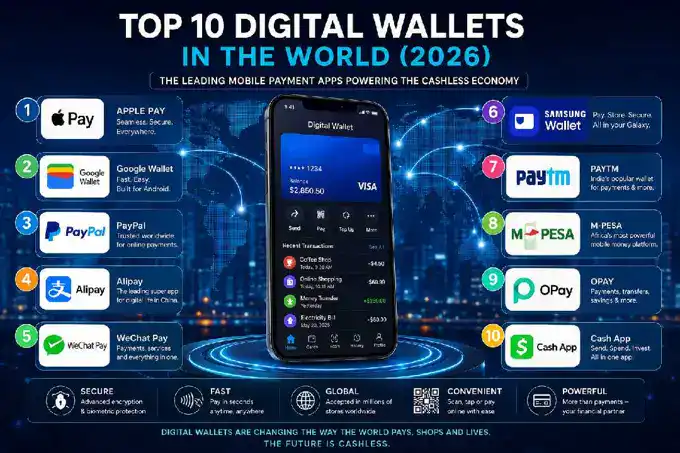
Top 10 Digital Wallets in the World (2026): The Biggest Mobile Payment Apps Transforming Global Finance

Introduction: Top 10 Digital Wallets in the World (2026)
Top 10 Digital Wallets in the World (2026) showcases the payment platforms that are redefining how billions of people shop, transfer money, and manage their finances. Digital wallets have evolved far beyond simple payment apps; they now serve as financial ecosystems offering contactless payments, peer-to-peer transfers, online shopping, savings, rewards, and business services. Industry rankings consistently place Apple Pay, Google Wallet, PayPal, Alipay, WeChat Pay, Samsung Wallet, and major regional leaders among the world’s most influential digital wallet providers. What Is a Digital Wallet?
How It Works and Why Millions Use It in the Digital Economy
In this premium Frenovara feature, we rank the world’s leading digital wallets based on global adoption, innovation, security, ecosystem strength, merchant acceptance, and overall influence on digital commerce.
How We Ranked the World’s Best Digital Wallets
Our ranking considers:
- Global user adoption.
- Merchant acceptance.
- Security and privacy.
- Innovation.
- Payment features.
- International availability.
- Business ecosystem.
- Financial services integration.
1. Apple Pay
Apple Pay remains one of the most trusted digital wallets globally thanks to its seamless integration across the Apple ecosystem.
Why It Ranks #1
- Exceptional security through tokenization.
- Face ID and Touch ID authentication.
- Contactless payments worldwide.
- Strong merchant acceptance.
- Smooth integration across iPhone, Apple Watch, iPad, and Mac.
Its focus on privacy and user experience continues to make it a benchmark for premium mobile payments.
2. Google Wallet (Google Pay)
Google Wallet powers digital payments for billions of Android users worldwide.
Key features include:
- Contactless payments.
- Transit passes.
- Loyalty cards.
- Event tickets.
- Online purchases.
- Peer-to-peer payment support in selected markets.
Its integration with Android devices gives it one of the largest user bases globally. How Fintech Is Powering Online Shopping
3. PayPal
PayPal remains one of the pioneers of online digital payments.
Millions of businesses rely on PayPal for:
- E-commerce.
- International payments.
- Business transactions.
- Consumer protection.
- Merchant services.
Its strong reputation makes it one of the world’s most recognized digital wallets.
4. Alipay
Operated by Ant Group, Alipay has transformed digital payments across China.
It offers:
- QR-code payments.
- Bill payments.
- Investments.
- Insurance.
- Travel services.
- Lifestyle applications.
Alipay is widely regarded as one of the world’s largest financial super apps.
5. WeChat Pay
Integrated into WeChat, this wallet combines messaging, commerce, and payments in one platform.
Users can:
- Shop online.
- Pay merchants.
- Transfer money.
- Book services.
- Access mini-apps.
Its all-in-one ecosystem has helped redefine mobile commerce in China.
6. Samsung Wallet
Samsung Wallet combines payments with digital identity and credential storage.
Recent developments, including Samsung’s expansion into financial services with a co-branded U.S. credit card, highlight the company’s ambition to deepen its wallet ecosystem.
7. Paytm
Paytm remains one of India’s leading digital wallet platforms.
Its ecosystem includes:
- Utility bill payments.
- Mobile recharges.
- QR-code payments.
- Online shopping.
- Financial services.
- Merchant solutions.
Paytm played a significant role in accelerating India’s cashless economy.
8. M-Pesa
M-Pesa is Africa’s most influential mobile money platform.
It has transformed financial inclusion by enabling millions of users to:
- Send money.
- Receive salaries.
- Pay bills.
- Purchase goods.
- Access financial services without traditional bank accounts.
Its impact extends far beyond payments, especially across East Africa.
9. OPay
Nigeria-based OPay has become one of Africa’s fastest-growing fintech companies.
Its services include:
- Money transfers.
- Bill payments.
- Merchant payments.
- Savings products.
- Debit cards.
- Business payment solutions.
OPay’s rapid expansion has strengthened digital payment adoption across Nigeria and beyond.
10. Cash App
Cash App has grown from a simple peer-to-peer payment app into a broader financial platform.
Users can:
- Send and receive money.
- Use debit cards.
- Invest.
- Manage personal finances.
Its ease of use has made it especially popular in the United States.
Why Digital Wallets Continue to Grow
Several factors continue driving adoption worldwide:
Cashless Payments
Consumers increasingly prefer fast digital transactions.
Smartphone Growth
Mobile devices have become financial hubs.
Better Security
Tokenization, encryption, and biometric authentication improve payment safety.
E-commerce Expansion
Online shopping continues increasing demand for seamless digital payments.
Financial Inclusion
Digital wallets help people access financial services even without traditional bank accounts.
The Top 10 Digital Wallets in the World (2026) demonstrate how financial technology is transforming global commerce. From Apple Pay and Google Wallet to Alipay, M-Pesa, OPay, and PayPal, these platforms have made payments faster, safer, and more convenient for billions of people.
If you noticed that, we ranked the Top 10 Digital Wallets in the World (2026) and explored the platforms transforming digital payments, online shopping, and financial services. We looked at industry leaders such as Apple Pay, Google Wallet, PayPal, Alipay, WeChat Pay, Samsung Wallet, M-Pesa, OPay, Paytm, and Cash App.
What we did now was that Frenovara examines how these digital wallet companies generate billions of dollars in revenue, the technologies behind their success, and why they have become indispensable to consumers, merchants, and businesses worldwide.
How Digital Wallet Companies Generate Revenue
Many digital wallet apps are free to download and use, leading many people to wonder how these companies make money.
The answer lies in a diversified business model built around financial services and payment infrastructure.
Their primary revenue streams include:
- Payment processing fees.
- Merchant service charges.
- Cross-border transaction fees.
- Financial products.
- Business solutions.
- Subscription services.
- Investment products.
- Strategic partnerships.
Together, these income streams generate billions of dollars annually.
Payment Processing Is Their Biggest Revenue Source
Every time a customer pays with a digital wallet, several financial institutions work together behind the scenes.
While consumers often pay nothing directly, merchants usually pay a small processing fee for each successful transaction.
These fees support services such as:
Card Payments
Processing debit and credit card transactions securely.
Contactless Payments
Enabling tap-to-pay purchases using smartphones and wearable devices.
QR Code Payments
Allowing businesses to receive instant digital payments.
Online Checkout
Supporting fast and secure e-commerce transactions.
Although each individual fee is small, billions of transactions every year make payment processing one of the industry’s largest revenue generators.
Merchant Services Create Long-Term Business Growth
Digital wallet providers increasingly offer businesses a wide range of financial tools beyond payment processing.
These include:
Business Payment Gateways
Helping merchants securely accept online payments.
Sales Analytics
Providing insights into customer spending and business performance.
Subscription Billing
Managing recurring payments for digital products and services.
Inventory and Business Tools
Some providers integrate financial management solutions directly into merchant platforms.
These services strengthen customer relationships while creating recurring revenue.
Artificial Intelligence Is Transforming Digital Wallets
Artificial intelligence has become one of the most valuable technologies in the digital wallet industry.
AI improves:
Fraud Detection
Machine learning identifies suspicious transactions within seconds.
Personalized Financial Services
Customers receive spending insights, budgeting suggestions, and customized offers.
Customer Support
AI-powered assistants answer payment questions around the clock.
Credit Assessment
Some digital wallets use AI to evaluate eligibility for loans and Buy Now, Pay Later services.
Artificial intelligence helps companies improve both efficiency and customer satisfaction.
Security Is a Competitive Advantage
Consumer trust is essential for every digital wallet provider.
Leading companies invest billions of dollars in security technologies to protect users and businesses.
Important security features include:
Tokenization
Real payment card numbers are replaced with encrypted digital tokens during transactions.
End-to-End Encryption
Sensitive financial information is protected throughout the payment process.
Biometric Authentication
Users approve transactions using fingerprint scans, facial recognition, or other biometric methods.
Multi-Factor Authentication
Additional verification steps help prevent unauthorized account access.
These technologies make digital wallets among the safest methods for digital payments.
Why Businesses Prefer Digital Wallet Payments
Businesses increasingly encourage customers to use digital wallets because they improve both operational efficiency and customer satisfaction.
Major advantages include:
Faster Checkout
Customers complete purchases in just a few seconds.
Reduced Cart Abandonment
Simplified payment processes increase completed sales.
Better Cash Flow
Merchants receive payments more quickly.
Lower Cash Handling Costs
Digital payments reduce expenses associated with managing physical cash.
Improved Customer Experience
Convenient payment options encourage repeat business.
For many retailers, digital wallets have become an essential component of modern commerce.
The Rise of Super Apps
Several leading digital wallets have evolved into comprehensive “super apps.”
Instead of offering only payment services, these platforms now include:
- Banking.
- Insurance.
- Investments.
- Bill payments.
- Food delivery.
- Ride-hailing.
- Shopping.
- Travel bookings.
By combining multiple services into one application, companies increase customer engagement and create additional revenue opportunities.
Challenges Facing Digital Wallet Companies
Despite remarkable growth, digital wallet providers face several ongoing challenges.
Cybersecurity Threats
Protecting user information remains a constant priority.
Regulatory Compliance
Companies must comply with financial regulations across different countries.
Market Competition
Traditional banks, fintech startups, and global technology companies continue introducing competing payment solutions.
Consumer Trust
Maintaining transparency, reliability, and strong security is essential for long-term success.
Successfully navigating these challenges will determine which companies remain industry leaders.
The Expanding Role of Digital Wallets in Emerging Markets
Emerging markets continue driving the next phase of digital wallet adoption.
Across Africa, Asia, and Latin America, digital wallets are helping millions of people access financial services for the first time.
These platforms enable users to:
- Receive salaries.
- Pay utility bills.
- Shop online.
- Transfer money instantly.
- Save funds digitally.
- Support small businesses.
As smartphone adoption and internet connectivity improve, digital wallets are expected to play an even greater role in expanding financial inclusion and economic growth.
The world’s leading digital wallets have evolved far beyond simple payment applications.
Today, they operate sophisticated financial ecosystems powered by artificial intelligence, secure payment technologies, merchant services, and integrated financial products. Their ability to process billions of transactions while delivering fast, secure, and convenient experiences has made them central to the future of global commerce.
However, the digital wallet revolution is still in its early stages.
Top 10 Digital Wallets in the World (2026): The Future of Mobile Payments and Digital Finance
We ranked the Top 10 Digital Wallets in the World (2026) and explored the platforms leading the digital payment revolution earlier. We have examined how these companies generate billions of dollars through payment processing, merchant services, artificial intelligence, and financial products.
In this final installment, Frenovara explores the future of digital wallets, emerging technologies, the opportunities for businesses and investors, and why digital wallets are becoming the foundation of the global cashless economy.
The Future of Digital Wallets
Digital wallets are no longer limited to making payments.
Over the next decade, they are expected to become complete financial ecosystems that combine banking, commerce, identity verification, investments, insurance, and artificial intelligence within a single application.
Several innovations are already shaping this future.
Artificial Intelligence Will Transform Digital Wallets
Artificial intelligence is expected to become one of the most valuable features of digital wallets.
Future AI capabilities may include:
Smart Budgeting
AI will automatically categorize spending and help users manage their finances.
Personalized Financial Advice
Digital wallets may recommend savings plans, investment products, or payment options based on spending habits.
Advanced Fraud Detection
Machine learning systems will identify suspicious activities in real time before transactions are completed.
Automated Customer Support
AI assistants will resolve payment issues, answer financial questions, and guide users through transactions instantly.
These innovations will make digital wallets more intelligent and more useful than ever before.
Biometric Payments Will Replace Passwords
Security remains a top priority for digital wallet providers.
Future authentication methods are expected to include:
Facial Recognition
Users will authorize transactions simply by looking at their devices.
Fingerprint Authentication
Fingerprint scanning will continue replacing traditional passwords and PINs.
Voice Recognition
Voice verification may become another secure payment option.
Behavioral Biometrics
Artificial intelligence will analyze user behavior, such as typing speed and touch patterns, to detect fraudulent activity.
These technologies will strengthen security while making payments faster and more convenient.
Central Bank Digital Currencies (CBDCs) Could Change Payments
Many governments are exploring or testing Central Bank Digital Currencies (CBDCs).
Unlike cryptocurrencies, CBDCs are digital versions of a country’s official currency issued by its central bank.
If widely adopted, digital wallets could become the primary way people:
- Receive salaries.
- Pay taxes.
- Send money.
- Shop online.
- Receive government benefits.
- Pay utility bills.
CBDCs could significantly expand the role of digital wallets in everyday financial life.
Cross-Border Payments Will Become Faster and Cheaper
International commerce continues growing rapidly.
Digital wallets are expected to simplify cross-border payments through:
Multi-Currency Support
Consumers will pay in their local currency while merchants receive funds in theirs.
Instant International Transfers
Payment networks will reduce settlement times from days to seconds.
Lower Transaction Costs
Technology and increased competition are expected to reduce international payment fees.
Greater Global Access
Small businesses will find it easier to reach customers around the world.
These improvements will strengthen global e-commerce and international trade.
Digital Wallets Will Drive Financial Inclusion
One of the greatest achievements of digital wallets has been expanding access to financial services.
Across Africa, Asia, and Latin America, millions of people now use digital wallets to:
- Receive income.
- Save money.
- Pay bills.
- Purchase goods online.
- Transfer funds instantly.
- Access digital lending.
For many users, a smartphone has become their first gateway to formal financial services.
As mobile internet continues expanding, digital wallets will help connect even more people to the global economy.
What Businesses Can Learn from Digital Wallet Success
The growth of leading digital wallet companies offers valuable lessons for entrepreneurs.
Solve Everyday Problems
Successful digital wallets simplify complex financial processes.
Focus on Customer Experience
Fast, intuitive, and secure services encourage long-term loyalty.
Embrace Innovation
Artificial intelligence, automation, and cybersecurity help businesses stay competitive.
Build Strong Partnerships
Collaboration with banks, merchants, technology providers, and regulators supports sustainable growth.
Earn Consumer Trust
Reliable security and transparent services remain essential for success in financial technology.
These lessons apply to startups, established businesses, and technology companies alike.
Why Investors Are Paying Attention
Digital wallets continue attracting investment because they combine:
- Recurring transaction revenue.
- Scalable digital platforms.
- Strong customer growth.
- Artificial intelligence capabilities.
- Expanding global markets.
- Merchant ecosystems.
- Financial services integration.
As the global shift toward cashless commerce accelerates, digital wallet providers are expected to remain among the most influential companies in the fintech industry.
Challenges That Will Shape the Industry
Despite their rapid growth, digital wallets still face important challenges.
Cybersecurity
Protecting customer data remains a constant priority.
Regulation
Governments continue introducing new rules for digital payments and financial technology.
Competition
Banks, fintech startups, and technology giants continue launching competing payment solutions.
Consumer Education
Helping new users understand digital financial services will remain important, particularly in emerging markets.
The companies that successfully address these challenges will be best positioned for long-term growth.
Final Thoughts
The Top 10 Digital Wallets in the World (2026) demonstrate how financial technology is reshaping the way people interact with money.
From Apple Pay and Google Wallet to PayPal, Alipay, M-Pesa, and OPay, these platforms have transformed payments from a routine transaction into a seamless digital experience. Their innovations have made online shopping easier, expanded financial inclusion, improved security, and enabled businesses to reach customers across the globe.
Looking ahead, artificial intelligence, biometric authentication, central bank digital currencies, embedded finance, and real-time global payments will continue redefining the digital wallet landscape.
For consumers, digital wallets offer unmatched convenience. For businesses, they create new opportunities to improve customer experiences and expand into international markets. For investors, they represent one of the fastest-growing segments of the digital economy.
As the world continues its transition toward cashless commerce, digital wallets are no longer just payment tools; they are becoming the backbone of modern finance and one of the defining technologies of the 21st century.