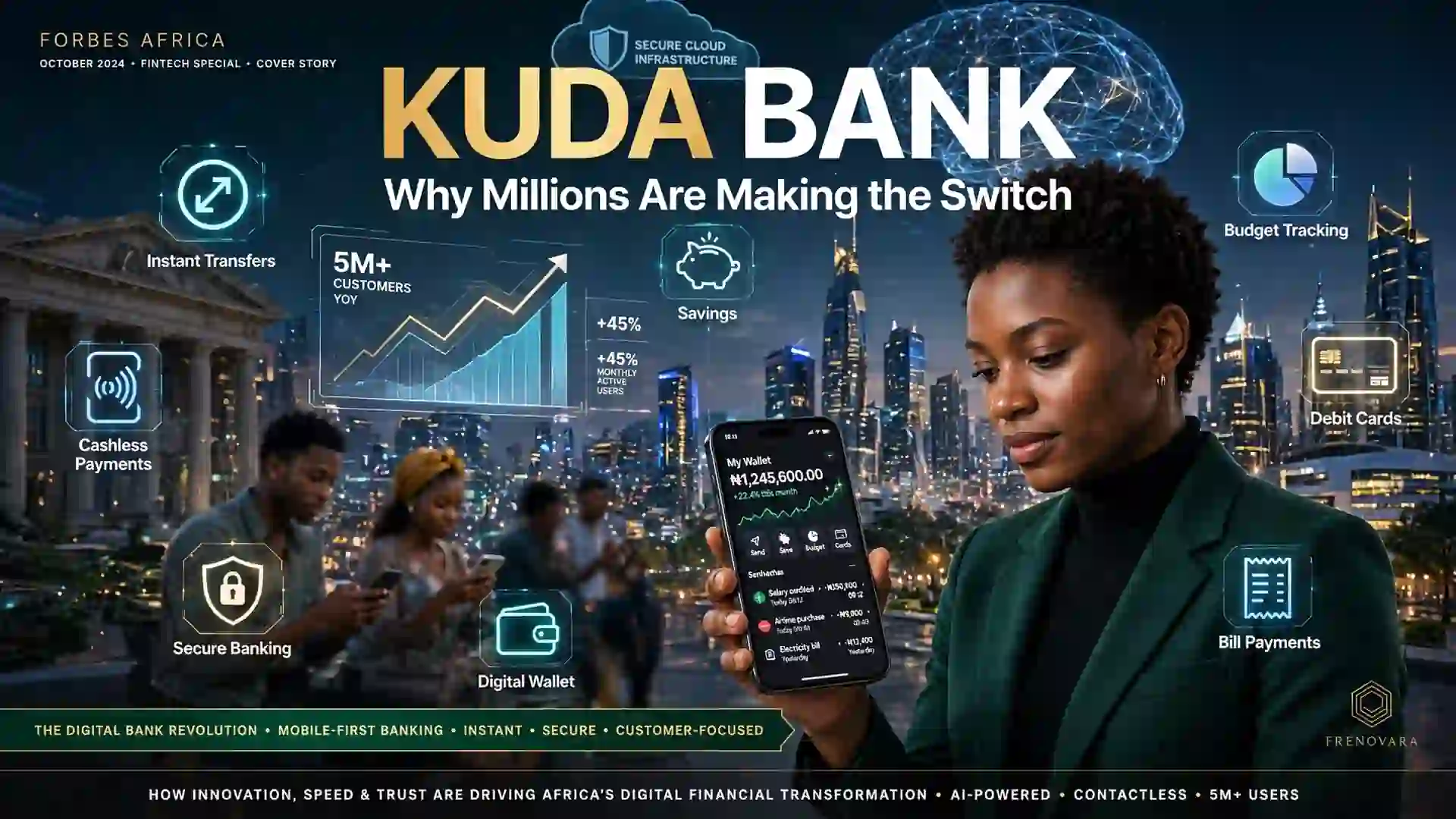
Why Kuda Bank Is Winning Millions of Customers

Kuda Bank has become one of the biggest success stories in Nigeria’s financial technology industry.
In just a few years, the digital bank has attracted millions of users by offering something many traditional financial institutions struggled to provide: simple, affordable, and customer-friendly banking.
While legacy banks spent decades building thousands of physical branches, Kuda focused on building an exceptional mobile banking experience.
The Untold Story of Kuda Bank: How Nigeria’s Digital Bank Is Challenging Traditional Banks
That decision changed everything.
Today, Kuda has become one of Africa’s leading digital banks, proving that convenience, transparency, and innovation can outperform traditional banking models.
But what exactly makes Kuda so popular?
Why are millions of Nigerians opening Kuda accounts?
And what lessons can entrepreneurs learn from its remarkable growth?
Kuda Bank Was Built for the Smartphone Generation
Unlike traditional banks that later adapted to mobile banking, Kuda Bank was designed from the beginning as a digital-first financial institution.
Customers can perform nearly every banking activity directly from their smartphones, including:
- Opening an account
- Sending money
- Receiving payments
- Paying bills
- Saving money
- Managing spending
- Tracking expenses
Without visiting a physical branch.
For younger Nigerians who rely heavily on smartphones, this convenience is a major advantage.
Zero Maintenance Fees Attracted Millions
For years, Nigerians complained about numerous banking charges.
These included:
- Account maintenance fees
- SMS charges
- Transfer fees
- Card maintenance fees
- Hidden deductions
Kuda entered the market with a different message.
It branded itself as:
“The Bank of the Free.”
By reducing or eliminating many common banking charges, Kuda quickly attracted customers looking for a more affordable alternative.
Simplicity Is Part of Kuda Bank’s Success
Many banking applications overwhelm users with complicated menus and confusing interfaces.
Kuda took the opposite approach.
Its mobile application emphasizes:
- Clean design
- Easy navigation
- Fast transactions
- Simple budgeting
- Instant notifications
This user-friendly experience makes digital banking accessible even for first-time users.
Fast Account Opening
Opening a traditional bank account often involves paperwork, documentation, and waiting.
Kuda significantly simplified this process.
Most customers can register directly through the mobile application by following a straightforward digital verification process.
This convenience removes barriers that previously discouraged many people from joining the formal banking system.
Real-Time Transaction Notifications
One feature many customers appreciate is instant transaction alerts.
Whenever money enters or leaves an account, Kuda immediately notifies the customer.
This improves:
- Financial awareness
- Security
- Budget management
Real-time information increases customer confidence.
Smart Budgeting Features
Modern banking is no longer just about storing money.
People increasingly want help managing it.
Kuda provides budgeting tools that allow users to:
- Track spending
- Categorize expenses
- Monitor financial habits
- Build savings
These features transform the application from a simple bank into a personal financial assistant.
Automatic Savings Encourages Better Financial Habits
Saving consistently can be difficult.
Kuda introduced automated savings features designed to help customers achieve financial goals.
Users can:
- Schedule automatic savings
- Create savings targets
- Separate spending money from savings
This encourages stronger financial discipline.
Customer Experience Comes First
One reason Kuda Bank continues growing is its strong focus on customer satisfaction.
Rather than designing products around internal banking processes, the company designs products around customer needs.
This philosophy influences:
- Product development
- App updates
- Customer support
- User interface
- Service improvements
Customer-focused companies often build stronger long-term loyalty.
Financial Inclusion Matters
Millions of Africans remain underserved by traditional financial institutions.
Kuda contributes to financial inclusion by making banking more accessible.
Its digital-first approach benefits:
- Students
- Freelancers
- Small business owners
- Young professionals
- Entrepreneurs
Accessible financial services support broader economic growth.
Trust Continues Growing
Many people initially questioned whether a branchless bank could be trusted.
Kuda addressed these concerns through:
- Regulatory compliance
- Secure technology
- Transparent communication
- Continuous product improvements
As confidence increased, customer adoption accelerated.
Trust remains one of Kuda’s strongest competitive advantages.
Word-of-Mouth Marketing Became Powerful
Unlike many companies that rely heavily on advertising, Kuda benefited significantly from customer referrals.
Satisfied customers recommended the platform to:
- Friends
- Family
- Colleagues
- Business partners
Positive experiences spread rapidly through social media and personal networks.
This reduced customer acquisition costs while strengthening brand credibility.
Kuda Represents the Future of Banking
The rapid growth of Kuda demonstrates that consumers increasingly value:
- Convenience
- Transparency
- Speed
- Affordability
- Innovation
Traditional banks continue modernizing, but digital-first institutions like Kuda have permanently changed customer expectations.
The future of banking is increasingly mobile.
How Kuda Bank Makes Money
One of the biggest misconceptions about Kuda Bank is that it cannot be profitable because it charges customers little or nothing for many of its services.
In reality, Kuda operates a diversified business model similar to many successful digital banks around the world.
Rather than depending heavily on maintenance fees, the company generates income through multiple revenue streams.
These include:
- Card transaction fees
- Lending products
- Business banking
- Premium financial services
- Strategic partnerships
- Interest income
- Payment processing
This approach allows Kuda to keep everyday banking affordable while maintaining a sustainable business.
Card Payments Generate Significant Revenue
Every time customers use their Kuda debit cards, merchants pay processing fees through payment networks.
A percentage of these fees is shared with financial institutions.
Although each transaction generates only a small amount, millions of transactions every month create substantial revenue.
As Kuda’s customer base continues expanding, transaction income grows alongside it.
Lending Has Become a Major Growth Area
Digital banks possess one important advantage.
They collect valuable financial data that helps assess customer behaviour.
Using transaction histories and spending patterns, Kuda can evaluate credit risk more efficiently than traditional manual processes.
This enables the company to offer:
- Personal loans
- Salary advances
- Short-term credit
- Small business financing
Interest earned from responsible lending represents an important source of long-term income.
Business Banking Expands Opportunities
Although Kuda initially focused on personal banking, the company has increasingly expanded its business banking services.
Small businesses require:
- Business accounts
- Payroll management
- Payment collection
- Expense tracking
- Financial reporting
Serving entrepreneurs creates additional revenue while strengthening customer loyalty.
Partnerships Strengthen the Ecosystem
Kuda collaborates with multiple technology and financial service providers.
These partnerships help deliver:
- Payment solutions
- Investment services
- Insurance products
- Merchant services
- Financial education
Rather than building every service independently, strategic partnerships allow faster innovation.
Product Innovation Keeps Customers Engaged
One reason Kuda Bank continues attracting millions of users is its commitment to continuous improvement.
The company frequently introduces new features based on customer feedback.
Examples include:
- Spending analytics
- Budget planning
- Automated savings
- Virtual debit cards
- Improved security features
- Business banking tools
Regular updates keep the application relevant while improving customer satisfaction.
Competing With Traditional Banks
Kuda is no longer competing only with other fintech startups.
It now competes directly with Nigeria’s largest financial institutions.
Unlike traditional banks that rely heavily on physical branches, Kuda focuses on:
- Digital convenience
- Lower operating costs
- Faster product development
- Better mobile experiences
This forces conventional banks to accelerate their own digital transformation.
Digital Wallet vs Mobile Banking
Why Young Nigerians Prefer Kuda
Nigeria has one of Africa’s youngest populations.
Many young professionals expect banking to function as smoothly as social media or messaging applications.
Kuda aligns with these expectations by offering:
- Instant account setup
- Fast transfers
- Simple interfaces
- Transparent pricing
- Mobile-first banking
These qualities resonate strongly with digitally connected customers.
Financial Inclusion Remains a Major Opportunity
Millions of Africans remain either unbanked or underbanked.
Digital banking reduces many traditional barriers by removing the need for extensive branch networks.
Kuda contributes to financial inclusion by making banking more accessible for:
- Students
- Freelancers
- Small business owners
- Remote workers
- Entrepreneurs
Greater financial inclusion benefits both individuals and national economies.
Expansion Beyond Nigeria
Although Nigeria remains Kuda’s primary market, the company’s ambitions extend beyond one country.
Africa presents enormous opportunities because of:
- Growing smartphone adoption
- Expanding internet access
- Rising digital payments
- Young populations
- Increasing demand for fintech services
Expansion into additional African markets could significantly increase Kuda’s long-term growth potential.
Challenges Facing Digital Banks
Despite its remarkable success, Kuda faces several important challenges.
These include:
- Increasing competition
- Cybersecurity threats
- Regulatory changes
- Customer acquisition costs
- Economic uncertainty
- Profitability pressures
Successfully navigating these obstacles will determine how far the company can expand.
Competition Is Becoming More Intense
Nigeria’s fintech sector has become one of Africa’s most competitive.
Kuda now competes alongside:
- Moniepoint
- OPay
- PalmPay
- FairMoney
- Carbon
Traditional banks have also significantly improved their digital banking services.
This competition encourages continuous innovation across the industry.
Technology Drives Every Decision
Unlike legacy banking institutions operating decades-old systems, Kuda was built using modern technology infrastructure.
This provides several advantages:
- Faster updates
- Better scalability
- Improved security
- Greater flexibility
- Enhanced customer experiences
Technology remains the foundation of Kuda’s competitive advantage.
Customer Trust Continues Growing
Building trust remains essential for any financial institution.
Kuda continues strengthening customer confidence through:
- Secure transactions
- Transparent communication
- Reliable mobile services
- Continuous innovation
- Regulatory compliance
Trust is often the most valuable asset a bank can possess.
Five Business Lessons Entrepreneurs Can Learn from Kuda Bank
The remarkable rise of Kuda Bank offers valuable lessons for entrepreneurs, startup founders, and business leaders.
Its success proves that innovation is not always about inventing something entirely new. Sometimes, it is about improving an existing experience so dramatically that customers willingly switch.
1. Solve Real Problems
Kuda did not become popular because it called itself a digital bank.
It became successful because it addressed frustrations Nigerians had complained about for years.
Those frustrations included:
- Excessive banking charges.
- Long queues.
- Slow customer service.
- Complicated account opening.
- Poor mobile banking experiences.
Businesses that solve genuine customer pain points usually experience stronger long-term growth.
2. Put Customers First
Kuda consistently designs products around customer convenience.
Rather than asking customers to adapt to banking processes, the company redesigned banking around customer needs.
Customer-focused companies typically enjoy:
- Better loyalty.
- Higher referrals.
- Stronger retention.
- Positive online reviews.
Customer experience has become one of the strongest competitive advantages in modern business.
3. Technology Is an Investment
Many companies view technology as an expense.
Kuda treats technology as its greatest asset.
Continuous investment in:
- Software.
- Security.
- User experience.
- Infrastructure.
allows the bank to improve products rapidly while maintaining operational efficiency.
Technology should accelerate business growth rather than merely support operations.
4. Build a Strong Brand
Kuda’s branding played a major role in its success.
“The Bank of the Free” immediately communicated value.
Customers understood the promise before downloading the application.
Clear positioning helps businesses stand out in crowded markets.
5. Never Stop Innovating
Customer expectations continue changing.
Successful companies evolve continuously.
Kuda regularly introduces:
- New banking features.
- Better financial tools.
- Improved user experiences.
- Business solutions.
Innovation keeps customers engaged while discouraging competitors from catching up.
Why Digital Banking Will Continue Growing
The future of Kuda Bank is closely connected to broader digital banking trends.
Several factors support continued industry expansion.
These include:
- Increasing smartphone ownership.
- Faster internet access.
- Growing digital payments.
- Financial inclusion.
- Younger populations.
- Rising e-commerce adoption.
These trends suggest digital banking will continue expanding across Africa.
Artificial Intelligence Could Shape Kuda’s Future
Artificial intelligence is transforming financial services globally.
Future AI-powered banking could include:
- Personalized financial advice.
- Smarter budgeting.
- Fraud detection.
- Predictive spending analysis.
- Automated customer support.
- Intelligent savings recommendations.
Banks that successfully integrate AI may strengthen customer relationships while improving operational efficiency.
Can Kuda Become Africa’s Largest Digital Bank?
Kuda has already established itself as one of Nigeria’s leading digital banks.
Its long-term potential depends on several strengths:
- Strong brand recognition.
- Technology infrastructure.
- Customer-first philosophy.
- Product innovation.
- Venture capital support.
If the company successfully expands into additional African markets while maintaining customer satisfaction, its influence could continue growing significantly.
Frequently Asked Questions (FAQs)
What Is Kuda Bank?
Kuda Bank is a Nigerian digital bank that offers mobile-first banking services designed to simplify financial management while reducing traditional banking fees.
Who Founded Kuda Bank?
Kuda was founded by:
- Babs Ogundeyi.
- Musty Mustapha.
Their vision was to build an affordable digital bank focused entirely on customer convenience.
Why Is Kuda Called “The Bank of the Free”?
The company became known for reducing or eliminating many traditional banking charges while offering customers a modern digital banking experience.
How Does Kuda Bank Make Money?
Kuda generates revenue through:
- Card transaction fees.
- Lending.
- Business banking.
- Partnerships.
- Premium financial products.
- Payment processing.
Is Kuda Safe?
Kuda operates under Nigeria’s banking regulations while implementing multiple security measures designed to protect customer accounts and transactions.
Why Kuda’s Story Matters
The rise of Kuda Bank represents something much bigger than one successful fintech company.
It demonstrates how African entrepreneurs increasingly solve local problems using modern technology.
Rather than waiting for legacy institutions to change, startups like Kuda create entirely new customer experiences.
Its success also highlights the growing importance of:
- Financial inclusion.
- Mobile technology.
- Digital payments.
- Customer-centric innovation.
These themes will continue shaping Africa’s financial future.
Beyond the Headlines
Kuda Bank has proven that innovation does not require hundreds of physical branches or decades of operating history.
Instead, it requires understanding customers better than competitors.
By eliminating unnecessary banking charges, simplifying financial management, embracing mobile technology, and continuously improving its products, Kuda has successfully challenged some of Nigeria’s largest traditional financial institutions.
Its journey serves as an inspiring reminder that startups can disrupt established industries when they focus relentlessly on solving customer problems.
As Africa’s digital economy continues expanding, Kuda Bank is likely to remain one of the companies shaping the continent’s financial future.