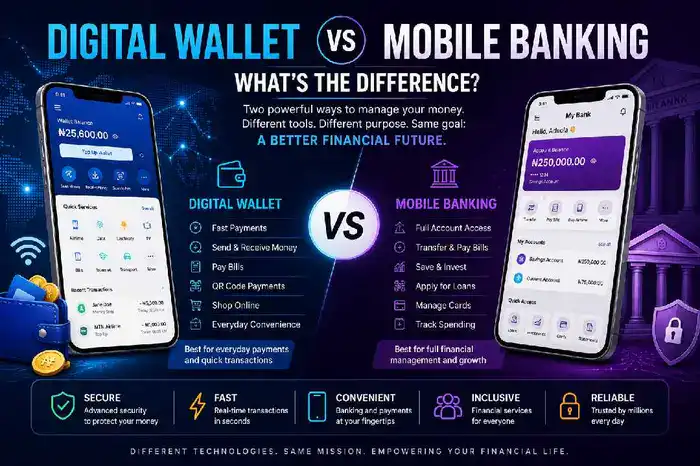
Digital Wallet vs Mobile Banking: What’s the Difference?

The way people manage money has changed dramatically over the past decade.
Not long ago, visiting a physical bank branch was almost unavoidable.
Customers needed to queue for deposits, withdrawals, transfers, and bill payments.
Today, most financial activities happen through smartphones.
Whether paying for groceries, transferring money to family members, purchasing online, or saving for future expenses, digital financial services have made banking more convenient than ever.
Yet despite this technological progress, many people still confuse digital wallets with mobile banking.
The two terms are often used interchangeably.
In reality, they represent different financial technologies designed to solve different problems. Top 10 Digital Wallets in the World (2026)
Understanding the distinction can help individuals and businesses choose the right financial tools while improving security, convenience, and financial management.
Understanding Digital Wallets
A digital wallet is an electronic application that stores payment information and enables users to make financial transactions digitally.
Instead of carrying physical cash or numerous payment cards, users can keep their financial information securely within a smartphone application.
Depending on the provider, digital wallets may allow users to:
- Store money digitally.
- Send and receive payments.
- Purchase goods and services.
- Pay utility bills.
- Buy airtime and data.
- Scan QR codes for payments.
- Shop online.
Digital wallets focus primarily on facilitating payments.
They simplify transactions without requiring users to carry physical wallets. What Is a Digital Wallet? How It Works and Why Millions Use It in the Digital Economy
Popular digital wallets have become increasingly common as smartphone adoption continues rising across Africa and the rest of the world.
What Is Mobile Banking?
Mobile banking refers to banking services provided directly by licensed financial institutions through mobile applications.
Rather than simply making payments, mobile banking provides access to an individual’s entire bank account.
Customers can typically:
- Check account balances.
- Transfer funds.
- Download statements.
- Open savings accounts.
- Apply for loans.
- Manage investments.
- Pay bills.
- Monitor spending.
- Block or activate debit cards.
Unlike digital wallets, mobile banking serves as a complete banking platform.
It connects customers directly with their financial institution while offering comprehensive financial management capabilities.
Why People Often Confuse Both
The confusion is understandable.
Both digital wallets and mobile banking applications allow users to perform similar everyday tasks.
For example, both may enable customers to:
- Transfer money.
- Make payments.
- Buy airtime.
- Pay utility bills.
- Receive funds.
Because these services overlap, many users assume both technologies are identical.
However, their underlying structures, regulatory frameworks, and business models differ significantly. How Fintech Is Powering Online Shopping: The Technology Behind Faster, Safer, and Smarter E-commerce
Understanding those differences becomes increasingly important as digital finance continues evolving.
Ownership and Regulation
One major distinction lies in who operates these services.
Mobile banking applications are typically owned by licensed commercial banks.
Examples include:
- Kuda Bank.
- Access Bank.
- GTBank.
- First Bank.
- Zenith Bank.
Digital wallets, on the other hand, may be operated by:
- Fintech companies.
- Licensed payment service providers.
- Mobile money operators.
- Financial technology startups.
Although many fintech companies are heavily regulated, their operating models often differ from traditional banks.
This distinction influences the range of financial products available to customers.
Primary Purpose
The primary objective of a digital wallet is simple.
Enable fast, convenient digital payments.
Mobile banking has a broader objective.
Provide comprehensive banking services.
Digital wallets prioritise transaction convenience.
Mobile banking prioritises complete financial management.
While both continue evolving, this difference remains one of the clearest ways to distinguish between them.
The Rise of Cashless Economies
Across Africa, governments and financial institutions increasingly encourage digital financial services.
Cashless transactions continue growing because they offer:
- Greater convenience.
- Faster payments.
- Improved transparency.
- Better financial inclusion.
- Reduced cash handling risks.
Both digital wallets and mobile banking contribute significantly to this transformation.
The Future of OPay: What’s Next for One of Africa’s Biggest Fintech Companies?
Rather than competing directly, they increasingly complement each other within the broader digital financial ecosystem.
Key Differences Between Digital Wallets and Mobile Banking
Although digital wallets and mobile banking applications share several features, their core functions differ in important ways.
Understanding these distinctions helps consumers choose the right solution for their financial needs.
Purpose
A digital wallet is primarily designed for making payments quickly and conveniently.
Mobile banking is designed to give customers full access to their bank accounts and financial services. Top 10 Things You Didn’t Know About OPay
Provider
Digital wallets are commonly operated by:
- Fintech companies.
- Payment service providers.
- Mobile money operators.
Mobile banking services are provided by licensed banks.
This difference often determines the range of products available.
Financial Services
Digital wallets usually focus on:
- Payments.
- Transfers.
- Airtime purchases.
- Bill payments.
- Merchant transactions.
Mobile banking offers much broader services, including:
- Savings accounts.
- Fixed deposits.
- Loan applications.
- Investment products.
- Account statements.
- Card management.
Account Structure
Most mobile banking applications require users to have an existing bank account.
Some digital wallets allow users to create accounts with minimal documentation while offering simplified financial services. The Rise of OPay: A Journey Across Nigeria and Africa
This flexibility has helped improve financial inclusion in many developing economies.
Security Comparison
Security remains one of the biggest concerns whenever money moves digitally.
Fortunately, both technologies invest heavily in protecting customer funds.
Common security features include:
- PIN authentication.
- Password protection.
- Fingerprint recognition.
- Facial recognition.
- Two-factor authentication.
- Transaction alerts.
- Encryption technologies.
Licensed banks often operate under stricter regulatory requirements.
However, many fintech companies now implement security standards comparable to traditional financial institutions.
Ultimately, user behaviour also plays a major role in financial security.
Advantages of Digital Wallets
Digital wallets continue growing because of their simplicity.
Key benefits include:
Faster Payments
Transactions often take only seconds.
Convenience
Users can complete purchases without carrying physical cash.
Merchant Acceptance
Many businesses now accept wallet-based payments through QR codes and digital payment links.
Easy Everyday Transactions
Buying airtime, paying utility bills, and making small purchases become significantly easier.
Advantages of Mobile Banking
Mobile banking provides a much broader financial experience.
Benefits include:
Complete Financial Control
Customers manage their entire bank account from one application.
Savings Tools
Many banking apps offer automated savings and investment products.
Loan Access
Qualified customers can apply for loans directly through mobile banking applications.
Detailed Financial Records
Bank statements, spending history, and account monitoring provide better financial management.
Which One Is Better for Businesses?
Businesses often require more than simple payment acceptance.
They need comprehensive financial management.
Mobile banking provides businesses with:
- Business accounts.
- Payroll services.
- Financial reporting.
- Cash flow management.
- Account reconciliation.
Digital wallets complement these services by making customer payments easier.
Many businesses therefore use both technologies simultaneously. Top Fintech Founders in Africa and Their Impact
For example:
- A retailer may receive customer payments through digital wallets.
- The same retailer manages finances using mobile banking.
Rather than replacing each other, both systems often work together.
Fintech Companies Continue Blurring the Lines
The distinction between digital wallets and mobile banking is becoming less obvious.
Many fintech companies now provide services that resemble traditional banks. Flutterwave Products and Their Key Features Explained
Similarly, banks increasingly offer payment experiences that resemble digital wallets.
This convergence benefits consumers.
Customers enjoy:
- Better technology.
- Faster innovation.
- Lower costs.
- Improved financial accessibility.
Competition has accelerated innovation throughout Africa’s financial sector.
Digital Finance Is Driving Financial Inclusion
Millions of Africans previously lacked access to formal banking services.
Digital financial technologies have changed that reality.
Today, many individuals can:
- Receive salaries.
- Save money.
- Pay bills.
- Transfer funds.
- Purchase goods online.
- Access financial services.
all from smartphones.
Both digital wallets and mobile banking continue expanding financial inclusion across urban and rural communities.
The Future Will Combine Both Technologies
Looking ahead, consumers are unlikely to choose one technology exclusively.
Instead, financial ecosystems will continue integrating:
- Banking.
- Payments.
- Savings.
- Investments.
- Insurance.
- Lending.
Artificial Intelligence, Open Banking, and embedded finance will further blur the boundaries between digital wallets and traditional banking.
How Kuda Bank Makes Money: Revenue Streams Behind Africa’s Leading Digital Bank
Customers will increasingly experience one seamless financial ecosystem rather than separate products.
Which One Should You Choose?
The answer depends on your financial needs.
Neither digital wallets nor mobile banking applications are universally better.
They simply serve different purposes.
Choose a Digital Wallet If You:
- Frequently make everyday payments.
- Shop online regularly.
- Prefer fast QR code payments.
- Pay utility bills often.
- Want quick peer-to-peer transfers.
- Need convenient merchant payments.
Digital wallets are ideal for speed and convenience.
Choose Mobile Banking If You:
- Need full banking services.
- Manage savings regularly.
- Apply for loans.
- Monitor account balances.
- Download bank statements.
- Manage debit cards.
- Invest money.
- Operate business accounts.
Mobile banking provides complete financial management.
Why Many People Use Both
In reality, millions of people use both services every day.
For example:
- A customer receives their salary into a bank account.
- They transfer money using mobile banking.
- They use a digital wallet to pay for groceries.
- They pay electricity bills through a fintech app.
- They save money using their banking application.
Rather than replacing one another, both technologies complement each other.
How Businesses Benefit from Both
Businesses increasingly combine digital wallets with traditional banking to improve operations.
Typical workflow:
- Customer payments arrive through digital wallets.
- Revenue moves into business bank accounts.
- Expenses are managed through mobile banking.
- Payroll is processed digitally.
- Financial reports are generated from banking platforms.
This combination creates greater operational efficiency while improving customer convenience.
Five Lessons from the Digital Finance Revolution
The rise of digital wallets and mobile banking offers valuable lessons for consumers and entrepreneurs alike.
1. Convenience Wins
People naturally adopt technologies that make life easier.
The simplest payment solution often becomes the most popular.
2. Security Builds Trust
Customers only continue using financial services they trust.
Strong cybersecurity remains essential for long-term success.
3. Innovation Never Stops
Digital finance continues evolving.
Businesses that embrace innovation remain competitive.
Consumers benefit from continuous improvements.
4. Financial Inclusion Matters
Technology should expand access rather than create barriers.
Digital financial services have enabled millions of previously unbanked individuals to participate in the formal economy.
5. The Future Is Digital
Cash continues to exist.
However, digital transactions increasingly dominate commerce.
Businesses and consumers that adapt early position themselves for long-term success.
Frequently Asked Questions (FAQs)
What Is a Digital Wallet?
A digital wallet is an electronic application that stores payment information and enables users to make digital transactions such as transfers, purchases, and bill payments.
What Is Mobile Banking?
Mobile banking allows customers to access their bank accounts through official banking applications to perform financial activities including transfers, savings, loans, investments, and account management.
Is a Digital Wallet the Same as Mobile Banking?
No.
Digital wallets primarily focus on payments.
Mobile banking provides comprehensive banking services linked directly to a licensed financial institution.
Which Is More Secure?
Both digital wallets and mobile banking applications invest heavily in security.
Users should also protect themselves by:
- Using strong passwords.
- Enabling two-factor authentication.
- Avoiding suspicious links.
- Keeping applications updated.
Can I Use Both?
Absolutely.
Many consumers combine mobile banking with digital wallets to enjoy the strengths of both technologies.
The Future of Digital Finance
The distinction between digital wallets and mobile banking will continue becoming less obvious. How to Open a Moniepoint Business Account: Step-by-Step Guide for Entrepreneurs (2026)
Artificial Intelligence, Open Banking, embedded finance, biometric authentication, and real-time payments are already reshaping financial services.
Future financial platforms may combine:
- Payments.
- Banking.
- Investments.
- Insurance.
- Lending.
- Personal finance management.
all within a single application.
Consumers will increasingly experience seamless financial ecosystems rather than separate banking products.
Beyond the Headlines
The debate between digital wallets and mobile banking is not about choosing one over the other.
It is about understanding how each technology contributes to a rapidly evolving financial landscape.
Digital wallets have simplified everyday transactions.
Mobile banking has placed full financial control into customers’ hands.
Together, they represent one of the most significant technological transformations in modern finance.
As cashless economies continue expanding across Africa and beyond, individuals who understand these technologies will be better prepared to manage their money, grow their businesses, and participate confidently in the digital economy.
The future of finance is not simply digital.
It is intelligent, connected, secure, and increasingly accessible to everyone.