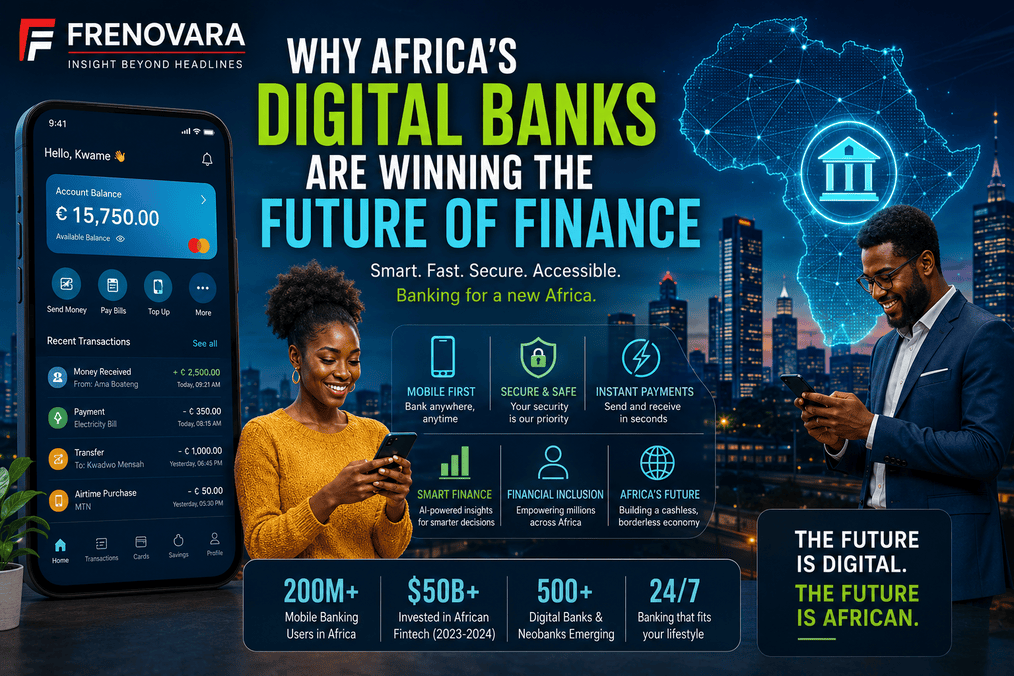
Why Africa’s Digital Banks Are Winning the Future of Finance
Not long ago, opening a bank account often meant standing in long queues, completing paperwork, and waiting days for approval.
Today, millions of Africans can open fully functional bank accounts in just a few minutes using only a smartphone.
This dramatic shift has fuelled the rise of Digital Banks in Africa, one of the fastest-growing sectors within the continent’s financial ecosystem.
Unlike traditional banks, digital banks operate primarily through mobile applications and online platforms.
They deliver faster onboarding, lower operating costs, improved customer experiences, and innovative financial products that appeal to both individuals and businesses.
The rapid growth of African Digital Banking reflects a broader transformation in how Africans save, spend, invest, and manage money.
What Are Digital Banks?
Digital banks—often called Neobanks Africa—are financial institutions that provide banking services almost entirely through digital channels.
Rather than relying on large branch networks, they allow customers to:
- Open accounts online.
- Transfer money instantly.
- Pay bills.
- Save automatically.
- Access virtual cards.
- Manage investments.
- Apply for loans.
Their convenience has made them increasingly popular among younger, tech-savvy customers.
Why Digital Banking Is Growing Rapidly
Several forces are driving the expansion of Mobile Banking Africa.
Smartphone Adoption
Affordable smartphones have made digital financial services accessible to millions of people.
Faster Internet Access
Improved connectivity allows customers to complete transactions from virtually anywhere.
Cashless Payments
Consumers increasingly prefer digital transactions over cash.
Customer Convenience
Digital banks operate 24 hours a day, offering faster services than many traditional banking channels.
Traditional Banks Are Being Forced to Innovate
The emergence of Banking Innovation Africa has intensified competition.
To remain competitive, many established banks are now investing heavily in:
- Mobile banking apps.
- Artificial Intelligence.
- Digital customer service.
- Instant payments.
- Biometric security.
- Cloud banking infrastructure.
Competition ultimately benefits consumers through better services and lower costs.
Fintech and Digital Banks Are Working Together
Rather than replacing fintech companies, many digital banks collaborate with them.
Together they are building an ecosystem that includes:
- Digital payments.
- Personal finance tools.
- Investment platforms.
- Small business financing.
- Cross-border transfers.
- Financial education.
This collaboration continues strengthening Digital Finance Africa.
Artificial Intelligence Is Revolutionizing African Digital Banking
One of the biggest competitive advantages of Digital Banks in Africa is their ability to leverage Artificial Intelligence (AI).
Unlike traditional banking systems that often depend on manual processes, digital banks increasingly use AI to deliver faster, smarter, and more personalized financial services.
AI is now helping banks:
- Detect fraudulent transactions in real time.
- Approve loans faster.
- Recommend savings plans.
- Provide 24/7 virtual customer support.
- Predict customer financial needs.
- Analyze spending habits.
As AI continues to evolve, it will play an even greater role in shaping Banking Innovation Africa, making financial services more accessible and efficient.
Digital Lending Is Expanding Financial Inclusion
Access to credit has historically been one of Africa’s biggest financial challenges.
Traditional banks often require extensive paperwork, collateral, and lengthy approval processes.
Digital banks are changing that.
Using alternative data—such as mobile payment history, transaction patterns, and income behavior—many digital banks can assess creditworthiness within minutes.
This innovation has opened new opportunities for:
- Small business owners.
- Freelancers.
- Farmers.
- Students.
- Young entrepreneurs.
- Informal sector workers.
By simplifying access to credit, Digital Finance Africa is empowering millions who were previously excluded from formal financial systems.
Cybersecurity Has Become a Top Priority
As banking moves online, protecting customer data becomes increasingly important.
Digital banks invest heavily in cybersecurity technologies to protect users from fraud and cyberattacks.
Common security features include:
- Two-factor authentication.
- Biometric login.
- Facial recognition.
- Fingerprint authentication.
- Real-time fraud monitoring.
- End-to-end encryption.
Strong security builds customer trust, which remains one of the most valuable assets in African Digital Banking.
Financial Inclusion Is Driving Economic Growth
Perhaps the greatest contribution of Mobile Banking Africa is financial inclusion.
Millions of Africans who previously operated entirely with cash now have access to:
- Savings accounts.
- Digital payments.
- Credit.
- Insurance.
- Investment products.
Financial inclusion supports economic growth by allowing individuals and businesses to participate more actively in the formal economy.
For governments, this also improves transparency and tax collection while encouraging entrepreneurship.
Small Businesses Are Benefiting the Most
Small and medium-sized enterprises (SMEs) form the backbone of many African economies.
Digital banks are helping these businesses by offering:
- Business accounts.
- Invoice management.
- Payroll solutions.
- Merchant payment systems.
- Expense tracking.
- Instant transfers.
These services reduce administrative burdens while improving financial management.
As a result, digital banking has become an essential tool for Financial Technology Africa.
Investors See Huge Opportunities in African Banking
Global investors increasingly recognise that Africa’s financial sector remains underpenetrated.
This creates enormous opportunities for growth.
Investment continues flowing into:
- Digital banks.
- Fintech startups.
- Payment platforms.
- Lending technology.
- Wealth management apps.
- Cross-border payment solutions.
As more consumers adopt digital financial services, investor confidence in Future of Banking Africa continues strengthening.
Challenges Facing Digital Banks
Despite remarkable growth, digital banks still face several obstacles.
These include:
- Internet connectivity challenges.
- Digital literacy gaps.
- Regulatory uncertainty.
- Cybersecurity threats.
- Customer trust issues.
- Infrastructure limitations.
- Competition from traditional banks and fintech companies.
Successfully addressing these challenges will determine which institutions emerge as long-term leaders.
Why Competition Is Good for Customers
The rise of digital banks has forced the entire banking industry to improve.
Customers now benefit from:
- Faster services.
- Lower transaction fees.
- Better mobile applications.
- More innovative financial products.
- Improved customer support.
- Greater transparency.
Healthy competition ultimately creates a stronger financial ecosystem that benefits individuals, businesses, and national economies alike.
Africa 2035 – Banking Without Borders
The banking industry across Africa is entering one of the most transformative periods in its history.
By 2035, Digital Banks in Africa are expected to become the primary financial service providers for hundreds of millions of people.
The future of banking will likely include:
- AI-powered financial advisors.
- Instant cross-border payments.
- Voice-enabled banking.
- Digital identity verification.
- Blockchain-powered settlements.
- Embedded financial services.
- Fully cashless ecosystems.
Rather than visiting physical branches, customers will manage almost every financial activity through smartphones, wearable devices, and intelligent digital assistants.
This transformation will redefine the Future of Banking Africa.
Cross-Border Banking Will Unlock the African Continental Free Trade Area (AfCFTA)
One of the greatest opportunities for African Digital Banking lies in supporting trade across African borders.
Today, businesses often face challenges such as:
- Expensive international transfers.
- Currency conversion costs.
- Payment delays.
- Banking restrictions between countries.
Digital banks are already developing solutions that simplify cross-border transactions.
As the African Continental Free Trade Area (AfCFTA) expands, seamless digital banking will become essential for:
- Exporters.
- Importers.
- Freelancers.
- Digital entrepreneurs.
- Small businesses.
Financial institutions capable of supporting continental trade will likely become the biggest winners.
Opportunities for Entrepreneurs
The growth of Financial Technology Africa creates opportunities beyond launching a bank.
Entrepreneurs can build businesses in areas including:
Fintech Software Development
Creating banking software, payment gateways, fraud detection systems, and financial management tools.
Cybersecurity Services
Helping financial institutions protect customer information and digital infrastructure.
Financial Education Platforms
Providing digital literacy, investment education, budgeting tools, and financial planning services.
Payment Infrastructure
Building technologies that enable merchants to accept faster and more secure digital payments.
Business Banking Solutions
Developing accounting platforms, invoicing software, payroll systems, and cash-flow management tools for SMEs.
The digital banking ecosystem is creating opportunities for thousands of businesses that support financial services.
Why Investors Remain Optimistic
Despite economic uncertainty, investors continue viewing Tech Investment Africa as a long-term growth opportunity.
Several factors support this optimism:
- Increasing smartphone penetration.
- Growing middle class.
- Rising digital commerce.
- Expanding internet access.
- Young population.
- Improving regulatory frameworks.
- Strong demand for financial inclusion.
As Africa continues digitising its economy, financial technology is expected to remain one of the continent’s most attractive investment sectors.
Frequently Asked Questions (FAQs)
What Is a Digital Bank?
A digital bank provides banking services primarily through mobile applications and online platforms rather than traditional branch networks.
Are Digital Banks Safe?
Yes.
Most licensed digital banks implement advanced cybersecurity measures including encryption, biometric authentication, fraud monitoring, and multi-factor authentication.
Customers should still follow good digital security practices.
Why Are Digital Banks Growing Faster Than Traditional Banks?
Digital banks typically offer:
- Faster account opening.
- Lower operating costs.
- Better mobile experiences.
- Lower transaction fees.
- Greater convenience.
- Continuous innovation.
These advantages appeal particularly to younger consumers and digital businesses.
Will Digital Banks Replace Traditional Banks?
Not entirely.
Many traditional banks are successfully transforming into digital-first institutions.
The future will likely involve collaboration between established banks, fintech companies, and digital-only banks.
What Frenovara Sees Next
Digital banking is no longer just a financial trend.
It is becoming part of Africa’s broader digital transformation.
As businesses increasingly adopt e-commerce, artificial intelligence, mobile payments, and digital identities, financial services will become deeply integrated into everyday life.
The next generation of African entrepreneurs will expect financial services that are:
- Instant.
- Intelligent.
- Secure.
- Borderless.
- Accessible.
The institutions that embrace these expectations will shape the continent’s financial future.
Beyond the Headlines
Throughout history, the strongest economies have been built on efficient financial systems.
Banks have always served as the engine that powers commerce.
What is changing today is not the importance of banking.
It is the way banking is delivered.
Africa’s digital banks are proving that financial innovation does not require hundreds of physical branches.
It requires understanding people.
Understanding technology.
And solving real problems at scale.
Millions of Africans are experiencing formal financial services for the first time because digital innovators challenged decades-old banking models.
That achievement goes beyond convenience.
It expands opportunity.
Every digital account opened represents another entrepreneur who can receive payments.
Another student who can save for education.
Another small business that can access financing.
Another family participating in the formal economy.
Africa’s banking revolution is therefore not simply about technology.
It is about economic empowerment.
And as this transformation continues, the continent will not just consume financial innovation—it will increasingly create it.
That’s the Frenovara perspective—looking beyond the headlines to uncover the innovations, entrepreneurs, and ideas transforming Africa’s financial future.