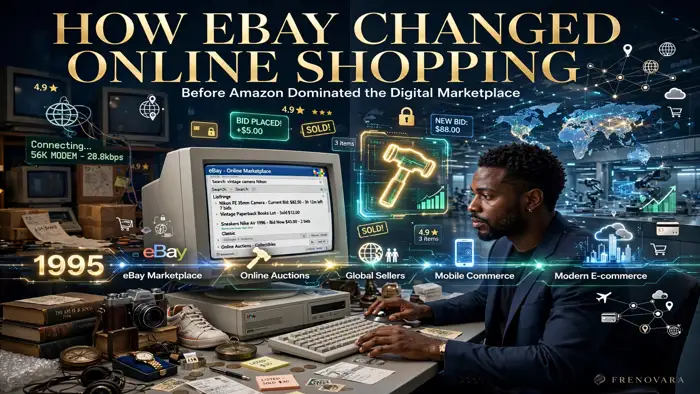

Before Amazon Dominated: How eBay Changed Online Shopping Forever
When most people think about online shopping today, Amazon is usually the first company that comes to mind.
Millions of people order products from Amazon every single day.
It has become one of the world’s largest companies and has completely transformed retail.
But before Amazon became the global e-commerce giant we know today, another company had already changed the internet forever.
That company was eBay.
Understanding How eBay Changed Online Shopping helps explain the origins of modern e-commerce and why online marketplaces became one of the most successful business models in history.
Long before mobile shopping apps, one-click checkout, and AI-powered recommendations, eBay connected millions of buyers and sellers across the world through a simple but revolutionary idea.
Instead of selling products itself, eBay created a digital marketplace where ordinary people could sell almost anything.
That single idea changed global commerce forever.
The Evolution of E-commerce: From Amazon to AI Shopping and the Future of Online Retail
What Was Online Shopping Like Before eBay?
To understand How eBay Changed Online Shopping, we first need to understand the internet during the early 1990s.
At the time:
- Few people trusted online payments.
- Internet access was limited.
- Most shopping happened in physical stores.
- Businesses rarely sold products online.
Consumers preferred visiting shopping malls because online commerce seemed risky.
The idea of purchasing from complete strangers over the internet appeared almost impossible.
Then eBay arrived. Best SEO Strategies for E-commerce Websites That Increase Traffic and Sales
The Birth of eBay
The story of eBay began in 1995.
Software engineer Pierre Omidyar created a simple website called AuctionWeb.
Initially, it was nothing more than an experiment.
Its purpose was straightforward:
Allow people to buy and sell items directly with one another.
Nobody expected the platform to become one of the world’s biggest online marketplaces.
Yet within months, users began listing:
- Collectibles
- Electronics
- Toys
- Books
- Clothing
- Antiques
The marketplace expanded rapidly through word of mouth. The Rise of Social Commerce in Africa: How Social Media Is Transforming Online Shopping
The Simple Idea That Changed Everything
The biggest reason How eBay Changed Online Shopping became such an important business story is because the company introduced an entirely different model.
Traditional retailers purchased inventory before selling it.
eBay didn’t.
Instead, it connected:
Seller → Marketplace → Buyer
This marketplace model meant eBay could scale without owning warehouses filled with products. Email Marketing for Online Stores: How to Increase Sales and Customer Loyalty
It simply provided the platform.
That innovation became one of the greatest business ideas in internet history.
Online Auctions Created Excitement
One feature made eBay completely different from other websites.
Its auction system.
Rather than displaying fixed prices, many products were sold through competitive bidding.
Buyers competed against one another until the auction ended.
This created:
- Urgency
- Competition
- Entertainment
- Better price discovery
The auction experience encouraged users to visit repeatedly.
Shopping became interactive. How to Rank Product Pages on Google: Proven SEO Strategies That Increase Sales
Trust Became the Foundation
Buying from strangers online required trust.
eBay solved this problem through one revolutionary innovation:
Seller ratings.
After every transaction:
- Buyers rated sellers.
- Sellers built reputations.
- Honest businesses gained visibility.
This feedback system dramatically reduced uncertainty.
Today, customer reviews remain one of the most important features of online shopping.
Many modern platforms adopted similar systems.
Opening Global Markets
Before eBay, selling products internationally was difficult for ordinary people.
The platform changed that.
A seller in one country could now reach buyers across the world.
This dramatically expanded market opportunities.
Small businesses suddenly gained access to international customers without opening physical stores abroad. How WooCommerce Powers Millions of Online Businesses: The WordPress E-commerce Success Story
Empowering Small Entrepreneurs
Another reason How eBay Changed Online Shopping remains important is because it empowered ordinary people.
People began creating businesses from their homes.
Many entrepreneurs started by selling:
- Vintage items
- Used electronics
- Handmade products
- Fashion accessories
- Collectibles
Some eventually built full-time businesses.
Others transformed small side hustles into successful companies.
eBay demonstrated that anyone with internet access could become an entrepreneur. How Google Pay Became a Global Digital Wallet and Changed Digital Payments Forever
Why Consumers Loved eBay
Consumers embraced eBay for several reasons.
The platform offered:
- Competitive prices
- Rare products
- International access
- Auctions
- Product variety
Many buyers discovered items unavailable in traditional stores.
This uniqueness became one of eBay’s biggest competitive advantages. Top 10 Digital Wallets in the World (2026)
Building One of the Internet’s Largest Communities
Unlike many retail websites, eBay encouraged interaction.
Buyers and sellers communicated directly.
Communities formed around:
- Collectibles
- Cars
- Electronics
- Memorabilia
- Fashion
These communities strengthened customer loyalty while encouraging repeat visits.
The Beginning of Marketplace Commerce
Today, marketplace businesses dominate digital commerce.
Examples include:
- Amazon Marketplace
- Etsy
- Facebook Marketplace
- Alibaba
- Jumia Marketplace
However, eBay helped popularize this business model long before most competitors entered the market. How Amazon Makes Billions: The Business Model Explained
Its influence continues across modern e-commerce.
How eBay Changed Online Shopping Through Its Business Model
One of the biggest reasons How eBay Changed Online Shopping became a global success story is that the company completely reimagined how online retail could work.
Unlike traditional retailers, eBay did not need to purchase products before selling them.
Instead, it created a marketplace.
Its role was to connect buyers and sellers while earning revenue from transactions taking place on its platform.
This asset-light model allowed eBay to expand rapidly without maintaining massive inventories.
How Paystack Makes Money: The Nigerian Fintech Success Story Behind Every Transaction
How eBay Makes Money
Understanding How eBay Changed Online Shopping also requires understanding how the company generates revenue.
Unlike Amazon, which earns significant income by selling products directly, eBay primarily earns money by charging sellers.
Its major revenue sources include:
Listing Fees
Certain product listings attract fees depending on category, listing volume, and promotional options.
Final Value Fees
Whenever an item sells successfully, eBay receives a percentage of the final selling price.
This remains one of its largest revenue streams. Digital Wallet vs Mobile Banking: What’s the Difference and Which One Should You Use?
Advertising Services
Sellers can pay to increase the visibility of their listings.
Promoted listings appear higher in search results, increasing the likelihood of making sales.
Store Subscriptions
Professional sellers often subscribe to premium eBay stores, which provide:
- Lower selling fees
- Advanced selling tools
- Marketing features
- Business analytics
These recurring subscriptions create predictable revenue.
PayPal Helped Accelerate eBay’s Growth
One of the most important chapters in How eBay Changed Online Shopping came through payments.
Initially, buyers and sellers struggled with payment methods.
Many relied on:
- Cheques
- Bank transfers
- Money orders
Transactions could take days or weeks.
The situation changed dramatically after eBay acquired PayPal in 2002.
PayPal made online payments:
- Faster
- Safer
- Easier
Consumers gained confidence in purchasing from strangers.
Payment convenience accelerated marketplace growth.
Creating Opportunities for Millions of Sellers
eBay did more than create an online marketplace.
It created economic opportunities.
Individuals who previously had no access to retail infrastructure suddenly gained the ability to reach global customers.
Many entrepreneurs started by selling:
- Second-hand electronics
- Sneakers
- Fashion items
- Rare collectibles
- Vintage furniture
- Trading cards
Some eventually grew into full-time businesses employing staff and serving international markets. How Shopify Powers Millions of Online Stores: The Business Model Behind the E-commerce Giant Part
Why eBay Grew So Quickly
Several factors explain How eBay Changed Online Shopping so successfully.
Network Effects
Every new seller attracted additional buyers.
Every new buyer encouraged more sellers to join.
This self-reinforcing cycle created powerful long-term growth.
Low Operating Costs
Because sellers supplied inventory themselves, eBay avoided many expenses traditional retailers faced.
It required:
- Less warehousing
- Less inventory financing
- Lower logistics costs
This efficient model improved profitability.
Global Accessibility
Anyone with internet access could become a seller.
This dramatically expanded the platform’s reach.
Trust Became eBay’s Competitive Advantage
Trust remained central to eBay’s success.
The platform introduced systems that rewarded honest behaviour.
Seller ratings.
Buyer feedback.
Verified accounts.
Transaction protection.
These innovations increased confidence while reducing fraud.
Today, nearly every major e-commerce platform uses similar reputation systems.
Competition Begins to Intensify
Although eBay dominated early online marketplace commerce, competition eventually increased.
Several companies entered the market.
The biggest competitor became Amazon.
Unlike eBay’s marketplace model, Amazon increasingly focused on:
- Owning inventory
- Faster shipping
- Warehousing
- Prime membership
- Logistics infrastructure
The different business models produced very different customer experiences.
eBay vs Amazon
The competition between Amazon and eBay shaped modern e-commerce.
eBay
- Marketplace-first
- Auctions
- Individual sellers
- Unique products
- Collectibles
Amazon
- Direct retail
- Fast delivery
- Warehouses
- Standardized shopping
- Massive inventory
While Amazon eventually became the larger company, eBay remained influential by focusing on marketplace commerce.
Innovation Continued
Despite increasing competition, eBay continued introducing improvements.
These included:
- Mobile applications
- Simplified checkout
- Better seller tools
- AI-powered recommendations
- International shipping programs
Continuous innovation helped maintain relevance within a rapidly changing digital economy.
Challenges Along the Way
Even successful companies face obstacles.
eBay encountered several challenges.
Increased Competition
Amazon changed consumer expectations regarding delivery speed.
Counterfeit Products
Marketplace businesses must constantly combat fraudulent listings.
Changing Consumer Behaviour
Consumers increasingly preferred fixed prices over auctions.
eBay adapted by supporting both pricing models.
Lessons Modern Businesses Can Learn
The story of How eBay Changed Online Shopping provides valuable lessons.
Successful businesses:
- Solve genuine problems.
- Build trust.
- Embrace technology.
- Adapt continuously.
- Focus on customer experience.
These principles remain relevant today.
eBay’s Lasting Impact on Global Commerce
More than three decades after its launch, How eBay Changed Online Shopping remains one of the most influential stories in the history of the internet.
While Amazon eventually became the world’s largest e-commerce company, eBay introduced ideas that permanently transformed online buying and selling.
Those innovations include:
- Customer ratings and reviews.
- Online marketplaces.
- Peer-to-peer commerce.
- Global seller access.
- Digital trust systems.
- Online auctions.
Today, nearly every major e-commerce platform uses some version of these concepts.
eBay didn’t simply build a website.
It changed how the world thinks about commerce.
The Rise of the Sharing Economy
Long before terms like sharing economy and circular economy became popular, eBay encouraged people to reuse and resell products.
Instead of throwing away items they no longer needed, individuals could:
- Sell electronics.
- Auction collectibles.
- Resell fashion.
- Trade antiques.
- Find rare products.
This extended product lifecycles while creating additional income opportunities.
Today, resale marketplaces have become a major global industry.
Mobile Commerce Opened New Opportunities
As smartphones became common, eBay adapted quickly.
Its mobile application allowed users to:
- Buy products.
- Track auctions.
- Receive bidding alerts.
- List products.
- Manage businesses.
The shift toward mobile shopping ensured eBay remained relevant during the smartphone revolution.
Artificial Intelligence Is Shaping eBay’s Future
Like many technology companies, eBay increasingly uses Artificial Intelligence.
AI helps improve:
- Product recommendations.
- Fraud detection.
- Search results.
- Personalized shopping.
- Seller analytics.
- Customer support.
Artificial Intelligence allows buyers to discover products more efficiently while helping sellers reach relevant customers.
Sustainability Through Resale
Another reason How eBay Changed Online Shopping continues to matter is sustainability.
Consumers increasingly prefer buying second-hand products to reduce waste.
eBay supports this movement by encouraging:
- Reuse.
- Recycling.
- Refurbishment.
- Resale.
This approach benefits both consumers and the environment.
Five Business Lessons Entrepreneurs Can Learn from eBay
The success of eBay provides valuable lessons for entrepreneurs.
1. Solve Real Problems
eBay solved a genuine problem.
People wanted a simple way to buy and sell products online.
Businesses that solve meaningful problems often create lasting value.
2. Trust Is More Valuable Than Technology
Technology alone rarely guarantees success.
Trust creates sustainable businesses.
Seller ratings became one of eBay’s greatest competitive advantages.
3. Platforms Can Scale Faster Than Traditional Businesses
Because eBay did not own inventory, it expanded much faster than traditional retailers.
Platform businesses often grow more efficiently than inventory-heavy companies.
4. Adaptation Is Essential
Consumer preferences evolve.
Technology changes.
Competition increases.
Successful companies continuously adapt.
eBay’s ability to evolve has helped it remain relevant for decades.
5. Innovation Creates Entire Industries
Few people imagined that an online auction website would transform global commerce.
Yet eBay’s innovation influenced:
- Marketplace businesses.
- Fintech.
- Digital payments.
- E-commerce logistics.
- Customer review systems.
Innovation often creates opportunities far beyond the original idea.
Frequently Asked Questions (FAQs)
What Is eBay?
eBay is an online marketplace where individuals and businesses buy and sell products directly with one another.
How Did eBay Change Online Shopping?
How eBay Changed Online Shopping can be summarized through several innovations:
- Online auctions.
- Peer-to-peer selling.
- Customer ratings.
- Global marketplaces.
- Digital trust.
These innovations transformed internet commerce.
Who Founded eBay?
eBay was founded by Pierre Omidyar in 1995.
The company began as AuctionWeb before eventually becoming eBay.
Is eBay Bigger Than Amazon?
No.
Amazon became significantly larger in terms of revenue and market value.
However, eBay pioneered several marketplace concepts that influenced modern e-commerce.
Does eBay Still Make Money?
Yes.
eBay continues generating revenue through:
- Seller fees.
- Transaction fees.
- Advertising.
- Store subscriptions.
- Marketplace services.
It remains one of the world’s largest online marketplaces.
Why eBay Still Matters Today
Although newer companies receive greater media attention, the story of How eBay Changed Online Shopping remains highly relevant.
Modern online commerce owes much of its development to ideas first popularized by eBay.
Millions of entrepreneurs have launched businesses through online marketplaces inspired by its model.
Its influence extends beyond retail into fintech, logistics, digital marketing, and global entrepreneurship.
Beyond the Headlines
The story of How eBay Changed Online Shopping is not merely about one successful internet company.
It is about the democratization of commerce.
Before eBay, global retail opportunities belonged primarily to large corporations with physical stores and extensive distribution networks.
eBay proved that ordinary individuals could become entrepreneurs using nothing more than an internet connection and a product to sell.
That simple but revolutionary idea transformed millions of lives and inspired countless online marketplaces that followed.
Today, whether consumers purchase products through Amazon, Etsy, Facebook Marketplace, Jumia, Shopify stores, or countless other digital platforms, many of the foundational principles trace back to eBay’s pioneering marketplace model.
Its legacy continues to shape global commerce and will likely influence digital entrepreneurship for decades to come.
WordPress SEO Tags
How eBay Changed Online Shopping, eBay Business Model, eBay History, eBay Marketplace, Online Shopping History, E-commerce, Amazon vs eBay, Marketplace Business Model, Digital Commerce, Online Auctions, E-commerce Innovation, Global Business, Entrepreneurship, Technology, Business Models, Digital Economy, Internet History, Online Retail, Frenovara
SEO Image Filename
how-ebay-changed-online-shopping-frenovara.webp
SEO Image Title
How eBay Changed Online Shopping
SEO Image Alt Text
Illustration showing eBay transforming online shopping through digital auctions, online marketplaces, global buyers and sellers, and e-commerce innovation before Amazon's dominance.