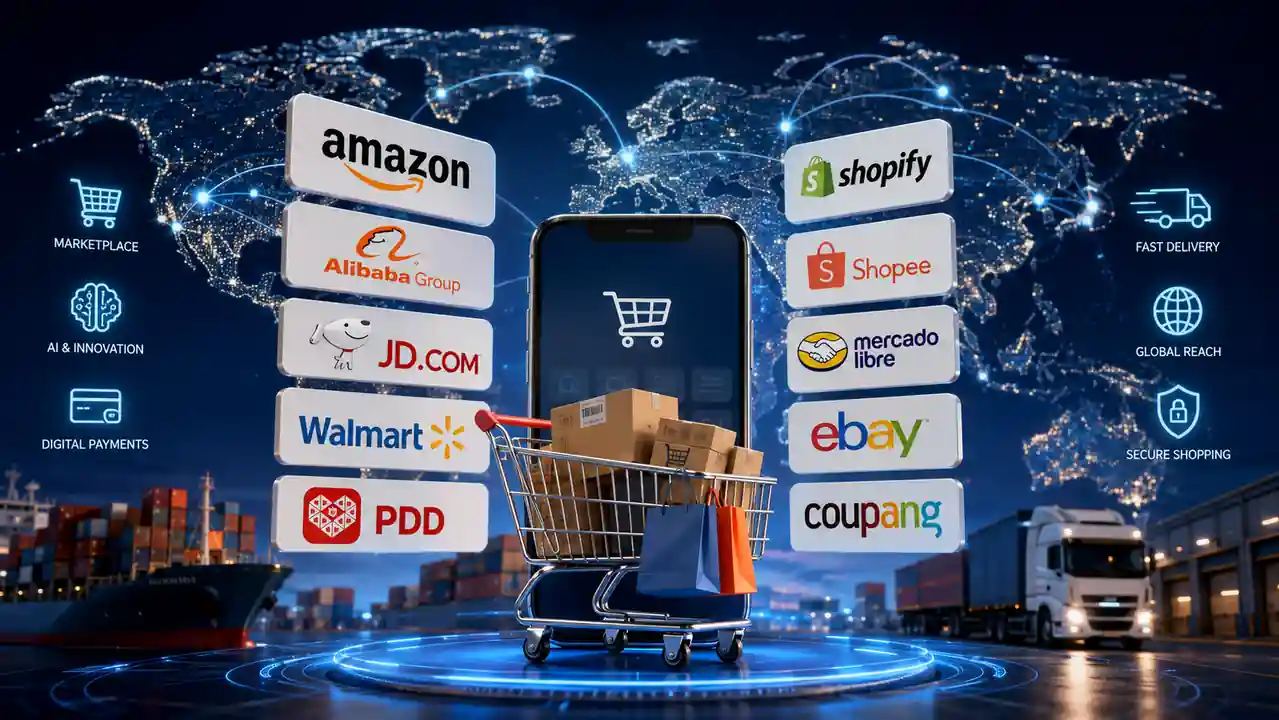
Top 20 Biggest E-commerce Companies in the World in 2026
The biggest e-commerce companies in the world in 2026 are no longer competing only on the number of products they sell. They are building digital ecosystems that combine online marketplaces, artificial intelligence, logistics, payments, cloud technology, advertising, mobile commerce, and financial services.
Amazon remains the defining global e-commerce powerhouse, but the market is far more competitive than it was a decade ago. Chinese companies such as Alibaba, JD.com and PDD Holdings have built enormous digital commerce ecosystems, while Walmart, Shopify, Mercado Libre, Coupang and Sea Limited continue to expand their influence across major markets.
This updated ranking examines the Top 20 Biggest E-commerce Companies in the World in 2026, using a combination of revenue, e-commerce scale, gross merchandise volume (GMV) where available, customer reach, marketplace influence, logistics capabilities, technology infrastructure and international presence.
Editor’s note: Because companies report e-commerce activity differently, this is not a strict ranking by revenue alone. Some companies are primarily retailers, some operate marketplaces, and others provide the technology infrastructure that powers millions of online merchants.
Top 20 Biggest E-commerce Companies in the World in 2026
| Rank | Company | Headquarters | Major E-commerce Platform |
|---|---|---|---|
| 1 | Amazon | United States | Amazon |
| 2 | Alibaba Group | China | Taobao, Tmall, Alibaba.com, AliExpress |
| 3 | JD.com | China | JD.com |
| 4 | Walmart | United States | Walmart.com, Walmart Marketplace |
| 5 | PDD Holdings | China | Pinduoduo, Temu |
| 6 | Shopify | Canada | Shopify |
| 7 | Sea Limited | Singapore | Shopee |
| 8 | Mercado Libre | Argentina | Mercado Libre |
| 9 | eBay | United States | eBay |
| 10 | Coupang | South Korea / United States | Coupang |
| 11 | Rakuten Group | Japan | Rakuten Ichiba |
| 12 | Flipkart Group | India | Flipkart |
| 13 | Etsy | United States | Etsy |
| 14 | Zalando | Germany | Zalando |
| 15 | Target | United States | Target.com |
| 16 | Wayfair | United States | Wayfair |
| 17 | Otto Group | Germany | OTTO |
| 18 | Best Buy | United States | BestBuy.com |
| 19 | Jumia | Africa | Jumia |
| 20 | Chewy | United States | Chewy |
How We Ranked The Top 20 Biggest E-commerce Companies 2026
There is no single universal metric for determining the world’s biggest e-commerce company.
Amazon, for example, reports enormous company-wide revenue that includes businesses such as AWS, while Shopify reports the GMV processed through its merchant platform. Walmart combines physical retail with rapidly expanding e-commerce operations, while marketplace companies such as eBay generate revenue primarily from transactions and services.
For this reason, Frenovara’s 2026 ranking considers several factors:
- E-commerce revenue and overall company revenue where relevant.
- Gross merchandise volume (GMV).
- Number and geographic reach of customers.
- Marketplace scale.
- Seller ecosystem.
- Logistics infrastructure.
- International presence.
- Technology and AI capabilities.
- Digital payments and financial services.
- Long-term influence on global online commerce.
The ranking is therefore designed to measure overall e-commerce influence and scale, rather than simply placing companies in order of reported annual revenue.
1. Amazon
No list of the biggest e-commerce companies in the world can begin anywhere else.
Founded by Jeff Bezos in 1994, Amazon started as an online bookstore before becoming one of the world’s most powerful technology and commerce companies.
Amazon now operates across:
- Online retail.
- Third-party marketplaces.
- Cloud computing.
- Digital advertising.
- Streaming.
- Artificial intelligence.
- Logistics.
- Smart devices.
- Digital subscriptions.
Amazon reported $716.9 billion in net sales for 2025, demonstrating the extraordinary scale of the company. Its e-commerce operation is supported by one of the world’s largest fulfillment and logistics networks.
The company’s competitive advantage comes from the combination of its enormous product selection, Prime membership ecosystem, logistics infrastructure, recommendation technology and increasingly sophisticated artificial intelligence capabilities.
Amazon is not simply an online retailer anymore.
It is an ecosystem.
How Amazon Makes Billions: The Business Model Explained
The Evolution of E-commerce: From Amazon to AI Shopping and the Future of Online Retail
2. Alibaba Group
China’s Alibaba Group is one of the most important companies in global e-commerce.
Its ecosystem includes:
- Taobao.
- Tmall.
- Alibaba.com.
- AliExpress.
- Cainiao.
- Digital commerce services.
- Cloud computing.
- Digital payments and financial technology partnerships.
Alibaba’s strength comes from connecting consumers, brands, manufacturers, wholesalers and businesses across multiple layers of commerce.
Unlike Amazon, which combines retail and marketplace operations heavily under one global consumer brand, Alibaba operates several major platforms serving different segments of the market.
Its influence extends across China and international markets, making it one of the world’s most important digital commerce groups.
Before Alibaba and Temu: How Amazon Built the World’s Largest E-commerce Empire
3. JD.com
JD.com is one of China’s largest integrated e-commerce and technology companies.
The company is particularly notable because it has invested heavily in controlling its supply chain and fulfillment infrastructure.
JD.com reported RMB1.309 trillion ($187.2 billion) in 2025 net revenue, representing 13% growth from the previous year.
Its operations include:
- Online retail.
- Logistics.
- Warehousing.
- Technology services.
- Marketplace services.
- Consumer electronics.
- General merchandise.
JD.com’s logistics network is one of its greatest competitive advantages.
Its ability to combine technology, inventory management, warehousing and delivery allows the company to compete on speed and reliability.
4. Walmart
Walmart is one of the clearest examples of a traditional retailer successfully transforming into a major digital commerce company.
Rather than abandoning its physical stores, Walmart has integrated them into its e-commerce strategy.
Its model includes:
- Walmart.com.
- Walmart Marketplace.
- Grocery delivery.
- Click-and-collect.
- Store-fulfilled delivery.
- Pickup services.
- Advertising.
- Digital payments and financial services.
Walmart reported approximately $99.6 billion in U.S. e-commerce sales and $35.8 billion in international e-commerce sales for fiscal 2026.
That gives Walmart an enormous omnichannel advantage.
Its thousands of physical stores effectively function as a distributed fulfillment network, allowing the company to bring products closer to customers.
5. PDD Holdings
One of the biggest changes to the 2026 ranking is the inclusion of PDD Holdings.
The company operates major digital commerce platforms including Pinduoduo and Temu.
PDD Holdings reported RMB431.8 billion ($61.75 billion) in revenue for 2025, up from RMB393.8 billion in 2024.
Pinduoduo became famous for its social-commerce model, encouraging consumers to participate in group-oriented purchasing.
Temu subsequently expanded the company’s international footprint.
PDD Holdings is particularly important because it demonstrates how social commerce, low-cost marketplace models, data and mobile technology can challenge established e-commerce companies.
6. Shopify
Shopify is different from most companies on this list.
It does not primarily operate as a conventional retailer.
Instead, Shopify provides the technology infrastructure that allows millions of businesses to create and operate online stores.
Its ecosystem includes:
- Online storefronts.
- Payments.
- Point-of-sale systems.
- Marketing.
- Inventory management.
- Business analytics.
- Artificial intelligence.
- Cross-border commerce.
In 2025, merchants using Shopify generated $378.4 billion in GMV, while Shopify itself recorded $11.6 billion in revenue.
That distinction is important.
Shopify’s $378.4 billion GMV does not mean Shopify earned $378.4 billion in revenue. It represents the value of orders facilitated through its platform.
Nevertheless, the figure demonstrates how deeply Shopify is embedded in global commerce.
Shopify’s Billion-Dollar Business Model: How the E-commerce Giant Makes Money
7. Sea Limited
Singapore-based Sea Limited has built one of Southeast Asia’s most important digital ecosystems.
Its businesses include:
- Shopee.
- Garena.
- SeaMoney.
Shopee is the company’s major e-commerce platform and has become one of the leading online marketplaces across Southeast Asia and other emerging markets.
Sea reported $22.9 billion in revenue for 2025, representing 36.4% year-over-year growth.
Shopee’s growth has been driven by mobile commerce, digital payments, live shopping, promotions and a highly localized marketplace strategy.
Its success demonstrates the importance of adapting e-commerce to local consumer behavior rather than simply copying Western models.
8. Mercado Libre
Mercado Libre is Latin America’s leading digital commerce ecosystem.
Often described as the “Amazon of Latin America,” the company operates across multiple markets and combines commerce with financial technology.
Its ecosystem includes:
- Online marketplace.
- Mercado Pago.
- Logistics.
- Advertising.
- Consumer finance.
- Digital payments.
Mercado Libre’s strength is not simply the size of its marketplace.
The company has built an ecosystem where commerce, payments and logistics reinforce one another.
That model has helped it become one of the world’s most influential e-commerce businesses outside the United States, China and Europe.
9. eBay
Long before social commerce and mobile shopping became mainstream, eBay helped establish the modern online marketplace.
Founded in 1995, eBay pioneered:
- Online auctions.
- Peer-to-peer selling.
- Seller ratings.
- Digital marketplaces.
- Cross-border online commerce.
eBay reported $11.1 billion in 2025 revenue, while its marketplace generated approximately $79.6 billion in GMV. The company also reported around 135 million active buyers.
Unlike Amazon, eBay does not attempt to own the entire retail experience.
Its marketplace model allows millions of sellers to connect with buyers around the world.
That asset-light structure remains one of the company’s defining strengths.
Before Amazon Dominated: How eBay Changed Online Shopping
10. Coupang
Coupang has transformed online retail in South Korea through an extraordinary focus on logistics and delivery speed.
The company is known for services built around:
- Rapid delivery.
- Grocery delivery.
- Fulfillment.
- Mobile commerce.
- Logistics.
- AI-powered operations.
Coupang generated $34.5 billion in revenue in 2025, an increase of 14% from the previous year.
Its logistics infrastructure is central to the customer experience.
Coupang has also increasingly positioned itself as a global commerce technology company, using AI and its fulfillment network to expand beyond its traditional Korean market.
11. Rakuten Group
Rakuten is one of Japan’s most diversified digital commerce ecosystems.
Its businesses extend beyond shopping into:
- Banking.
- Payments.
- Mobile services.
- Travel.
- Digital content.
- Financial services.
- Advertising.
Rakuten’s domestic e-commerce gross merchandise sales exceeded ¥6.3 trillion in fiscal 2025, according to the company.
The company’s broader ecosystem strategy is one of its greatest advantages.
Instead of treating e-commerce as an isolated business, Rakuten connects shopping activity with financial services, loyalty programs and digital products.
12. Flipkart Group
Flipkart is one of India’s most important e-commerce companies.
The company began as an online bookstore before expanding into:
- Electronics.
- Fashion.
- Home appliances.
- Beauty.
- Grocery.
- Digital services.
India’s enormous and increasingly digital consumer market gives Flipkart significant long-term growth potential.
Its competition with Amazon India has also helped accelerate the development of India’s online retail ecosystem.
Flipkart’s strong local market knowledge and extensive logistics network remain important competitive advantages.
13. Etsy
Etsy has built a highly differentiated position by focusing on products that are difficult to replicate on mass-market marketplaces.
Its platform specializes in:
- Handmade products.
- Vintage goods.
- Personalized products.
- Art.
- Crafts.
- Creative products.
- Gifts.
Etsy demonstrates that e-commerce success does not always require selling everything.
A highly focused marketplace can build significant global influence by connecting a specific community of buyers and sellers.
14. Zalando
Zalando is one of Europe’s most prominent online fashion platforms.
The company focuses on:
- Fashion.
- Footwear.
- Beauty.
- Sportswear.
- Lifestyle products.
Its European footprint gives brands access to millions of consumers across multiple countries.
Zalando’s competitive advantage comes from combining a broad assortment with technology, logistics, personalization and a strong understanding of European consumers.
15. Target
Target is another example of a traditional retailer that successfully integrated physical stores with digital commerce.
Its e-commerce strategy includes:
- Online ordering.
- Same-day delivery.
- Drive-up pickup.
- Buy online, pick up in store.
- Mobile shopping.
- Marketplace services.
The company does not need to choose between physical and digital retail.
Its stores are part of its digital fulfillment infrastructure.
This omnichannel strategy demonstrates an important lesson for modern retailers: physical stores can become an advantage in e-commerce when they are properly integrated with technology.
16. Wayfair
Wayfair built its business around one of the largest online selections of home-related products.
Its marketplace covers:
- Furniture.
- Home décor.
- Lighting.
- Kitchen products.
- Outdoor products.
- Home improvement.
Unlike Amazon, Wayfair has developed deep specialization in the home category.
Its model demonstrates how an e-commerce company can compete successfully by becoming an expert in a particular product category.
17. Otto Group
Germany’s Otto Group is one of Europe’s major digital commerce groups.
Its operations span:
- Fashion.
- Furniture.
- Consumer electronics.
- E-commerce.
- Logistics.
- Financial services.
Otto has spent decades adapting from traditional mail-order retail into digital commerce.
Its transformation demonstrates that established retail companies can remain competitive by continually changing their technology and business models.
18. Best Buy
Best Buy remains one of North America’s best-known electronics retailers while continuing to operate a substantial online business.
Its major categories include:
- Computers.
- Smartphones.
- Gaming.
- Appliances.
- Home theater.
- Smart-home technology.
Best Buy’s competitive advantage comes from combining online shopping with physical stores and professional services.
Consumers can research products online and then access installation, technical support and in-store services.
19. Jumia
Jumia remains one of Africa’s most recognizable e-commerce companies.
The company operates across several African markets and provides access to:
- Electronics.
- Fashion.
- Household products.
- Beauty.
- Grocery and other consumer goods.
- Marketplace services.
- Logistics.
Jumia’s 2025 filings show operations across nine African countries, giving it substantial reach across the continent’s digital consumer market.
Africa remains one of the world’s most promising long-term e-commerce markets because of its growing internet population, expanding smartphone adoption and rapidly developing digital-payment infrastructure.
Jumia’s journey also illustrates the operational challenges involved in building large-scale e-commerce networks across markets with different logistics, payment and infrastructure conditions.
20. Chewy
Chewy completes the list with a powerful example of niche e-commerce.
Rather than competing directly with Amazon across every category, Chewy focuses on the pet market.
Its products include:
- Pet food.
- Veterinary products.
- Pet medication.
- Toys.
- Accessories.
- Subscription deliveries.
The company’s specialization allows it to build strong customer relationships and recurring purchasing behavior.
Chewy demonstrates that a focused e-commerce business can become highly influential without attempting to become a general marketplace.
What the Top 20 Biggest E-commerce Companies In 2026 Have in Common
Despite their different business models, the world’s biggest e-commerce companies share several characteristics.
1. They Invest Heavily in Technology
Technology is no longer simply a support function for e-commerce.
It is the business.
Leading companies use technology for:
- Search.
- Recommendations.
- Fraud detection.
- Pricing.
- Inventory forecasting.
- Customer service.
- Advertising.
- Logistics.
- Payments.
2. Artificial Intelligence Is Becoming a Core Competitive Advantage
AI is changing how consumers discover products and how companies operate their businesses.
E-commerce companies are increasingly using AI for:
- Personalized recommendations.
- Conversational shopping.
- Product search.
- Demand forecasting.
- Fraud prevention.
- Customer support.
- Advertising.
- Inventory management.
- Delivery optimization.
The next generation of online retail will increasingly be shaped by companies capable of turning enormous amounts of consumer and transaction data into better decisions.
3. Logistics Can Be as Important as the Marketplace
Amazon, JD.com, Walmart and Coupang demonstrate a crucial principle:
Customers do not only want to find products. They want those products delivered quickly and reliably.
That makes warehouses, fulfillment centers, transportation networks and last-mile delivery increasingly important competitive assets.
4. Payments Are Becoming Part of E-commerce
Companies such as Alibaba, Mercado Libre and Rakuten demonstrate the growing relationship between commerce and financial technology.
When a company controls more parts of the transaction—from discovery to payment to delivery—it can create a stronger customer ecosystem.
5. Mobile Commerce Is Central to Growth
Smartphones have changed how consumers shop.
Modern consumers increasingly expect:
- Mobile-first websites.
- Fast applications.
- Digital wallets.
- One-click payments.
- Personalized recommendations.
- Social shopping.
- Real-time delivery tracking.
For companies operating in emerging markets, mobile commerce can be particularly important because smartphones may represent the primary gateway to the internet.
Marketplace vs. Retail E-commerce Models
The companies on this list do not all make money in the same way.
Marketplace Model
Companies such as eBay, Etsy and many Alibaba platforms connect independent sellers with buyers.
Advantages include:
- Large product selection.
- Lower inventory requirements.
- Seller-driven expansion.
- Greater scalability.
Retail Model
Companies such as Amazon, Walmart and JD.com also sell products directly to consumers and may control significant portions of inventory and fulfillment.
Advantages include:
- Greater control over quality.
- Better fulfillment.
- More consistent customer experience.
- Stronger control over pricing and inventory.
Commerce Infrastructure Model
Shopify represents another category.
Rather than operating one giant marketplace, Shopify provides the infrastructure businesses use to build their own digital stores.
This model allows Shopify to participate in enormous amounts of global commerce without owning the majority of the products being sold.
How AI Could Change the E-commerce Rankings
The next major shift in e-commerce may not come from simply building a larger online store.
It could come from AI-powered commerce.
Imagine a consumer saying:
“Find me the best laptop under $1,000 for video editing.”
Instead of manually searching through hundreds of products, an AI shopping assistant could compare products, evaluate reviews, check availability, compare prices and recommend the best option.
This could fundamentally change the relationship between consumers, search engines, marketplaces and retailers.
Companies that control product data, customer relationships, payment systems and fulfillment networks could have a significant advantage.
The Rise of Social Commerce
The boundary between entertainment and shopping is also disappearing.
Consumers increasingly discover products through:
- TikTok.
- Instagram.
- YouTube.
- Facebook.
- Livestreams.
- Influencers.
- Creator communities.
Social commerce is particularly powerful because discovery and purchasing can happen within the same digital environment.
This creates opportunities for both the world’s largest marketplaces and smaller businesses.
The Rise of Social Commerce in Africa: How Social Media Is Transforming Online Shopping
The Future of Global E-commerce
The next phase of e-commerce is likely to be defined by several major trends.
Artificial Intelligence
AI will increasingly influence search, recommendations, customer service, advertising and logistics.
Social Commerce
Consumers will increasingly discover and purchase products through social platforms and creators.
Cross-Border Commerce
Technology will make it easier for consumers to purchase products from businesses located in other countries.
Digital Payments
Digital wallets, instant payments and embedded financial services will continue reducing friction at checkout.
Faster Fulfillment
Consumers will continue demanding faster and more predictable delivery.
Personalized Shopping
The shopping experience will increasingly adapt to individual consumers rather than presenting everyone with the same products.
Sustainable E-commerce
Packaging, delivery emissions, product recycling and second-hand commerce will increasingly influence purchasing decisions.
Frequently Asked Questions
Which is the biggest e-commerce company in the world in 2026?
Amazon remains the world’s largest overall e-commerce company by a combination of revenue, marketplace scale, customer reach, logistics infrastructure and global influence.
Amazon reported $716.9 billion in net sales for 2025.
Which country has the biggest e-commerce companies?
The United States and China dominate the global e-commerce landscape.
The United States is home to Amazon, Walmart, eBay, Shopify’s major market and several other global commerce companies, while China is home to Alibaba, JD.com and PDD Holdings.
Is Shopify an e-commerce company?
Yes, but Shopify operates differently from Amazon or Walmart.
Shopify provides commerce infrastructure that allows merchants to build and operate online stores. In 2025, its platform facilitated $378.4 billion in GMV.
Which is the biggest e-commerce company in China?
China has several enormous e-commerce companies, including Alibaba Group, JD.com and PDD Holdings.
Their business models differ, so determining a single “largest” company depends on whether the measurement is revenue, GMV, users, market capitalization or another metric.
Which is Africa’s biggest e-commerce company?
Jumia is one of Africa’s most prominent publicly traded e-commerce companies and has built a substantial multi-country marketplace and logistics operation.
However, Africa’s e-commerce market is highly fragmented, with numerous local and regional businesses also serving consumers.
Will AI replace traditional e-commerce?
AI is more likely to transform e-commerce than eliminate it.
AI can make product discovery, comparison, personalization and customer service much more efficient.
The companies that adapt quickly may gain a major competitive advantage.
Why the Biggest E-commerce Companies Continue to Grow
The world’s biggest e-commerce companies have survived because they understand that online retail is constantly changing.
Amazon transformed online retail.
Alibaba built an ecosystem around digital marketplaces.
JD.com demonstrated the power of integrated logistics.
Walmart connected physical stores with digital commerce.
PDD Holdings showed how social commerce can scale.
Shopify empowered millions of independent merchants.
Sea built a mobile-first marketplace across Southeast Asia.
Mercado Libre connected commerce with financial technology across Latin America.
And companies such as Coupang, Rakuten, Etsy, Zalando and Jumia have demonstrated the power of regional specialization.
The next generation of e-commerce leaders may come from companies that are not currently among the world’s biggest.
Artificial intelligence, social commerce, digital payments, cross-border marketplaces and autonomous logistics could completely reshape the competitive landscape.
For consumers, that means shopping will become increasingly personalized, faster and more integrated into everyday digital life.
For entrepreneurs, the lesson is even more important:
The future of e-commerce will belong to companies that understand technology, customers, data, logistics and trust—and know how to combine all five into a seamless experience.
The biggest e-commerce companies of 2026 are not simply selling products online.
They are building the infrastructure for how the world will shop in the future.