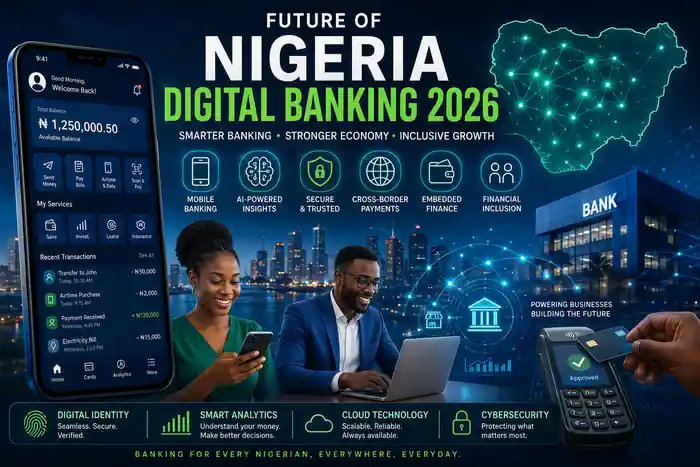
Nigeria Digital Banking 2026: How Technology Is Changing the Way Nigerians Manage Money — Part 1
FRENOVARA
Beyond The Headlines
Nigeria digital banking 2026 is no longer simply about replacing a visit to the bank with a mobile application.
It is changing how Nigerians interact with money.
A customer can now transfer funds without visiting a branch.
A business can receive payments electronically.
A consumer can monitor an account from a smartphone.
A merchant can accept digital payments using a POS terminal.
A freelancer can receive money from clients through digital channels.
A small business can manage several financial activities from a mobile device.
These changes may appear ordinary today.
However, they represent a major transformation in the structure of Nigerian banking.
For decades, the traditional bank branch was one of the most important points of contact between financial institutions and customers.
Today, the smartphone is increasingly becoming that point of contact.
That shift has created a new competitive environment.
Banks are competing with fintech companies.
Fintech companies are increasingly expanding into regulated financial services.
Payment companies are moving closer to banking.
And customers are becoming more comfortable managing financial activities digitally.
Nigeria’s Central Bank has recognised this transformation as part of a wider evolution of the country’s financial system. Its fintech report describes Nigeria as one of Africa’s most vibrant digital-finance ecosystems, while its Payments System Vision 2028 sets out a longer-term ambition for a secure, inclusive, innovative and interoperable payments system.
The question now is not whether Nigerian banking will become more digital.
It is how far that transformation will go.
Look at some of the articles we’ve published on Frenovara:
- How Stripe Became One of the World’s Most Valuable Fintech Companies
- The Future of Cashless Payments: Are Digital Wallets Replacing Cash?
- Why Kuda Bank Is Winning Millions of Customers: The Digital Banking Revolution in Nigeria
- How Google Pay Became a Global Digital Wallet and Changed Digital Payments Forever
- The Untold Story of Kuda Bank: How Nigeria’s Digital Bank Is Challenging Traditional Banks
- How Fintech Is Powering Online Shopping: The Technology Behind Faster, Safer, and Smarter E-commerce
From Bank Branches to Smartphones
The traditional banking model was built around physical infrastructure.
Customers visited branches to open accounts.
They visited branches to withdraw money.
They visited branches to resolve problems.
They visited branches to request financial products.
The model worked, but it had limitations.
Nigeria is geographically large.
Millions of people live far from traditional banking infrastructure.
Long queues, transportation costs and limited branch availability could make routine financial activities inconvenient.
Digital banking introduced another possibility.
Instead of taking the customer to the bank, technology could bring banking services to the customer.
The smartphone became particularly important because it combines connectivity, authentication, communication and financial applications in one device.
This has changed customer expectations.
People increasingly expect financial services to be:
- Fast
- Accessible
- Convenient
- Available beyond traditional banking hours
- Easy to understand
- Mobile-friendly
Banks and fintech companies have had to respond to these expectations.
What Digital Banking Actually Means
Digital banking is sometimes confused with mobile banking.
The two concepts overlap, but they are not exactly the same.
Mobile banking generally refers to using a smartphone or mobile device to access banking services.
Digital banking is broader.
It involves using technology across the entire banking experience.
That can include:
- Digital account opening
- Mobile banking applications
- Internet banking
- Electronic transfers
- Digital payments
- Automated customer service
- Digital lending
- Digital savings
- Online financial management
- Electronic statements
- Digital identity verification
- Automated fraud monitoring
The difference matters because digital banking is not simply about creating an application.
It is about redesigning financial services around digital processes.
A bank that still depends heavily on manual processes but has a mobile application is only partially digital.
A truly digital institution attempts to make the underlying operation more automated.
Why Nigerian Consumers Are Embracing Digital Banking
Several factors have contributed to the growth of digital finance in Nigeria.
The first is convenience.
Customers can perform many transactions without travelling to a branch.
The second is accessibility.
A smartphone can provide access to financial services from almost anywhere with connectivity.
The third is speed.
Digital transactions can often be completed in seconds or minutes.
The fourth is the growth of fintech.
Fintech companies have introduced consumers to financial applications designed around simplicity and speed.
That competition has also pressured traditional banks to improve their digital experiences.
Finally, changing consumer behaviour has played an important role.
Younger Nigerians in particular are increasingly comfortable conducting everyday activities through smartphones.
Banking is becoming part of that behaviour.
Fintech Changed Customer Expectations
The rise of Nigerian fintech companies has had an important effect on traditional banking.
Fintech platforms entered the market by solving specific problems.
Some focused on payments.
Others focused on transfers.
Some built merchant networks.
Others developed online payment infrastructure.
Their products often emphasised simple interfaces and rapid transactions.
That created a new standard for financial technology.
Customers began asking a different question.
Instead of:
“Can my bank provide this service?”
they increasingly asked:
“Which financial platform provides this service most conveniently?”
That change is significant.
The customer’s relationship is no longer automatically tied to one bank.
A person can maintain a traditional bank account while also using several fintech applications.
They may use one platform for transfers, another for payments and another for savings or investment.
Consequently, Nigerian banking is becoming more competitive.
Banks Are Responding to the Fintech Challenge
Traditional banks still have enormous advantages.
They have established customer relationships.
They have large deposits.
They have regulatory experience.
They have extensive infrastructure.
They also possess significant financial data and institutional knowledge.
However, fintech companies have challenged banks in areas such as speed, user experience and product experimentation.
The response has been increased investment in digital banking.
Banks are developing more sophisticated mobile applications.
They are expanding digital account services.
They are improving payment infrastructure.
They are introducing more automated customer-service systems.
They are also exploring partnerships with technology companies.
The result is a convergence between banking and fintech.
The two sectors increasingly compete in some areas while collaborating in others.
The Rise of the Digital Bank Customer
The typical banking customer is changing.
A customer may rarely enter a branch.
Instead, the relationship with the bank may happen through a phone.
The customer checks their balance through an application.
They transfer money digitally.
They receive notifications electronically.
They pay bills through digital channels.
They communicate with customer support online.
This means the quality of a bank’s digital experience can increasingly influence customer satisfaction.
A bank with excellent physical branches but a frustrating mobile application can struggle to maintain customer loyalty.
The reverse is also becoming true.
A strong digital experience can make financial services feel more accessible.
Digital Banking Is Changing Small Businesses Too
Consumers are not the only beneficiaries of digital banking.
Small businesses are becoming an increasingly important part of the transformation.
Consider a small retailer.
In the past, the business might have relied heavily on cash.
Today, customers may pay through transfers, cards or POS terminals.
The business can receive money electronically.
It can monitor transactions.
It can maintain a business account.
It can use digital tools to manage payments.
This creates a more connected financial environment.
For entrepreneurs, digital banking can reduce some of the friction associated with managing money.
However, the bigger opportunity goes beyond payments.
Businesses increasingly need access to financial products that are connected to their daily operations.
That is where the next stage of digital banking becomes particularly interesting.
Banking Is Moving Beyond Payments
Payments were one of the earliest drivers of digital-finance adoption.
But payments are only one part of banking.
A customer also needs to save.
A business needs working capital.
A family may need insurance.
An entrepreneur may need credit.
An investor may need access to investment products.
This creates an opportunity for digital platforms to become broader financial ecosystems.
Instead of offering one isolated service, a platform can connect several services together.
For example:
Payments → Savings → Credit → Investments
For businesses:
Payments – Banking – Credit – Business Management
The more financial needs that can be addressed within a trusted digital environment, the deeper the relationship between the customer and the platform becomes.
The Smartphone Is Becoming a Financial Dashboard
One of the most important changes is the consolidation of financial information.
A smartphone can potentially become a personal financial dashboard.
Instead of relying on paper statements, customers can view transactions digitally.
Instead of visiting a branch, they can initiate transfers.
Instead of waiting for certain services to become available during business hours, they can access digital channels at different times.
This does not eliminate the need for human banking support.
Complex problems still require human intervention.
However, technology can reduce the number of routine activities that require physical interaction.
That allows banks to focus more resources on specialised services and customer support.
Artificial Intelligence Will Take Digital Banking Further
Artificial intelligence could become one of the biggest developments in Nigerian digital banking.
Today, AI can already support tasks such as automated customer-service responses, fraud analysis and data processing.
Its future role could be much broader.
AI could help customers understand spending patterns.
It could identify unusual account behaviour.
It could assist with financial planning.
It could help businesses analyse cash flow.
It could automate repetitive back-office processes.
It could also support employees by helping them find information faster.
The important point is that AI does not necessarily have to appear as a chatbot.
Some of the most valuable AI applications may operate quietly in the background.
A fraud-detection system, for example, can use intelligent analysis without the customer ever seeing the underlying technology.
Security Is Becoming More Important
Digital banking creates convenience.
It also creates new risks.
As more money moves through digital channels, fraudsters have more opportunities to target customers and institutions.
That makes cybersecurity a central part of digital banking.
The CBN introduced new instant-payment guidance in 2026 requiring stronger controls around fraud monitoring, identity verification and mobile-banking device activation. The rules include measures such as real-time enterprise fraud monitoring, stronger online identity verification and temporary transaction limits when mobile banking is activated on a new device.
These measures demonstrate an important shift.
Digital banking is no longer being judged only by how quickly it processes transactions.
It is also being judged by how safely it processes them.
Trust Could Become the Biggest Competitive Advantage
Financial services are built on trust.
Customers need confidence that their money will arrive.
They need confidence that their accounts are secure.
They need confidence that financial institutions will respond when something goes wrong.
This becomes even more important as banking becomes more digital.
A customer may never meet the people operating the technology behind a transaction.
The system itself must therefore create confidence.
For banks and fintech companies, reliability is becoming part of the product.
An application that is fast but frequently unavailable can frustrate customers.
A platform with attractive features but weak security can lose trust.
A digital bank therefore needs to combine convenience with reliability.
Digital Identity Will Shape the Next Stage
Opening a bank account traditionally involved paperwork and physical verification.
Digital banking is changing that process.
Customers can increasingly complete parts of onboarding remotely.
Identity infrastructure makes this possible.
In Nigeria, systems such as BVN play an important role in linking customers to the formal financial system.
The CBN also amended its BVN framework in 2026, including measures concerning suspicious BVNs, enrolment and access to BVN information.
As digital banking expands, identity will become even more important.
The financial system needs to answer a basic question:
Who is actually controlling this account?
Strong identity systems can make digital finance safer.
They can also help expand access to financial services.
Financial Inclusion Remains a Major Opportunity
Digital banking should not only make existing customers more convenient.
It should also bring more people into the formal financial system.
Nigeria still has significant financial-inclusion challenges.
Rural communities may have fewer traditional banking facilities.
Some consumers may have limited financial literacy.
Others may have inconsistent access to connectivity.
The CBN’s financial-inclusion strategy specifically identifies groups including women, young people, rural communities and MSMEs as priority segments, while highlighting digital financial services and agent networks as important channels.
This creates a major opportunity.
Digital banking can potentially reach people who traditional branch-based banking struggled to serve efficiently.
However, technology must be designed around their realities.
Digital Banking Will Not Completely Eliminate Physical Banking
It would be a mistake to assume that branches will disappear entirely.
Some financial activities require human interaction.
Customers dealing with complex financial issues may want to speak with someone.
Businesses seeking sophisticated financial services may require relationship managers.
Older customers may prefer physical support.
Rural communities may still depend on agents.
Therefore, the future is more likely to be hybrid.
Digital channels will handle more routine activities.
Physical channels will focus increasingly on complex needs, relationship management and specialised services.
The strongest banks may be those that connect both experiences seamlessly.
The Competitive Battlefield Is Expanding
Nigeria’s digital-banking competition is becoming more complex.
Banks compete with banks.
Banks compete with fintech companies.
Fintech companies increasingly move into regulated financial services.
Payment companies develop broader financial products.
Digital platforms can embed financial services into commerce.
The CBN’s current list of licensed payment providers illustrates how diverse the ecosystem has become, including mobile-money operators, switching and processing companies, payment solution providers and other specialised providers.
This means consumers have more choices.
It also means financial companies must work harder to retain customers.
What Nigeria Digital Banking 2026 Means for the Average Customer
For the average Nigerian, the transformation is likely to be felt in small everyday moments.
Opening an account may become easier.
Transfers may become faster.
Fraud monitoring may become more sophisticated.
Financial applications may become more personalised.
Customer service may become increasingly automated.
Businesses may gain access to more digital financial tools.
Cross-platform payments may become more seamless.
The biggest change, however, may be psychological.
People may increasingly stop thinking of banking as something they visit.
They may begin thinking of banking as something that is always available through technology.
That is a fundamental change in consumer behaviour.
The Beginning of a Larger Transformation
Nigeria’s digital-banking transformation is still developing.
Payments created the foundation.
Fintech expanded consumer choice.
Smartphones made financial services more accessible.
Merchant networks connected digital finance to physical commerce.
Now, banking is moving toward deeper integration.
AI can make financial services more intelligent.
Digital identity can make them more secure.
Interoperability can connect different platforms.
Embedded finance can put banking inside everyday applications.
Cross-border infrastructure can connect Nigerian businesses to wider African markets.
The result could be a financial system that is less dependent on physical infrastructure and more connected to the digital economy.
Conclusion: Nigeria’s Banking Future Is Becoming Digital
Nigeria digital banking 2026 represents more than a change in how customers access their accounts.
It represents a change in the relationship between Nigerians and financial institutions.
The bank branch is no longer the only centre of the banking experience.
The smartphone has become one of the most important financial interfaces.
Fintech companies have accelerated the transition by introducing new products, simpler experiences and alternative ways to move and manage money.
Traditional banks, meanwhile, are responding with stronger digital services and greater investment in technology.
The next phase could be even more significant.
AI could make banking more intelligent.
Digital identity could strengthen security.
Embedded finance could place banking inside other digital experiences.
Better interoperability could connect different financial platforms.
And stronger digital infrastructure could help bring financial services to more underserved Nigerians.
The CBN’s Payments System Vision 2028 reflects this broader direction, with a stated focus on interoperability, security, inclusion, innovation, trust and collaboration.
Yet technology alone will not determine the winners.
The financial institutions that succeed will need to combine innovation with reliability.
They will need to protect customers.
They will need to comply with regulation.
They will need to understand the needs of consumers and businesses.
Most importantly, they will need to earn trust.
Because in the future of Nigerian banking, the most valuable financial relationship may not be the one with the biggest branch network.
It may be the one that provides the simplest, safest and most useful financial experience wherever the customer happens to be.
FRENOVARA — Beyond The Headlines