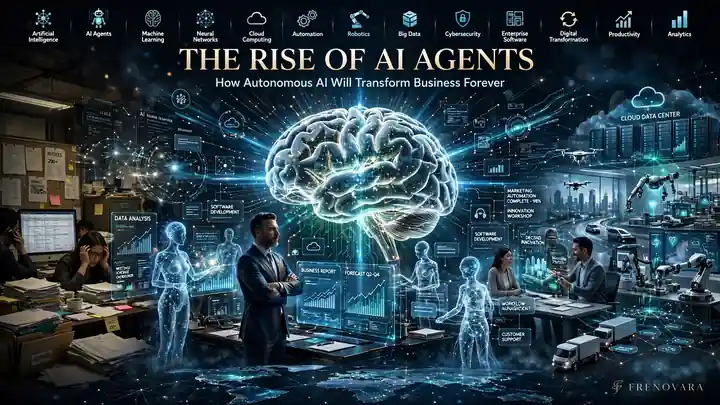
The Rise of AI Agents: How Autonomous AI Will Transform Business marks the beginning of what many technology experts believe will be the next great revolution in artificial intelligence. While chatbots like ChatGPT and Claude introduced millions of people to conversational AI, AI agents are taking the technology a step further by performing complex tasks with minimal human supervision.
Instead of simply answering questions, AI agents can plan, reason, make decisions, interact with software, and complete multi-step workflows independently. From customer service and financial analysis to software engineering and healthcare, autonomous AI is expected to redefine how organizations operate.
Businesses that understand this shift early will likely gain a significant competitive advantage in the coming years.
What Are AI Agents?
AI agents are intelligent software systems capable of carrying out tasks autonomously.
Unlike traditional AI assistants that wait for instructions before responding, AI agents can:
- Plan multiple steps
- Make decisions
- Learn from feedback
- Interact with digital tools
- Complete assigned objectives
- Adapt to changing environments
In simple terms, AI agents behave more like digital employees than digital assistants.
AI Assistants vs AI Agents
Many people confuse AI assistants with AI agents.
There are important differences.
AI Assistants
Examples include:
- ChatGPT
- Claude
- Gemini
These systems primarily respond to prompts and generate information.
AI Agents
AI agents go beyond conversation.
They can:
- Analyze information
- Execute tasks
- Coordinate workflows
- Use software tools
- Solve problems with limited supervision
The difference is similar to hiring someone who answers questions versus hiring someone who actually completes the work.
Why AI Agents Matter
Businesses are constantly searching for ways to improve efficiency while reducing operational costs.
AI agents offer the potential to automate repetitive knowledge work that previously required human employees.
Examples include:
- Managing emails
- Scheduling meetings
- Preparing reports
- Monitoring inventory
- Conducting research
- Customer support
- Data analysis
Rather than replacing every employee, AI agents are more likely to augment human productivity by handling routine tasks.
The Technology Behind AI Agents
Modern AI agents combine several technologies.
These include:
- Large Language Models (LLMs)
- Machine Learning
- Natural Language Processing
- Memory systems
- Planning algorithms
- Software integrations
- APIs
- Cloud computing
Together, these technologies allow AI agents to understand objectives, develop action plans, execute tasks, and refine future performance.
AI Agents Are Already Being Used
Although many people believe AI agents are futuristic, businesses have already begun deploying them.
Organizations now use autonomous AI for:
Customer Service
Responding to customer inquiries around the clock.
Software Development
Generating, reviewing, and debugging code.
Finance
Analyzing transactions, detecting fraud, and preparing reports.
Marketing
Planning campaigns, creating content, and analyzing customer behavior.
Healthcare
Supporting clinical documentation and medical research.
This adoption is expected to accelerate significantly over the next decade.
Related Read
Continue exploring the artificial intelligence revolution on Frenovara:
- The Future of Cashless Payments: Are Digital Wallets Replacing Cash?
- How Artificial Intelligence Is Revolutionizing Football: From Scouting to VAR
- How Africa’s Drone Industry Is Creating the Next Billion-Dollar Economy
- How African SMEs Are Using AI to Compete with Global Businesses
- How Artificial Intelligence Is Transforming Healthcare in Africa and Saving Millions of Lives
Businesses Are Entering the AI Agent Era
For decades, companies automated physical tasks through machinery.
Today, they are beginning to automate knowledge work.
Instead of manually reviewing thousands of documents or answering repetitive emails, AI agents can perform these activities within seconds.
This allows employees to focus on:
- Strategy
- Creativity
- Innovation
- Relationship building
- Decision-making
Businesses that successfully integrate AI agents may achieve higher productivity without proportionally increasing operating costs.
AI Agents Can Work Together
One of the most exciting developments is the emergence of multi-agent systems.
Rather than relying on one AI model, organizations can deploy specialized agents.
For example:
- Research Agent
- Writing Agent
- Coding Agent
- Financial Analysis Agent
- Customer Support Agent
Each agent performs a specific role while collaborating with others.
This resembles how departments work inside successful organizations.
Challenges Ahead
Despite their enormous potential, AI agents still face several challenges.
These include:
- Hallucinations
- Security concerns
- Privacy issues
- Regulatory compliance
- Ethical decision-making
- Accuracy verification
Businesses must therefore implement appropriate governance before deploying autonomous AI at scale.
Related Read
AI is transforming industries beyond technology.
Explore more Frenovara articles:
- How African Startups Are Attracting Billions in Global Investment
- Digital Wallets for Businesses: Why Merchants Are Adopting Them
- The Creator Economy in Africa: How Young Africans Are Building Million-Dollar Brands Online
- Kuda Bank Business Model Explained
- How Mobile Money Is Powering African E-commerce (2026)
- How 5G Will Transform African Businesses: The Next Digital Revolution
The Business Model Behind AI Agents
AI agents are quickly becoming one of the most profitable segments of the artificial intelligence industry.
Unlike traditional software, AI agents can continuously perform tasks, learn from interactions, and improve over time. This makes them highly valuable to businesses seeking greater efficiency.
Companies developing AI agents typically generate revenue through:
- Subscription-based platforms
- Enterprise software licenses
- API access for developers
- AI agent marketplaces
- Industry-specific AI solutions
- Custom enterprise deployments
This recurring revenue model is attracting billions of dollars in investment from venture capital firms and major technology companies.
Why Businesses Are Investing in AI Agents
Organizations are under constant pressure to increase productivity while reducing operational costs.
AI agents offer a solution by automating repetitive digital work that consumes employee time.
Instead of hiring additional staff for routine tasks, businesses can deploy AI agents to:
- Handle customer inquiries
- Schedule meetings
- Generate reports
- Analyze business data
- Manage inventory
- Monitor compliance
- Draft emails
- Conduct market research
The result is faster execution, improved consistency, and lower operating expenses.
Industries That Will Be Transformed First
Virtually every industry stands to benefit from AI agents, but some sectors are likely to experience faster adoption.
Financial Services
Banks and fintech companies are using AI agents to:
- Detect fraud
- Review transactions
- Analyze credit risk
- Assist customers
- Generate compliance reports
As digital finance continues expanding, AI agents will become indispensable.
Healthcare
Hospitals and healthcare providers are deploying AI agents for:
- Clinical documentation
- Appointment scheduling
- Medical research
- Patient communication
- Administrative workflows
Rather than replacing doctors, AI agents allow medical professionals to spend more time with patients.
Software Development
Programming teams increasingly rely on AI agents to:
- Write code
- Debug applications
- Review software
- Generate documentation
- Test systems
This significantly accelerates software development cycles.
Marketing
Marketing departments now use AI agents to:
- Plan campaigns
- Analyze customer behavior
- Generate content
- Monitor competitors
- Optimize advertising
Businesses can therefore make faster, data-driven marketing decisions.
Related Read
Explore how artificial intelligence is reshaping global business:
- The Untold Story of OpenAI: How ChatGPT Changed Artificial Intelligence
- The Untold Story of Anthropic: How Claude Is Competing with ChatGPT
- How NVIDIA Became the World’s Most Valuable AI Company
- How Canva Became a Billion-Dollar Startup Without Competing With Adobe
AI Agents Will Create New Jobs
One common concern is that autonomous AI will eliminate employment.
History suggests technology often transforms jobs rather than simply removing them.
The rise of AI agents is expected to create new roles, including:
- AI Workflow Designers
- AI Automation Specialists
- Prompt Engineers
- AI Compliance Officers
- AI Auditors
- AI Operations Managers
Employees who learn to collaborate with AI agents will likely become more valuable than those who ignore the technology.
Entrepreneurs Have Massive Opportunities
The emergence of AI agents creates enormous entrepreneurial opportunities.
Instead of building general-purpose AI, founders can create specialized agents for specific industries.
Examples include:
- Legal AI agents
- Real estate AI agents
- Healthcare AI agents
- Accounting AI agents
- Recruitment AI agents
- Education AI agents
- Agriculture AI agents
Businesses increasingly prefer AI systems tailored to their unique workflows.
Big Tech Is Racing to Build AI Agents
Several major technology companies are investing heavily in autonomous AI.
These include:
- OpenAI
- Anthropic
- Microsoft
- Meta
- Amazon
- xAI
Each organization is developing increasingly capable AI systems designed to perform more complex business tasks.
Competition continues accelerating innovation.
Security Will Become More Important
As AI agents gain greater autonomy, security becomes increasingly critical.
Organizations must ensure AI systems:
- Protect sensitive information
- Follow company policies
- Prevent unauthorized actions
- Maintain regulatory compliance
- Produce reliable outputs
Responsible governance will therefore become an essential part of enterprise AI adoption.
Small Businesses Will Benefit Too
AI agents are not limited to multinational corporations.
Small businesses can also benefit by automating daily operations.
Examples include:
- Managing customer support
- Processing invoices
- Scheduling appointments
- Tracking inventory
- Preparing financial summaries
- Managing social media
This allows entrepreneurs to focus more on growth and strategy.
Related Read
Discover how technology is transforming finance and entrepreneurship:
- How Stripe Became One of the World’s Most Valuable Fintech Companies
- The Future of Cashless Payments: Are Digital Wallets Replacing Cash?
- Digital Wallets for Businesses: Why Merchants Are Adopting Them
- What Is a Digital Wallet? How It Works
- Kuda Bank Business Model Explained
- How Mobile Money Is Powering African E-commerce (2026)
The Next Competitive Advantage
In the past, businesses competed through:
- Capital
- Manufacturing
- Distribution
- Marketing
Tomorrow, one of the biggest competitive advantages may simply be how effectively companies deploy AI agents.
Organizations capable of combining human expertise with autonomous AI will likely outperform competitors that continue relying entirely on manual workflows.
The Future of AI Agents
Artificial intelligence is evolving far beyond chatbots.
The next generation of AI systems will not simply answer questions—they will complete projects, coordinate teams, and make intelligent decisions with minimal human intervention.
In the coming years, AI agents are expected to become common across:
- Businesses
- Governments
- Healthcare systems
- Financial institutions
- Universities
- Manufacturing companies
- Retail organizations
- Scientific research laboratories
Much like the internet transformed communication, AI agents are poised to transform work itself.
From Digital Assistants to Digital Employees
Today’s AI assistants primarily respond to instructions.
Tomorrow’s AI agents may function more like digital employees capable of:
- Managing projects
- Coordinating teams
- Conducting research
- Writing reports
- Monitoring business performance
- Identifying problems
- Recommending solutions
Rather than replacing people entirely, these systems will likely work alongside human professionals, allowing them to focus on higher-value strategic work.
Businesses That Delay May Fall Behind
Throughout history, companies that ignored technological shifts often struggled to remain competitive.
The same may happen with artificial intelligence.
Organizations embracing AI agents today can gain advantages in:
- Productivity
- Customer service
- Decision-making
- Cost efficiency
- Innovation
- Speed
Businesses that wait too long may eventually find themselves competing against organizations capable of delivering better results with fewer resources.
The Human Element Will Remain Essential
Despite rapid advances, AI agents cannot replace every aspect of human work.
People remain indispensable for:
- Leadership
- Creativity
- Emotional intelligence
- Strategic thinking
- Ethical judgment
- Relationship building
- Complex negotiations
The future belongs to professionals who know how to collaborate effectively with artificial intelligence.
The most valuable employees will increasingly become those who understand how to direct AI rather than compete against it.
Related Read
Continue building your knowledge of artificial intelligence and business:
- The Untold Story of OpenAI: How ChatGPT Changed Artificial Intelligence
- The Untold Story of Anthropic: How Claude Is Competing with ChatGPT
- How NVIDIA Became the World’s Most Valuable AI Company
- Top 10 AI Tools Every Business Should Use in 2026
- How Canva Became a Billion-Dollar Startup Without Competing With Adobe
- How Stripe Became One of the World’s Most Valuable Fintech Companies
- How Elon Musk Built Multiple Billion-Dollar Companies
- The Future of Cashless Payments: Are Digital Wallets Replacing Cash?
- Digital Wallets for Businesses: Why Merchants Are Adopting Them
- What Is a Digital Wallet? How It Works
- Kuda Bank Business Model Explained
- How Mobile Money Is Powering African E-commerce (2026)
Lessons Entrepreneurs Can Learn from AI Agents
The rise of AI agents offers several important lessons for founders and business leaders.
Embrace Innovation Early
Companies that adopt transformative technologies before competitors often build lasting advantages.
Waiting until everyone else has adopted AI may be too late.
Automate Repetitive Work
Business owners should identify routine activities that consume valuable employee time.
AI agents are particularly effective at handling repetitive digital workflows while humans focus on higher-level decision-making.
Build Around Human Strengths
Successful businesses won’t replace people with AI.
Instead, they’ll combine human creativity with AI efficiency.
This partnership will become one of the defining characteristics of modern organizations.
Continue Learning
Artificial intelligence evolves rapidly.
Entrepreneurs who continuously learn new AI tools and workflows will remain more competitive than those relying solely on traditional business practices.
Frequently Asked Questions (FAQs)
What Is an AI Agent?
An AI agent is an autonomous software system capable of planning, reasoning, making decisions, and completing tasks with limited human supervision.
How Are AI Agents Different from Chatbots?
Traditional chatbots respond to prompts.
AI agents can plan multi-step tasks, interact with software, and independently complete objectives.
Which Industries Will Benefit Most?
Nearly every industry can benefit, particularly:
- Finance
- Healthcare
- Software development
- Marketing
- Manufacturing
- Retail
- Education
- Logistics
Will AI Agents Replace Human Workers?
AI agents are more likely to automate repetitive tasks than replace all workers.
Human expertise remains essential for leadership, creativity, ethics, and strategic decision-making.
Which Companies Are Building AI Agents?
Several leading technology companies are investing heavily in autonomous AI, including:
- OpenAI
- Anthropic
- Microsoft
- Meta
- Amazon
- xAI
Should Small Businesses Use AI Agents?
Yes.
Even small businesses can use AI agents to improve productivity by automating customer service, scheduling, reporting, content creation, and administrative work.
Beyond the Headlines
The conversation around artificial intelligence has largely focused on chatbots.
However, AI agents represent a much bigger shift.
Instead of becoming better conversational tools, artificial intelligence is gradually becoming capable of executing real work.
That transition has enormous implications for every organization.
Businesses will increasingly evaluate employees not only by what they can do personally, but also by how effectively they manage teams of AI agents.
The companies leading tomorrow’s economy won’t necessarily have the largest workforces.
They’ll have the smartest combination of human expertise and autonomous AI.
The rise of AI agents therefore represents far more than another software trend.
It marks the beginning of a new era in business productivity, digital transformation, and economic growth.
Those who understand this shift today will be better prepared for the opportunities of tomorrow.