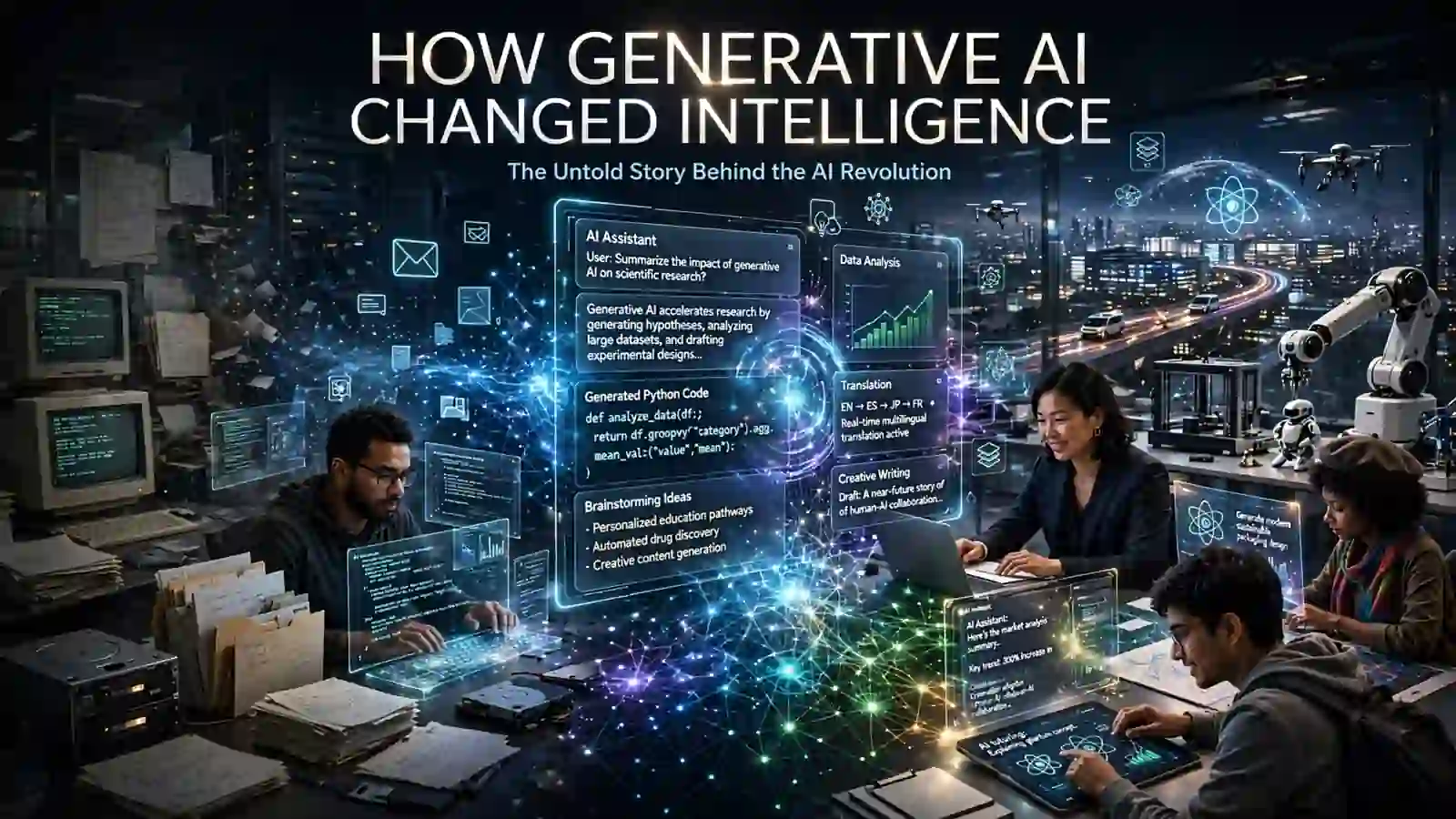
The Untold Story of OpenAI: How ChatGPT Changed Artificial Intelligence

Artificial intelligence has existed for decades. That’s one of the untold stories of OpenAI that you are not aware. GhatGPT is changing how people use artificial intelligence.
For much of its history, however, AI remained hidden inside laboratories, universities, and technology companies.
Most people rarely interacted with it directly.
That changed in November 2022.
Within days of its public launch, ChatGPT attracted millions of users curious about a conversational AI capable of writing essays, generating code, answering questions, translating languages, and helping solve complex problems.
In only a few months, ChatGPT became one of the fastest-growing consumer technologies ever created.
But ChatGPT’s overnight success was years in the making.
Behind it stood a research organization with an ambitious mission:
Ensure that artificial general intelligence benefits all of humanity.
That organization is OpenAI.
Its journey is one of vision, scientific breakthroughs, controversy, fierce competition, and relentless innovation.
Kuda Bank Business Model Explained
Why OpenAI Was Created
OpenAI was founded in December 2015.
Unlike many Silicon Valley startups that were built primarily to maximize profits, OpenAI began as a research organization focused on advancing artificial intelligence responsibly.
Its founders believed AI would eventually become one of humanity’s most powerful technologies.
The Future of Cashless Payments: Are Digital Wallets Replacing Cash?
If developed carelessly, it could create enormous risks.
If developed responsibly, it could dramatically improve education, healthcare, science, business, and everyday life.
The organization therefore committed itself to researching AI with safety and long-term societal benefit in mind.
The Visionaries Behind OpenAI
OpenAI attracted some of the technology industry’s most influential entrepreneurs and researchers.
Its early supporters included:
- Sam Altman
- Elon Musk
- Greg Brockman
- Ilya Sutskever
- Wojciech Zaremba
- John Schulman
Together, they assembled one of the strongest AI research teams in the world.
Their objective was clear:
Push the boundaries of artificial intelligence while ensuring it remained beneficial to humanity.
How Stripe Became One of the World’s Most Valuable Fintech Companies
OpenAI Began as a Nonprofit
Initially, OpenAI operated as a nonprofit research organization.
The goal was to prioritize scientific discovery over commercial success.
Researchers openly published many of their findings to encourage global collaboration.
However, AI research quickly became extraordinarily expensive.
Training increasingly powerful models required:
- Massive computing infrastructure
- Thousands of advanced GPUs
- World-class researchers
- Billions of dollars in investment
The nonprofit model eventually became difficult to sustain.
A New Funding Model
To continue competing with technology giants, OpenAI introduced a “capped-profit” structure.
This hybrid model allowed the organization to raise significant investment while still limiting financial returns to investors.
The change generated considerable debate within the technology community.
Why Digital Wallets May Replace Debit Cards Sooner Than You Think
Supporters argued it was necessary.
Critics questioned whether OpenAI could still maintain its original mission.
Nevertheless, the additional funding dramatically accelerated research.
The GPT Revolution
One of OpenAI’s biggest breakthroughs came through the development of the Generative Pre-trained Transformer (GPT) family of language models.
Each generation represented a significant leap forward.
GPT models became progressively better at:
- Understanding language
- Generating text
- Summarizing information
- Translating languages
- Writing code
- Answering questions
The improvements surprised even experienced AI researchers.
ChatGPT Changed Everything
Although OpenAI had released several impressive AI models previously, ChatGPT became the product that introduced artificial intelligence to mainstream audiences.
People quickly discovered they could use it for:
- Writing articles
- Learning new skills
- Programming
- Brainstorming ideas
- Research
- Education
- Customer support
- Business planning
Rather than interacting with AI through complicated software, users simply had conversations.
This dramatically lowered the barrier to adoption.
Related Read
Interested in how disruptive technology companies change industries?
Explore these Frenovara stories:
- How Elon Musk Built Multiple Billion-Dollar Companies
- How Canva Became a Billion-Dollar Startup Without Competing With Adobe
- How Stripe Became One of the World’s Most Valuable Fintech Companies
Businesses Quickly Embraced AI
The business world rapidly recognized ChatGPT’s potential.
Companies began using conversational AI for:
- Customer service
- Marketing
- Content creation
- Software development
- Internal knowledge management
- Productivity
Entire industries started integrating generative AI into everyday workflows.
This accelerated global investment in artificial intelligence.
Competition Intensified
OpenAI’s rapid success sparked intense competition across the technology industry.
Major technology companies accelerated investments in generative AI, launching competing products and expanding research budgets.
Artificial intelligence quickly became one of the world’s most competitive technology sectors.
OpenAI’s Influence Extended Beyond Technology
ChatGPT changed more than software.
It transformed public conversations about:
- Education
- Employment
- Creativity
- Ethics
- Scientific research
- Government regulation
- Business innovation
Artificial intelligence became a mainstream topic discussed by students, business leaders, policymakers, and everyday consumers alike.
ChatGPT Became the Fastest-Growing Consumer Application in History
When OpenAI released ChatGPT to the public in November 2022, few people expected what would happen next.
Within days, social media was flooded with examples of people using ChatGPT to:
- Write essays
- Generate business ideas
- Create marketing content
- Debug computer code
- Translate languages
- Prepare for interviews
- Learn new skills
The platform reached one million users in less than a week, then continued growing at an unprecedented pace.
Within just two months, ChatGPT surpassed 100 million monthly active users, making it one of the fastest-growing consumer applications ever launched.
Its explosive adoption demonstrated one important fact:
Artificial intelligence had finally become accessible to everyone, not just scientists and engineers.
How Elon Musk Built Multiple Billion-Dollar Companies
Microsoft Saw the Future Early
Long before ChatGPT became a household name, Microsoft recognized OpenAI’s potential.
The technology giant invested billions of dollars into OpenAI while providing the cloud infrastructure needed to train increasingly powerful AI models.
This partnership gave OpenAI access to enormous computing resources through Microsoft Azure.
In return, Microsoft integrated OpenAI’s technology into many of its products, including:
- Microsoft Copilot
- Microsoft Word
- Excel
- PowerPoint
- Outlook
- GitHub Copilot
- Bing AI
Rather than competing directly, the partnership accelerated AI adoption across Microsoft’s global ecosystem.
How Mobile Money Is Powering African E-commerce (2026)
GPT-4 Raised the Standard Again
OpenAI continued improving its language models.
The release of GPT-4 represented another major leap in capability.
Compared with earlier models, GPT-4 demonstrated improvements in:
- Reasoning
- Creativity
- Coding
- Problem solving
- Context understanding
- Accuracy
Businesses increasingly trusted GPT-powered tools for complex professional tasks.
This expanded AI beyond experimentation into real business operations.
OpenAI’s Business Model
Although OpenAI began as a research organization, it gradually developed multiple revenue streams.
Today, its business includes:
ChatGPT Plus
A subscription service providing access to premium AI features.
Enterprise Solutions
Businesses pay for secure AI deployments designed for organizations.
API Services
Developers integrate OpenAI models directly into their own software products.
Strategic Partnerships
Major technology companies license OpenAI’s models and infrastructure.
Research Collaborations
OpenAI continues collaborating with universities, governments, and private organizations.
This diversified model supports continued research while expanding commercial adoption.
AI Became a Productivity Tool
Before ChatGPT, many people viewed artificial intelligence as futuristic technology.
After ChatGPT, AI became part of everyday work.
Professionals now use generative AI for:
- Writing reports
- Brainstorming ideas
- Software development
- Customer service
- Marketing
- Data analysis
- Research
- Education
Rather than replacing human creativity, AI increasingly enhances productivity.
If you’re fascinated by companies transforming entire industries, continue with these Frenovara features.
Competition Became Fierce
OpenAI’s rapid rise sparked one of the biggest technology races in history.
Technology companies worldwide accelerated investments in generative AI.
Major competitors began releasing their own AI systems, while startups emerged almost daily.
The competition expanded into areas including:
- Search engines
- Productivity software
- Coding assistants
- Education
- Healthcare
- Finance
- Customer support
Rather than slowing OpenAI’s progress, increased competition accelerated AI innovation across the industry.
Ethical Questions Emerged
As AI capabilities improved, important questions followed.
Researchers, governments, educators, and businesses began debating issues such as:
- AI safety
- Copyright
- Misinformation
- Data privacy
- Job displacement
- Bias in AI systems
- Responsible deployment
OpenAI increasingly positioned safety research alongside technological advancement.
Balancing innovation with responsibility became one of the company’s biggest challenges.
OpenAI Is Reshaping Education
Education has become one of ChatGPT’s largest use cases.
Students use AI to:
- Understand difficult concepts
- Practice languages
- Solve programming problems
- Generate study guides
- Prepare for examinations
Teachers increasingly use AI to:
- Create lesson plans
- Develop quizzes
- Personalize learning materials
- Save administrative time
Rather than replacing education, AI is reshaping how learning happens.
Are Digital Wallets Safe? Everything You Need to Know About Mobile Payment Security
Businesses Are Rebuilding Around AI
Many organizations no longer treat AI as an optional tool.
Instead, it has become central to digital transformation strategies.
Companies increasingly redesign workflows around AI-assisted productivity.
This trend is expected to continue as AI models become more capable and affordable.
OpenAI’s Influence Extends Beyond ChatGPT
Although ChatGPT remains OpenAI’s most recognizable product, the organization continues investing in broader artificial intelligence research.
Its work now spans:
- Language models
- Image generation
- Voice interaction
- Multimodal AI
- Scientific research
- Robotics
- Agentic AI systems
The company’s long-term ambition extends far beyond conversational AI.
What’s Next for OpenAI?
OpenAI’s journey is far from over.
The company is investing heavily in the next generation of artificial intelligence, with a vision that extends well beyond chatbots.
Jeff Bezos: How He Built Amazon into a Global Empire
Future developments are expected to focus on:
- More capable reasoning models
- AI agents that can complete complex tasks autonomously
- Personalized AI assistants
- Scientific research acceleration
- Healthcare innovation
- Education technology
- Robotics integration
- Enterprise automation
As computing power improves and AI models become more sophisticated, OpenAI is likely to remain at the center of the global AI revolution.
What Is a Digital Wallet? How It Works
Artificial Intelligence Will Reshape Every Industry
The impact of OpenAI will not be limited to technology companies.
AI is already transforming sectors including:
- Healthcare
- Banking
- Manufacturing
- Retail
- Media
- Education
- Agriculture
- Transportation
- Government
- Customer service
Businesses that successfully integrate AI into their operations are likely to gain significant competitive advantages over those that delay adoption.
This transformation is comparable to the arrival of the internet itself.
Challenges That OpenAI Still Faces
Despite its remarkable success, OpenAI faces several significant challenges.
Digital Wallets for Businesses: Why Merchants Are Adopting Them
Increasing Competition
Technology giants and emerging startups continue investing billions into generative AI.
Competition is becoming more intense every year.
Regulation
Governments worldwide are developing AI regulations covering:
- Privacy
- Copyright
- Safety
- National security
- Consumer protection
Navigating these regulations will become increasingly important.
Infrastructure Costs
Training frontier AI models requires enormous computational resources.
Maintaining leadership in AI research demands continuous investment in:
- Data centers
- GPUs
- Research talent
- Cloud infrastructure
Balancing innovation with financial sustainability remains a major priority.
Lessons Entrepreneurs Can Learn from OpenAI
OpenAI’s rise offers powerful lessons for founders and business leaders.
Think Long-Term
OpenAI invested years in research before ChatGPT became a global success.
Great companies often require patience.
Solve Important Problems
Rather than building technology for its own sake, OpenAI focused on making artificial intelligence genuinely useful.
Businesses solving meaningful problems create lasting value.
Build Strategic Partnerships
OpenAI’s partnership with Microsoft accelerated growth dramatically.
Strategic alliances often create opportunities impossible to achieve alone.
Continue Innovating
OpenAI never stopped improving.
From GPT-2 to GPT-3, GPT-4, and beyond, each generation built upon the previous one.
Continuous innovation remains essential in fast-moving industries.
Balance Innovation with Responsibility
Powerful technologies require responsible development.
OpenAI’s emphasis on AI safety demonstrates that innovation and ethics must advance together.
Related Read
Continue exploring the companies transforming the future of business and technology:
- How Elon Musk Built Multiple Billion-Dollar Companies
- How Canva Became a Billion-Dollar Startup Without Competing With Adobe
- How Stripe Became One of the World’s Most Valuable Fintech Companies
- How Amazon Built the World’s Largest E-commerce Empire
- The Future of Cashless Payments: Are Digital Wallets Replacing Cash?
- Kuda Bank Business Model Explained
- What Is a Digital Wallet? How It Works
Frequently Asked Questions (FAQs)
What Is OpenAI?
OpenAI is an artificial intelligence research and technology company founded in 2015 to develop AI that benefits humanity.
Who Founded OpenAI?
OpenAI was founded by several prominent technology leaders and researchers, including Sam Altman, Elon Musk, Greg Brockman, Ilya Sutskever, John Schulman, and Wojciech Zaremba.
What Is ChatGPT?
ChatGPT is a conversational AI developed by OpenAI that allows users to interact naturally with artificial intelligence for writing, research, coding, education, brainstorming, and many other tasks.
How Does OpenAI Make Money?
OpenAI generates revenue through:
- ChatGPT Plus subscriptions
- Enterprise AI solutions
- API licensing
- Strategic partnerships
- Commercial AI products
Why Is ChatGPT So Popular?
ChatGPT became popular because it made advanced artificial intelligence accessible to ordinary users through simple conversations.
Its versatility allows people to use it for work, education, creativity, and productivity.
Is OpenAI Still a Nonprofit?
OpenAI began as a nonprofit research organization but later adopted a capped-profit structure to attract investment while continuing to pursue its broader mission.
Beyond the Headlines
OpenAI’s story is not simply the story of ChatGPT.
It is the story of how a bold research vision evolved into one of the world’s most influential technology organizations.
By making artificial intelligence accessible to millions, OpenAI fundamentally changed public perceptions of what AI could accomplish.
Today, students learn with AI.
Businesses operate with AI.
Developers build with AI.
Researchers accelerate discoveries using AI.
The technology is no longer confined to laboratories.
It has become part of everyday life.
Whether OpenAI ultimately becomes the defining AI company of the century remains uncertain.
What is already clear, however, is that it permanently changed the direction of artificial intelligence.
Just as the internet transformed communication and smartphones transformed connectivity, ChatGPT transformed humanity’s relationship with intelligent machines.
The age of conversational AI has only just begun.
WordPress SEO Tags
SEO Image Filename
SEO Image Title
SEO Image Alt Text