Africa Energy Economy: The Future Opportunities, Investments and Businesses That Could Shape the Continent
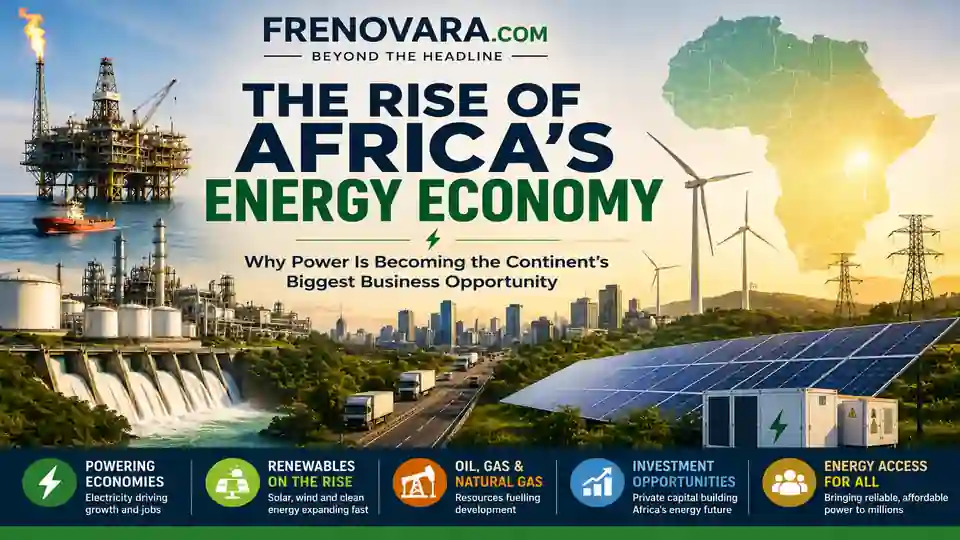
FRENOVARA
Beyond The Headline
The Africa energy economy is moving into a new phase.
For decades, conversations about African energy focused heavily on oil, gas, hydropower and electricity shortages. Today, the picture is much broader.
Solar power is expanding.
Battery storage is becoming increasingly important.
Digital technology is changing how electricity is monitored and consumed.
Private companies are entering markets once dominated by state-owned utilities.
At the same time, Africa’s growing population and expanding businesses are creating demand for more reliable power.
That combination could make energy one of the defining business stories of Africa’s next economic chapter.
Part 1 examined the forces driving Africa’s growing energy demand.
Part 2 looked at how oil, gas, solar, wind, geothermal energy and electricity infrastructure are reshaping major African markets.
Now, Part 3 looks ahead.
Which businesses could benefit?
Where could investors find opportunities?
What technologies could transform the market?
And what challenges could prevent Africa from achieving its enormous energy potential?
The Africa Energy Economy Will Be Built Around Demand
The first major opportunity comes from something simple: Africa needs more electricity.
Economic growth requires energy.
Factories need electricity to operate.
Hospitals need dependable power.
Schools need electricity for computers and digital learning.
Farmers increasingly need energy for irrigation, processing and storage.
Retail businesses need refrigeration, lighting and connectivity.
Telecommunications networks require electricity.
Data centres require even more.
As African economies become more digital, energy demand will become increasingly connected to technology.
That means the Africa energy economy is not simply about producing electricity.
It is about providing the infrastructure that allows businesses and consumers to use electricity productively.
Africa Energy Investment Could Become a Major Growth Market
Investment will determine how quickly the continent can close its energy infrastructure gap.
Governments will remain important.
Development institutions will continue to provide financing.
However, private capital will become increasingly important as projects become larger and more commercially attractive.
That creates opportunities across several categories.
Infrastructure investors can finance power plants and transmission systems.
Private-equity firms can invest in energy companies.
Banks can provide project finance.
Venture capital firms can support energy technology startups.
Institutional investors can participate in long-term infrastructure projects.
Meanwhile, entrepreneurs can build smaller businesses around installation, maintenance, financing and energy services.
The opportunity is therefore much wider than investing directly in a power plant.
Solar Could Become One of the Biggest Business Opportunities
Solar energy is particularly attractive because Africa has one of the world’s strongest solar resources.
Yet sunlight alone does not create an energy business.
The real opportunity exists across the entire solar value chain.
That includes:
- Solar panels
- Inverters
- Batteries
- Installation
- Maintenance
- Financing
- Software
- Monitoring
- Distribution
- Mini-grids
- Solar home systems
- Commercial solar projects
A company does not necessarily need to manufacture solar panels to participate in the market.
It could finance installations.
It could provide maintenance.
It could develop software.
It could aggregate customers.
It could sell energy as a service.
As a result, thousands of smaller businesses could emerge around the expanding solar market.
Battery Storage Could Become the Next Major Opportunity
Solar power creates a natural demand for batteries.
Electricity generation and electricity consumption do not always happen at the same time.
A solar system may generate significant power during the day while demand increases in the evening.
Battery storage helps bridge that gap.
It can also support businesses that cannot afford power interruptions.
For example, a factory may combine grid electricity, solar generation, battery storage and backup generation into one integrated system.
A supermarket could use batteries to protect refrigeration systems during outages.
A telecommunications company could use storage to support remote infrastructure.
A residential customer could use a battery to reduce dependence on the grid.
Consequently, battery technology could become one of the most important components of the Africa energy economy.
Energy Startups Could Disrupt Traditional Utilities
Africa’s energy transformation is also creating space for startups.
These companies may not look like traditional energy businesses.
Some will build digital platforms.
Others will provide financing.
Some will operate mini-grids.
Others will provide smart meters and energy-management systems.
There could also be companies focused on connecting consumers with installers, lenders and energy providers.
This is where energy begins to overlap with fintech and technology.
A customer could potentially finance a solar installation through a digital platform, pay gradually through mobile money and monitor electricity consumption through a smartphone application.
The technology already exists.
The opportunity lies in adapting it to African markets at scale.
The Energy Economy Will Become More Digital
The future electricity system will increasingly depend on data.
Utilities need to know how much electricity customers are consuming.
Energy companies need to understand demand patterns.
Battery systems need software to determine when electricity should be stored or released.
Solar operators need monitoring systems.
Businesses need tools that show how much power they are consuming and where costs can be reduced.
These requirements create an entirely new layer of the Africa energy economy.
Software developers, artificial-intelligence companies and data specialists could become important participants in the sector.
This is one reason the energy industry should not be viewed as separate from Africa’s technology revolution.
They are increasingly becoming connected.
AI Could Change How Africa Manages Electricity
Artificial intelligence could eventually influence everything from energy forecasting to equipment maintenance.
AI systems can analyse consumption patterns.
They can identify unusual equipment behaviour.
They can forecast electricity demand.
They can help operators determine when renewable generation is likely to increase or decrease.
They can also support predictive maintenance.
For example, instead of waiting for a transformer or solar inverter to fail, an intelligent monitoring system could identify unusual behaviour and alert engineers before a major breakdown occurs.
That could reduce downtime.
It could also lower maintenance costs.
The wider growth of AI therefore creates another reason to modernise Africa’s energy infrastructure.
You can explore this broader technology trend in Frenovara’s coverage of the future of AI agents and autonomous AI.
Africa’s Data Centre Boom Will Increase Energy Demand
Africa’s digital economy is expanding.
Cloud computing is becoming more important.
Streaming platforms are growing.
Fintech companies process enormous volumes of transactions.
Artificial intelligence requires computing infrastructure.
All of these activities depend on data centres.
Data centres, in turn, require reliable electricity.
That creates an important connection between Africa’s energy economy and its digital economy.
Countries that can provide reliable electricity, strong telecommunications networks and favourable investment conditions could become attractive destinations for data-centre development.
Therefore, energy infrastructure could influence which African countries become leaders in the next phase of the digital economy.
Manufacturing Could Benefit From Better Energy Infrastructure
Reliable electricity can transform manufacturing economics.
A factory that experiences frequent power interruptions may have to rely heavily on diesel generators.
That increases operating costs.
Production can also be interrupted.
Equipment may suffer damage.
Workers may lose productive hours.
Improving electricity reliability can therefore make local manufacturing more competitive.
The impact could extend to food processing, textiles, pharmaceuticals, chemicals, construction materials and consumer goods.
This is why the Africa energy economy should not be viewed as an industry operating separately from manufacturing.
Energy is an input into almost every major economic activity.
Energy Could Strengthen Africa’s Industrialisation
Africa has significant natural resources.
Yet exporting raw materials without developing sufficient processing capacity limits the economic value that remains within local economies.
Reliable energy can help change that.
Minerals can be processed locally.
Agricultural products can be transformed into finished goods.
Manufacturing plants can operate more consistently.
Industrial parks can attract companies that require dependable electricity.
As energy infrastructure improves, countries may become better positioned to move from resource extraction toward higher-value production.
This could make energy policy an important part of Africa’s industrialisation strategy.
The Green Hydrogen Opportunity
Another emerging opportunity is green hydrogen.
The concept involves producing hydrogen using electricity generated from renewable sources.
Africa’s solar and wind resources could potentially support large-scale hydrogen production in suitable locations.
North African countries are particularly well positioned because of their proximity to European markets.
However, green hydrogen remains capital-intensive.
Infrastructure must be built.
Production costs must become competitive.
Transportation and storage systems must develop.
Long-term buyers are also required.
Consequently, green hydrogen should be viewed as a long-term opportunity rather than an immediate replacement for existing energy systems.
If the economics improve, however, it could become an important part of Africa’s future energy exports.
Africa’s Energy Economy Could Create New Export Industries
Energy does not have to be consumed entirely within the country where it is produced.
Regional electricity markets can allow countries with excess generation to sell power across borders.
Gas can be exported.
Renewable-energy components can be manufactured for regional markets.
Battery systems can potentially become export products.
Green hydrogen could eventually create another export category.
That means the Africa energy economy could become increasingly regional.
Instead of thinking only in terms of national electricity systems, companies may increasingly build projects around regional demand.
The Biggest Opportunity May Be Transmission
Generation receives most of the attention.
Transmission receives less.
Yet transmission may become one of the most valuable parts of the energy investment landscape.
A country can build a massive solar or wind project, but the electricity has little economic value if it cannot reach consumers.
Africa therefore needs stronger transmission networks.
It also needs modern distribution infrastructure.
Interconnected grids could allow electricity to move between areas with different supply and demand patterns.
That would make renewable generation more useful.
For investors, this creates opportunities in cables, transformers, substations, engineering, construction, grid software and maintenance.
Mini-Grids Could Transform Underserved Communities
Large national grids will remain important.
Nevertheless, connecting every community to a central grid can be expensive and slow.
Mini-grids provide another option.
A solar-powered mini-grid can generate electricity locally and distribute it to households and businesses within a defined area.
Battery storage can provide electricity when solar production falls.
Digital payment systems can make collection easier.
Remote monitoring can allow operators to manage infrastructure without maintaining a large physical presence.
This model could be particularly useful in rural and underserved communities.
More importantly, electricity can become economically productive when businesses have access to reliable power.
A small processing business can operate longer.
A cold-storage facility can preserve agricultural products.
A workshop can use electric machinery.
A shop can remain open after sunset.
Energy access can therefore become economic access.
Financing Will Decide Which Projects Survive
One of the biggest risks facing the Africa energy economy is financing.
A project may be technically feasible but financially difficult.
Investors worry about currency fluctuations.
Lenders worry about repayment.
Developers worry about regulation.
Utilities may have difficulty paying for electricity.
Consumers may struggle with affordability.
These problems can make otherwise attractive projects difficult to finance.
That is why innovative financing structures will become increasingly important.
Blended finance can combine public and private capital.
Guarantees can reduce investor risk.
Long-term power-purchase agreements can provide predictable revenue.
Local-currency financing can reduce foreign-exchange exposure.
The financial structure of an energy project can be just as important as the technology.
Energy Affordability Will Remain Critical
There is another issue that cannot be ignored.
Africa does not simply need more electricity.
It needs electricity that households and businesses can afford.
If energy becomes too expensive, businesses may struggle to compete.
If tariffs are too low to support utilities, infrastructure may deteriorate.
The challenge is finding a sustainable balance.
Governments must protect vulnerable consumers.
At the same time, energy companies need enough revenue to maintain infrastructure and invest in expansion.
This balance will be one of the defining policy challenges of the Africa energy economy.
Climate Change Will Increase the Pressure
Climate change adds another layer of complexity.
Extreme weather can damage energy infrastructure.
Drought can affect hydropower generation.
Heat can increase electricity demand for cooling.
Flooding can damage transmission and distribution systems.
These risks mean future energy infrastructure must be designed for greater resilience.
Solar, wind, geothermal and battery storage can contribute to diversification.
However, diversification alone is not enough.
Infrastructure must also be physically resilient.
That creates another market for engineering, insurance, risk management and climate-adaptation services.
The Future Energy Company May Look Very Different
The traditional energy company was relatively easy to define.
It produced oil.
Or it generated electricity.
Or it distributed power.
The future energy company may do several things at once.
It could combine solar generation, batteries, financing and software.
It could provide electricity to customers through a subscription.
It could operate a digital marketplace.
It could use AI to forecast demand.
It could finance equipment through partnerships with banks.
In other words, energy businesses could increasingly resemble technology and financial companies.
That convergence could produce some of Africa’s next major corporate success stories.
What Entrepreneurs Should Watch
Entrepreneurs looking at the Africa energy economy should not focus only on becoming energy producers.
Some of the biggest opportunities may exist around problems.
How can electricity payments become easier?
How can solar equipment be financed?
How can installers find customers?
How can businesses monitor their energy consumption?
How can batteries be maintained remotely?
How can electricity theft be reduced?
How can utilities improve billing?
How can renewable-energy companies access affordable capital?
Every unanswered question can potentially become a business opportunity.
What Investors Should Watch
Investors should also think beyond headline announcements.
A large energy project may sound impressive, but investors need to examine the fundamentals.
Who will buy the electricity?
Who owns the infrastructure?
How will the project be financed?
What happens when the local currency depreciates?
Is the regulatory environment stable?
Can the grid absorb the additional electricity?
What happens if construction costs increase?
Can the project generate predictable cash flow?
These questions matter because energy projects often operate for decades.
Long-term economics matter more than short-term excitement.
Nigeria Could Become a Major Energy-Economy Story
Nigeria deserves particular attention.
The country has oil and gas resources.
It has enormous solar potential.
It has a huge population.
It has one of Africa’s largest consumer markets.
It also has significant electricity-access challenges.
That combination creates both risk and opportunity.
If Nigeria can improve its electricity infrastructure, attract energy investment and expand domestic energy production, the impact could spread across manufacturing, technology, agriculture, transportation and services.
The country could therefore become one of the most important markets in Africa’s energy transformation.
Frenovara’s wider business coverage of Africa’s richest entrepreneurs and Nigeria’s wealthiest businessmen provides additional context on the scale of private capital and business leadership emerging from the continent.
Energy and Agriculture Will Become More Connected
Agriculture remains central to many African economies.
Energy can increase agricultural productivity at several stages.
Solar pumps can support irrigation.
Cold storage can reduce post-harvest losses.
Electric machinery can improve processing.
Reliable electricity can support agro-processing facilities.
Digital technology can connect farmers with markets.
As a result, energy investment could help transform agriculture from a largely raw-material industry into a more productive value chain.
This connection between energy and agriculture is one of the opportunities investors should watch closely.
Energy Could Transform Africa’s Transport System
Transportation is another major area of opportunity.
Electric vehicles are gradually gaining attention across African markets.
Electric motorcycles are particularly relevant because two-wheelers are widely used for commercial transportation in many countries.
Charging infrastructure will therefore become increasingly important.
Battery-swapping models could also develop in markets where charging time is a major concern.
Meanwhile, renewable electricity could eventually support larger-scale electric transport systems.
The transition will not happen everywhere at the same pace.
Still, transport could become another major customer for the future Africa energy economy.
The Next Decade Could Produce New Energy Giants
Africa already has major companies in oil, gas, mining, telecommunications, banking and manufacturing.
The next generation of major companies could emerge from energy technology.
Some may become large solar developers.
Others could build regional electricity platforms.
Some could manufacture batteries.
Others could provide energy financing.
There may also be companies that combine energy with fintech, AI or telecommunications.
The eventual winners will probably not be determined solely by who owns the largest physical assets.
Execution will matter.
So will access to capital, technology, customers and government partnerships.
What Could Hold Africa Back?
The opportunity is enormous, but the risks are equally real.
Political uncertainty can discourage investors.
Weak infrastructure can increase project costs.
Currency instability can affect financing.
Poor utility finances can undermine electricity markets.
Regulatory delays can slow development.
Skills shortages can make projects more expensive.
Limited local manufacturing can increase dependence on imports.
Energy projects can also face community and environmental challenges.
Solving these issues will require cooperation between governments, businesses, investors and communities.
A New Energy Ecosystem Is Emerging
The most important change may be the emergence of an ecosystem rather than a single dominant technology.
Oil and gas will continue to play important roles.
Renewable energy will expand.
Battery storage will become more common.
Transmission networks will grow.
Digital platforms will become more sophisticated.
AI will increasingly support energy management.
Fintech will make energy financing more accessible.
Manufacturing will create local value.
Regional electricity markets will become more important.
Each part reinforces the others.
That is why the Africa energy economy could become much larger than the traditional energy industry.
The Real Winners Will Solve Multiple Problems
The strongest energy businesses will likely be those that solve more than one problem.
A solar company that only sells equipment may face intense competition.
A company that combines equipment, financing, installation, monitoring and maintenance could offer a more complete solution.
Likewise, an electricity developer that can combine generation with storage and grid services may be more resilient than one focused on generation alone.
Customers ultimately want outcomes.
They want reliable electricity.
They want predictable costs.
They want equipment that works.
They want financing they can afford.
They want simple systems.
Businesses that deliver those outcomes could gain an advantage.
Africa Energy Economy: What the Future Could Look Like
Imagine an African city ten years from now.
Solar panels are common on commercial buildings.
Factories combine grid electricity with renewable generation and storage.
Electric motorcycles use battery-swapping stations.
Data centres operate on increasingly diversified power systems.
Businesses monitor electricity consumption through digital platforms.
AI forecasts demand and identifies equipment problems.
Regional power markets move electricity across borders.
Rural communities use mini-grids.
Farmers use solar-powered irrigation and cold storage.
Energy companies provide electricity through flexible financing models.
That future is not guaranteed.
However, many of its individual components are already being developed.
The challenge is scaling them.
Conclusion: The Next African Energy Story Is About Opportunity
The Africa energy economy could become one of the continent’s most important growth engines.
The opportunity extends beyond oil and gas.
It includes solar.
It includes batteries.
It includes transmission.
It includes mini-grids.
It includes energy financing.
It includes manufacturing.
It includes AI.
It includes data centres.
It includes electric transportation.
It includes agriculture.
Most importantly, it includes the businesses that connect all these pieces together.
Africa’s energy challenge is enormous.
Yet that challenge is precisely what makes the market so significant.
Millions of households need reliable electricity.
Millions of businesses need affordable power.
Industries need stronger infrastructure.
Digital companies need dependable energy.
Governments need investment.
Investors need commercially viable opportunities.
The companies capable of connecting these needs could become some of the continent’s most influential businesses.
Ultimately, Africa’s energy transformation will not be defined by whether the continent chooses oil, gas or renewable energy.
It will be defined by how effectively Africa builds an energy system capable of supporting the next generation of businesses, industries and consumers.
That is the bigger story.
And it may be one of the most important economic stories Africa has to tell.
FRENOVARA — Beyond The Headline