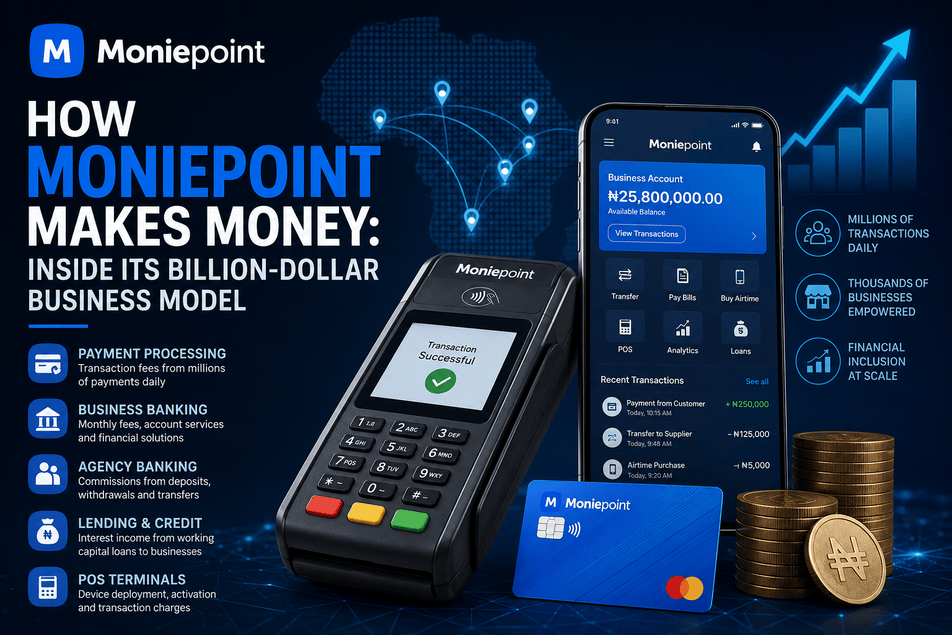
How Moniepoint Makes Money: Inside Its Billion-Dollar Business Model
Every day, millions of financial transactions take place across Nigeria using Moniepoint’s payment infrastructure.
Business owners receive customer payments.
POS agents process cash withdrawals.
Merchants transfer funds.
Companies pay suppliers.
Customers settle bills.
Behind every one of these transactions lies a sophisticated financial ecosystem that has transformed Moniepoint into one of Africa’s most valuable fintech companies.
But while many people use Moniepoint’s services daily, relatively few understand how the company actually generates revenue.
Unlike traditional banks that primarily earn income through deposits and lending, Moniepoint has built a diversified financial technology business capable of generating revenue from multiple sources simultaneously.
This diversified approach has become one of the company’s greatest competitive advantages.
Rather than depending on a single income stream, Moniepoint has created an integrated financial ecosystem where every product strengthens another.
Understanding this business model explains why investors continue to value the company so highly and why its future growth potential remains enormous.
The Shift From Banking Software to Financial Services
Before Moniepoint became one of Nigeria’s most recognised fintech brands, the company operated under the name TeamApt.
Its original business focused on developing banking infrastructure and enterprise software for financial institutions.
Working closely with banks provided something more valuable than immediate profits.
It gave the company first-hand insight into how Africa’s financial system operated.
The founders observed that while banks focused primarily on consumers and large corporate organisations, millions of small businesses remained underserved.
These merchants struggled with unreliable payment systems, expensive banking processes, and limited access to modern financial tools.
Rather than simply improving existing banking software, TeamApt decided to build financial products directly around the needs of businesses.
That decision laid the foundation for Moniepoint’s modern business model.
Why Moniepoint’s Business Model Is Different
Most fintech companies begin by solving one financial problem.
Some focus only on digital payments.
Others specialise in mobile banking.
Some provide lending.
Others operate payment gateways.
Moniepoint took a different approach.
Instead of building one financial product, it built an ecosystem.
Today, businesses can use Moniepoint for:
- Business banking
- Payment collections
- POS terminals
- Agency banking
- Expense management
- Working capital
- Business accounts
- Transaction monitoring
- Financial reporting
Every service creates opportunities for customers to remain within the Moniepoint ecosystem.
The longer businesses stay, the greater the lifetime value of each customer.
This ecosystem strategy has become one of the strongest drivers of the company’s long-term profitability.
Transaction Fees Form the Foundation
The largest source of Moniepoint’s revenue comes from transaction processing.
Every day, businesses use the platform to:
- Receive transfers.
- Accept card payments.
- Process POS transactions.
- Send money.
- Complete digital payments.
For many of these transactions, Moniepoint earns service fees.
Although individual transaction charges may appear relatively small, the company’s enormous transaction volume transforms these fees into substantial recurring revenue.
As more businesses join the platform, transaction volumes increase.
Higher transaction volumes generate higher revenues without requiring proportional increases in operational costs.
This scalability makes payment processing one of the company’s strongest income generators.
Business Banking Creates Long-Term Revenue
Unlike consumer-focused fintech platforms, Moniepoint has built much of its success around serving businesses.
Its business accounts provide merchants with financial tools that extend beyond ordinary banking.
Businesses use Moniepoint to:
- Manage company finances.
- Receive customer payments.
- Pay employees.
- Monitor cash flow.
- Track transactions.
- Separate personal and business finances.
As businesses grow, their financial activity naturally increases.
This creates additional opportunities for Moniepoint to generate recurring revenue while strengthening customer loyalty.
Instead of attracting customers for a single transaction, the company becomes deeply integrated into their daily operations.
POS Terminals Drive Merchant Growth
One of Moniepoint’s most recognisable products is its Point-of-Sale (POS) terminal.
Across Nigeria, thousands of businesses rely on Moniepoint terminals to accept electronic payments from customers.
For merchants, reliable payment acceptance directly affects sales.
Customers increasingly expect businesses to provide cashless payment options.
Moniepoint supplies merchants with terminals designed to process transactions quickly and consistently.
Every active terminal contributes to the company’s broader payment ecosystem.
The more terminals deployed across the country, the more opportunities Moniepoint has to generate revenue through payment processing and related financial services.
The Network Effect
One reason Moniepoint’s business model continues strengthening is because each new customer increases the value of the overall ecosystem.
More merchants attract more customers.
More transactions improve financial data.
Better data enables stronger financial products.
Improved products attract even more businesses.
This creates a self-reinforcing growth cycle.
Few financial technology companies achieve this level of integration.
For Moniepoint, growth is no longer driven solely by customer acquisition.
It is driven by network expansion.
Each additional business strengthens the platform for everyone else.
Agency Banking Is One of Moniepoint’s Biggest Revenue Drivers
If transaction processing forms the foundation of Moniepoint’s business, agency banking has become one of its most powerful growth engines.
Across Nigeria, millions of people still live far from traditional bank branches.
In many communities, the nearest commercial bank may be several kilometres away, making simple financial transactions both time-consuming and expensive.
Moniepoint recognised this challenge early.
Rather than investing billions of naira in building physical branches, the company adopted a more scalable approach by empowering entrepreneurs to become banking agents.
Today, thousands of Moniepoint agents provide financial services within their own communities using POS terminals supplied by the company.
These agents perform services such as:
- Cash withdrawals.
- Cash deposits.
- Fund transfers.
- Airtime purchases.
- Bill payments.
- Account services.
Every transaction processed through this network generates income.
While agents earn commissions for serving customers, Moniepoint also earns revenue by powering the infrastructure that makes those services possible.
As the network continues expanding, transaction volumes naturally increase, strengthening one of the company’s largest recurring revenue streams.
Lending Creates Another Powerful Source of Income
One advantage of serving hundreds of thousands of businesses is access to enormous amounts of financial data.
Every payment processed through Moniepoint provides valuable insight into a business’s financial activity.
Unlike traditional lenders that often rely on collateral and lengthy documentation, Moniepoint can analyse transaction histories to better understand a merchant’s cash flow.
This enables the company to offer working capital solutions to qualified businesses.
For merchants, access to financing can help them:
- Purchase additional inventory.
- Expand operations.
- Meet short-term cash flow needs.
- Invest in business growth.
For Moniepoint, lending represents another important revenue opportunity.
Interest income and related financial services diversify earnings beyond payment processing while deepening customer relationships.
Businesses that receive financing often continue using Moniepoint’s broader financial ecosystem, increasing long-term customer value.
Business Solutions Generate Long-Term Customer Value
Many people associate Moniepoint primarily with POS terminals.
In reality, those terminals represent only one component of a much larger ecosystem.
The company increasingly provides comprehensive business solutions designed to simplify daily operations for entrepreneurs.
These include:
- Business accounts.
- Payment collections.
- Expense management.
- Financial reporting.
- Employee payment tools.
- Merchant support services.
Rather than earning revenue from a single product, Moniepoint generates income across multiple financial touchpoints.
Every additional service adopted by a business strengthens customer loyalty while increasing recurring revenue.
This ecosystem strategy reduces customer turnover because businesses become deeply integrated into the platform.
Leaving Moniepoint would often require replacing several financial tools simultaneously.
Technology Gives Moniepoint an Operational Advantage
Moniepoint’s success is driven not only by financial services but also by technology.
The company continuously invests in digital infrastructure capable of processing enormous transaction volumes with speed and reliability.
Areas receiving significant investment include:
- Cloud computing.
- Artificial intelligence.
- Fraud detection.
- Cybersecurity.
- Data analytics.
- Payment infrastructure.
- Customer support automation.
Artificial intelligence now plays an increasingly important role in detecting suspicious transactions, identifying fraud patterns, and improving operational efficiency.
This technology allows Moniepoint to serve more customers while maintaining high service quality.
As transaction volumes continue increasing, technology becomes an even greater competitive advantage.
Scalability Makes the Business Model Attractive
One reason investors remain optimistic about Moniepoint is the scalability of its business model.
Unlike businesses that require opening physical branches to grow, Moniepoint’s digital infrastructure allows expansion without proportionally increasing operating costs.
When more merchants join the platform:
- More transactions are processed.
- More businesses require POS terminals.
- More agents join the network.
- More payment services are used.
- More financial data becomes available.
- More lending opportunities emerge.
This creates a powerful network effect.
Growth in one area strengthens every other part of the ecosystem.
Over time, this operational leverage improves profitability.
It is one of the reasons many analysts consider Moniepoint one of Africa’s most promising fintech businesses.
Investor Confidence Continues Growing
Global investors increasingly recognise that Africa represents one of the world’s largest untapped financial services markets.
Millions of businesses remain underserved.
Digital banking adoption continues rising.
Cashless payments are becoming more common.
These trends have attracted international investment into African fintech companies.
Moniepoint has benefited from this growing investor confidence.
Funding has enabled the company to:
- Expand nationwide.
- Improve technology.
- Launch new products.
- Strengthen cybersecurity.
- Recruit experienced professionals.
- Invest in future innovation.
Rather than viewing Moniepoint as simply another payment company, many investors see it as financial infrastructure capable of supporting Africa’s long-term digital economy.
That perception significantly increases the company’s strategic value.
Challenges That Come With Rapid Growth
Building one of Africa’s largest fintech companies is not without significant challenges.
As Moniepoint continues expanding its operations, the company faces increasing pressure to maintain service quality while navigating one of the continent’s most competitive technology industries.
Success has created new opportunities, but it has also introduced greater responsibilities.
Increasing Competition
Nigeria has become Africa’s fintech capital.
Companies including:
- Flutterwave
- Paystack
- OPay
- PalmPay
- Kuda Bank
- Interswitch
continue investing heavily in technology, product development, customer acquisition, and market expansion.
Each competitor offers unique strengths.
Flutterwave dominates enterprise payment infrastructure.
Paystack remains a preferred solution for online businesses.
OPay and PalmPay continue expanding their consumer financial ecosystems.
Kuda has established itself as one of Africa’s leading digital banks.
Rather than attempting to compete directly across every market segment, Moniepoint has maintained a clear strategic focus on merchants, SMEs, and agency banking.
That focus has allowed the company to strengthen its leadership position while avoiding unnecessary distractions.
Maintaining Transaction Reliability
Businesses depend on reliable payment infrastructure.
Unlike social media platforms where temporary downtime may simply frustrate users, payment failures can directly affect a merchant’s daily income.
Every failed transaction represents:
- Lost revenue.
- Customer dissatisfaction.
- Operational delays.
- Reduced trust.
This means Moniepoint must continuously invest in:
- Server infrastructure.
- Cloud technology.
- Payment routing.
- Network redundancy.
- Customer support.
- System monitoring.
Reliability remains one of the company’s strongest competitive advantages—and one of its biggest operational responsibilities.
Cybersecurity Remains Critical
As digital payments continue growing, cybercriminals become increasingly sophisticated.
Financial institutions remain constant targets for:
- Phishing attacks.
- Identity theft.
- Account takeovers.
- Payment fraud.
- Social engineering.
Moniepoint has responded by strengthening:
- Fraud detection systems.
- Transaction monitoring.
- Artificial intelligence security models.
- Identity verification.
- Risk management frameworks.
Protecting customer trust will remain essential as the company expands across Africa.
The Future of Moniepoint
If the last decade was about establishing itself in Nigeria, the next decade could be about becoming one of Africa’s dominant financial infrastructure companies.
Several long-term trends favour continued expansion.
Digital Banking Growth
Across Africa, millions of businesses continue moving away from cash-based operations.
Digital banking adoption is expected to accelerate as internet access improves and smartphone ownership increases.
This creates enormous opportunities for merchant-focused platforms.
Artificial Intelligence
Artificial Intelligence will likely become one of Moniepoint’s biggest competitive advantages.
AI can improve:
- Fraud prevention.
- Credit assessment.
- Customer support.
- Financial insights.
- Business recommendations.
- Operational efficiency.
As these technologies mature, businesses will increasingly expect intelligent financial services rather than basic banking products.
Regional Expansion
Although Nigeria remains Moniepoint’s largest market, Africa presents substantial opportunities.
Many countries continue experiencing similar financial challenges:
- Limited banking access.
- Growing SME sectors.
- Increasing digital commerce.
- Expanding mobile adoption.
The knowledge Moniepoint has developed in Nigeria provides a strong foundation for expansion into additional African markets.
Five Business Lessons Entrepreneurs Can Learn from Moniepoint
Moniepoint’s journey offers valuable lessons for entrepreneurs across every industry.
1. Solve a Real Problem
The company did not become successful by creating technology for its own sake.
It solved genuine challenges affecting millions of businesses.
Businesses built around real problems create lasting value.
2. Focus Creates Competitive Advantage
Rather than trying to serve everyone immediately, Moniepoint concentrated on merchants and SMEs.
Specialisation often produces stronger long-term growth than trying to dominate every market simultaneously.
3. Build an Ecosystem
The company’s products complement one another.
Business banking supports payments.
Payments support lending.
Lending strengthens customer relationships.
This ecosystem approach increases customer lifetime value while creating multiple revenue streams.
4. Invest in Infrastructure
Technology companies often prioritise rapid growth.
Moniepoint invested heavily in reliability.
That investment became one of its strongest competitive advantages.
Businesses trust platforms that consistently deliver.
5. Think Long-Term
Moniepoint’s success did not happen overnight.
Years of infrastructure development, product refinement, and customer engagement created the foundation for today’s billion-dollar valuation.
Sustainable businesses are built through patience and continuous improvement.
Frequently Asked Questions (FAQs)
What is Moniepoint?
Moniepoint is one of Africa’s leading fintech companies providing business banking, payment processing, POS terminals, agency banking, and financial services for businesses and individuals.
How does Moniepoint make money?
Moniepoint earns revenue through:
- Payment transaction fees.
- POS terminal services.
- Agency banking.
- Business banking.
- Merchant services.
- Lending.
- Financial products.
Its diversified revenue model reduces dependence on any single income source.
Is Moniepoint a bank?
Moniepoint provides banking services through licensed financial institutions while operating as a regulated financial technology company focused primarily on businesses.
Why is Moniepoint considered valuable?
Its value comes from:
- Massive transaction volumes.
- Large merchant network.
- Strong payment infrastructure.
- Scalable technology.
- Growing financial ecosystem.
- Investor confidence.
- Long-term growth potential.
Who are Moniepoint’s biggest competitors?
Major competitors include:
- Flutterwave.
- Paystack.
- OPay.
- PalmPay.
- Kuda Bank.
- Interswitch.
Each company operates different business models while competing within Africa’s rapidly growing fintech industry.
Moniepoint Is Building More Than a Payment Company
The future of Moniepoint extends far beyond processing transactions.
The company is steadily positioning itself as financial infrastructure supporting African commerce.
As businesses increasingly embrace digital banking, cashless payments, embedded finance, and artificial intelligence, Moniepoint’s role within Africa’s digital economy is expected to become even more significant.
Its greatest strength is not simply the number of transactions it processes.
It is the ecosystem it continues building around businesses.
That ecosystem has the potential to power millions of entrepreneurs across the continent for decades to come.
Beyond the Headlines
Moniepoint’s story demonstrates that Africa’s biggest technology opportunities are often hidden within everyday problems.
Millions of businesses simply wanted reliable payments, easier banking, and access to financial services that actually understood how they operated.
Instead of trying to reinvent banking, Moniepoint rebuilt it around the needs of entrepreneurs.
That strategic decision transformed a payment platform into one of Africa’s most valuable fintech companies.
As digital commerce continues reshaping the continent, companies capable of building trusted financial infrastructure will become increasingly important.
Moniepoint is no longer just participating in Africa’s fintech revolution.
It is helping define what the future of African business banking will look like.