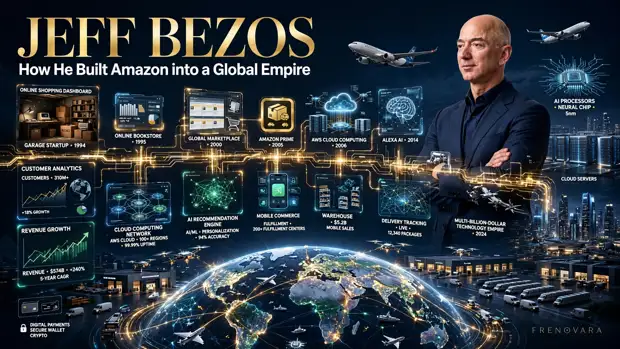

Jeff Bezos: How He Built Amazon into a Global Empire
Jeff Bezos: How He Built Amazon into a Global Empire is one of the most remarkable business stories ever told.
Today, Amazon is recognized as one of the world’s most influential companies, serving hundreds of millions of customers while operating across e-commerce, cloud computing, artificial intelligence, entertainment, logistics, and digital technology.
Yet this extraordinary success began with a simple idea.
Jeff Bezos did not start with billions of dollars or an international corporation.
He started with a vision.
That vision transformed online shopping forever and permanently changed how businesses serve customers around the world.
His entrepreneurial journey continues inspiring founders, investors, executives, and business students across every continent. How Amazon Makes Billions: The Business Model Explained
Who Is Jeff Bezos?
Jeffrey Preston Bezos was born on January 12, 1964, in Albuquerque, New Mexico.
From an early age, he displayed curiosity about science, engineering, and technology.
Rather than simply accepting how things worked, Bezos constantly asked how they could be improved.
This mindset would later become one of his greatest strengths.
His willingness to think differently shaped every stage of his business career.
Education and Early Career
Jeff Bezos studied electrical engineering and computer science at Princeton University.
After graduating, he worked for several technology and finance companies before joining the investment firm D. E. Shaw.
There, he quickly rose through the ranks.
Despite enjoying a successful Wall Street career, Bezos recognized a much larger opportunity.
Before Alibaba and Temu: How Amazon Built the World’s Largest E-commerce Empire
During the early 1990s, internet usage was growing at an astonishing pace.
Bezos realized this technological revolution would create entirely new industries.
Leaving Wall Street to Pursue a Dream
Many people would have remained in a high-paying investment career.
Jeff Bezos chose uncertainty instead.
He left Wall Street in 1994 and relocated to Seattle.
His decision surprised many colleagues.
However, Bezos believed the internet represented one of the greatest business opportunities of the century.
Rather than regretting failure, he feared regretting never trying.
This philosophy became known as his “regret minimization framework.”
Why Amazon Started as an Online Bookstore
One of the smartest decisions in Jeff Bezos: How He Built Amazon into a Global Empire involved focusing on books first.
Books offered several advantages:
- Millions of available titles.
- Standardized products.
- Easy shipping.
- High customer demand.
- Limited physical bookstore inventory.
By solving these problems online, Amazon immediately offered customers a better shopping experience. How Shopify Powers Millions of Online Stores
Launching Amazon
Amazon officially launched in July 1995.
Initially operating from a garage, the company processed customer orders using basic equipment and a small team.
The business quickly attracted attention.
Customers appreciated:
- Wide product selection.
- Competitive prices.
- Convenient online ordering.
- Reliable delivery.
Growth accelerated far faster than many industry experts expected.
Customer Obsession Became Amazon’s Foundation
One principle distinguishes Jeff Bezos: How He Built Amazon into a Global Empire from many other success stories.
Customer obsession.
Rather than focusing primarily on competitors, Amazon focused relentlessly on improving customer experiences.
This philosophy produced innovations including:
- Customer reviews.
- Personalized recommendations.
- Fast shipping.
- Easy returns.
- One-click purchasing.
Every improvement strengthened customer loyalty. How WooCommerce Powers Millions of Online Businesses
Thinking Long-Term
Many companies prioritize immediate profits.
Jeff Bezos prioritized long-term growth.
Instead of maximizing quarterly earnings, Amazon invested aggressively in:
- Warehouses.
- Technology.
- Logistics.
- Software.
- Artificial intelligence.
- Infrastructure.
Although these investments reduced short-term profits, they created enormous competitive advantages over time. Best SEO Strategies for E-commerce Websites
Expanding Beyond Books
Once Amazon dominated online book sales, Bezos gradually expanded into new product categories.
These included:
- Electronics.
- Toys.
- Clothing.
- Music.
- Movies.
- Home products.
- Beauty.
- Groceries.
Eventually, Amazon evolved into one of the world’s largest online marketplaces.
Amazon Marketplace Changed Everything
Another breakthrough came when Amazon invited third-party sellers onto its platform.
Instead of selling only Amazon-owned inventory, businesses worldwide could now reach millions of customers through Amazon Marketplace. The Business Model Behind Temu’s Rapid Global Growth
This strategy benefited:
Customers
Greater product variety and competitive pricing.
Businesses
Access to global markets.
Amazon
Additional revenue through commissions and services.
Marketplace expansion dramatically increased Amazon’s scale.
Amazon Prime Created Loyal Customers
In 2005, Amazon introduced Prime.
Initially offering fast shipping, Prime gradually expanded into:
- Prime Video.
- Prime Music.
- Gaming benefits.
- Cloud storage.
- Exclusive discounts.
Prime encouraged customers to shop more frequently while strengthening long-term loyalty.
It became one of Amazon’s most valuable competitive advantages.
Jeff Bezos Built More Than an Online Store
By the mid-2000s, Amazon had become much more than an e-commerce company.
It increasingly invested in:
- Technology.
- Cloud computing.
- Artificial intelligence.
- Logistics.
- Entertainment.
This diversification would eventually transform Amazon into one of the world’s most valuable companies.
Amazon Web Services (AWS): The Billion-Dollar Game Changer
One of the biggest milestones in Jeff Bezos: How He Built Amazon into a Global Empire had nothing to do with online shopping.
In 2006, Amazon launched Amazon Web Services (AWS).
Originally created to support Amazon’s own technological infrastructure, AWS quickly became one of the world’s leading cloud computing platforms. Top 20 Biggest E-commerce Companies in the World
Today, millions of businesses rely on AWS for:
- Cloud storage.
- Data analytics.
- Artificial intelligence.
- Machine learning.
- Website hosting.
- Enterprise software.
AWS generates tens of billions of dollars in annual revenue and remains one of Amazon’s most profitable business divisions.
Investing in Artificial Intelligence
Jeff Bezos understood that technology would shape the future of commerce.
Long before artificial intelligence became mainstream, Amazon invested heavily in AI.
Today, AI powers many Amazon services, including:
- Personalized product recommendations.
- Inventory forecasting.
- Dynamic pricing.
- Fraud detection.
- Customer service chatbots.
- Voice assistants.
Artificial intelligence enables Amazon to provide faster, smarter, and more personalized shopping experiences. The Evolution of E-commerce: From Amazon to AI Shopping
Alexa Expanded Amazon Beyond Retail
Amazon’s ambitions extended far beyond e-commerce.
The company introduced Alexa, an AI-powered voice assistant integrated into Echo smart speakers.
Alexa allows users to:
- Shop using voice commands.
- Control smart home devices.
- Play music.
- Set reminders.
- Access information instantly.
Rather than remaining only a shopping company, Amazon entered millions of households through connected devices.
Logistics Became Amazon’s Superpower
Most businesses view logistics as an operational necessity.
Jeff Bezos transformed logistics into a competitive advantage.
Amazon invested billions in:
- Fulfilment centres.
- Robotics.
- Delivery vans.
- Cargo aircraft.
- Last-mile delivery.
- Warehouse automation.
This infrastructure enables Amazon to deliver products faster than many competitors.
Fast delivery strengthened customer satisfaction while increasing repeat purchases.
Acquiring Companies to Accelerate Growth
Amazon has consistently expanded through strategic acquisitions.
Rather than developing every service internally, the company purchased businesses that strengthened its ecosystem.
Notable acquisitions include:
- Whole Foods Market.
- Audible.
- Ring.
- Twitch.
- MGM Studios.
Each acquisition expanded Amazon into new industries while increasing long-term revenue opportunities.
The Whole Foods Acquisition
Amazon’s purchase of Whole Foods surprised many industry analysts.
However, the acquisition supported several long-term objectives. The Evolution of E-commerce: From Amazon to AI Shopping and the Future of Online Retail
It enabled Amazon to combine:
- Physical retail.
- Grocery delivery.
- Digital shopping.
- Supply chain optimization.
- Customer data.
This move significantly strengthened Amazon’s position in grocery retail.
Global Expansion
Amazon steadily expanded beyond the United States.
Today, the company serves customers across:
- North America.
- Europe.
- Asia.
- Australia.
- South America.
International growth diversified revenue while expanding Amazon’s global influence.
Each new market presented unique challenges, but Bezos consistently prioritized long-term investment over immediate profitability. Why Most E-commerce Businesses Fail (And How to Avoid It)
Jeff Bezos’ Leadership Principles
Throughout Jeff Bezos: How He Built Amazon into a Global Empire, several leadership principles remained consistent.
Customer Obsession
Every decision begins with the customer.
Innovation
Experiment constantly.
Long-Term Thinking
Build for decades rather than quarters.
High Standards
Demand operational excellence.
Calculated Risk
Be willing to make bold decisions when opportunities arise.
These principles continue shaping Amazon even after Bezos stepped down as CEO.
Amazon’s Culture of Experimentation
Jeff Bezos encouraged experimentation.
His philosophy recognized that innovation requires occasional failure.
Amazon experimented with numerous products and services.
Others failed.
Rather than avoiding risk, Bezos viewed unsuccessful experiments as valuable learning opportunities.
This willingness to innovate kept Amazon ahead of many competitors.
Competing Against Alibaba and Temu
Although Alibaba dominates Chinese e-commerce and Temu has rapidly expanded internationally, Amazon maintains several competitive strengths.
These include:
- Customer trust.
- Prime membership.
- Cloud computing.
- Logistics.
- Artificial intelligence.
- Product selection.
Rather than competing solely on price, Amazon competes on convenience, speed, reliability, and ecosystem integration.
Challenges Facing Amazon
Despite extraordinary success, Amazon continues facing significant challenges.
These include:
- Regulatory investigations.
- Labour concerns.
- Environmental sustainability.
- Rising logistics costs.
- Increasing global competition.
- Antitrust scrutiny.
Managing these issues will influence Amazon’s future growth.
Jeff Bezos’ Lasting Influence
Although Jeff Bezos stepped down as Amazon CEO in 2021, his influence remains deeply embedded within the company’s culture.
His emphasis on:
- Innovation.
- Customer satisfaction.
- Long-term investment.
- Operational excellence.
continues guiding Amazon’s strategic direction.
His entrepreneurial philosophy has influenced countless startups worldwide.
Five Business Lessons Entrepreneurs Can Learn from Jeff Bezos
The story of Jeff Bezos: How He Built Amazon into a Global Empire offers practical lessons for entrepreneurs, startups, and established business leaders.
Amazon’s rise was not driven by luck.
It resulted from consistent execution, bold decision-making, and an unwavering commitment to innovation.
1. Think Decades, Not Quarters
One of Jeff Bezos’ defining characteristics was his long-term mindset.
Rather than focusing on immediate profits, Amazon invested heavily in:
- Technology.
- Warehouses.
- Artificial intelligence.
- Logistics.
- Customer experience.
These investments reduced short-term earnings but created enormous long-term value.
Entrepreneurs who prioritize sustainable growth often outperform those chasing quick profits.
2. Customer Obsession Beats Competitor Obsession
Jeff Bezos repeatedly emphasized that Amazon competes by serving customers better, not by reacting to competitors.
Instead of asking:
“What are our competitors doing?”
Amazon asks:
“What can we do to improve our customers’ lives?”
This philosophy produced innovations like:
- One-click ordering.
- Customer reviews.
- Fast delivery.
- Personalized recommendations.
- Hassle-free returns.
Businesses that genuinely solve customer problems earn lasting loyalty.
3. Innovation Requires Experimentation
Jeff Bezos accepted that not every experiment would succeed.
Amazon has launched products and services that failed.
Yet every failure provided valuable lessons.
Its willingness to experiment enabled breakthroughs including:
- Amazon Prime.
- AWS.
- Kindle.
- Alexa.
- Marketplace.
Innovation requires accepting calculated risks.
4. Build Systems That Scale
Amazon invested early in systems capable of supporting global growth.
These include:
- Automated warehouses.
- Robotics.
- Cloud infrastructure.
- AI-powered logistics.
- Sophisticated software.
Scalable systems allow businesses to grow without sacrificing efficiency.
5. Technology Creates Competitive Advantages
Technology remains Amazon’s greatest strength.
Artificial intelligence, cloud computing, automation, and data analytics continue to reduce costs while improving customer experiences.
Businesses that embrace technology often outperform slower-moving competitors.
Why Amazon Remains One of the World’s Most Valuable Companies
Several factors continue strengthening Amazon’s market position.
These include:
Diversified Revenue
Amazon earns income from:
- E-commerce.
- AWS.
- Advertising.
- Prime memberships.
- Entertainment.
- Devices.
Diversification reduces dependence on any single business.
Customer Loyalty
Prime membership encourages repeat purchases.
Customers often remain within Amazon’s ecosystem because of convenience and value.
Global Infrastructure
Amazon’s logistics network spans warehouses, fulfilment centres, aircraft, delivery vehicles, and sophisticated supply chain systems.
This infrastructure creates significant barriers for competitors.
Continuous Innovation
Amazon continues investing in:
- Artificial intelligence.
- Robotics.
- Healthcare.
- Logistics.
- Smart devices.
- Cloud computing.
Innovation keeps the company competitive despite changing markets.
Jeff Bezos Beyond Amazon
Although Jeff Bezos is best known for Amazon, his influence extends much further.
His investments include:
- Blue Origin.
- The Washington Post.
- Bezos Earth Fund.
- Venture capital investments.
These ventures reflect his broader interest in technology, media, sustainability, and space exploration.
Frequently Asked Questions (FAQs)
Who Founded Amazon?
Amazon was founded by Jeff Bezos in 1994.
Why Did Jeff Bezos Leave Wall Street?
He believed the rapidly growing internet presented one of the greatest business opportunities of the century.
Rather than risk lifelong regret, he left his successful investment career to build Amazon.
What Was Amazon’s First Product?
Books.
Amazon initially operated as an online bookstore before expanding into additional product categories.
What Is Amazon Web Services (AWS)?
AWS is Amazon’s cloud computing platform.
It provides cloud infrastructure, storage, computing power, artificial intelligence, and enterprise technology services to organizations worldwide.
Why Is Jeff Bezos Considered One of History’s Greatest Entrepreneurs?
Jeff Bezos transformed a small online bookstore into one of the world’s largest technology companies through innovation, customer obsession, long-term thinking, and operational excellence.
Why Jeff Bezos’ Story Continues Inspiring Entrepreneurs
The story of Jeff Bezos: How He Built Amazon into a Global Empire demonstrates that extraordinary companies rarely emerge overnight.
Instead, they evolve through:
- Patience.
- Innovation.
- Discipline.
- Adaptability.
- Customer focus.
Amazon’s success reminds entrepreneurs that sustainable growth often requires years of consistent improvement rather than instant results.
Beyond the Headlines
Jeff Bezos changed far more than online shopping.
He fundamentally transformed how businesses think about customers, technology, logistics, innovation, and long-term strategy.
From a garage startup selling books to one of the world’s most valuable companies, Amazon’s journey illustrates the power of bold ideas supported by disciplined execution.
Even as competitors such as Alibaba, Temu, Walmart, and countless digital marketplaces continue expanding, Amazon remains influential because it consistently reinvents itself.
For entrepreneurs around the world, Bezos’ greatest lesson may be this:
The companies that shape the future are those willing to think differently, invest patiently, embrace innovation, and remain relentlessly committed to solving customer problems.
That philosophy transformed Amazon into a global empire and continues influencing modern business today.