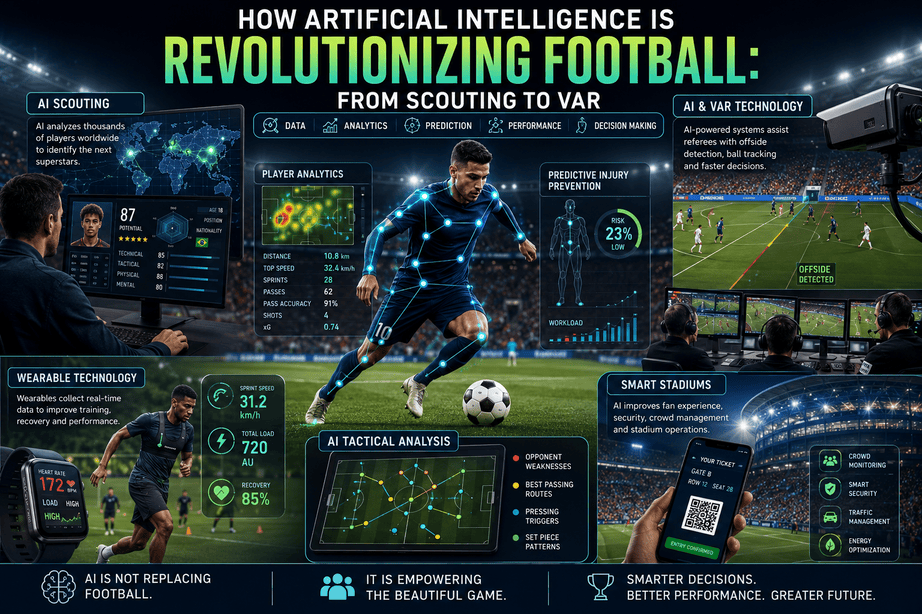
How Artificial Intelligence Is Revolutionizing Football: From Scouting to VAR
Football has always embraced innovation.
From lightweight boots and advanced training methods to goal-line technology and the Video Assistant Referee (VAR), the sport continues to evolve.
Today, another revolution is underway.
Its name is Artificial Intelligence (AI).
AI is rapidly transforming football at every level.
Elite clubs use it to discover young talent.
Managers rely on it to analyse opponents.
Medical teams use it to predict injuries.
Broadcasters enhance fan experiences with AI-powered statistics.
Referees receive technological support during crucial decisions.
The beautiful game is becoming smarter.
And this transformation has only just begun.
What Is Artificial Intelligence in Football?
Artificial intelligence refers to computer systems capable of analysing enormous amounts of information, recognizing patterns, making predictions, and assisting human decision-making.
In football, AI processes millions of data points collected from:
- Player movements.
- Match statistics.
- GPS tracking.
- Video footage.
- Biometric sensors.
- Training sessions.
- Historical performance data.
Rather than replacing coaches or players, AI helps them make better decisions.
Football Has Become a Data-Driven Sport
Years ago, football decisions depended mainly on observation and experience.
Today, almost every movement on the pitch can be measured.
Modern clubs collect data including:
- Distance covered.
- Sprint speed.
- Passing accuracy.
- Defensive positioning.
- Shooting efficiency.
- Ball recovery.
- Pressing intensity.
- Heat maps.
Artificial intelligence converts these numbers into actionable insights that coaches can immediately apply.
AI Is Changing Player Scouting
Finding the next superstar has become increasingly competitive.
Instead of relying solely on scouts travelling around the world, clubs now combine traditional scouting with AI-powered analysis.
AI systems evaluate thousands of players simultaneously.
The Business of Football: How the World’s Biggest Sport Became a Trillion-Dollar Industry
They compare:
- Technical ability.
- Physical performance.
- Tactical intelligence.
- Consistency.
- Injury history.
- Age profile.
- Development potential.
This allows clubs to identify promising talents long before they become household names.
Recruitment Is Becoming Smarter
Transfer fees continue rising every year.
Making poor recruitment decisions can cost clubs millions.
Artificial intelligence reduces that risk.
Instead of signing players based purely on reputation, clubs can evaluate whether a player actually fits their tactical system.
AI compares:
- Playing style.
- Formation compatibility.
- Passing networks.
- Defensive contribution.
- Offensive output.
- Physical demands.
Recruitment departments increasingly combine human expertise with machine intelligence.
Coaches Use AI to Prepare for Matches
Preparing for opponents once required countless hours of video analysis.
AI dramatically speeds up that process.
Modern systems automatically identify:
- Passing patterns.
- Defensive weaknesses.
- Set-piece routines.
- Counter-attacking tendencies.
- Pressing behaviour.
- Preferred attacking channels.
Coaches receive detailed reports before every match, allowing them to adjust tactics more effectively.
AI Supports Tactical Analysis
Artificial intelligence doesn’t simply collect statistics.
It explains them.
For example, AI can identify:
- Which passing combinations create the most chances.
- Which formations expose defensive weaknesses.
- Which substitutions improve performance.
- Which players perform better together.
This information helps coaching staff make more informed tactical decisions.
Predicting Injuries Before They Happen
One of football’s biggest challenges is player injuries.
Artificial intelligence now assists medical teams by analysing:
- Training workload.
- Running intensity.
- Recovery periods.
- Muscle fatigue.
- Previous injuries.
- Sleep patterns.
When AI detects increased injury risk, coaches can reduce training intensity or rotate players before serious problems develop.
Preventing injuries protects both players and club investments.
Why AI Matters Financially
Football is no longer only about winning matches.
It is also about protecting valuable assets.
A world-class footballer may represent an investment worth hundreds of millions of dollars.
Artificial intelligence helps clubs:
- Reduce expensive transfer mistakes.
- Improve player performance.
- Extend careers.
- Lower medical costs.
- Increase competitive success.
Better decisions often translate directly into greater financial return.
How VAR Uses Artificial Intelligence
One of the most visible technological innovations in modern football is the Video Assistant Referee (VAR).
Although human referees still make the final decisions, artificial intelligence plays an increasingly important supporting role.
AI-powered systems assist officials by:
- Tracking player positions.
- Detecting potential offsides.
- Analyzing ball movement.
- Synchronizing multiple camera angles.
- Identifying incidents requiring review.
The objective is not to replace referees but to reduce clear and obvious errors.
This has made football officiating more accurate, even if VAR remains one of the sport’s most debated technologies.
Semi-Automated Offside Technology
The FIFA World Cup introduced Semi-Automated Offside Technology (SAOT), which combines AI with advanced camera systems.
The technology continuously tracks:
- Every player’s position.
- Ball movement.
- Limb positioning.
- Passing moments.
Within seconds, AI determines whether an attacking player was in an offside position.
This dramatically reduces review times while improving decision accuracy.
Instead of relying solely on manually drawn lines, AI performs calculations almost instantly.
Wearable Technology Is Creating Smarter Players
Modern footballers wear advanced tracking devices during training.
These wearable technologies collect valuable information, including:
- Heart rate.
- Sprint speed.
- Acceleration.
- Distance covered.
- Fatigue levels.
- Recovery time.
- Muscle workload.
Artificial intelligence analyzes this information to help coaches tailor training programs for individual players.
Every athlete receives personalized recommendations based on real-time performance data.
AI Helps Improve Player Performance
Artificial intelligence can identify weaknesses that may not be obvious during live matches.
For example, AI may discover that a midfielder:
- Loses possession under high pressure.
- Prefers passing to one side.
- Covers less distance after the 70th minute.
- Performs better against specific formations.
These insights allow coaches to design targeted training sessions that improve individual performance.
Small improvements often produce significant competitive advantages.
AI Is Transforming Football Broadcasting
Watching football has become far more interactive.
Broadcasters now use artificial intelligence to generate:
- Live statistics.
- Win probabilities.
- Passing networks.
- Player rankings.
- Heat maps.
- Tactical graphics.
Fans receive richer information while commentators gain instant access to advanced match analysis.
This creates a more engaging viewing experience for global audiences.
Smarter Fan Experiences
Artificial intelligence also improves how supporters interact with football.
Many clubs now use AI to provide:
- Personalized match recommendations.
- Digital ticketing assistance.
- Virtual fan engagement.
- Customized merchandise suggestions.
- AI-powered chat support.
Supporters increasingly enjoy experiences tailored to their individual interests.
This strengthens fan loyalty while creating additional commercial opportunities.
Smart Stadiums Are Becoming Reality
Modern football stadiums are evolving into technology hubs.
Artificial intelligence supports:
- Crowd management.
- Security monitoring.
- Queue optimization.
- Digital ticket verification.
- Energy management.
- Parking systems.
Some stadiums even analyze crowd movement in real time to improve safety and reduce congestion.
Technology enhances both operational efficiency and the overall fan experience.
Data Analytics Has Become a Billion-Dollar Industry
Football clubs no longer rely solely on internal analysts.
Entire companies now specialize in sports data.
These organizations provide:
- Match analysis.
- Recruitment reports.
- Tactical insights.
- Performance metrics.
- Injury predictions.
- Statistical modelling.
Their services help clubs make better sporting and financial decisions.
Sports analytics has become one of football’s fastest-growing business sectors.
AI Is Influencing Transfer Decisions
Before signing players, clubs increasingly simulate how they would fit into existing squads.
Artificial intelligence evaluates questions such as:
- Will this striker suit our playing style?
- Can this defender adapt to a high defensive line?
- Does this midfielder improve our pressing system?
- Will this goalkeeper perform well under pressure?
Rather than relying only on intuition, clubs combine AI recommendations with human expertise.
This reduces costly transfer mistakes.
Why Technology Companies Are Investing in Football
Football provides technology companies with an ideal testing environment.
Innovations developed for elite football often find applications in:
- Healthcare.
- Manufacturing.
- Transportation.
- Security.
- Consumer electronics.
- Artificial intelligence research.
This explains why leading technology firms increasingly partner with football clubs, leagues, and FIFA.
The relationship benefits both industries.
Football gains better technology.
Technology companies gain global visibility and valuable real-world testing environments.
The Future of Artificial Intelligence in Football
Artificial intelligence is still in its early stages within football.
The next decade promises even greater innovation.
Experts predict that AI will increasingly support:
- Match preparation.
- Player recruitment.
- Injury prevention.
- Youth development.
- Tactical simulations.
- Fan engagement.
- Stadium operations.
- Refereeing technology.
Some clubs are already experimenting with AI systems capable of simulating thousands of match scenarios before kickoff, helping coaches identify the most effective strategies.
The future of football will likely involve even closer collaboration between human expertise and machine intelligence.
Ethical Questions Surrounding AI in Football
As AI becomes more influential, important ethical questions emerge.
Critics argue that excessive dependence on algorithms could reduce the human element of football.
Key concerns include:
Player Privacy
Wearable devices collect sensitive biometric information.
Clubs must ensure this data is handled responsibly.
Data Ownership
Who owns a player’s performance data?
The player?
The club?
The technology provider?
This remains an ongoing debate.
Competitive Balance
Wealthier clubs can invest in more sophisticated AI systems.
Some observers fear this could widen the gap between elite clubs and smaller teams.
Human Decision-Making
Artificial intelligence should assist coaches—not replace them.
Football remains a game of creativity, emotion, instinct, and leadership.
Those qualities cannot be fully replicated by machines.
How AI Is Creating New Careers in Football
The growth of sports technology has created entirely new professions.
Football organizations now recruit specialists such as:
- Data scientists.
- AI engineers.
- Performance analysts.
- Machine learning specialists.
- Sports statisticians.
- GPS performance coaches.
- Video analysts.
- Football software developers.
Technology is changing not only how football is played but also who works within the industry.
AI Is Helping Smaller Clubs Compete
Artificial intelligence is not reserved exclusively for Europe’s richest clubs.
Smaller organizations increasingly use affordable AI platforms to:
- Identify undervalued players.
- Analyze opponents.
- Improve fitness management.
- Reduce scouting costs.
- Maximize limited budgets.
This allows intelligent decision-making to partially compensate for financial limitations.
Technology is gradually making football more efficient across all levels.
Five Business Lessons Entrepreneurs Can Learn From AI in Football
Artificial intelligence in football offers valuable lessons for every entrepreneur.
1. Data Supports Better Decisions
Successful clubs increasingly rely on evidence rather than assumptions.
Businesses should adopt the same mindset.
2. Technology Creates Competitive Advantage
Clubs investing wisely in innovation often outperform rivals.
Businesses that embrace technology gain similar advantages.
3. Human Expertise Still Matters
Artificial intelligence provides recommendations.
Humans make final decisions.
The strongest organizations combine both.
4. Continuous Improvement Wins
Football clubs constantly analyze performance after every match.
Businesses should regularly review their own performance using data.
5. Innovation Never Stops
Football continues evolving through technology.
Organizations that refuse to innovate eventually fall behind.
Frequently Asked Questions (FAQs)
Is Artificial Intelligence Replacing Football Coaches?
No.
AI assists coaches by providing better information, but tactical decisions, leadership, motivation, and match management remain human responsibilities.
Which Football Clubs Use AI?
Many leading clubs around the world use artificial intelligence in areas such as scouting, recruitment, tactical analysis, injury prevention, and performance monitoring.
How Does AI Improve VAR?
AI speeds up offside detection, tracks player movements, synchronizes camera feeds, and supports referees by providing faster, more accurate information.
Can AI Predict Football Results?
AI can estimate probabilities using historical data, player statistics, and tactical information.
However, football remains unpredictable because human performance can never be perfectly forecast.
Will AI Change Football Forever?
Yes.
Artificial intelligence is expected to become increasingly important in coaching, scouting, broadcasting, stadium management, fan engagement, and sports business.
The future of football will almost certainly be driven by intelligent technology.
Why AI Represents Football’s Next Great Revolution
Football has evolved through many innovations.
Professional coaching.
Sports science.
Nutrition.
Goal-line technology.
VAR.
Artificial intelligence represents the next major transformation.
Rather than replacing football’s human spirit, AI enhances decision-making, improves efficiency, and creates new opportunities across the sport.
The clubs that embrace innovation responsibly will likely enjoy significant competitive advantages in the years ahead.
Beyond the Headlines
Artificial intelligence is changing football in ways supporters rarely notice.
Behind every successful transfer, every tactical adjustment, every injury prevented, and every accurate offside decision lies an increasingly sophisticated network of algorithms, sensors, cameras, and data scientists.
The future of football will not be decided solely by faster players or better tactics.
It will also belong to organizations that understand how to combine technology with human intelligence.
For clubs, AI offers a competitive edge.
For businesses, it demonstrates how data and innovation can transform traditional industries.
For fans, it promises an even richer, more engaging football experience.
The beautiful game is becoming smarter—and its greatest technological innovations may still be ahead.
At Frenovara, we believe the future belongs to industries that embrace innovation without losing their human identity. Football’s AI revolution is not just reshaping sport—it is redefining how technology and people work together to achieve excellence.