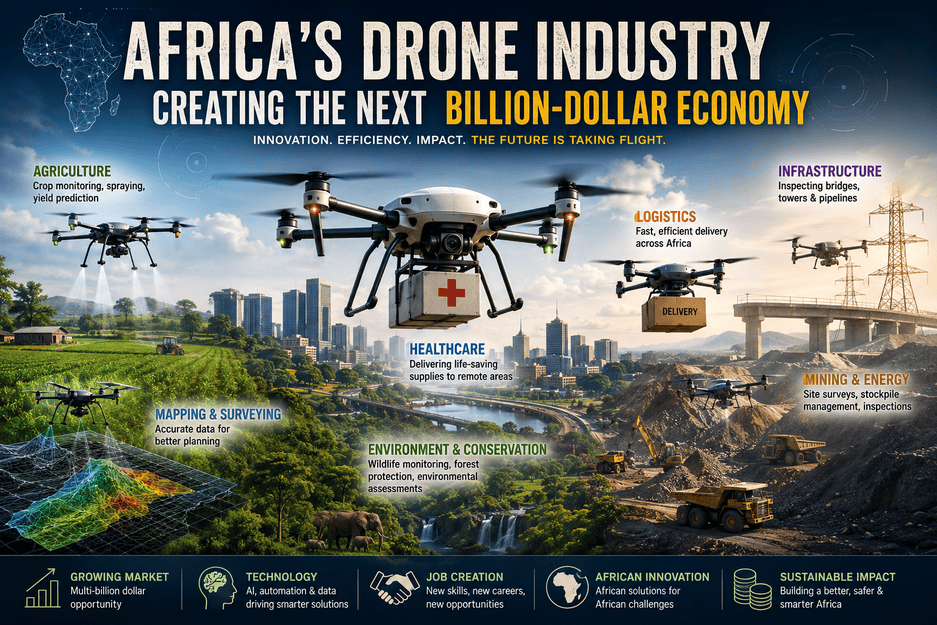
How Africa’s Drone Industry Is Creating the Next Billion-Dollar Economy
When most people hear the word drone, they immediately think of flying cameras capturing beautiful landscapes.
In reality, drones have evolved far beyond photography.
Today, they deliver life-saving medicine.
Monitor crops.
Inspect bridges.
Survey mines.
Protect wildlife.
Map cities.
Support emergency response teams.
Across Africa, this technology is creating entirely new industries while helping businesses operate faster, cheaper, and more efficiently.
As governments modernize regulations and private investors increase funding, the Africa Drone Industry is emerging as one of the continent’s most promising technology sectors.
Industry analysts believe commercial drones could become a multi-billion-dollar market across Africa over the next decade.
Why Drones Matter More Than Ever
Africa faces unique challenges.
Large rural populations.
Limited transportation infrastructure.
Difficult terrain.
Rapid urbanization.
Climate change.
Traditional solutions often require expensive infrastructure that takes years to build.
Drones offer a different approach.
Instead of building new roads, aircraft can transport small but critical supplies directly to communities.
Instead of sending survey teams into dangerous environments, drones can inspect infrastructure safely from the air.
This ability to solve practical problems quickly explains why Drone Technology Africa continues attracting attention from governments, entrepreneurs, and investors.
Africa’s Drone Economy Is Expanding Rapidly
Only a few years ago, commercial drone operations were rare across Africa.
Today, the landscape looks completely different.
Governments have introduced aviation regulations.
Universities are launching drone research programmes.
Private companies are developing commercial drone services.
International investors are supporting African drone startups.
The result is a rapidly growing Drone Economy Africa that supports industries ranging from agriculture to healthcare.
Rwanda Became Africa’s Drone Pioneer
One country often recognised as Africa’s drone success story is Rwanda.
The country gained international attention after introducing drone deliveries for medical supplies.
These drones transport:
- Blood.
- Vaccines.
- Emergency medicine.
- Laboratory samples.
Remote hospitals that once waited hours—or even days—for critical supplies can now receive deliveries within minutes.
Rwanda demonstrated that drones are not simply impressive technology.
They save lives.
Nigeria’s Growing Drone Industry
Nigeria has quickly become one of Africa’s largest markets for commercial drone services.
Businesses increasingly use drones for:
- Land surveying.
- Real estate development.
- Oil and gas inspections.
- Agricultural monitoring.
- Security operations.
- Construction planning.
As Africa’s largest economy, Nigeria offers enormous opportunities for Drone Business Africa.
Growing investment in infrastructure and technology continues expanding commercial demand.
South Africa Leads Industrial Drone Applications
South Africa possesses one of Africa’s most advanced commercial drone ecosystems.
Companies regularly deploy drones within:
- Mining.
- Energy.
- Construction.
- Insurance.
- Infrastructure inspection.
Mining companies, in particular, benefit from aerial surveys that improve operational efficiency while reducing safety risks.
Agriculture Is Being Revolutionized
Agriculture remains Africa’s largest employer.
Yet many farmers still rely on traditional methods.
Drones are changing that reality.
Modern agricultural drones help farmers:
- Monitor crop health.
- Detect pest infestations.
- Measure irrigation efficiency.
- Estimate yields.
- Map farmland.
- Apply fertilizers more accurately.
By reducing waste and improving productivity, Agriculture Drones Africa are becoming powerful tools for food security.
Infrastructure Inspection Is Becoming Safer
Inspecting bridges, power lines, pipelines, and telecommunications towers has traditionally been dangerous and expensive.
Drones now perform many of these inspections more safely.
Engineers receive high-resolution aerial imagery without climbing dangerous structures.
This improves safety while reducing maintenance costs.
Across Africa, infrastructure inspection is becoming one of the fastest-growing commercial drone markets.
Environmental Protection Is Improving
Africa possesses extraordinary biodiversity.
Protecting forests, wildlife, and natural resources requires accurate monitoring.
Conservation organizations increasingly deploy drones to:
- Monitor illegal logging.
- Track wildlife populations.
- Detect poaching.
- Survey forests.
- Assess environmental damage.
These applications demonstrate how African Innovation extends beyond business into conservation and sustainable development.
Investors See Huge Potential
Global venture capital firms increasingly recognise the commercial opportunities within Africa’s drone ecosystem.
Investment opportunities include:
- Drone manufacturing.
- Software development.
- Flight management platforms.
- Mapping technologies.
- Data analytics.
- Agricultural services.
- Healthcare logistics.
- Security solutions.
As regulations improve and commercial adoption accelerates, African Drone Startups are expected to attract significantly more investment over the coming years.
Drones Are Revolutionizing Healthcare Across Africa
Perhaps nowhere has drone technology had a greater impact than in healthcare.
Across many African countries, remote communities often struggle to access hospitals because of poor road networks, flooding, or long travel distances.
Commercial drones are helping solve this challenge.
Today, drones are used to transport:
- Blood supplies.
- Vaccines.
- Emergency medicines.
- Medical equipment.
- Laboratory samples.
- Diagnostic test kits.
Instead of waiting several hours—or even days—for deliveries by road, healthcare facilities can receive critical supplies in minutes.
This innovation is saving lives while strengthening healthcare systems across the continent.
Logistics and E-Commerce Are Entering a New Era
Africa’s e-commerce market continues growing rapidly.
However, delivery remains one of the industry’s biggest challenges.
Heavy traffic.
Poor road conditions.
Long rural distances.
High fuel costs.
Drone technology offers businesses a faster alternative for selected deliveries.
Future commercial applications may include:
- Same-day parcel delivery.
- Medical supply distribution.
- High-value package transport.
- Emergency replacement parts.
- Rural last-mile delivery.
As online shopping expands, Logistics Drones Africa could become one of the continent’s fastest-growing commercial sectors.
Mining Companies Are Increasing Drone Adoption
Africa remains one of the world’s richest regions for natural resources.
Mining companies increasingly rely on drones to improve efficiency.
Modern drone systems help mining operations:
- Survey exploration sites.
- Monitor excavation progress.
- Calculate stockpile volumes.
- Detect environmental risks.
- Improve worker safety.
- Inspect difficult terrain.
Instead of sending personnel into hazardous environments, companies now obtain highly accurate aerial data within minutes.
This significantly reduces operational costs while improving productivity.
Construction Projects Are Becoming Smarter
Large infrastructure projects require continuous monitoring.
Across Africa, construction companies now use drones to:
- Track project progress.
- Create 3D maps.
- Measure land accurately.
- Monitor equipment.
- Improve site safety.
- Detect structural defects.
Developers can compare weekly drone images to ensure projects remain on schedule.
This improves accountability while reducing expensive delays.
Smart Cities Need Drone Technology
Africa’s urban population continues growing rapidly.
Governments are investing heavily in smart city initiatives.
Drones support these efforts by helping planners:
- Map urban expansion.
- Monitor traffic.
- Inspect public infrastructure.
- Manage utilities.
- Improve emergency response.
- Support law enforcement.
Combined with artificial intelligence, drones provide valuable real-time information that helps cities operate more efficiently.
Disaster Response Is Becoming Faster
Natural disasters can strike without warning.
Floods.
Wildfires.
Landslides.
Storms.
Earthquakes.
Drones provide emergency responders with immediate aerial intelligence.
Instead of waiting for helicopters or satellite updates, emergency teams can launch drones within minutes.
These aircraft quickly identify:
- Damaged roads.
- Flooded communities.
- Blocked evacuation routes.
- Survivors needing assistance.
- Infrastructure damage.
This faster situational awareness improves rescue operations while reducing casualties.
Artificial Intelligence Is Making Drones Smarter
The future of Drone Technology Africa lies in artificial intelligence.
Modern AI-powered drones can increasingly:
- Detect crop diseases automatically.
- Identify damaged infrastructure.
- Monitor wildlife.
- Count livestock.
- Analyse traffic patterns.
- Produce automated reports.
Rather than simply collecting images, drones now generate actionable business intelligence.
This combination of AI and drone technology creates enormous opportunities for African entrepreneurs.
Drone Startups Are Attracting Investors
Private investors increasingly recognize that drones represent more than flying devices.
They are platforms for solving real-world business problems.
Many African Drone Startups focus on:
- Agricultural analytics.
- Surveying services.
- Security monitoring.
- Healthcare logistics.
- Infrastructure inspections.
- Mapping technologies.
- Environmental monitoring.
- Data analysis.
As commercial demand increases, venture capital investment is expected to accelerate significantly.
Employment Opportunities Continue Expanding
The drone industry creates jobs far beyond pilots.
Growing demand exists for:
- Drone engineers.
- Software developers.
- Data analysts.
- Surveyors.
- Maintenance technicians.
- AI specialists.
- Flight operators.
- Geographic Information Systems (GIS) experts.
Universities and technical institutions across Africa are increasingly introducing drone-related training programmes.
These initiatives help prepare young Africans for high-paying technology careers.
Why Businesses Should Prepare Now
Many industries still underestimate drone technology.
However, businesses that adopt early often gain competitive advantages.
Drones improve:
- Efficiency.
- Accuracy.
- Safety.
- Productivity.
- Customer service.
- Cost management.
For entrepreneurs, the opportunity extends beyond operating drones.
Successful businesses may instead develop software, maintenance services, training programmes, analytics platforms, or specialized industry solutions.
The Africa Drone Industry remains relatively young, leaving considerable room for innovation.
Africa’s Drone Industry by 2035
The future of the Africa Drone Industry looks exceptionally promising.
Over the next decade, drones are expected to become as common in many industries as smartphones and cloud computing are today.
By 2035, analysts expect commercial drones to play a major role in:
- Precision agriculture.
- Smart cities.
- Healthcare delivery.
- Infrastructure inspection.
- Security operations.
- Environmental conservation.
- Mining.
- Oil and gas.
- Logistics and e-commerce.
- Disaster response.
As drone hardware becomes more affordable and artificial intelligence continues improving autonomous flight capabilities, African businesses will increasingly adopt drones as standard operational tools.
Rather than replacing human workers, drones will help professionals perform their jobs more safely, accurately, and efficiently.
Governments Will Play a Critical Role
The growth of Drone Business Africa will depend heavily on supportive government policies.
Countries that establish clear aviation regulations while encouraging innovation are likely to become continental leaders.
Governments can accelerate growth by:
- Simplifying commercial licensing.
- Supporting drone research.
- Investing in aviation infrastructure.
- Encouraging public-private partnerships.
- Funding innovation hubs.
- Training drone professionals.
The countries that move quickly today could become Africa’s drone manufacturing and innovation centres tomorrow.
Why Investors Are Paying Close Attention
Global investors increasingly view Africa as one of the world’s fastest-growing technology markets.
Commercial drones represent an especially attractive opportunity because they solve practical business problems across multiple industries.
Investment opportunities include:
Drone Manufacturing
Producing aircraft designed specifically for African conditions.
Software Platforms
Developing flight management systems, mapping applications, and AI-powered analytics.
Agricultural Services
Helping farmers improve productivity through aerial monitoring.
Healthcare Logistics
Building delivery networks for hospitals and pharmacies.
Security Solutions
Supporting surveillance, infrastructure monitoring, and emergency response.
Infrastructure Inspection
Providing inspection services for governments, construction companies, and energy providers.
Each of these sectors offers substantial room for growth as adoption continues expanding.
Frequently Asked Questions (FAQs)
H3: Which African Country Leads the Drone Industry?
Several countries are making significant progress, including:
- Rwanda.
- Nigeria.
- South Africa.
- Kenya.
- Ghana.
Each country specializes in different commercial applications, from healthcare to agriculture and infrastructure.
How Are Drones Used in Africa?
Commercial drones support:
- Agriculture.
- Healthcare.
- Mining.
- Logistics.
- Construction.
- Environmental monitoring.
- Infrastructure inspection.
- Emergency response.
Their applications continue expanding every year.
Can Entrepreneurs Build Drone Businesses?
Absolutely.
Entrepreneurs can launch businesses focused on:
- Drone operations.
- Data analytics.
- Mapping services.
- Equipment maintenance.
- Pilot training.
- Agricultural consulting.
- Inspection services.
Many successful businesses never manufacture drones themselves—they simply provide specialized services using existing technologies.
Will Drones Replace Human Jobs?
Not entirely.
Instead, drones create new employment opportunities while helping professionals work more efficiently.
The industry increasingly demands:
- Drone pilots.
- Software engineers.
- Data analysts.
- AI specialists.
- Surveyors.
- Maintenance technicians.
Why Is the Drone Industry Important?
Drones reduce costs, improve efficiency, increase safety, and provide access to locations that are difficult or dangerous for humans.
For many African industries, they represent one of the most practical examples of technology solving real-world problems.
Business Lessons Entrepreneurs Can Learn
Africa’s drone revolution offers valuable lessons beyond aviation.
Solve Real Problems
Successful drone companies focus on practical challenges rather than technology alone.
The best businesses solve expensive problems.
Innovation Creates Opportunity
Many of today’s leading drone companies did not exist a decade ago.
Emerging industries reward those willing to innovate early.
Collaboration Matters
Drone companies frequently partner with governments, universities, hospitals, farmers, and logistics providers.
Strong partnerships accelerate growth.
Technology Is a Tool
Customers rarely buy drones because they love aircraft.
They buy solutions that save time, reduce costs, or improve outcomes.
Entrepreneurs should always prioritize customer value over technology itself.
Why Frenovara Believes the Drone Revolution Matters
The conversation about Africa’s future often focuses on natural resources, oil, minerals, or agriculture.
While these sectors remain important, the continent’s next wave of economic growth will increasingly come from innovation.
Drone technology sits at the intersection of:
- Artificial Intelligence.
- Data analytics.
- Agriculture.
- Healthcare.
- Logistics.
- Climate technology.
- Smart infrastructure.
That combination makes it one of Africa’s most exciting emerging industries.
Beyond the Headlines
Throughout history, the greatest technological revolutions have rarely been defined by the machines themselves.
They are remembered for the problems they solved.
Railways connected nations.
Electricity powered factories.
The internet transformed communication.
Today, drones are beginning to reshape how Africa farms, builds, delivers, protects, and innovates.
Their greatest value is not in flying through the sky.
It lies in improving lives on the ground.
The entrepreneurs who recognize this opportunity today may build some of Africa’s next billion-dollar companies tomorrow.
For investors, governments, and innovators, the message is becoming increasingly clear:
The future of African technology is not arriving someday.
It is already taking off.
That’s the Frenovara perspective—looking beyond the headlines to uncover the industries, innovators, and technologies quietly transforming Africa before they dominate global conversations.