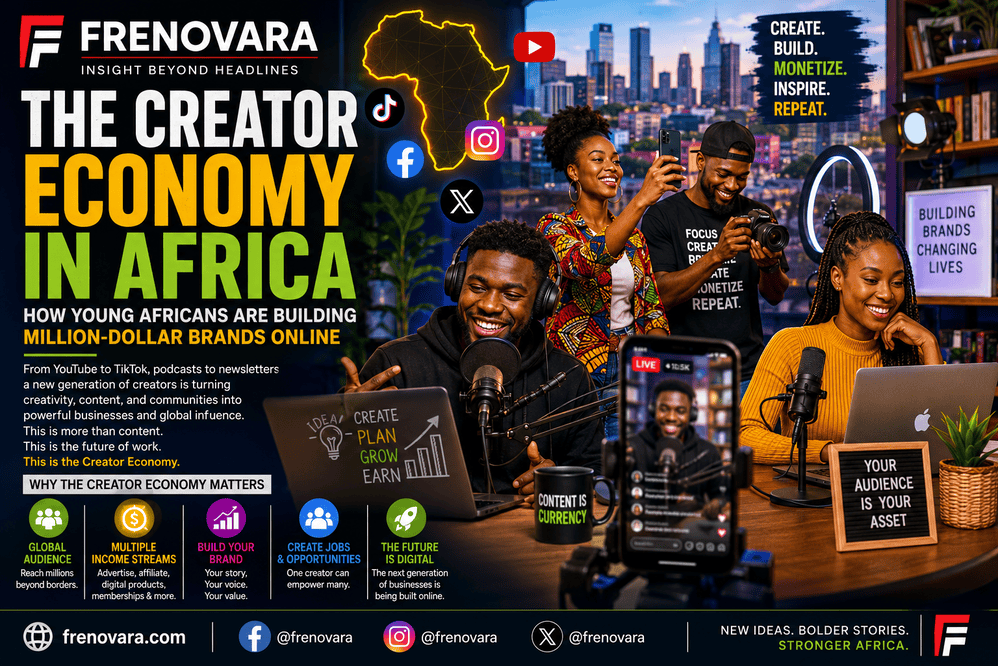
The Creator Economy in Africa: How Young Africans Are Building Million-Dollar Brands Online
For decades, building a successful business often required significant capital.
You needed:
- A physical office.
- Employees.
- Expensive equipment.
- Large startup funding.
Today, the rules have changed.
Across Africa, thousands of young entrepreneurs are building profitable businesses using nothing more than a smartphone, a laptop, internet access, and their creativity.
This transformation is known as the Creator Economy in Africa.
Whether through YouTube, Instagram, TikTok, X, Facebook, LinkedIn, podcasts, newsletters, or digital products, African creators are proving that influence can become an enterprise. Best Payment Gateways for African E-commerce Businesses
Some have built brands worth hundreds of thousands of dollars.
Others have crossed into the million-dollar category.
The Creator Economy is no longer just about posting content.
It is becoming one of the fastest-growing sectors within the Digital Economy Africa.
What Is the Creator Economy?
The creator economy refers to an ecosystem where individuals earn income by creating and distributing original content online.
Instead of working for traditional media companies, creators build their own audiences and monetize them through multiple income streams.
These creators include:
- YouTubers.
- Bloggers.
- Podcasters.
- TikTok creators.
- Instagram influencers.
- Newsletter writers.
- Educators.
- Live streamers.
- Digital artists.
- Online coaches.
Unlike traditional businesses that sell physical products, creators often build communities first before introducing products and services.
This audience-first model has become one of the defining characteristics of the Creator Business Africa movement.
Why Africa’s Creator Economy Is Growing So Fast
Several factors are accelerating the rise of African Content Creators.
Affordable Smartphones
Millions of Africans now own smartphones capable of producing professional-quality photos and videos.
Internet Expansion
Mobile internet continues reaching new communities every year, giving creators access to larger audiences.
Social Media Platforms
Platforms including:
allow creators to reach global audiences without traditional media gatekeepers.
Digital Payments
Improved payment systems now allow African creators to receive income from international clients, subscribers, advertisers, and customers.
Combined, these factors have made content creation one of the most accessible forms of Online Business Africa.
Content Creators Are Becoming Entrepreneurs
Many people still view influencers as individuals who simply post photos or videos.
That perception is outdated.
Today’s successful creators operate like business owners.
They build:
- Personal brands.
- Media companies.
- Educational businesses.
- Merchandise stores.
- Digital product businesses.
- Consulting firms.
In many cases, the content itself becomes the marketing engine for larger businesses.
This shift is redefining African Entrepreneurship.
Personal Branding Has Become a Valuable Asset
One of the biggest lessons from the creator economy is the importance of personal branding.
Audiences increasingly connect with people before companies.
Trust becomes the product.
Strong personal brands often attract opportunities including:
- Brand partnerships.
- Speaking engagements.
- Book deals.
- Investment opportunities.
- Consulting projects.
- Business collaborations.
For many creators, reputation has become one of their most valuable assets.
This explains why Personal Branding Africa is receiving increasing attention among young entrepreneurs.
Multiple Income Streams Are Replacing Traditional Employment
Unlike conventional jobs that depend on one salary, creators often generate income from several sources simultaneously.
Common revenue streams include:
- Advertising revenue.
- Brand sponsorships.
- Affiliate marketing.
- Digital products.
- Online courses.
- Membership communities.
- Merchandise.
- Events.
- Consulting.
- Freelancing.
Diversifying income provides greater financial stability while allowing creators to scale their businesses over time.
The Creator Economy Is Creating Jobs
Successful creators rarely work alone forever.
As their businesses expand, many hire:
- Video editors.
- Graphic designers.
- Writers.
- Social media managers.
- Virtual assistants.
- Marketing specialists.
- Community managers.
This means one successful creator can generate employment for several others.
The ripple effect contributes significantly to the Future of Work Africa, where digital careers increasingly replace traditional employment pathways.
The Platforms Powering Africa’s Creator Economy
The explosive growth of the Creator Economy in Africa would not have been possible without digital platforms that allow creators to publish content directly to global audiences.
Each platform offers unique opportunities depending on a creator’s niche and goals.
YouTube
YouTube remains one of the most profitable platforms for long-form content.
Creators earn through:
- Ad revenue
- Channel memberships
- Super Chats
- Brand sponsorships
- Affiliate marketing
- Merchandise
Many African creators now earn a full-time income from educational videos, entertainment, technology, finance, travel, and lifestyle content.
Instagram has evolved beyond photo sharing into a powerful business platform.
Creators monetize through:
- Brand partnerships
- Sponsored posts
- Product promotions
- Affiliate sales
- Digital products
- Personal branding
For many African Influencers, Instagram serves as both a portfolio and a marketplace.
TikTok
TikTok has become one of the fastest-growing platforms among young Africans.
Its algorithm allows creators with small followings to reach millions of viewers through engaging short-form videos.
Many businesses now discover creators through TikTok before offering brand partnerships.
Despite newer platforms, Facebook remains one of Africa’s largest social networks.
Its ecosystem supports:
- Video monetization
- Facebook Stars
- Reels
- Pages
- Communities
- Live broadcasts
For publishers like Frenovara, Facebook continues to be a valuable traffic source.
X (formerly Twitter)
X has become a platform where creators establish authority through conversations, breaking news, thought leadership, and professional networking.
Writers, journalists, entrepreneurs, and business leaders increasingly use X to grow highly engaged audiences.
African Creators Are Reaching Global Audiences
One of the greatest strengths of today’s digital economy is that geography matters less than ever.
A creator based in Lagos, Nairobi, Accra, Kigali, or Johannesburg can build an audience spanning:
- United States
- United Kingdom
- Canada
- Australia
- Europe
- Asia
- The Middle East
This global reach allows Digital Creators Africa to compete internationally while remaining rooted in African stories and perspectives.
Their success demonstrates that valuable content knows no borders.
Brands Are Investing More Than Ever in Creator Partnerships
Businesses have recognised that audiences increasingly trust creators more than traditional advertisements.
Instead of relying solely on television commercials or billboards, companies now collaborate with creators to promote products authentically.
Popular partnership opportunities include:
- Product reviews
- Sponsored videos
- Brand ambassadorships
- Event appearances
- Social media campaigns
- Product launches
- Affiliate collaborations
This shift has created a thriving ecosystem where creators and businesses grow together. Quantum Computing in Africa: Could It Shape the Continent’s Future?
As Social Media Business Africa expands, influencer marketing budgets are expected to increase significantly.
Challenges Facing African Content Creators
Despite the enormous opportunities, creators still face several obstacles.
These include:
- Unstable internet connectivity
- High data costs
- Limited access to professional equipment
- Copyright issues
- Platform algorithm changes
- Burnout from constant content production
- Difficulty securing international payment options
Many creators also struggle to transform growing audiences into sustainable businesses.
Those who overcome these challenges often succeed by treating content creation as a long-term enterprise rather than a short-term hobby.
Consistency Is the Biggest Competitive Advantage
Talent alone rarely guarantees success.
The most successful Creator Business Africa stories are built on consistency.
Leading creators publish regularly, improve their skills continuously, and engage with their audiences over many years.
Consistency helps creators:
- Build trust.
- Improve platform visibility.
- Attract sponsors.
- Grow loyal communities.
- Generate recurring income.
The creators who succeed are often those who continue creating even when growth appears slow.
The Future of the Creator Economy in Africa
The creator economy is still in its early stages across much of Africa.
As internet access expands and digital payment systems improve, millions more young Africans are expected to join the industry.
Future growth areas include:
- Educational content
- Business and finance
- Technology reviews
- Artificial Intelligence
- Gaming
- Podcasts
- Documentary storytelling
- Local language content
- Digital newsletters
- Online learning platforms
The next generation of African entrepreneurs may not begin with factories or office buildings.
Many will start with a camera, an internet connection, and a compelling story.
The Biggest Income Streams Beyond Advertising
Many people believe creators only make money from advertisements.
In reality, advertising often becomes just one of many income sources.
The most successful creators build businesses around their audiences rather than depending on a single platform. The Rise of Smart Cities in Africa
Here are some of the most profitable revenue streams in the Creator Economy in Africa.
Brand Partnerships
Companies increasingly partner with trusted creators to promote products and services.
These partnerships often include:
- Sponsored videos.
- Product reviews.
- Brand ambassador deals.
- Event appearances.
- Long-term campaigns.
For established creators, brand partnerships frequently become the largest source of income.
Affiliate Marketing
Creators earn commissions by recommending products or services.
Whenever someone purchases through their referral link, they receive a percentage of the sale.
Popular affiliate categories include:
- Technology.
- Fashion.
- Software.
- Books.
- Online courses.
- Financial services.
Affiliate marketing allows creators to earn passive income while recommending products they genuinely use. Top African AI Startups Revolutionizing Retail
Digital Products
Many creators now sell their own digital products, including:
- E-books.
- Templates.
- Online courses.
- Premium newsletters.
- AI prompts.
- Business guides.
- Design resources.
Unlike physical products, digital products can be sold repeatedly without manufacturing costs. The Green Economy in Africa
This makes them one of the most scalable opportunities within Online Business Africa.
Membership Communities
Loyal followers increasingly pay for exclusive content.
Memberships may include:
- Private communities.
- Live Q&A sessions.
- Early access to videos.
- Exclusive articles.
- Premium tutorials.
Building a community creates predictable recurring revenue while strengthening audience relationships.
Speaking and Consulting
Successful creators often become recognised experts in their industries.
This opens opportunities for:
- Conference speaking.
- Corporate training.
- Business consulting.
- Media interviews.
- University lectures.
Many creators eventually discover that their expertise becomes just as valuable as their content.
What Businesses Can Learn From Creators
The rise of Creator Business Africa offers valuable lessons for every entrepreneur.
Successful creators understand that modern business is built on trust.
Rather than constantly selling products, they focus on:
- Educating audiences.
- Entertaining consistently.
- Building authentic relationships.
- Delivering long-term value.
This audience-first approach creates stronger customer loyalty than traditional advertising alone.
Businesses adopting similar strategies often outperform competitors that focus only on direct sales.
Africa 2035 – The Creator Economy Will Be Bigger Than Many Traditional Industries
Looking ahead, the Future of Work Africa will look very different from previous generations.
By 2035:
- Millions more Africans are expected to earn income online.
- Creator-led businesses will employ larger teams.
- African media companies will increasingly originate from individual creators.
- Digital exports will become a major contributor to economic growth.
- Local creators will compete globally while telling uniquely African stories.
The creator economy will no longer be viewed as an alternative career.
It will become a mainstream sector within Digital Economy Africa.
Frequently Asked Questions (FAQs)
What Is the Creator Economy?
The creator economy is an ecosystem where individuals earn income by creating original digital content and building audiences across platforms such as YouTube, Instagram, TikTok, Facebook, podcasts, newsletters, and blogs.
Can African Creators Build Global Businesses?
Absolutely.
Many African creators already serve audiences across multiple continents.
Digital platforms remove geographical barriers, allowing talented creators to compete internationally. How Mobile Money Is Powering African E-commerce
Which Platform Is Best for Beginners?
The answer depends on your strengths.
- YouTube for long-form educational content.
- TikTok for short viral videos.
- Instagram for visual storytelling.
- Facebook for community building.
- X for thought leadership.
- A personal website for long-term ownership.
Many successful creators eventually use multiple platforms together.
Is Content Creation a Sustainable Career?
Yes—but only when treated as a business.
Creators who diversify income, continuously improve their skills, and build strong communities are far more likely to achieve long-term success.
Why Frenovara Believes the Creator Economy Matters
At Frenovara, we don’t see creators as influencers alone.
We see them as founders.
Journalists.
Educators.
Entrepreneurs.
Innovators.
Every article, video, podcast, interview, or documentary has the potential to become intellectual property that generates value for years.
This is one reason Frenovara is expanding beyond written journalism into YouTube, interviews, documentaries, and digital storytelling.
The future belongs to media brands that create value across multiple platforms—not just one.
Beyond the Headlines
The creator economy is changing something much deeper than the way people earn money.
It is changing who gets to tell Africa’s stories.
For generations, African narratives were often filtered through foreign media organisations.
Today, a young creator with a smartphone in Lagos, Kigali, Accra, Nairobi, Johannesburg, or Cairo can reach millions directly.
That shift is powerful.
It means African entrepreneurs can build global brands without waiting for permission.
It means local voices can shape international conversations.
It means knowledge, creativity, and authenticity have become valuable economic assets.
The next generation of Africa’s most influential business leaders may not begin their journeys in boardrooms.
Some will start with a YouTube channel.
Others with a blog.
A podcast.
An Instagram page.
Or even a small website built with a simple idea and relentless consistency.
For Frenovara, this isn’t just another technology trend.
It represents the democratisation of opportunity.
The creators building audiences today are building companies tomorrow.
And those companies will help define Africa’s digital economy for decades to come.
That’s the Frenovara perspective—looking beyond the headlines to uncover the ideas, innovators, and opportunities shaping Africa’s future.