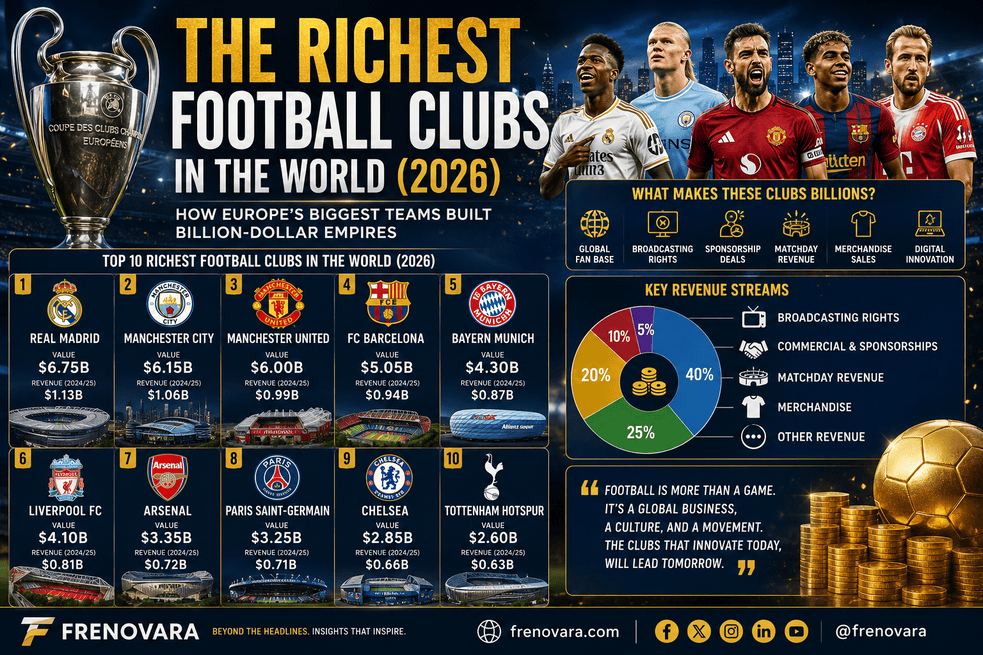
The Richest Football Clubs in the World (2026): How Europe’s Biggest Teams Built Billion-Dollar Empires
Football has evolved far beyond ninety minutes on the pitch.
Today’s biggest clubs are no longer simply sports organizations.
They are multinational corporations with worldwide supporters, billion-dollar commercial partnerships, advanced technology operations, and global media influence.
Every season, these clubs generate enormous income from broadcasting rights, sponsorship deals, merchandise, digital platforms, stadium operations, and player transfers.
Some are now worth more than many Fortune 500 companies.
But what separates these football giants from everyone else?
Why are certain clubs consistently among the richest in the world?
The answer lies in decades of strategic planning, global branding, sporting success, and commercial innovation.
What Makes a Football Club Rich?
Being one of the richest football clubs is not simply about winning trophies.
Financial strength comes from several key factors:
- Annual revenue.
- Global fan base.
- Brand value.
- Broadcasting income.
- Sponsorship agreements.
- Matchday revenue.
- Merchandise sales.
- Stadium ownership.
- Digital presence.
- Commercial partnerships.
The clubs that perform well across these categories usually dominate football’s financial rankings.
Revenue vs Club Valuation
Many supporters confuse revenue with valuation.
They are not the same.
Revenue
Revenue refers to the money a club earns each year through its various income streams.
Valuation
Valuation represents what experts estimate the club is worth as an overall business.
A club may generate billions annually while being valued even higher because of:
- Future growth potential.
- Global brand recognition.
- Stadium assets.
- Commercial opportunities.
- Loyal supporters.
Both figures help determine a club’s financial strength.
Why European Clubs Dominate Football Finance
Europe remains the financial centre of world football.
Several factors explain this dominance:
- The world’s biggest leagues.
- Global television audiences.
- International sponsorships.
- Historic football brands.
- Elite competitions like the UEFA Champions League.
- Large stadium capacities.
Although football continues growing across Africa, Asia, North America, and the Middle East, Europe still generates the highest commercial revenues.
1 Real Madrid
Real Madrid continues to rank among the richest football clubs on Earth.
Founded in 1902, the Spanish giants have built one of the strongest brands in global sport.
Their commercial success comes from:
- Massive worldwide fan base.
- Multiple UEFA Champions League titles.
- Global sponsorship agreements.
- Matchday revenue.
- Merchandise sales.
- Digital media.
- International partnerships.
The club’s reputation extends far beyond football.
Real Madrid represents excellence, prestige, and sporting history.
Its iconic white jersey remains one of the world’s most recognizable sporting symbols.
2 Manchester City
Manchester City has transformed dramatically over the past two decades.
Once regarded as Manchester United’s smaller neighbour, City has become one of football’s commercial powerhouses.
The club benefits from:
- Modern infrastructure.
- Elite football success.
- Global commercial expansion.
- Advanced technology.
- Strong sponsorship portfolio.
- Growing international fan base.
Their business model combines football excellence with long-term commercial investment.
3 Manchester United
Despite experiencing mixed performances on the pitch in recent years, Manchester United remains one of the world’s most valuable sports brands.
The club possesses:
- Hundreds of millions of supporters.
- Historic commercial partnerships.
- Exceptional merchandise sales.
- Strong global recognition.
- Long-standing football heritage.
Old Trafford continues attracting supporters from around the world, while the club’s commercial operations remain among football’s strongest.
4 FC Barcelona
Barcelona remains one of football’s biggest financial brands despite recent financial challenges.
The Catalan club benefits from:
- A global supporter base.
- Rich football tradition.
- Successful youth academy.
- Worldwide merchandising.
- Strong digital engagement.
- International sponsorships.
Their famous “La Masia” academy has produced some of football’s greatest players, reducing recruitment costs while strengthening the club’s identity.
Why Brand Power Matters
Football clubs compete not only on the pitch but also in the marketplace.
Supporters buy into club identities.
Brands like:
- Real Madrid.
- Barcelona.
- Manchester United.
- Manchester City.
have become global symbols that attract sponsors, investors, broadcasters, and commercial partners.
Brand strength often proves just as valuable as sporting success.
Global Fan Bases Drive Revenue
Today’s richest clubs serve supporters across every continent.
Digital technology allows clubs to reach fans through:
- Official websites.
- Mobile applications.
- Online stores.
- Streaming services.
- Social media.
- Fan memberships.
A supporter in Lagos, New York, Tokyo, or São Paulo contributes to the same global football economy.
This worldwide reach explains why elite clubs continue increasing their revenues every year.
5 Bayern Munich
Few football clubs are as financially disciplined as Bayern Munich.
The German champions have built one of the most sustainable business models in world football.
Unlike many clubs that rely heavily on wealthy owners, Bayern has consistently grown through smart financial management.
Its major revenue sources include:
- Bundesliga broadcasting income.
- UEFA Champions League participation.
- Long-term sponsorship agreements.
- Matchday revenue.
- Merchandise sales.
- International commercial partnerships.
The Allianz Arena is one of Europe’s most iconic football stadiums, generating significant income through sold-out matches, hospitality services, stadium tours, and events.
Bayern’s reputation for financial stability has made it one of football’s most respected institutions.
6 Liverpool FC
Liverpool’s global popularity has grown dramatically over the past decade.
Success under Jürgen Klopp, combined with intelligent commercial expansion, transformed the club into one of football’s richest brands.
Liverpool earns substantial revenue through:
- Television rights.
- Champions League football.
- Shirt sponsorships.
- Merchandise.
- Digital media.
- Global fan engagement.
The club’s famous anthem, You’ll Never Walk Alone, has become a powerful symbol that strengthens supporter loyalty worldwide.
This emotional connection translates into enormous commercial value.
7 Arsenal
Arsenal remains one of England’s biggest commercial football institutions.
Although trophies have fluctuated over the years, the club continues generating impressive financial returns.
Major income sources include:
- Emirates Stadium matchday revenue.
- Broadcasting rights.
- Sponsorship agreements.
- Retail sales.
- Digital memberships.
- International fan engagement.
The Emirates Stadium has become one of the Premier League’s strongest revenue-generating venues.
Combined with Arsenal’s global brand recognition, it provides long-term financial stability.
8 Paris Saint-Germain (PSG)
Paris Saint-Germain has evolved into one of football’s most recognizable luxury sports brands.
Backed by significant investment and aggressive commercial expansion, PSG has attracted worldwide attention.
The club generates revenue from:
- Premium sponsorship deals.
- Global merchandising.
- Luxury fashion collaborations.
- International tours.
- Broadcasting.
- Digital content.
Strategic partnerships with fashion and lifestyle brands have allowed PSG to expand beyond traditional football audiences.
Today, PSG is as much a lifestyle brand as it is a football club.
9 Chelsea
Chelsea continues to rank among football’s financial elite.
Years of investment in world-class players, infrastructure, and global marketing have strengthened the club’s commercial position.
Revenue comes from:
- Matchday operations.
- Television rights.
- Commercial sponsorships.
- Merchandise.
- European competitions.
- International partnerships.
Chelsea’s consistent presence in European football has significantly boosted its commercial appeal.
10 Tottenham Hotspur
Tottenham Hotspur has become one of football’s most modern business success stories.
Its state-of-the-art stadium transformed the club’s financial potential.
Unlike traditional football venues, Tottenham Hotspur Stadium hosts:
- Football matches.
- NFL games.
- Concerts.
- Conferences.
- Entertainment events.
- Corporate hospitality.
Operating the stadium throughout the year allows Tottenham to diversify revenue far beyond football.
It has become one of the club’s greatest commercial assets.
Comparing the Richest Football Clubs
Although each club has its own strategy, the world’s richest teams share several characteristics:
- Global supporter bases.
- Strong commercial departments.
- Modern stadiums.
- Consistent participation in elite competitions.
- Powerful sponsorship portfolios.
- Successful merchandising operations.
- Massive digital audiences.
Sporting success helps.
Commercial excellence sustains long-term growth.
Why Some Clubs Continue Growing Faster Than Others
Football finances are constantly evolving.
The fastest-growing clubs usually invest heavily in:
Global Branding
Expanding into new international markets.
Digital Innovation
Creating engaging online experiences for supporters.
How Football Clubs Make Money: Inside the Billion-Dollar Business of Modern Football
Commercial Partnerships
Working with global companies across multiple industries.
Stadium Development
Modern facilities generate significantly higher matchday income.
Youth Development
Producing talented players internally reduces transfer spending while increasing future profits.
These strategies allow clubs to remain financially competitive even during periods of inconsistent on-field performance.
Commercial Success Is No Longer Optional
Football has become fiercely competitive.
Clubs cannot rely solely on ticket sales or television income.
Modern commercial departments negotiate hundreds of partnerships every year.
Successful clubs now think like multinational corporations.
They analyze consumer behaviour.
Expand into new markets.
Develop digital products.
Strengthen brand loyalty.
Commercial success has become just as important as sporting success.
The Future of Football Club Wealth
Football is entering a new financial era.
The next generation of football clubs will not simply compete for trophies—they will compete for global attention, digital audiences, and commercial dominance.
Several trends are expected to shape the future of football finance.
Artificial Intelligence
AI is helping clubs make smarter decisions in:
- Player recruitment.
- Tactical analysis.
- Injury prevention.
- Fan engagement.
- Commercial forecasting.
The clubs that embrace AI responsibly are likely to gain a long-term competitive advantage.
Digital Fan Communities
Supporters no longer interact with clubs only on matchdays.
Elite clubs now generate revenue through:
- Membership platforms.
- Mobile applications.
- Exclusive content.
- Premium subscriptions.
- Virtual experiences.
- Personalized shopping.
Digital communities are becoming one of football’s most valuable assets.
Global Expansion
Europe remains football’s commercial center, but future growth is expected to come from:
- Africa.
- Asia.
- North America.
- The Middle East.
As football continues attracting new supporters, clubs will increasingly localize content, merchandise, and commercial partnerships for these emerging markets.
Smart Stadiums
Modern stadiums are evolving into year-round entertainment venues.
Future stadiums will integrate:
- AI-powered security.
- Cashless payments.
- Smart parking.
- Digital ticketing.
- Personalized fan experiences.
- Sustainable energy systems.
These innovations will increase operational efficiency while creating new revenue streams.
Why Brand Value Matters More Than Ever
The world’s richest clubs understand one important lesson:
People don’t only support football teams.
They support brands.
The strongest football brands represent:
- Excellence.
- Tradition.
- Identity.
- Community.
- Success.
- Entertainment.
Supporters buy jerseys, subscribe to streaming services, visit stadiums, and engage online because they feel emotionally connected.
That emotional connection is one of football’s greatest commercial strengths.
Five Business Lessons Entrepreneurs Can Learn From Elite Football Clubs
Football’s biggest clubs provide valuable lessons for every entrepreneur.
1. Build a Global Brand
The richest clubs think beyond local markets.
Businesses should also develop brands capable of reaching international audiences.
2. Diversify Income
Successful clubs rarely depend on a single source of revenue.
Entrepreneurs should also create multiple income streams.
3. Invest in Long-Term Assets
Football academies, stadiums, technology, and brand reputation generate value for decades.
Businesses should prioritize investments that create sustainable growth.
4. Embrace Innovation
From artificial intelligence to digital marketing, football clubs constantly adapt to technological change.
Innovation often determines future competitiveness.
5. Build Loyal Communities
Supporters remain with clubs through victories and defeats.
Businesses should focus on building genuine relationships with customers rather than chasing only short-term sales.
Frequently Asked Questions (FAQs)
Which Is the Richest Football Club in the World?
The rankings change annually, but clubs such as Real Madrid, Manchester City, Manchester United, Barcelona, and Bayern Munich consistently rank among the world’s richest football organizations.
How Do Football Clubs Earn Most of Their Money?
The largest revenue sources include:
- Broadcasting rights.
- Sponsorship deals.
- Commercial partnerships.
- Matchday income.
- Merchandise sales.
- Digital media.
Why Are Football Clubs Worth Billions?
Their value reflects:
- Global brand recognition.
- Massive supporter bases.
- Valuable assets.
- Long-term commercial opportunities.
- Consistent revenue generation.
Which League Generates the Most Revenue?
The English Premier League remains the world’s most commercially successful football league due to its enormous international broadcasting agreements and global audience.
Can Smaller Clubs Become Rich?
Yes.
Intelligent recruitment, strong youth academies, financial discipline, commercial innovation, and effective branding allow smaller clubs to grow significantly over time.
Football’s Billion-Dollar Economy
Football has become one of the world’s largest entertainment industries.
It supports millions of jobs across sectors including:
- Broadcasting.
- Hospitality.
- Tourism.
- Technology.
- Retail.
- Manufacturing.
- Marketing.
- Financial services.
Every major football club contributes to an ecosystem that extends far beyond the stadium.
As technology, artificial intelligence, and global commercialization continue expanding, football’s economic influence will likely become even greater.
Beyond the Headlines
The richest football clubs did not become global giants overnight.
Their success is built on decades of strategic planning, world-class branding, commercial innovation, sporting excellence, and continuous adaptation.
While trophies inspire supporters, sustainable business practices secure long-term success.
The clubs that dominate football financially are those that understand how to balance tradition with innovation, passion with profitability, and local identity with global ambition.
For entrepreneurs, investors, and business leaders, football offers more than entertainment.
It provides a blueprint for building resilient global brands capable of thriving in an increasingly competitive marketplace.
At Frenovara, we believe football is one of the world’s greatest business case studies. Behind every sold-out stadium, championship trophy, and iconic jersey lies a powerful lesson about leadership, innovation, branding, and long-term value creation.
1 thought on “The Richest Football Clubs in the World (2026): How Europe’s Biggest Teams Built Billion-Dollar Empires”