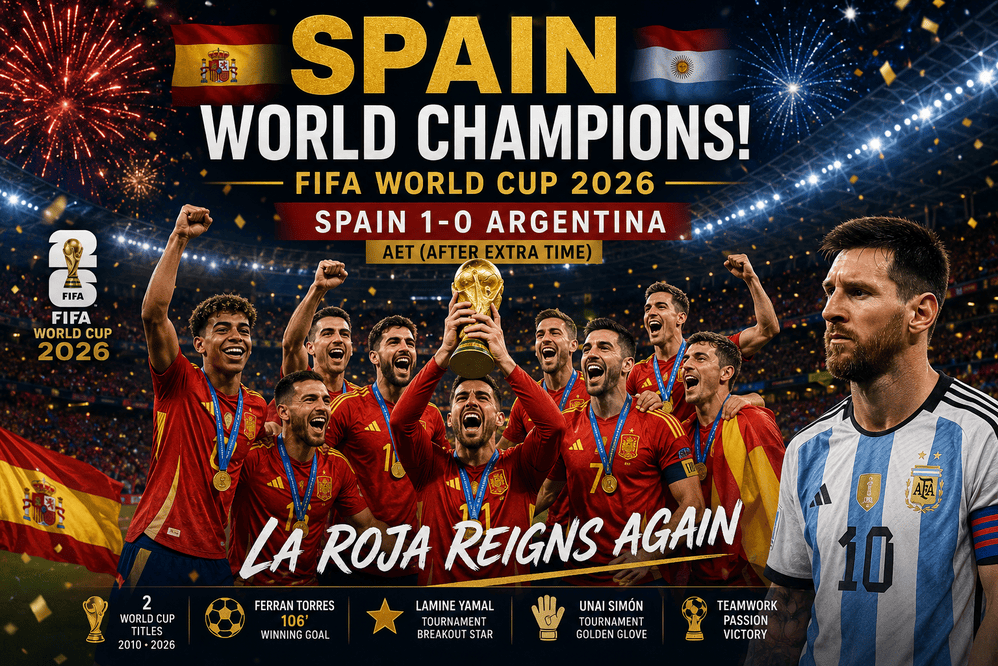
Spain Crowned World Champions: How La Roja Defeated Argentina to Win the FIFA World Cup 2026
Spain are once again kings of world football.
After 120 minutes of intense drama at the FIFA World Cup 2026 Final, La Roja defeated defending champions Argentina 1–0 after extra time, capturing their second FIFA World Cup title since their historic triumph in South Africa in 2010.
The decisive moment came in the 106th minute when Ferran Torres found the back of the net after sustained Spanish pressure, breaking Argentine resistance and writing his name into football history.
For Argentina, the defeat marked the end of a remarkable campaign. Lionel Messi, appearing in what many believe could be his final World Cup match, was unable to inspire another unforgettable comeback as Spain’s disciplined, possession-based football finally prevailed.
A Final Worthy of the Biggest Stage
Football supporters around the globe expected a classic.
They got exactly that.
The final brought together two footballing giants with contrasting styles.
Spain arrived with their trademark possession football, patient build-up play, and youthful energy led by rising superstar Lamine Yamal.
Argentina relied on experience, defensive resilience, and the leadership of Lionel Messi in pursuit of back-to-back World Cup titles.
The match remained goalless after 90 minutes despite Spain dominating possession and creating the clearer chances. Goalkeeper Emiliano Martínez produced several outstanding saves to keep Argentina in contention.
Ferran Torres Delivers the Winning Goal
The breakthrough finally arrived deep into extra time.
After sustained pressure, Spain worked the ball into the attacking third before Ferran Torres finished clinically to give La Roja a priceless 1–0 lead in the 106th minute.
The goal sparked wild celebrations among Spanish supporters inside the stadium and millions watching around the world.
Argentina pushed forward desperately during the closing minutes but could not find an equaliser.
How Football Clubs Make Money: Inside the Billion-Dollar Business of Modern Football
When the final whistle arrived, Spain had secured football’s greatest prize once again.
Argentina’s Brave Resistance
Although Spain controlled large portions of the match, Argentina refused to surrender easily.
The South Americans defended courageously for over 100 minutes despite playing the latter stages with ten men following the dismissal of Enzo Fernández for a second yellow card late in normal time.
Even with a numerical disadvantage, Argentina extended the match into extra time and nearly forced a penalty shootout.
Their determination reflected the resilience that has defined Argentine football for generations.
Spain’s Tactical Masterclass
Spain’s victory was built on discipline rather than individual brilliance alone.
Throughout the tournament they consistently demonstrated:
- Excellent ball retention.
- Intelligent positional play.
- High pressing.
- Defensive organisation.
- Patient attacking combinations.
- Tactical flexibility.
Their midfield once again controlled the rhythm of the match, limiting Argentina’s attacking opportunities while creating wave after wave of pressure.
Spain finished as deserving champions after one of the most consistent performances of the tournament.
Lionel Messi’s Final World Cup Chapter?
For millions of football supporters, the 2026 FIFA World Cup Final carried emotional significance beyond the trophy itself.
It may have marked the final World Cup appearance of one of the greatest footballers in history—Lionel Messi.
Having already fulfilled his lifelong dream by lifting the World Cup in Qatar in 2022, Messi arrived in North America hoping to guide Argentina to consecutive world titles.
Although Argentina fell short in the final, Messi once again demonstrated why he remains one of football’s greatest ambassadors.
Throughout the tournament, he:
- Led by example.
- Created scoring opportunities.
- Inspired younger teammates.
- Controlled the tempo during crucial moments.
- Captained Argentina with composure and determination.
Regardless of the final result, his legacy remains untouched.
For many supporters, Messi leaves the FIFA World Cup as one of its greatest players of all time.
Lamine Yamal Announces Himself to the World
While Messi’s World Cup journey may be reaching its conclusion, another global superstar appears ready to take football into its next generation.
At just 19 years old, Lamine Yamal played with remarkable maturity throughout the tournament.
His performances combined:
- Creativity.
- Pace.
- Vision.
- Confidence.
- Intelligent decision-making.
Although he did not score in the final, his influence stretched Argentina’s defence repeatedly, creating space for Spain’s attacking movement.
The tournament firmly established Yamal as one of the brightest talents in world football and a leading contender to become football’s next global icon.
Player Ratings
Spain
Unai Simón – 8/10
Made important saves whenever Argentina threatened and remained calm under pressure.
Spain Defence – 9/10
Disciplined, organised, and difficult to break down throughout the match.
Midfield – 9.5/10
Completely controlled possession and dictated the tempo from start to finish.
Lamine Yamal – 9/10
Constantly troubled Argentina’s defenders with intelligent movement and creativity.
Ferran Torres – 10/10
Scored the winning goal and delivered when Spain needed him most.
Argentina
Emiliano Martínez – 9/10
Produced several outstanding saves that kept Argentina in the contest for over 100 minutes.
Defence – 8.5/10
Worked tirelessly despite sustained Spanish pressure.
Lionel Messi – 8.5/10
Continued to create opportunities despite Spain’s defensive discipline.
Midfield – 8/10
Battled courageously but struggled to maintain possession.
Tactical Breakdown
Spain’s success came through patience rather than urgency.
Instead of forcing attacks, La Roja repeatedly recycled possession until openings appeared.
Their tactical approach focused on:
- Maintaining possession.
- High pressing.
- Quick ball recovery.
- Overloading wide areas.
- Rotating midfield positions.
- Patient attacking build-up.
Argentina adopted a more compact defensive structure, attempting to absorb pressure before launching quick counterattacks.
However, Spain’s relentless control eventually created the decisive opportunity.
Key Match Statistics
Although the exact statistics varied throughout the match, Spain largely dominated the overall contest.
Key trends included:
- Higher possession.
- More completed passes.
- Greater territorial control.
- More shots on goal.
- More attacking sequences.
Argentina’s defensive resilience prevented Spain from scoring in normal time, but sustained pressure finally paid off during extra time.
The statistics reflected Spain’s control throughout most of the final.
Spain’s Journey to the Title
Spain’s World Cup campaign demonstrated remarkable consistency.
Throughout the tournament they displayed:
- Strong defensive organisation.
- Clinical finishing.
- Tactical discipline.
- Squad depth.
- Excellent teamwork.
Unlike many previous champions that relied heavily on individual brilliance, Spain won through collective football.
Every player understood their role.
Every line of the team worked together.
That unity became their greatest strength.
Argentina Can Leave Proud
Although defeat always hurts, Argentina exits the tournament with immense pride.
The reigning champions once again reached the World Cup Final. That’s an achievement few nations accomplish.
Their campaign showcased:
- Determination.
- Experience.
- Leadership.
- Tactical discipline.
- Competitive spirit.
The defeat does little to diminish Argentina’s standing among world football’s elite.
The future remains bright with a talented generation ready to continue the nation’s rich football tradition.
Spain Enters a New Golden Era
Spain’s victory in the FIFA World Cup 2026 Final represents far more than another trophy.
It signals the arrival of a new footballing generation capable of dominating the global game for years to come.
After winning the 2010 FIFA World Cup and multiple UEFA European Championships, Spain successfully rebuilt its national team around exciting young talents while maintaining its famous possession-based philosophy.
The result is a balanced squad featuring:
- World-class youth.
- Experienced leaders.
- Tactical intelligence.
- Technical excellence.
- Squad depth.
Their triumph in 2026 confirms that Spanish football has entered another golden era.
The Financial Reward of Becoming World Champions
Winning the FIFA World Cup brings more than international prestige.
It also delivers significant financial benefits.
Spain’s victory is expected to generate increased income through:
- FIFA prize money.
- Sponsorship opportunities.
- Commercial endorsements.
- Merchandise sales.
- Broadcasting interest.
- Tourism.
- International brand value.
Many Spanish internationals are also likely to see increases in their market values following their performances throughout the tournament.
Success on the pitch often creates enormous commercial opportunities off it.
Global Reactions
Spain’s victory immediately sparked celebrations across the country.
Supporters gathered in:
- Madrid.
- Barcelona.
- Valencia.
- Seville.
- Bilbao.
- Málaga.
Meanwhile, football legends, clubs, former players, and fans around the world congratulated Spain on social media.
Although Argentina fell short, tributes poured in for Lionel Messi and the Argentine squad, recognizing another remarkable World Cup campaign.
The final reminded the football world why the FIFA World Cup remains the biggest sporting event on Earth.
Five Lessons From Spain’s Triumph
Spain’s success offers valuable lessons beyond football.
1. Invest in Youth
Spain trusted young players and gave them opportunities to grow.
Long-term investment often produces extraordinary results.
2. Stay True to Your Identity
Rather than abandoning their football philosophy, Spain refined it.
Strong organizations succeed by remaining consistent while adapting to change.
3. Teamwork Wins Championships
Individual brilliance matters.
But collective discipline wins tournaments.
Spain demonstrated the importance of unity throughout the competition.
4. Patience Pays Off
Spain controlled matches patiently instead of forcing opportunities.
Businesses and entrepreneurs often benefit from strategic patience rather than impulsive decisions.
5. Continuous Development Matters
The Spanish Football Federation invested in coaching, academies, and player development for years.
Sustained investment eventually produced world champions.
Frequently Asked Questions (FAQs)
Who Won the FIFA World Cup 2026?
Spain defeated Argentina 1–0 after extra time to become FIFA World Cup 2026 champions.
Who Scored the Winning Goal?
Ferran Torres scored the decisive goal during extra time, securing Spain’s historic victory.
Was This Lionel Messi’s Final World Cup?
Although no official announcement has been made, many football observers believe this could be Lionel Messi’s final FIFA World Cup appearance.
How Many FIFA World Cups Has Spain Won?
Spain has now won two FIFA World Cup titles:
- 2010 (South Africa)
- 2026 (United States, Canada & Mexico)
What Does This Victory Mean for Spanish Football?
Spain’s triumph confirms the country’s successful footballing rebuild and establishes its current generation among the strongest national teams in world football.
A Final That Will Be Remembered
The FIFA World Cup Final delivered everything football supporters hoped for.
Drama.
Emotion.
Tactical brilliance.
World-class performances.
Historic moments.
Spain’s patience, discipline, and technical quality ultimately proved decisive against a courageous Argentine side that fought until the very end.
While one nation celebrated another world title, the other left with its head held high after another outstanding tournament.
Football once again reminded the world why no other sporting event captures global attention quite like the FIFA World Cup.
Beyond the Headlines
Every World Cup produces unforgettable champions.
But only a few tournaments mark the beginning of a new footballing era.
Spain’s victory in 2026 feels like one of those defining moments.
The triumph was built on vision, youth development, tactical intelligence, and unwavering belief in a football philosophy that has inspired generations.
For Argentina, the defeat closes one remarkable chapter while opening another.
For Lionel Messi, regardless of whether this proves to be his final World Cup appearance, his legacy as one of football’s greatest players remains firmly secured.
For Spain, however, the future looks exceptionally bright.
A talented generation has now climbed football’s highest mountain.
The challenge ahead is staying there.
At Frenovara, we believe football is more than a game. It is a story of ambition, resilience, innovation, and leadership—qualities that inspire not only athletes but entrepreneurs, businesses, and communities around the world.