FRENOVARA
Beyond The Headlines
Nigeria Digital Banking 2026: The Banks, Fintechs and Technologies Driving the Transformation
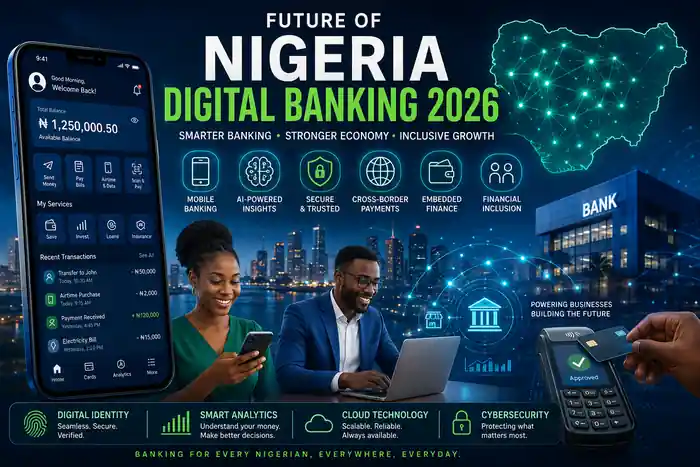
The transformation discussed in Part 1 of Nigeria digital banking 2026 is being driven by more than smartphones and mobile applications.
Behind the experience customers see on their screens is a much larger financial-technology ecosystem.
Traditional banks are upgrading their digital platforms.
Fintech companies are creating alternative financial services.
Payment processors are connecting merchants and consumers.
Infrastructure companies are providing the systems that allow transactions to move between institutions.
Meanwhile, artificial intelligence, digital identity, cloud computing and data analytics are changing how financial institutions operate.
As a result, Nigeria’s banking industry is becoming less defined by the traditional distinction between a bank and a technology company.
The boundaries are becoming increasingly blurred.
Traditional Banks Are Becoming Technology Businesses
Nigeria’s major commercial banks still control a significant portion of the country’s financial infrastructure.
Their advantage comes from scale.
They have large customer bases, established brands, extensive branch networks and years of financial experience.
However, those advantages are no longer enough.
Customers now compare a bank’s mobile experience with the best digital products they use every day.
A banking application that is difficult to navigate can therefore become a competitive weakness.
This has pushed traditional banks to invest heavily in technology.
Modern banking platforms increasingly include:
- Mobile applications
- Internet banking
- Digital account opening
- Instant notifications
- Electronic statements
- Card management
- Digital payments
- Automated customer support
- Fraud monitoring
- Personal financial tools
The transformation is not simply cosmetic.
Banks are also redesigning internal processes so that more activities can happen electronically.
That reduces dependence on paperwork and manual processing.
More importantly, it can allow financial institutions to serve customers at greater scale.
Related articles:
Why Kuda Bank Is Winning Millions of Customers: The Digital Banking Revolution in Nigeria
Fintech Companies Changed the Rules
Traditional banks had the customers.
Fintech companies brought a different advantage: speed.
Many Nigerian fintech businesses entered the market by solving specific problems that consumers and merchants faced.
Some concentrated on payments.
Others focused on transfers, merchant services, savings, lending or financial infrastructure.
The result was a new generation of financial products that often prioritised simple interfaces and rapid transactions.
This changed consumer expectations.
Customers became accustomed to opening an application and completing a financial transaction within moments.
That experience put pressure on traditional banks.
It also created an entirely new market for financial technology.
Digital Wallets Created a New Financial Relationship
Digital wallets have become one of the most visible parts of Nigeria’s fintech ecosystem.
Platforms such as OPay and PalmPay helped popularise mobile-first financial services among millions of Nigerians.
The wallet model is powerful because it can combine several everyday activities.
A customer may use the same platform to:
- Transfer money
- Receive money
- Pay bills
- Buy airtime
- Pay merchants
- Manage financial balances
The wallet therefore becomes more than a payment tool.
It becomes a regular financial interface.
This development connects directly with Frenovara’s recent Digital Wallets in Africa series, where we examined how wallets are moving from simple payment applications toward broader financial ecosystems.
The next stage is even more significant.
Digital wallets are increasingly becoming gateways to additional financial products.
Merchant Payments Are Changing Nigerian Commerce
One of the most important parts of Nigeria’s digital-finance ecosystem exists outside traditional banking applications.
It is the merchant network.
POS terminals have become a familiar part of everyday commerce.
Small retailers, restaurants, transport operators and other businesses can accept electronic payments without maintaining the infrastructure of a traditional bank branch.
This has created a huge opportunity for fintech companies.
Instead of acquiring customers one person at a time, a financial platform can build relationships with businesses.
Each merchant can then introduce digital payments to hundreds or thousands of customers.
The network effect can be powerful.
More merchants create more reasons for consumers to use digital payments.
More consumers create greater value for merchants.
That cycle can accelerate adoption.
Payment Infrastructure Is the Hidden Engine
Consumers often see the application.
They rarely see the infrastructure behind it.
Yet payment infrastructure is one of the most important parts of Nigeria’s digital-banking system.
Switching and processing companies help connect financial institutions and payment providers.
They allow transactions to move between different parts of the financial ecosystem.
This infrastructure is particularly important because customers do not want to think about which institution sits behind a payment.
They simply expect the money to arrive.
Interoperability therefore becomes a competitive advantage for the entire financial system.
The CBN’s Payments System Vision 2028 places interoperability among its central objectives, reflecting the importance of connecting different financial platforms and payment channels.
NIBSS Is an Important Part of the Ecosystem
The Nigeria Inter-Bank Settlement System, commonly known as NIBSS, occupies an important position in Nigeria’s payment infrastructure.
Its role illustrates an important point about digital banking.
The industry is not powered only by consumer-facing applications.
There is also a network of infrastructure organisations supporting the movement and settlement of electronic transactions.
That infrastructure becomes increasingly important as transaction volumes rise.
If digital finance continues expanding, the systems supporting reliability, settlement and interoperability will become even more critical.
Open Banking Could Create More Competition
Another major development is open banking.
The basic idea is straightforward.
With appropriate consent and security controls, customers can allow authorised financial providers to access relevant financial information through standardised systems.
That can make it easier to build financial products across multiple institutions.
Imagine a customer with accounts at several banks.
Instead of checking each application separately, a financial-management platform could potentially provide a consolidated view.
For businesses, the opportunity could be even greater.
An entrepreneur could connect banking, payments and accounting services.
Financial software could then provide a more complete picture of the company’s finances.
Open banking could therefore make financial services more interconnected.
It could also reduce the importance of individual financial silos.
Artificial Intelligence Is Moving Into Banking Operations
AI is becoming another major layer of digital banking.
The most obvious application is customer service.
An AI system can answer routine questions at any time.
However, customer service is only one use case.
Financial institutions can also apply AI to:
- Fraud detection
- Risk assessment
- Transaction monitoring
- Document processing
- Customer segmentation
- Financial forecasting
- Internal operations
- Compliance support
The real opportunity is automation.
Banks process enormous amounts of information every day.
AI can help employees analyse that information more quickly.
The technology can also identify patterns that may be difficult for humans to detect at scale.
AI Could Change Credit Assessment
Credit remains one of the biggest challenges facing Nigerian consumers and small businesses.
Traditional credit assessment can be difficult when customers have limited formal financial histories.
Digital platforms generate different kinds of information.
Transaction activity can reveal patterns.
Payment behaviour can provide signals.
Business cash flow can provide additional information.
AI systems can potentially analyse these datasets to support more sophisticated risk assessment.
That does not mean every customer should automatically receive credit.
Responsible lending still requires strong controls.
Nevertheless, better data analysis could help financial institutions distinguish between different levels of risk.
That could eventually make some financial products more accessible.
Data Is Becoming a Financial Asset
Digital banking produces enormous quantities of data.
Every transfer creates information.
Every payment creates information.
Every login creates information.
Every interaction with an application can generate additional data.
The challenge is turning that information into useful insights without compromising customer privacy.
Financial institutions can use responsible data analysis to understand customer behaviour.
They can identify demand for particular services.
They can improve fraud detection.
They can design better products.
They can also help businesses understand their financial activity.
Yet the more valuable financial data becomes, the more attractive it becomes to criminals.
That makes data security inseparable from digital banking.
Cybersecurity Is Becoming Part of the Product
A banking application is only useful when customers trust it.
Security must therefore be built into the experience.
Modern financial platforms need to protect accounts from several threats.
These include:
- Phishing
- Account takeover
- SIM-related fraud
- Identity theft
- Malware
- Social engineering
- Payment fraud
The technology used to fight these threats is becoming increasingly sophisticated.
Banks can monitor transaction patterns.
They can analyse device behaviour.
They can identify unusual login activity.
They can introduce additional verification when risk increases.
This creates a delicate balance.
Too little security creates risk.
Too much friction frustrates legitimate customers.
The strongest platforms will need to find the middle ground.
Digital Identity Is Becoming Critical
Digital banking cannot expand efficiently without reliable identity systems.
A financial institution needs confidence that the person opening or accessing an account is genuinely who they claim to be.
Nigeria’s Bank Verification Number system has become an important component of the country’s financial identity infrastructure.
As more services move online, identity verification will become even more important.
Future systems could combine different forms of verification.
These may include:
- Biometric information
- Device intelligence
- Digital identification
- Behavioural signals
- Transaction history
The objective should be simple.
Make legitimate access easier while making fraudulent access harder.
Cloud Technology Is Changing Banking Infrastructure
Another transformation is happening behind the scenes.
Financial institutions increasingly rely on modern computing infrastructure.
Cloud technology can allow businesses to scale computing resources more flexibly.
For digital banks and fintech companies, that flexibility can be valuable.
A financial platform may experience a sudden increase in transaction activity.
Its infrastructure must be capable of handling that demand.
Cloud-based systems can provide greater flexibility than some traditional infrastructure models.
However, financial institutions also have to consider security, reliability, regulatory requirements and data governance.
Technology decisions in banking are therefore rarely simple.
APIs Are Connecting Financial Services
Application programming interfaces, or APIs, allow different software systems to communicate.
They are becoming increasingly important in fintech.
A business can use financial APIs to connect its application to payment services.
An accounting platform can connect to banking data.
An e-commerce platform can integrate payments.
A financial application can connect different services.
This creates opportunities for fintech infrastructure businesses.
Instead of building a consumer application, a company can build the technology that thousands of other businesses use.
That model can scale differently from traditional consumer fintech.
Embedded Finance Could Be the Next Major Step
The logical evolution of APIs is embedded finance.
Instead of forcing customers to leave an application to access a financial service, businesses can integrate that service directly into their products.
An online marketplace can provide payment options.
A business platform can offer financial services.
A transportation company can integrate payments.
An e-commerce platform can provide credit or financial tools.
In this environment, the customer may not even realise that a fintech company is powering the financial service.
The technology becomes invisible.
That could create a much larger market than standalone financial applications.
Why Small Businesses Could Benefit the Most
Large companies already have access to financial services.
Small businesses often have fewer options.
Many entrepreneurs need simple tools for receiving payments, managing cash flow and accessing working capital.
Digital financial platforms can bring these services closer together.
A merchant could eventually have one digital environment for:
Payments – Banking – Accounting – Cash Flow – Credit
That would make the financial platform part of the business operating system.
The opportunity is particularly important for Nigeria because MSMEs represent a major part of economic activity.
Fintech companies that understand the practical problems facing these businesses could therefore find large opportunities.
The Competition Is Moving From Apps to Ecosystems
A few years ago, fintech competition often looked like an application-versus-application battle.
Which app was faster?
Which app had better promotions?
Which app had more users?
That model is changing.
The bigger question is now:
Which platform can provide the most useful financial ecosystem?
A strong ecosystem can connect several services.
For consumers:
Payments + Savings + Credit + Investments
For businesses:
Payments + Banking + Accounting + Credit + Commerce
This creates deeper customer relationships.
It can also make switching platforms more difficult.
Banks and Fintechs May Become Partners
Competition does not mean traditional banks and fintech companies will always operate separately.
In many cases, partnerships can benefit both sides.
Banks have financial infrastructure, regulatory relationships and large customer bases.
Fintech companies often have technology, specialised products and faster development cycles.
Combining these strengths can create new products.
A fintech may build the technology.
A bank may provide regulated infrastructure.
A payment company may provide transaction processing.
The customer sees one seamless experience.
This type of collaboration could become increasingly common.
Regulation Will Shape the Winners
Technology can move quickly.
Financial regulation cannot always move at the same speed.
That creates a difficult balance.
Regulators need to encourage innovation while protecting customers and maintaining financial stability.
Fintech companies need enough freedom to experiment.
At the same time, they need clear rules.
Nigeria’s Payments System Vision 2028 provides a long-term framework focused on building a more secure, inclusive, innovative and interoperable payment ecosystem.
That framework will influence how the industry develops.
Companies that understand regulation as well as technology will have an advantage.
The Next Generation of Nigerian Fintech
The Nigerian fintech sector is entering a more mature phase.
The early opportunity was largely about solving basic payment problems.
Now, companies are looking at much larger questions.
How can financial services become more intelligent?
How can small businesses gain better access to financial products?
How can African payments become more connected?
How can fraud be reduced?
How can financial identity become more reliable?
How can financial services be embedded into other digital products?
These questions represent the next stage of competition.
What This Means for Customers
Consumers should expect financial applications to become more sophisticated.
The basic transfer button will remain important.
However, it will increasingly sit inside a much larger ecosystem.
Customers could eventually receive personalised financial insights.
They may gain access to more digital financial products.
Security systems could become more responsive.
Cross-platform services could become easier to use.
Financial applications could also become more intelligent.
The experience may increasingly feel less like traditional banking and more like a digital service designed around the individual.
What This Means for Entrepreneurs
For entrepreneurs, the opportunity may be even larger.
The future of Nigerian fintech is not limited to building another wallet.
New companies can build:
- Payment infrastructure
- Financial APIs
- Fraud-detection systems
- Digital identity tools
- AI banking solutions
- Merchant technology
- Financial-management software
- Cross-border payment infrastructure
- Embedded-finance platforms
Some of the biggest future fintech companies may never become household names.
They may instead power the services that millions of people use every day.
The Real Battle Will Be About Trust
Technology can attract customers.
Trust keeps them.
A fintech company can offer a beautiful application.
A bank can introduce an impressive feature.
An AI system can provide useful recommendations.
None of those advantages matter if customers do not trust the platform with their money.
That is why security, transparency and reliability will become increasingly important.
The winners of Nigeria’s next digital-banking phase will not necessarily be the companies with the most features.
They may be the companies that consistently deliver the safest and simplest experience.
Conclusion: The Infrastructure Behind Nigeria’s Digital Banking Future
Nigeria’s digital-banking transformation is being built by several groups at once.
Traditional banks are modernising their infrastructure.
Fintech companies are creating new financial experiences.
Payment providers are connecting transactions.
Digital identity systems are strengthening verification.
AI is improving analysis and automation.
Cloud technology is supporting scale.
APIs are connecting financial services.
Embedded finance is beginning to move banking into other digital platforms.
Together, these technologies are creating something much larger than mobile banking.
They are building a new financial infrastructure.
The next stage of Nigeria digital banking 2026 will therefore be determined by how these different systems connect.
The CBN’s long-term payment-system strategy places interoperability, security, inclusion and innovation at the centre of this transformation.
That direction matters because the future financial system will not operate through isolated institutions.
It will operate through connected platforms.
For consumers, that could mean greater convenience.
For businesses, it could mean better financial tools.
For fintech companies, it creates a much larger market.
For entrepreneurs, it creates opportunities far beyond building another payment application.
The most important question is no longer whether Nigeria will become a digital-banking economy.
That transformation is already underway.
The bigger question is which companies will build the infrastructure, platforms and technologies that define what comes next.
FRENOVARA — Beyond The Headline
Internal Linking Opportunities
Part 2 should connect naturally with relevant Frenovara content, particularly:
- Digital Wallets in Nigeria — when discussing OPay, PalmPay and wallet ecosystems.
- Future of Digital Wallets in Africa — around the transition from wallets to broader financial ecosystems.
- Future of AI Agents — when discussing AI-powered financial services and autonomous systems.
- Nigeria Economy 2026 — when discussing the effect of digital finance on businesses and economic activity.
- African Fintech articles — around cross-border infrastructure and the wider African market.
- AI-powered business content — around automation and financial management.
The links should appear naturally within the relevant paragraphs rather than being placed together in a list.
Image SEO
Suggested filename:nigeria-digital-banking-banks-fintech-technology.webp
Image title:
Nigeria Digital Banking 2026: Banks, Fintech and Technology
Alt text:
Nigeria digital banking 2026 showing banks, fintech companies and digital payment technology
Caption:
Nigeria’s digital-banking transformation is being driven by traditional banks, fintech companies and the technology connecting them.
FRENOVARA — Beyond The Headline