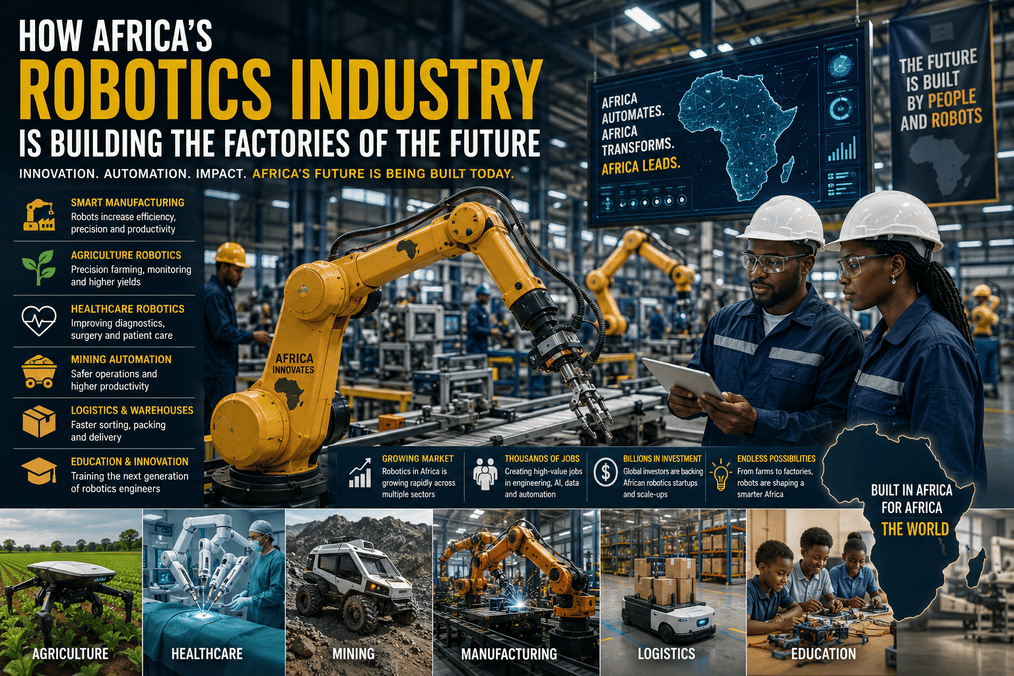
How Africa’s Robotics Industry Is Building the Factories of the Future
For decades, robotics was seen as technology reserved for wealthy nations.
Factories in Germany.
Automotive plants in Japan.
Research laboratories in the United States.
Advanced manufacturing facilities in South Korea.
Africa appeared far removed from this technological revolution.
That is changing rapidly.
Across the continent, engineers, universities, startups, and manufacturers are increasingly embracing robotics to solve real-world problems.
From improving agricultural productivity to automating industrial processes and enhancing healthcare delivery, robots are becoming powerful tools for economic growth.
The Africa Robotics Industry is no longer an idea for the future.
It is already taking shape.
Why Robotics Matters for Africa
Africa is projected to experience one of the fastest population growth rates in the world.
This creates enormous opportunities—but also significant challenges.
Growing populations require:
- More food.
- Better healthcare.
- Efficient manufacturing.
- Improved logistics.
- Stronger infrastructure.
- Higher productivity.
Robotics helps address many of these challenges.
Rather than replacing workers, robots often perform repetitive, dangerous, or highly precise tasks, allowing human workers to focus on higher-value responsibilities.
For Africa, robotics represents an opportunity to increase productivity while supporting industrial development.
The Rise of Smart Manufacturing
Manufacturing remains one of Africa’s biggest economic priorities.
Many governments hope industrialization will reduce imports, create jobs, and strengthen local economies.
Future of Smart Cities in Africa
Modern factories increasingly rely on robotics for:
- Assembly.
- Packaging.
- Welding.
- Quality inspection.
- Material handling.
- Precision manufacturing.
These technologies reduce production errors while increasing efficiency.
As Smart Manufacturing Africa continues expanding, robotics will play an increasingly important role.
South Africa Leads Industrial Robotics
South Africa remains one of Africa’s leaders in industrial automation.
Its automotive manufacturing sector already uses robotic systems for:
- Vehicle assembly.
- Welding.
- Painting.
- Component installation.
- Quality assurance.
These technologies improve production speed while maintaining high manufacturing standards.
As more industries modernize, similar technologies are expected to spread across other African countries.
Nigeria’s Robotics Ecosystem Is Growing
Nigeria’s technology ecosystem continues expanding beyond fintech.
Universities, research institutions, and private companies increasingly invest in robotics education and development.
Why Africa’s Digital Banks Are Winning the Future of Finance
Nigerian innovators are exploring robotic solutions for:
- Agriculture.
- Healthcare.
- Security.
- Manufacturing.
- Education.
- Artificial intelligence.
With Africa’s largest economy and population, Nigeria possesses enormous potential to become one of the continent’s leading robotics markets.
Universities Are Driving Innovation
Many of Africa’s robotics breakthroughs begin inside universities.
Engineering students across the continent are building robots capable of solving local problems.
Research focuses include:
- Autonomous vehicles.
- Agricultural robotics.
- Medical robotics.
- Artificial intelligence.
- Machine vision.
- Industrial automation.
University competitions and innovation hubs continue producing talented engineers who may establish tomorrow’s leading robotics companies.
Artificial Intelligence Makes Robots Smarter
Modern robots differ dramatically from earlier generations.
Thanks to artificial intelligence, today’s machines can increasingly:
- Recognize objects.
- Navigate environments.
- Analyse data.
- Learn from experience.
- Detect defects.
- Assist human workers.
Rather than performing fixed repetitive movements alone, AI-powered robots continuously improve their performance.
This combination of AI Robotics Africa creates exciting possibilities across multiple industries.
Manufacturing Is Only the Beginning
Many people associate robots exclusively with factories.
In reality, robotics now supports:
- Farming.
- Mining.
- Healthcare.
- Construction.
- Education.
- Warehousing.
- Logistics.
- Security.
- Disaster response.
This diversity explains why investors increasingly view robotics as one of Africa’s most promising technology sectors.
Governments Want Industrial Transformation
Across Africa, governments continue promoting industrialization through policies encouraging:
- Local manufacturing.
- Technology adoption.
- Innovation.
- Skills development.
- Research partnerships.
- Digital transformation.
Robotics aligns closely with these objectives.
Countries investing in automation today may strengthen their competitiveness over the coming decades.
Investors Are Watching Closely
Global investors increasingly recognise that robotics represents more than advanced machinery.
It creates opportunities in:
- Software.
- Hardware.
- Artificial intelligence.
- Data analytics.
- Manufacturing.
- Education.
- Maintenance.
- Consulting.
As African Robotics Startups continue to emerge, investment interest is expected to accelerate significantly.
Agriculture Is Becoming Smarter Through Robotics
Agriculture remains the backbone of many African economies.
Yet farmers continue facing challenges such as:
- Labour shortages.
- Climate change.
- Low productivity.
- Crop diseases.
- Rising production costs.
Robotics is helping transform these challenges into opportunities.
Modern agricultural robots can now:
- Plant seeds with greater precision.
- Monitor crop health using sensors.
- Detect pests before outbreaks spread.
- Apply fertilizers accurately.
- Harvest certain crops.
- Collect farm data in real time.
When combined with drones and artificial intelligence, robotics enables precision agriculture, allowing farmers to produce more food while reducing waste.
For a continent seeking to strengthen food security, this technology could prove revolutionary.
How African SMEs Are Using AI to Compete with Global Businesses
Healthcare Robots Are Improving Patient Care
Healthcare systems across Africa continue experiencing increasing pressure.
Growing populations require more doctors, nurses, laboratories, and hospitals.
Robotics is helping healthcare professionals improve efficiency rather than replacing them.
Examples include:
- Robotic pharmacy systems.
- Automated laboratory equipment.
- AI-assisted diagnostics.
- Rehabilitation robots.
- Hospital logistics robots.
- Telemedicine support systems.
Some hospitals already use robotic technologies to automate repetitive tasks, allowing healthcare workers to focus more directly on patient care.
As medical technology continues advancing, Robotics in Africa will likely become an essential part of modern healthcare.
Mining Companies Are Investing in Automation
Africa possesses some of the world’s richest mineral resources.
Mining companies increasingly deploy robotics to improve safety and productivity.
How Africa’s Space Industry Is Becoming a Multi-Billion-Dollar Opportunity
Modern robotic systems help:
- Inspect dangerous tunnels.
- Operate autonomous drilling equipment.
- Survey mining sites.
- Monitor equipment.
- Improve worker safety.
- Reduce operational downtime.
Rather than exposing workers to hazardous environments, robotic systems perform many dangerous inspections remotely.
This reduces accidents while increasing operational efficiency.
Warehouses Are Becoming More Efficient
Africa’s e-commerce sector continues growing rapidly.
Companies now require faster inventory management and order fulfilment.
How Mobile Money Is Powering African E-commerce
Warehouse robotics helps businesses:
- Sort packages.
- Move inventory.
- Scan products.
- Track stock automatically.
- Improve delivery preparation.
As online shopping expands, warehouse automation is expected to become increasingly common across major African cities.
Construction Is Entering the Automation Era
Construction companies increasingly rely on robotics for tasks requiring precision and efficiency.
Robotic systems assist with:
- Site surveying.
- Concrete inspection.
- Structural monitoring.
- Bricklaying research.
- Infrastructure maintenance.
- Building information modelling (BIM).
Combined with drones, robotics helps engineers monitor projects more accurately while reducing costly mistakes.
African Robotics Startups Are Emerging
Entrepreneurs across Africa are developing robotic solutions specifically designed for local challenges.
Instead of copying foreign technologies, many startups focus on solving uniquely African problems.
Current innovation areas include:
- Agricultural robots.
- Medical robotics.
- Educational robots.
- Security robots.
- Manufacturing automation.
- Artificial intelligence platforms.
These startups demonstrate that Africa is not simply importing technology.
It is increasingly creating its own.
Education Is Preparing the Next Generation
Robotics education is expanding rapidly.
Schools, universities, and technology hubs increasingly teach:
- Programming.
- Artificial intelligence.
- Electronics.
- Machine learning.
- Mechanical engineering.
- Robotics design.
Robotics competitions encourage students to build practical solutions while developing valuable technical skills.
Today’s engineering students could become tomorrow’s founders of Africa’s largest robotics companies.
Artificial Intelligence and Robotics Are Becoming One Industry
Modern robots rely heavily on artificial intelligence.
Without AI, many robotic systems cannot:
- Recognize objects.
- Interpret environments.
- Learn from experience.
- Make autonomous decisions.
- Improve performance over time.
The integration of AI and robotics creates enormous opportunities for businesses across Africa.
This convergence is expected to become one of the continent’s fastest-growing technology sectors.
Investors See Long-Term Potential
Global investment increasingly targets automation.
Why?
Because robots improve:
- Productivity.
- Accuracy.
- Operational efficiency.
- Workplace safety.
- Cost management.
African robotics companies now attract growing interest from venture capital firms seeking opportunities beyond traditional technology sectors.
As demand continues increasing, Robotics Companies Africa may become some of the continent’s most valuable future businesses.
Entrepreneurs Should Prepare Now
Many successful technology companies identify emerging trends before widespread adoption.
Robotics offers opportunities beyond manufacturing.
Businesses can provide:
- Robot maintenance.
- AI software.
- Technical consulting.
- Training programmes.
- Automation integration.
- Data analytics.
- Equipment servicing.
Entrepreneurs who begin developing expertise today may enjoy significant competitive advantages tomorrow.
Africa’s Robotics Industry by 2035
The future of the Africa Robotics Industry is no longer a distant vision—it is unfolding now.
By 2035, robotics is expected to become an essential part of nearly every major sector of the African economy.
Industry experts predict widespread adoption in:
- Manufacturing.
- Agriculture.
- Healthcare.
- Mining.
- Logistics.
- Construction.
- Education.
- Energy.
- Smart cities.
- Public infrastructure.
As artificial intelligence, cloud computing, and 5G connectivity continue advancing, robots will become more intelligent, more affordable, and more accessible to businesses of every size.
Rather than replacing workers, they will increasingly perform repetitive, hazardous, and highly precise tasks, allowing people to focus on creativity, strategy, and decision-making.
How Africa’s Drone Industry Is Creating the Next Billion-Dollar Economy
Africa Could Become a Global Robotics Hub
Historically, Africa has imported most advanced technologies.
Robotics presents an opportunity to change that narrative.
African engineers are already designing solutions tailored specifically for local industries and environments.
The continent possesses several competitive advantages:
- A young population.
- Rapid digital adoption.
- Expanding innovation hubs.
- Increasing venture capital investment.
- Growing engineering talent.
If governments continue supporting research and entrepreneurship, Africa could become a global centre for robotics innovation rather than simply a consumer of imported technology.
Business Opportunities Are Expanding Rapidly
The robotics ecosystem extends far beyond building robots.
Entrepreneurs can build profitable businesses in areas including:
Robotics Software
Developing AI systems that control autonomous machines.
Maintenance and Repairs
Providing technical support for commercial robotic systems.
Training and Certification
Preparing engineers, technicians, and drone operators for emerging industries.
Industrial Automation Consulting
Helping manufacturers modernize production facilities.
Robotics-as-a-Service (RaaS)
Allowing businesses to rent robotic equipment rather than purchasing expensive systems outright.
These opportunities demonstrate why investors increasingly view robotics as one of Africa’s fastest-growing technology markets.
Frequently Asked Questions (FAQs)
Does Africa Have a Robotics Industry?
Yes.
Countries including South Africa, Nigeria, Kenya, Rwanda, Egypt, and Morocco are investing in robotics research, education, startups, and industrial automation.
Which Industries Use Robotics in Africa?
Robotics currently supports:
- Agriculture.
- Manufacturing.
- Healthcare.
- Mining.
- Logistics.
- Construction.
- Education.
- Security.
- Infrastructure inspection.
Its applications continue expanding every year.
Can African Entrepreneurs Build Robotics Companies?
Absolutely.
Many startups focus on:
- AI software.
- Industrial automation.
- Educational robots.
- Agricultural robotics.
- Medical technologies.
- Data analytics.
Entrepreneurs do not necessarily need to manufacture robots themselves to build successful businesses.
Will Robots Eliminate Jobs?
Most experts believe robots will change jobs rather than eliminate them.
How African Startups Are Attracting Billions in Global Investment
New employment opportunities continue emerging in:
- Artificial intelligence.
- Robotics engineering.
- Software development.
- Data science.
- Automation consulting.
- Equipment maintenance.
Workers with technology skills will likely experience growing demand.
Why Is Robotics Important for Africa?
Robotics improves productivity, increases safety, reduces operational costs, and supports industrial growth.
For rapidly developing economies, these advantages are becoming increasingly important.
Lessons Entrepreneurs Can Learn
Africa’s robotics revolution offers important lessons beyond technology.
Focus on Solving Problems
Successful robotics businesses solve practical challenges.
Customers purchase solutions—not machines.
Build for Local Markets
African innovators understand local industries better than anyone.
Solutions designed for African conditions often outperform imported alternatives.
Combine Technologies
The most successful robotics companies increasingly combine:
- Artificial intelligence.
- Drones.
- Satellite data.
- Cloud computing.
- Internet of Things (IoT).
Innovation often happens where multiple technologies intersect.
Invest in Skills
Technology evolves quickly.
Continuous learning remains one of the greatest competitive advantages for entrepreneurs and professionals alike.
Why Frenovara Believes Robotics Will Shape Africa’s Future
Every technological revolution changes economies.
Steam engines transformed manufacturing.
Electricity transformed industry.
The internet transformed communication.
Artificial intelligence transformed decision-making.
Robotics now combines all these advances into physical machines capable of performing increasingly complex tasks.
For Africa, this represents an extraordinary opportunity.
Countries that invest in robotics today may become tomorrow’s industrial leaders.
Entrepreneurs who build solutions today may create the continent’s next billion-dollar companies.
Beyond the Headlines
History rarely remembers the technologies that merely looked impressive.
It remembers the technologies that changed everyday life.
Robots will not transform Africa because they are intelligent machines.
They will transform Africa because they help farmers grow more food.
Because they improve healthcare.
Because they increase factory productivity.
Because they reduce workplace injuries.
Because they allow businesses to compete globally.
Africa’s greatest advantage has never been its natural resources alone.
Its greatest resource has always been its people.
Robotics simply gives those people more powerful tools.
The future factory may not look like today’s factory.
The future farm may not resemble today’s farm.
The future hospital may operate very differently from today’s hospital.
But one thing appears increasingly certain:
The African economies that embrace robotics, automation, and artificial intelligence will likely become the continent’s strongest economic performers over the coming decades.
That’s the Frenovara perspective—looking beyond the headlines to uncover the technologies, businesses, and innovators quietly shaping Africa’s future long before they become global headlines.