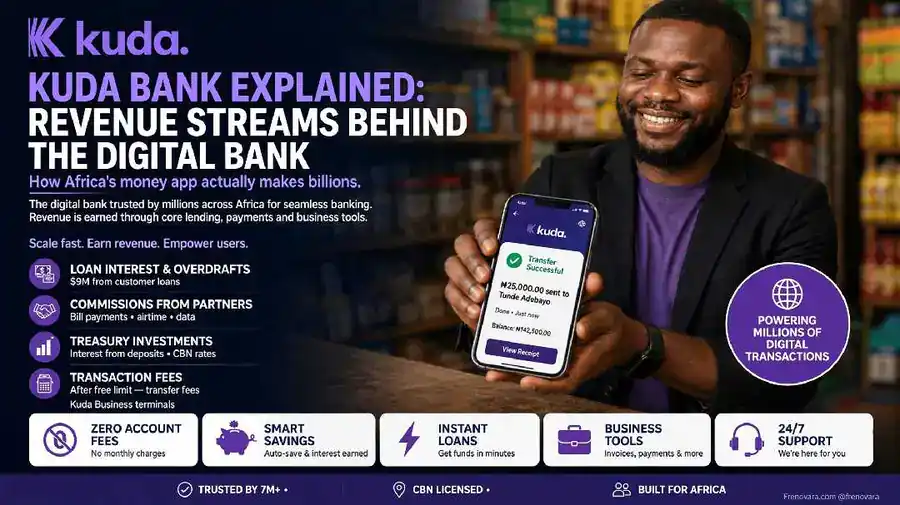

How Kuda Bank Makes Money: Revenue Streams Behind the Digital Bank
To millions of Nigerians, Kuda represents a different kind of bank.
There are no long queues.
No paperwork.
No unnecessary branch visits.
No hidden banking frustrations.
Instead, customers enjoy fast account opening, instant transfers, spending insights, automated savings, and an intuitive mobile banking experience.
For many people, it almost feels too good to be true.
If Kuda provides so many low-cost or free services, one important question naturally follows.
Kuda Bank Business Model Explained: How Africa’s Digital Bank Makes Money
How does Kuda Bank actually make money?
The answer lies in one of the most sophisticated digital banking business models operating across Africa today.
Like many successful technology companies, Kuda focuses on creating value first.
Revenue follows through multiple carefully designed financial products and services.
Understanding these revenue streams offers important lessons not only about digital banking but also about how modern fintech companies build billion-dollar businesses.
Kuda Is More Than a Bank
Most people still think of banks as buildings.
Large offices.
Long counters.
Numerous employees.
Paper files.
Kuda challenged that traditional definition.
Instead of investing heavily in physical branches, Kuda invested in technology.
Its banking platform lives primarily inside smartphones.
Customers can:
- Open accounts.
- Transfer money.
- Save automatically.
- Pay bills.
- Buy airtime.
- Request loans.
- Track expenses.
—all from one mobile application.
Removing expensive physical infrastructure dramatically reduces operational costs.
Those savings allow Kuda to provide better customer experiences while remaining financially sustainable.
Why Free Banking Doesn’t Mean Zero Revenue
One common misconception is that because certain banking services are free, the bank earns nothing.
That assumption is incorrect.
Modern fintech companies rarely rely on a single income source.
Instead, they build ecosystems.
Within those ecosystems, customers interact with multiple financial services.
Each interaction creates opportunities for revenue generation.
This diversified approach makes digital banking significantly stronger than relying solely on account maintenance charges.
How to Open a Moniepoint Business Account: Step-by-Step Guide for Entrepreneurs (2026)
Lending Remains One of Kuda’s Biggest Revenue Sources
Banks have traditionally earned substantial income by lending money.
Kuda follows the same principle.
Customers may qualify for:
- Personal loans.
- Salary advances.
- Credit facilities.
- Short-term financing.
These products generate interest income.
Interest represents one of the bank’s most reliable revenue streams.
Unlike conventional banks that often require lengthy documentation, Kuda leverages technology to assess customer eligibility much faster.
The better the bank evaluates credit risk, the healthier its lending portfolio becomes.
Card Payments Generate Interchange Revenue
Every day, millions of Kuda customers make payments using their debit cards.
Whenever a customer pays for:
- Groceries.
- Fuel.
- Restaurant meals.
- Online subscriptions.
- Shopping.
multiple organisations participate behind the scenes.
Payment processors.
Card schemes.
Banks.
Merchants.
Each transaction generates processing fees.
A portion of those fees flows back to Kuda.
This income is known as interchange revenue.
Although individual transactions produce relatively small earnings, millions of card payments collectively generate substantial income.
How Moniepoint Makes Money: Inside Its Billion-Dollar Business Model
Digital Payments Power Additional Revenue
Kuda customers increasingly use the platform for everyday financial activities.
Examples include:
- Bank transfers.
- Utility payments.
- Cable television subscriptions.
- Internet services.
- Airtime purchases.
- Merchant payments.
Every transaction strengthens customer engagement while creating opportunities for payment-related revenue through financial infrastructure partnerships.
The greater the transaction volume, the stronger the platform’s long-term earning potential.
Business Banking Opens New Opportunities
Retail banking remains important.
However, businesses represent another significant revenue opportunity.
Entrepreneurs require:
- Business accounts.
- Payment collection tools.
- Expense management.
- Payroll solutions.
- Financial reporting.
Supporting businesses enables Kuda to diversify beyond consumer banking while generating additional transaction volume.
Small and medium-sized enterprises continue representing one of Africa’s fastest-growing financial markets.
Technology Keeps Operating Costs Low
Traditional banks spend enormous amounts maintaining:
- Branch offices.
- Physical infrastructure.
- Paper documentation.
- Administrative operations.
Kuda’s digital-first approach reduces many of these expenses.
Instead of investing primarily in buildings, the company invests in:
- Software development.
- Cybersecurity.
- Artificial Intelligence.
- Customer experience.
- Digital infrastructure.
Lower operational costs improve profitability while allowing the company to remain highly competitive.
Why Digital Payments Continue to Transform Nigeria’s Economy in 2026
Strategic Partnerships Create Hidden Revenue
One of Kuda Bank’s greatest strengths lies in collaboration.
Rather than building every financial service from scratch, Kuda partners with multiple organisations across the financial ecosystem.
These partnerships include:
- Payment processors.
- Card networks.
- Insurance providers.
- Investment platforms.
- Financial technology companies.
- Business solution providers.
Each partnership expands Kuda’s product offerings while creating additional revenue opportunities.
For example, whenever customers complete certain financial transactions through integrated services, Kuda may earn commissions or service fees from partner organisations.
This model allows the bank to generate income without directly increasing customer charges.
Embedded Finance Is Becoming a Major Opportunity
The future of banking extends far beyond traditional bank accounts.
Increasingly, financial services are being embedded into everyday digital experiences.
This concept is known as embedded finance.
Instead of visiting a bank separately, customers can access financial products directly inside:
- Shopping platforms.
- Business software.
- Ride-hailing applications.
- E-commerce websites.
- Subscription services.
As Kuda expands its technology infrastructure, embedded finance could become one of its fastest-growing revenue streams.
By powering financial services behind other digital platforms, Kuda creates new business opportunities while reaching customers who may never visit a traditional bank.
Treasury and Investment Income
Like conventional financial institutions, Kuda also generates revenue by managing customer deposits responsibly.
Money deposited by customers does not simply remain idle.
Banks invest portions of these funds in low-risk financial instruments such as:
- Government securities.
- Treasury bills.
- Fixed-income investments.
- Short-term financial instruments.
Returns earned from these investments contribute to overall profitability while maintaining sufficient liquidity for customer withdrawals.
This income source is less visible to customers but remains important within the overall banking model.
Premium Financial Products
Although Kuda became popular for affordable banking, the company continues introducing products designed for customers with more advanced financial needs.
As its ecosystem expands, premium offerings may include:
- Enhanced business accounts.
- Advanced spending analytics.
- Exclusive financial services.
- Higher transaction limits.
- Premium customer support.
- Wealth management products.
These services provide opportunities for recurring subscription or service-based revenue without affecting the affordability of standard banking features.
OPay: How Nigeria’s Fintech Giant Is Revolutionizing Digital Banking and Financial Inclusion
Artificial Intelligence Is Improving Profitability
Artificial Intelligence has become one of Kuda’s most valuable business tools.
Rather than replacing human decision-making entirely, AI enhances operational efficiency across several departments.
Applications include:
Fraud Detection
AI continuously monitors transactions for suspicious activity.
Potential fraud can often be identified within seconds.
This reduces financial losses while protecting customers.
Credit Assessment
Instead of relying solely on traditional documentation, AI evaluates customer behaviour using:
- Transaction patterns.
- Spending habits.
- Savings history.
- Income consistency.
- Repayment records.
This improves lending accuracy while reducing loan defaults.
Customer Service
AI-powered chatbots assist customers with routine banking questions.
This allows customer support teams to focus on more complex issues while reducing operational costs.
Personalized Banking
Artificial Intelligence also enables Kuda to recommend:
- Better savings plans.
- Spending insights.
- Budget recommendations.
- Relevant financial products.
Greater personalization often leads to stronger customer engagement.
Customer Growth Drives Long-Term Revenue
Many people focus only on today’s revenue.
Technology companies often think differently.
Kuda understands that every new customer increases future earning potential.
Each active customer creates opportunities for:
- Card transactions.
- Loan products.
- Business banking.
- Investment services.
- Payment processing.
- Financial partnerships.
As transaction volume grows, so does the bank’s overall revenue.
This explains why Kuda continues investing heavily in improving customer experience rather than maximizing short-term profits.
PalmPay: How the Fintech Giant Is Transforming Digital Payments and Financial Inclusion in Nigeria
Why Investors Continue Funding Kuda
Since its launch, Kuda has attracted significant funding from international investors.
Their confidence is driven by several long-term trends.
These include:
- Africa’s rapidly growing population.
- Increasing smartphone adoption.
- Rising internet penetration.
- Expanding digital commerce.
- Greater financial inclusion.
- Strong demand for digital banking.
Investors recognise that digital banking remains in its early stages across much of Africa.
Companies capable of serving millions of customers efficiently may become extremely valuable over time.
Kuda continues positioning itself for that future.
Competition Encourages Innovation
The digital banking space has become increasingly competitive.
Kuda competes alongside organisations such as:
- Moniepoint.
- OPay.
- PalmPay.
- FairMoney.
- Traditional commercial banks.
Rather than viewing competition negatively, Kuda benefits from continuous innovation.
Competition encourages:
- Better products.
- Improved customer service.
- Faster technology adoption.
- Lower banking costs.
- Increased financial accessibility.
Ultimately, consumers become the biggest beneficiaries.
The Future of Kuda Bank
Kuda’s success story is still unfolding.
While the company has already transformed digital banking in Nigeria, its long-term ambitions extend far beyond becoming another successful fintech startup.
Several trends are expected to shape Kuda’s next phase of growth.
Artificial Intelligence
Artificial Intelligence will continue improving:
- Fraud detection.
- Customer service.
- Credit scoring.
- Personalised financial advice.
- Financial risk management.
- Regulatory compliance.
As AI becomes more sophisticated, digital banking will become faster, safer, and increasingly personalised.
How GTCO Built One of Africa’s Most Valuable Financial Institutions in 2026
Expansion Across Africa
Nigeria represents one of Africa’s largest fintech markets, but it is only one part of a much larger opportunity.
Millions of Africans remain underserved by traditional banking systems.
Digital banking allows companies like Kuda to expand without constructing expensive branch networks.
Future expansion into additional African countries could significantly increase:
- Customer acquisition.
- Transaction volumes.
- Revenue opportunities.
- Market valuation.
More Business Banking Services
Small businesses remain the backbone of Africa’s economy.
Kuda is expected to continue expanding products designed specifically for entrepreneurs, including:
- Business accounts.
- Merchant payment solutions.
- Payroll services.
- Working capital financing.
- Expense management.
- Financial analytics.
Supporting businesses creates stronger customer relationships while increasing transaction activity.
Embedded Finance
The future of banking is becoming increasingly invisible.
Financial services will continue integrating directly into:
- E-commerce platforms.
- Transportation services.
- Healthcare systems.
- Educational platforms.
- Business software.
Rather than customers visiting banks, banking will increasingly come to customers.
Kuda appears well-positioned to benefit from this transformation.
Five Lessons Entrepreneurs Can Learn from Kuda
Kuda’s journey offers practical lessons that apply far beyond financial technology.
1. Solve Problems People Already Have
Kuda succeeded because it simplified banking.
Businesses grow fastest when they remove existing frustrations rather than creating unnecessary complexity.
2. Technology Can Reduce Costs
Instead of building hundreds of expensive branches, Kuda built software.
Innovation often allows businesses to deliver better services while lowering operational expenses.
3. Customer Experience Creates Loyalty
Simple registration.
Fast transactions.
Clean interface.
Excellent user experience encouraged millions of Nigerians to embrace digital banking.
Customers rarely remain loyal to companies that complicate their lives.
Top 15 Most Influential Politicians in Nigeria Today: The Leaders Shaping Nigeria’s Future
4. Growth Comes Before Profit
Many technology companies initially prioritise building strong customer bases.
Kuda invested heavily in growth before maximising profitability.
Long-term thinking often produces stronger businesses.
5. Never Stop Innovating
The fintech industry evolves rapidly.
Companies that continually improve their products remain competitive.
Those that stop innovating eventually become irrelevant.
Innovation remains a continuous process—not a one-time achievement.
Frequently Asked Questions (FAQs)
What Is Kuda Bank?
Kuda Bank is a licensed Nigerian digital bank (neobank) providing banking services primarily through a mobile application rather than physical branches.
How Does Kuda Bank Make Money?
Kuda earns revenue through:
- Interest on loans.
- Card interchange fees.
- Payment processing.
- Business banking.
- Financial partnerships.
- Treasury investments.
- Premium financial products.
Is Kuda Really Free?
Many everyday banking services remain free or low-cost.
However, Kuda still generates revenue through multiple financial activities operating behind the scenes.
Who Owns Kuda Bank?
Kuda was founded by Babs Ogundeyi and Musty Mustapha, who launched the company with the goal of making banking simpler and more accessible across Africa.
Top 20 Richest Businessmen in Nigeria in 2026
Is Kuda Safe?
Yes.
Kuda operates under regulatory oversight and invests heavily in:
- Encryption.
- Fraud detection.
- Cybersecurity.
- Customer authentication.
- Compliance systems.
Users should still follow good online security practices by enabling two-factor authentication and protecting their account credentials.
Digital Banking Is Africa’s Next Financial Revolution
The success of Kuda demonstrates how technology continues transforming financial services across Africa.
Traditional banking once depended heavily on physical infrastructure.
Today, millions of customers complete nearly every financial transaction from smartphones.
This shift benefits everyone.
Consumers enjoy greater convenience.
Businesses process payments faster.
Entrepreneurs gain easier access to financial services.
Governments benefit from greater financial transparency.
As digital banking adoption continues accelerating, companies capable of combining innovation with customer trust are likely to dominate Africa’s financial future.
Kuda has positioned itself as one of those companies.
Beyond the Headlines
Kuda Bank is often described as “the bank of the free.”
But its greatest innovation is not free transfers.
It is proving that banking can be reimagined entirely.
By replacing buildings with technology, paperwork with automation, and bureaucracy with simplicity, Kuda has shown that modern financial institutions no longer need to look like traditional banks.
Its business model demonstrates an important principle shared by many successful technology companies.
When businesses create enough value for customers, revenue follows through multiple sustainable channels.
As Africa’s digital economy continues expanding, Kuda’s journey offers an important reminder.
The future belongs to organisations willing to challenge old assumptions, embrace innovation, and continuously improve the customer experience.