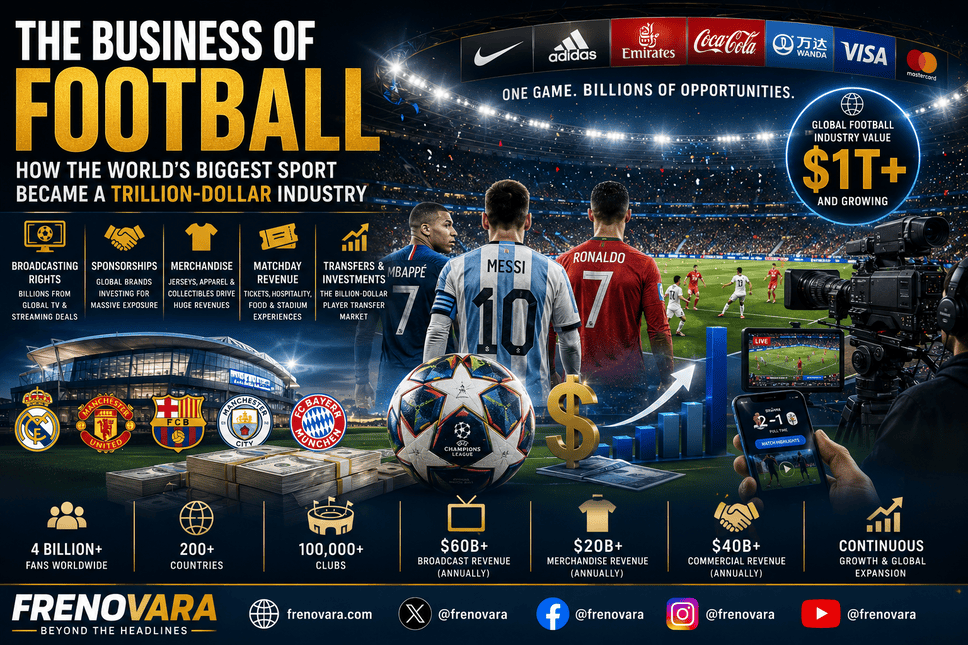
The Business of Football: How the World’s Biggest Sport Became a Trillion-Dollar Industry
Every weekend, billions of people around the world watch football.
They celebrate goals.
Debate refereeing decisions.
Buy jerseys.
Travel to stadiums.
Subscribe to streaming platforms.
Support their favourite clubs.
For many supporters, football is simply entertainment.
For businesses, however, football represents one of the most valuable industries on Earth.
Behind every goal scored lies an enormous commercial ecosystem involving broadcasters, airlines, banks, betting companies, apparel manufacturers, technology firms, media companies, sponsors, investors, and governments.
Football is no longer just the world’s most popular sport.
It has become one of the world’s largest businesses.
From the English Premier League to the FIFA World Cup, football generates hundreds of billions of dollars in economic activity every year.
Its influence extends far beyond the pitch.
Football Is the World’s Most Popular Sport
No other sport enjoys football’s global reach.
The game is played in virtually every country.
Professional leagues exist on every inhabited continent.
The FIFA World Cup attracts billions of viewers.
The UEFA Champions League reaches audiences in nearly every market.
Major clubs have supporters spread across every continent.
This worldwide popularity provides the foundation for football’s enormous commercial success.
Where attention exists, business follows.
From Local Clubs to Global Brands
Football clubs once relied primarily on ticket sales.
Today, many clubs operate as international entertainment companies.
Some clubs generate revenue from supporters who may never visit their stadiums.
Modern football clubs now function as global brands.
They sell:
- Merchandise.
- Digital subscriptions.
- Television rights.
- Sponsorship packages.
- Mobile applications.
- Streaming content.
- Tours.
- Fan experiences.
The shirt worn by supporters represents far more than club colours.
It is a global product.
Broadcasting Changed Everything
Television transformed football forever.
Before broadcasting agreements became widespread, clubs depended heavily on matchday attendance.
Today, broadcasting rights represent one of football’s largest revenue sources.
Broadcasters pay enormous sums because football consistently delivers massive audiences.
Every major competition negotiates television deals worth billions of dollars.
These include:
- Domestic league rights.
- International broadcasting rights.
- Digital streaming.
- Mobile broadcasting.
- Highlight packages.
For broadcasters, football remains one of the safest investments because supporters continue watching live matches in huge numbers.
Sponsorship Has Become Big Business
Walk into any football stadium and you’ll immediately notice commercial branding.
Sponsors appear everywhere.
On:
- Shirts.
- Training kits.
- Stadium advertising boards.
- Press conference backdrops.
- Social media campaigns.
- Television interviews.
Global companies invest billions because football delivers worldwide visibility.
Sponsors benefit from emotional connections supporters have with their clubs.
When fans celebrate victories, brands become part of those positive experiences.
Merchandise Generates Enormous Revenue
Supporters proudly purchase:
- Jerseys.
- Jackets.
- Scarves.
- Caps.
- Training wear.
- Collectibles.
- Footballs.
Every season brings new kit launches.
Limited editions frequently sell out within hours.
For many elite clubs, merchandise sales contribute hundreds of millions of dollars annually.
Supporters are not simply buying clothing.
They are buying identity.
Belonging.
Pride.
That emotional connection makes football merchandise remarkably valuable.
Football Has Become a Digital Industry
Today’s football supporters consume content constantly.
Before matches.
During matches.
After matches.
Across platforms such as:
- YouTube.
- Instagram.
- Facebook.
- TikTok.
- X.
- Streaming services.
- Podcasts.
Every interaction creates commercial opportunities.
Football clubs now employ:
- Content creators.
- Social media managers.
- Data analysts.
- Video producers.
- Digital marketers.
The modern football club increasingly resembles a global media company.
Why Investors Love Football
Private investors increasingly purchase football clubs.
Why?
Because football offers:
- Global audiences.
- Strong brand loyalty.
- Growing commercial revenues.
- Valuable intellectual property.
- International expansion opportunities.
Some investors see clubs as long-term assets capable of increasing significantly in value.
Others view football as an opportunity to expand their business empires.
Regardless of motivation, investment continues growing.
Football has become one of the world’s most attractive entertainment industries.
How Football Clubs Actually Make Money
Many fans assume football clubs survive by selling match tickets.
In reality, ticket sales represent only one piece of a much larger financial ecosystem.
Modern football clubs operate like multinational corporations with multiple income streams.
The biggest clubs generate revenue from:
- Broadcasting rights.
- Commercial sponsorships.
- Matchday income.
- Merchandise sales.
- Digital content.
- Player transfers.
- Hospitality services.
- Licensing agreements.
- International tours.
The clubs that successfully diversify these revenue sources remain financially competitive, even during challenging seasons.
Broadcasting Rights: Football’s Biggest Goldmine
If football has a financial engine, broadcasting rights are at its core.
Television networks and streaming platforms compete fiercely for the privilege of showing live matches because football consistently attracts massive audiences.
Leagues negotiate broadcasting contracts worth billions of dollars.
These agreements are divided into:
Domestic Rights
Matches shown within the league’s home country.
International Rights
Broadcasting deals sold across global markets.
For elite competitions, international rights have become increasingly valuable as football continues expanding into Asia, Africa, and North America.
The larger a club’s audience, the greater the commercial value of its matches.
Sponsorship Is More Than Shirt Logos
Football sponsorship extends far beyond the sponsor displayed across the front of a jersey.
Today’s clubs maintain multiple commercial partnerships, including:
- Kit manufacturers.
- Airline partners.
- Financial institutions.
- Beverage companies.
- Telecommunications firms.
- Technology companies.
- Betting brands.
- Automotive manufacturers.
Each agreement contributes additional revenue.
Some elite clubs sign dozens of sponsorship contracts simultaneously, making commercial partnerships one of their fastest-growing income streams.
Matchday Revenue Still Matters
Although broadcasting dominates football finances, matchday income remains significant.
Every home game generates revenue through:
- Ticket sales.
- VIP hospitality.
- Executive suites.
- Food and beverages.
- Parking.
- Stadium tours.
- Museum admissions.
Modern stadiums now operate throughout the year rather than only on matchdays.
Many venues host:
- Concerts.
- Conferences.
- Corporate events.
- Exhibitions.
- Community activities.
This allows clubs to generate income even during the off-season.
Merchandise Builds Global Brands
Supporters rarely stop buying club merchandise.
Popular products include:
- Home jerseys.
- Away kits.
- Training apparel.
- Scarves.
- Hats.
- Backpacks.
- Footballs.
- Lifestyle collections.
Limited-edition kit launches frequently sell out within hours.
The world’s biggest clubs generate enormous revenue simply because supporters proudly wear their colours.
Merchandise transforms loyalty into long-term commercial success.
The Billion-Dollar Transfer Market
Player transfers represent one of football’s most fascinating financial systems.
When clubs purchase players, transfer fees can reach extraordinary levels.
Beyond the headline fee, deals often include:
- Performance bonuses.
- Installment payments.
- Sell-on clauses.
- Agent commissions.
- Image rights.
- Loyalty bonuses.
Some clubs also generate substantial income by developing young players and selling them for profit.
Successful academies have become valuable business assets.
Digital Media Has Created New Revenue Streams
Football clubs no longer depend solely on television.
Today, they operate sophisticated digital media businesses.
Revenue increasingly comes from:
- YouTube monetization.
- Subscription platforms.
- Mobile applications.
- Premium content.
- Social media partnerships.
- Digital advertising.
- Streaming services.
Every goal, interview, behind-the-scenes video, and training clip creates opportunities to engage supporters while generating commercial income.
Football has become a content business.
Sports Betting Has Changed Football Economics
Licensed betting companies invest heavily in football because the sport attracts enormous global audiences.
Their involvement includes:
- Sponsorship agreements.
- Advertising.
- Statistical partnerships.
- Data licensing.
Meanwhile, technology firms provide:
- Live statistics.
- Predictive analytics.
- Real-time odds.
- Match data.
This has created an entirely new ecosystem surrounding football.
Financial Fair Play
As football revenues increased, spending also exploded.
To encourage financial sustainability, regulations were introduced requiring clubs to operate responsibly.
Financial Fair Play (FFP) aims to:
- Reduce excessive losses.
- Encourage responsible spending.
- Promote financial stability.
- Protect long-term competitiveness.
Although debates continue regarding its effectiveness, financial management has become just as important as tactical management.
Why Some Clubs Are Worth Billions
Football club valuations continue reaching record highs.
Investors value clubs based on:
- Global fan base.
- Commercial revenue.
- Broadcasting income.
- Brand strength.
- Stadium ownership.
- Youth academy.
- Long-term growth potential.
Today’s biggest clubs are among the world’s most valuable sports organizations.
Their value extends far beyond the players currently wearing the shirt.
It lies in the brand.
FIFA’s Business Model Explained
At the centre of world football sits one organization that has transformed the sport into one of the largest commercial enterprises on Earth—FIFA.
While many fans associate FIFA only with organizing tournaments, it actually operates one of the world’s most valuable sports businesses.
Its primary revenue streams include:
Broadcasting Rights
FIFA earns billions by selling television and streaming rights for the FIFA World Cup and other competitions.
These agreements account for the largest share of FIFA’s income.
Commercial Sponsorship
Global brands pay enormous sums to become official FIFA partners.
These partnerships provide worldwide exposure through:
- Stadium branding.
- Television coverage.
- Digital campaigns.
- Official events.
- Fan experiences.
Licensing
FIFA licenses its name and intellectual property for:
- Video games.
- Official merchandise.
- Collectibles.
- Apparel.
- Trading cards.
This creates recurring income even between tournaments.
Ticketing & Hospitality
Millions of supporters purchase match tickets every tournament.
Premium hospitality packages further increase FIFA’s commercial revenue.
Why Governments Compete to Host Football Tournaments
Hosting major football tournaments extends far beyond sport.
Governments see football as an opportunity to stimulate economic growth.
Benefits often include:
- Infrastructure development.
- Increased tourism.
- International media exposure.
- Foreign investment.
- Job creation.
- Urban regeneration.
Although hosting requires significant investment, many countries believe the long-term economic benefits justify the costs.
Football’s Influence on Other Industries
The football industry supports countless businesses outside the sport itself.
Industries benefiting include:
Aviation
Fans, teams, media crews, and officials travel internationally throughout the season.
Hospitality
Hotels, restaurants, bars, and entertainment venues experience increased demand during major competitions.
Fashion
Football shirts have become global fashion items.
Collaborations between clubs and luxury brands continue expanding.
Technology
Artificial intelligence, wearable devices, analytics platforms, and streaming technologies all play increasingly important roles.
Media
Television, newspapers, podcasts, YouTube channels, and sports websites generate enormous audiences through football content.
Football drives the global media economy every single day.
Five Business Lessons Entrepreneurs Can Learn From Football
Football offers valuable lessons for entrepreneurs and business leaders.
1. Build a Strong Brand
Supporters remain loyal because football clubs invest in identity.
Businesses should do the same.
2. Diversify Income
The biggest clubs never rely on a single revenue source.
Successful companies build multiple streams of income.
3. Develop Talent
Youth academies create future stars.
Businesses that invest in people build long-term success.
4. Think Globally
The world’s biggest clubs have supporters in every continent.
Digital technology allows businesses to reach international audiences more easily than ever.
5. Adapt to Change
Football constantly evolves through technology, data, and innovation.
Businesses that fail to adapt often fall behind.
Frequently Asked Questions (FAQs)
H3: How Much Is the Global Football Industry Worth?
The global football economy generates hundreds of billions of dollars annually through broadcasting, sponsorships, merchandising, ticket sales, digital media, tourism, and commercial partnerships.
What Is the Biggest Source of Football Revenue?
Broadcasting rights remain the largest revenue source for most major leagues, FIFA, UEFA, and elite football clubs.
Why Are Football Clubs Worth Billions?
Club valuations depend on:
- Brand strength.
- Fan base.
- Commercial income.
- Broadcasting revenue.
- Stadium assets.
- Global market reach.
Which Football League Generates the Most Money?
The English Premier League is widely regarded as the world’s most commercially successful domestic football league due to its broadcasting agreements and global audience.
Why Is Football So Attractive to Investors?
Football provides:
- Global audiences.
- Loyal supporters.
- Strong commercial opportunities.
- Valuable intellectual property.
- Growing digital revenues.
These factors make elite clubs attractive long-term investments.
The Future of Football Business
Football continues evolving rapidly.
Emerging trends include:
- Artificial Intelligence scouting.
- Virtual Reality fan experiences.
- Blockchain ticketing.
- Digital collectibles.
- Streaming-first broadcasting.
- Smart stadium technology.
- Data-driven player recruitment.
- Women’s football commercialization.
The next decade could transform football even more dramatically than the previous twenty years.
Beyond the Headlines
Most supporters see football as ninety minutes of excitement.
Business leaders see something much larger.
They see an ecosystem where media, finance, technology, entertainment, tourism, fashion, and marketing converge into one of the world’s most valuable industries.
The beauty of football lies not only in spectacular goals or dramatic victories.
Its true power lies in its ability to unite billions of people while simultaneously creating opportunities for businesses of every size—from local vendors outside stadiums to multinational corporations investing billions in sponsorships.
The game has evolved from neighbourhood pitches into boardrooms, stock exchanges, streaming platforms, data centres, and innovation labs.
Football is no longer simply the world’s favourite sport.
It is one of the world’s greatest businesses.
At Frenovara, we believe understanding the business behind football helps readers appreciate the game from a completely different perspective—one where every pass, every sponsorship, every broadcast, and every jersey sold contributes to an economic machine that shapes industries across the globe.