
How MTN Makes Billions Across Africa: Inside the Business Strategy of Africa’s Telecom Giant
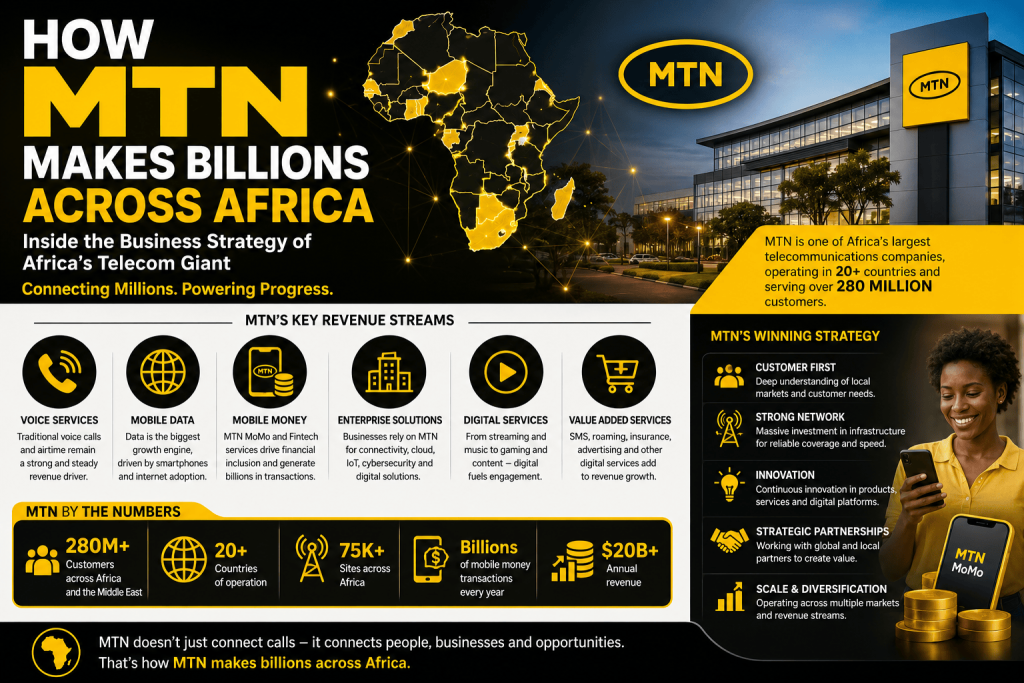
In today’s digital economy, few companies have had as much impact on Africa’s development as MTN. From connecting remote villages to enabling digital payments and powering internet access for millions, MTN has become one of the most influential businesses on the continent.
What began as a telecommunications company in South Africa has evolved into a multinational giant serving tens of millions of customers across numerous African and Middle Eastern markets. Its yellow brand has become instantly recognizable in countries such as Nigeria, Ghana, Uganda, Rwanda, Cameroon, Zambia, South Africa, and beyond.
But how exactly does MTN generate billions of dollars in revenue every year? What business strategies have allowed it to become one of Africa’s most successful corporations?
The answer lies in a combination of scale, innovation, digital transformation, financial services, and a deep understanding of African markets.
The Origins of MTN
MTN was founded in 1994 in South Africa, shortly after the country transitioned into a new democratic era. At the time, mobile telecommunications was still in its infancy across much of Africa.
Fixed telephone infrastructure was limited, especially in rural areas. Installing traditional landlines across vast regions would have required enormous investments.
MTN recognized an opportunity.
Instead of relying on expensive fixed-line networks, mobile technology offered a faster and more cost-effective way to connect millions of people.
As mobile phone adoption increased, MTN positioned itself as one of the pioneers of Africa’s telecommunications revolution.
Building a Massive Customer Base
One of the biggest reasons MTN generates billions is scale.
The company serves millions of subscribers across multiple countries.
Every day, customers use MTN services for:
- Voice calls
- Internet access
- Mobile money transactions
- Business communications
- Digital entertainment
- International remittances
Even relatively small payments become significant when multiplied across millions of users.
For example, if millions of customers spend a modest amount each month on data bundles, voice services, or financial transactions, the combined revenue becomes enormous.
Scale remains one of MTN’s most powerful competitive advantages.
The Core Revenue Streams Behind MTN’s Success
MTN does not rely on a single source of income. Instead, it generates revenue from several key business segments.
1. Voice Services
Although internet usage has grown dramatically, voice communication remains an important revenue source.
Customers continue to purchase:
- Airtime
- Call bundles
- International calling packages
Businesses also rely on voice communication for customer service and operations.
Despite changing consumer habits, voice services continue to contribute significantly to MTN’s earnings.
2. Mobile Data Services
Data has become one of MTN’s most important growth engines.
The rise of smartphones has transformed how people communicate, work, learn, and entertain themselves.
Customers purchase data bundles for:
- Social media
- Video streaming
- Online education
- Remote work
- E-commerce
- Messaging applications
As internet consumption increases across Africa, data revenues continue to expand.
Many analysts view mobile internet services as one of the most important drivers of MTN’s future growth.
3. Mobile Money and Fintech
Perhaps one of MTN’s most exciting business segments is financial technology.
Millions of Africans remain underserved by traditional banking institutions.
MTN recognized this gap and developed mobile financial services that allow users to:
- Send money
- Receive payments
- Pay bills
- Purchase airtime
- Save funds
- Conduct business transactions
Through mobile money platforms, customers can access financial services directly from their mobile phones.
This has created a powerful new revenue stream while promoting financial inclusion across the continent.
For many markets, fintech represents one of MTN’s fastest-growing business opportunities.
Why Mobile Money Is So Important
Traditional banking infrastructure can be expensive and difficult to access in certain regions.
Mobile money solves several challenges:
- Limited banking access
- Long travel distances to bank branches
- High transaction costs
- Financial exclusion
By leveraging its existing telecommunications infrastructure, MTN can provide financial services efficiently and at scale.
This combination of telecommunications and financial technology creates a significant competitive advantage.
4. Enterprise and Business Solutions
MTN serves not only individual consumers but also businesses.
Corporate clients require:
- Internet connectivity
- Cloud services
- Cybersecurity solutions
- Communication platforms
- Data management systems
As African businesses increasingly embrace digital transformation, demand for these services continues to grow.
Enterprise solutions often generate substantial revenue because businesses typically purchase larger and more sophisticated service packages.
5. Digital Services and Content
MTN has expanded beyond traditional telecommunications.
The company now participates in various digital sectors, including:
- Streaming services
- Music platforms
- Mobile applications
- Educational content
- Gaming solutions
These digital offerings help diversify revenue while improving customer engagement.
The strategy ensures MTN remains relevant in a rapidly evolving technological landscape.
The Power of Infrastructure Investment
One of MTN’s greatest strengths is its willingness to invest heavily in infrastructure.
Building telecommunications networks requires:
- Cell towers
- Fiber-optic networks
- Data centers
- Spectrum licenses
- Power systems
These investments require significant capital.
However, once established, the infrastructure creates barriers that make it difficult for competitors to replicate quickly.
This gives MTN a strong competitive position in many markets.
Expanding Across Multiple Countries
Unlike companies that focus on a single market, MTN pursued regional expansion.
Operating across multiple countries provides several advantages:
Revenue Diversification
Economic challenges in one country may be offset by stronger performance elsewhere.
Larger Customer Base
Expansion increases the number of potential subscribers.
Economies of Scale
The company can spread costs across multiple markets.
Brand Strength
A regional presence strengthens recognition and trust.
This expansion strategy has been central to MTN’s long-term growth. Check out the Top 10 Richest Entrepreneurs in Africa in 2026
Understanding African Consumers
A major factor behind MTN’s success is its understanding of local markets.
Africa is not a single market.
Consumer behavior varies across countries based on:
- Culture
- Income levels
- Technology adoption
- Infrastructure development
- Regulatory environments
MTN adapts its products and services to meet local needs.
This flexibility has allowed the company to remain competitive across diverse regions.
The Digital Transformation Opportunity
Africa’s digital economy continues to grow rapidly.
Several trends support MTN’s future growth:
Smartphone Adoption
More consumers are gaining access to internet-enabled devices.
E-Commerce Growth
Online shopping continues to expand.
Remote Work
Digital connectivity has become essential for modern work environments.
Online Education
Students increasingly rely on internet access for learning.
Digital Payments
Cashless transactions are becoming more common.
MTN sits at the center of these developments, providing the infrastructure that powers digital activities.
Challenges Facing MTN
Despite its success, MTN faces several challenges.
Regulatory Compliance
Telecommunications companies operate within highly regulated industries.
Governments often impose rules related to:
- Licensing
- Consumer protection
- Data privacy
- Competition
Compliance requires ongoing investment and adaptation.
Infrastructure Costs
Maintaining and upgrading networks can be expensive.
The company must continually invest to meet growing demand.
Competition
MTN competes with other telecommunications providers across multiple markets.
Maintaining market leadership requires continuous innovation.
Economic Volatility
Currency fluctuations and economic instability can impact profitability.
Managing these risks is essential for long-term success.
Lessons Entrepreneurs Can Learn from MTN
MTN’s journey offers several valuable lessons.
Solve Large Problems
The company addressed a critical need: communication.
Businesses that solve widespread problems often achieve significant growth.
Think Long-Term
Building telecommunications networks requires patience and long-term planning.
Diversify Revenue Streams
MTN earns income from multiple sources rather than relying on a single product.
Invest in Technology
Technology creates efficiency, scalability, and competitive advantages.
Understand Your Customers
Successful businesses adapt to the needs of their target markets.
These principles apply to companies of all sizes.
The Future of MTN
Looking ahead, MTN is expected to focus heavily on:
- 5G technology
- Mobile financial services
- Artificial intelligence
- Digital platforms
- Enterprise solutions
- Data services
As Africa’s population grows and internet adoption increases, demand for digital connectivity is likely to expand significantly.
This creates enormous opportunities for companies positioned at the center of the digital economy.
MTN’s investments in technology and innovation suggest it intends to remain a leading force in Africa’s telecommunications sector for years to come.
Conclusion
MTN’s success story is a powerful example of how strategic vision, infrastructure investment, and customer-focused innovation can create a multi-billion-dollar business.
By providing communication services, internet access, financial solutions, and digital platforms, MTN has become much more than a telecommunications company. It has evolved into a critical enabler of Africa’s digital transformation.
Its ability to scale across multiple markets, diversify revenue streams, and adapt to changing consumer needs has helped it generate billions while maintaining a strong competitive position.
For entrepreneurs and business leaders, MTN demonstrates the importance of solving real-world problems, embracing innovation, and building businesses capable of creating long-term value. As Africa’s digital economy continues to expand, MTN’s influence and opportunities are likely to grow alongside it.