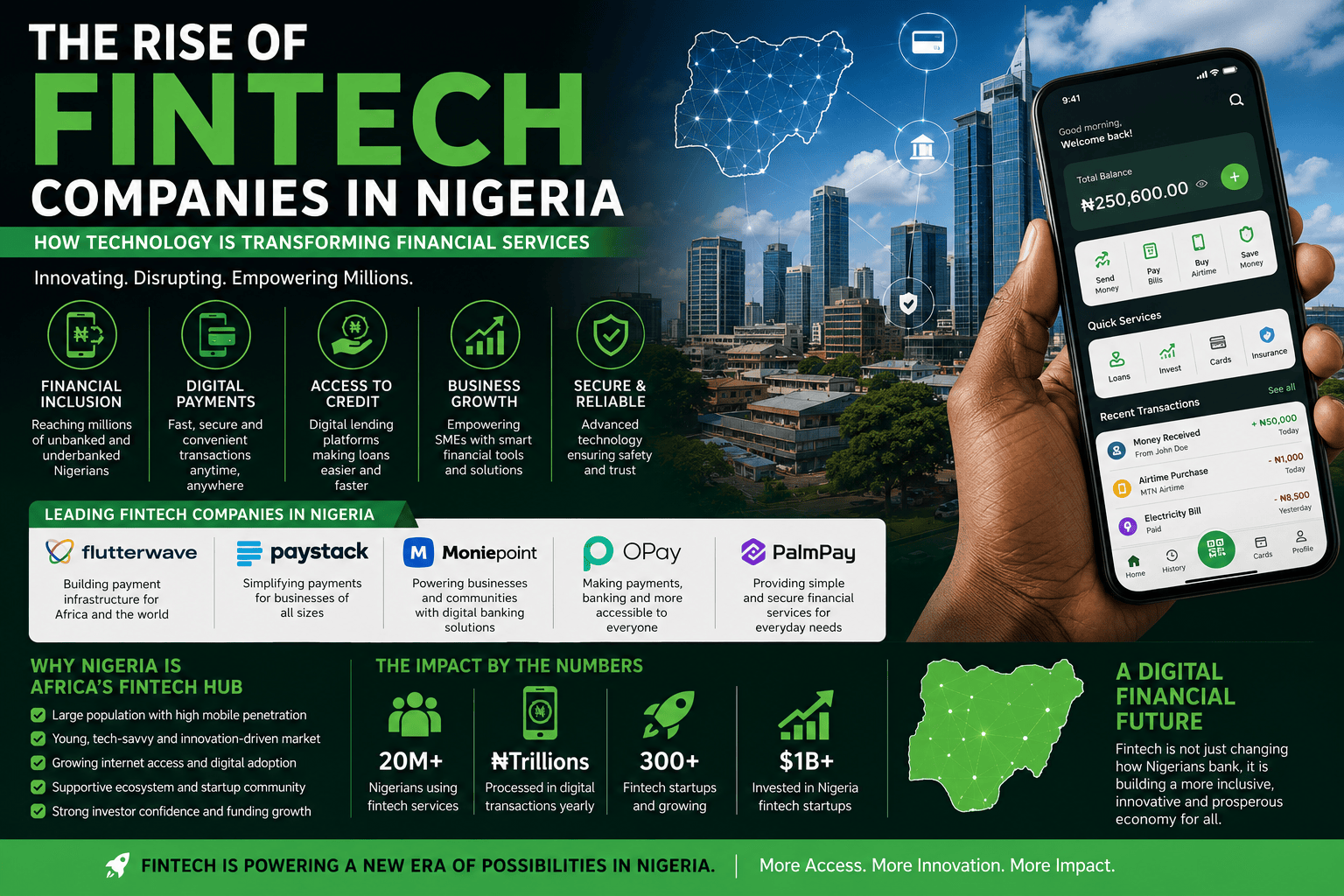
The Rise of Fintech Companies in Nigeria: How Technology Is Transforming Financial Services
Nigeria’s financial services industry has undergone a remarkable transformation over the past decade. What was once a sector dominated almost entirely by traditional banks has evolved into a dynamic ecosystem powered by technology-driven companies offering innovative financial solutions.
Today, millions of Nigerians can send money, receive payments, save, invest, borrow funds, and conduct business transactions directly from their smartphones. This shift has been largely driven by fintech companies that have identified gaps in the traditional banking system and developed digital solutions to address them.
From payment processing platforms to mobile banking applications and digital lending services, Nigeria’s fintech sector has become one of the fastest-growing industries in Africa. The country is now widely regarded as Africa’s fintech capital, attracting billions of dollars in investments and producing some of the continent’s most valuable startups.
But how did Nigeria become a fintech powerhouse, and what factors are fueling the industry’s continued growth?
Understanding Fintech
The term fintech is short for Financial Technology.
Fintech companies use technology to improve and automate financial services. Instead of relying solely on traditional bank branches, these companies leverage mobile apps, websites, artificial intelligence, cloud computing, and digital infrastructure to provide financial solutions.
Common fintech services include:
- Digital payments
- Mobile banking
- Online lending
- Investment platforms
- Savings applications
- Cross-border transfers
- Business payment solutions
- Cryptocurrency-related services
- Insurance technology
The goal is to make financial services faster, more affordable, and more accessible.
The Financial Challenges That Created Opportunities
The rise of fintech in Nigeria did not happen by chance.
For many years, traditional banking faced several challenges, including:
Limited Financial Inclusion
Millions of Nigerians lacked access to formal banking services.
Many people lived far from bank branches or found account opening requirements difficult to meet.
Slow Transactions
Traditional financial systems often involved delays, paperwork, and long queues.
High Costs
Transaction fees and banking charges sometimes discouraged customers from using financial services regularly.
Cash-Based Economy
A significant portion of economic activities depended on cash transactions, creating inefficiencies and security risks.
These challenges created opportunities for innovative companies to offer alternative solutions.
The Smartphone Revolution
One of the biggest drivers of fintech growth in Nigeria has been the rapid adoption of smartphones.
As mobile devices became more affordable, millions of Nigerians gained access to the internet and digital services.
Today, consumers can:
- Transfer money instantly
- Pay utility bills
- Purchase airtime
- Shop online
- Invest funds
- Access loans
All from their mobile phones.
This convenience has accelerated the adoption of fintech products across different age groups and income levels.
The Emergence of Fintech Giants
Nigeria has produced several fintech companies that have gained international recognition.
Flutterwave
Founded in 2016, Flutterwave has become one of Africa’s most successful fintech companies.
The company provides payment infrastructure that allows businesses to accept payments from customers through various channels.
Its services help merchants process transactions seamlessly across multiple countries.
Flutterwave’s rapid growth attracted significant investment from global investors and elevated Nigeria’s reputation in the global technology ecosystem.
Paystack
Paystack revolutionized online payments for businesses in Nigeria.
The company simplified payment collection for startups, small businesses, and large enterprises.
Its success attracted global attention and eventually led to a landmark acquisition by a major international payments company.
The acquisition demonstrated the enormous potential of Nigeria’s fintech industry.
Moniepoint
Moniepoint has emerged as one of the leading financial technology companies serving businesses and agents across Nigeria.
The platform provides:
- Business banking solutions
- Payment processing
- Agency banking services
- Financial management tools
Its extensive network has helped expand financial inclusion across urban and rural communities.
OPay
OPay has become a major player in Nigeria’s digital payments ecosystem.
The platform offers:
- Money transfers
- Bill payments
- Merchant services
- Mobile wallet solutions
Its aggressive expansion strategy and user-friendly platform have contributed to widespread adoption.
Why Investors Are Betting on Nigerian Fintech
Nigeria has become one of the leading destinations for venture capital funding in Africa.
Several factors explain investor interest.
Large Population
Nigeria is Africa’s most populous country, providing a massive potential customer base.
Young Demographics
The country’s youthful population is highly receptive to digital technology.
Growing Internet Penetration
Increasing internet access supports the adoption of online financial services.
Financial Inclusion Gap
Millions of Nigerians remain underserved by traditional banking systems, creating opportunities for fintech innovation.
Expanding Digital Economy
E-commerce, online services, and digital payments continue to grow rapidly.
These factors make Nigeria an attractive market for fintech investors.
The Role of Fintech in Financial Inclusion
Perhaps one of fintech’s greatest contributions has been expanding access to financial services.
Traditional banking infrastructure often struggles to reach every community.
Fintech companies address this challenge through:
Mobile Applications
Users can access financial services without visiting physical branches.
Agency Banking
Agents provide banking services in locations where traditional banks may not operate.
Simplified Account Opening
Digital verification processes reduce barriers to entry.
Affordable Services
Technology lowers operational costs, making services more accessible.
As a result, millions of Nigerians who previously lacked access to formal financial services can now participate in the digital economy.
The Impact on Small Businesses
Small and medium-sized enterprises (SMEs) are among the biggest beneficiaries of fintech innovation.
Businesses can now:
- Accept digital payments
- Manage transactions
- Access working capital
- Track financial performance
- Reach customers online
These capabilities improve efficiency and support business growth.
Fintech solutions have become essential tools for entrepreneurs across Nigeria.
Digital Lending and Credit Access
Access to credit has traditionally been a challenge for many Nigerians.
Fintech companies have introduced alternative lending models that use technology to assess risk and approve loans.
Benefits include:
- Faster approvals
- Reduced paperwork
- Increased accessibility
- Flexible repayment options
While digital lending continues to evolve, it has expanded opportunities for individuals and businesses seeking financial support.
Regulatory Support and Challenges
The Nigerian government and financial regulators have played important roles in shaping the fintech ecosystem.
Regulators aim to:
- Protect consumers
- Promote innovation
- Ensure financial stability
- Prevent fraud
However, balancing innovation with regulation can be challenging.
Fintech companies must navigate evolving policies while maintaining compliance.
Strong regulatory frameworks will remain essential for sustainable industry growth.
Competition and Innovation
Nigeria’s fintech market has become increasingly competitive.
Companies compete by offering:
- Better user experiences
- Lower transaction costs
- Faster services
- Innovative products
This competition benefits consumers by encouraging continuous improvement and innovation.
The result is a rapidly evolving ecosystem where new ideas and technologies emerge regularly.
The Future of Fintech in Nigeria
The future of Nigeria’s fintech sector appears highly promising.
Several trends are expected to drive growth.
Artificial Intelligence
AI-powered financial solutions can improve customer service and risk assessment.
Embedded Finance
Financial services will increasingly integrate into non-financial platforms.
Cross-Border Payments
Fintech companies will facilitate easier transactions across African markets.
Digital Banking
Fully digital banking experiences will continue expanding.
Financial Inclusion Expansion
Millions more Nigerians are expected to gain access to formal financial services.
Business Solutions
More fintech platforms will focus on serving entrepreneurs and SMEs.
These developments could further strengthen Nigeria’s position as Africa’s leading fintech hub.
Challenges Facing the Industry
Despite impressive growth, challenges remain.
Cybersecurity Risks
As digital transactions increase, protecting customer data becomes increasingly important.
Infrastructure Limitations
Reliable internet access and electricity remain challenges in some areas.
Regulatory Uncertainty
Policy changes can affect business operations and investor confidence.
Consumer Education
Many users still require education about digital financial services and security best practices.
Addressing these challenges will be critical for long-term success.
Lessons Entrepreneurs Can Learn from Nigeria’s Fintech Success
The rise of fintech in Nigeria offers valuable lessons.
Solve Real Problems
Successful companies identify genuine customer pain points.
Leverage Technology
Technology enables scalability and efficiency.
Focus on Accessibility
Products should be simple and easy to use.
Embrace Innovation
Continuous improvement drives competitive advantage.
Think Long-Term
Building sustainable businesses requires patience and strategic planning.
These principles apply far beyond the fintech industry.
Conclusion
The rise of fintech companies in Nigeria represents one of Africa’s most significant business success stories.
By addressing longstanding challenges in financial services, fintech firms have transformed how millions of Nigerians save, spend, borrow, invest, and conduct business.
Companies such as Flutterwave, Paystack, Moniepoint, and OPay have demonstrated that innovation, technology, and customer-focused solutions can create enormous value while driving financial inclusion.
As smartphone adoption, internet access, and digital commerce continue to expand, Nigeria’s fintech industry is poised for even greater growth.
For entrepreneurs, investors, and policymakers, the sector serves as a powerful example of how technology can solve real-world problems while creating sustainable economic opportunities. The future of finance in Nigeria is increasingly digital, and fintech companies are leading the way.
2 thoughts on “The Rise of Fintech Companies in Nigeria: How Technology Is Transforming Financial Services”