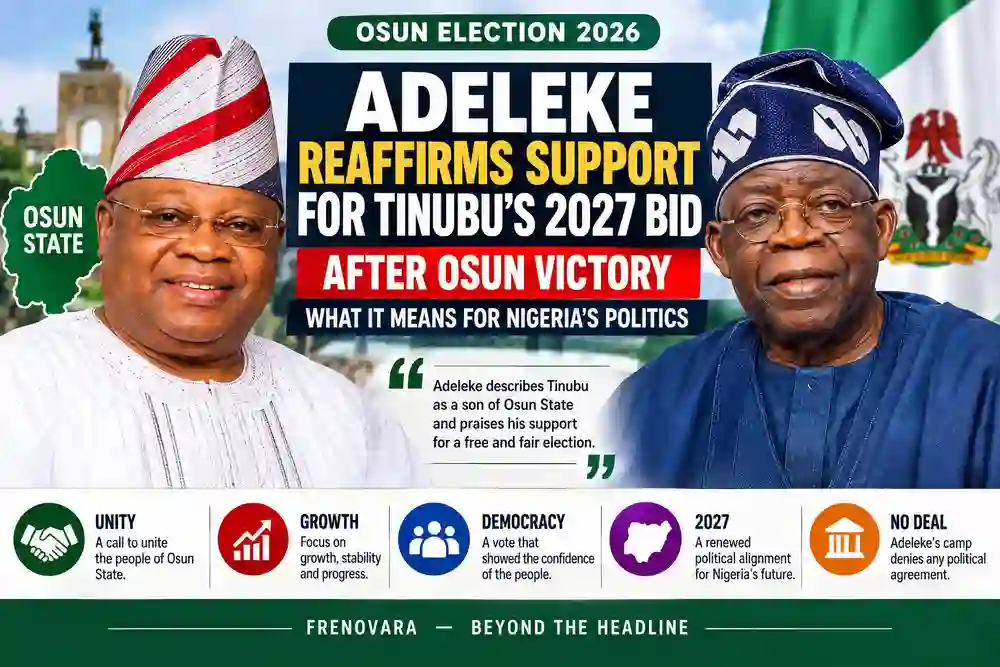
Adeleke Reaffirms Support for Tinubu’s 2027 Bid After Osun Victory: What It Means for Nigeria’s Politics
The Adeleke supports Tinubu 2027 story has become one of the most significant political developments to emerge immediately after the Osun governorship election.
Just hours after being declared the winner of the August 15, 2026 governorship election, Governor Ademola Adeleke reaffirmed his support for President Bola Ahmed Tinubu’s bid for a second term in the 2027 presidential election.
Adeleke, who contested the Osun election under the Accord Party, described Tinubu as a son of Osun State and said he was reaffirming his earlier endorsement of the President.
The development has attracted national attention because Adeleke and Tinubu belong to different political parties. Adeleke is the Accord governor of Osun, while Tinubu is the candidate of the All Progressives Congress (APC).
The timing is also significant.
Adeleke made the declaration immediately after securing another four-year mandate in Osun State.
Tinubu Congratulates Adeleke on Osun Election Victory, Calls for Unity
Adeleke Reaffirms Support for Tinubu After Winning Osun
Adeleke’s renewed support for Tinubu came during his post-election remarks after the Independent National Electoral Commission announced him as the winner of the Osun governorship election.
The governor praised Tinubu for what he described as his support for a free and fair electoral process.
He then reaffirmed his earlier support for the President’s 2027 re-election bid.
Several Nigerian media organisations reported the development, including TVC News, BusinessDay, Punch and TheCable.
The declaration immediately transformed the post-election conversation from a purely Osun political story into a broader discussion about Nigeria’s 2027 presidential election.
Why Adeleke’s Tinubu Support Is Politically Significant
At first glance, Adeleke’s endorsement might appear surprising.
Adeleke just defeated an APC candidate, Bola Oyebamiji, in the Osun governorship election.
The APC is also one of the major political forces preparing for the 2027 presidential election.
Yet the relationship between state-level electoral competition and national politics can be more complicated.
Adeleke’s support for Tinubu demonstrates that political competition at the state level does not necessarily prevent politicians from cooperating or supporting one another at the national level.
Why Adeleke Won Osun Governorship Election 2026: 7 Key Factors
The development could therefore have implications for how political alliances develop before 2027.
Adeleke and Tinubu Belong to Different Political Parties
One of the most interesting aspects of the development is the party difference.
Adeleke contested the Osun governorship election under the Accord Party.
Tinubu is a member of the All Progressives Congress.
The two politicians therefore do not share the same party platform.
Yet Adeleke has chosen to publicly support Tinubu’s presidential ambition.
That makes the endorsement different from a conventional party-based endorsement.
It suggests that the political relationship between the two men may be influenced by regional, personal and governance considerations in addition to party affiliation.
Adeleke Calls Tinubu a Son of Osun State
Adeleke’s explanation for his support also deserves attention.
The governor described Tinubu as a son of Osun State.
That statement places the endorsement within a broader South-West political context.
Tinubu is from Lagos State but has deep political roots across the South-West.
For Adeleke, the regional relationship appears to be an important part of his reasoning for supporting the President.
Adeleke has also previously expressed support for Tinubu’s 2027 ambition, meaning the latest statement was a reaffirmation rather than a completely new political position.
This Was Not Presented as a New Political Alliance
It is important not to overstate what happened.
Adeleke did not announce that he was joining the APC.
He did not announce a defection.
He did not say that Accord was merging with the APC.
Instead, he reaffirmed his personal political support for Tinubu’s second-term bid.
That distinction matters.
The political story is therefore about support for a presidential candidate, not a formal party realignment.
Adeleke’s Camp Denies a Political Deal With Tinubu
The story became even more interesting after reactions from the Tinubu camp.
Minister of Aviation and Aerospace Development Festus Keyamo praised Adeleke’s renewed support and referred to the principle that an agreement should be honoured.
That triggered speculation about whether Adeleke’s support for Tinubu was connected to a political agreement.
Adeleke’s campaign team subsequently rejected that interpretation.
The Imole Campaign Council denied that there was a political agreement between Adeleke and the Tinubu administration behind the governor’s support for the President’s 2027 bid.
Adeleke also said he had not reached an agreement with Tinubu concerning the 2027 election and explained his support in terms of regional considerations and his assessment of the President.
Osun Governorship Election 2026 Full Results: All 30 LGAs Breakdown
That distinction should remain clear in any discussion of the development.
Why the “Political Deal” Question Matters
The controversy illustrates why Adeleke’s statement has generated so much attention.
Nigerian politics is often shaped by alliances that cross party lines.
When a governor from one party publicly supports a President from another party, political observers naturally ask what is behind the decision.
But speculation should not be presented as fact.
At this point, the publicly reported position from Adeleke’s camp is that there was no political deal behind his support for Tinubu.
That makes the more defensible interpretation one of political support rather than a confirmed political bargain.
What Adeleke’s Victory Means for the Tinubu 2027 Campaign
The timing of the endorsement gives it additional significance.
Tinubu’s 2027 campaign will be fought across Nigeria, but the South-West will remain an important political region.
Osun is particularly interesting because it has demonstrated that APC control cannot automatically be assumed.
Adeleke’s victory under Accord shows that an opposition candidate can win the state’s governorship despite the APC’s strong national position.
His subsequent support for Tinubu creates an unusual political situation.
The governor who defeated the APC’s candidate at the state level is simultaneously supporting the APC’s presidential candidate at the national level.
That could make Adeleke an interesting political figure to watch as 2027 approaches.
What Does Adeleke’s Support Mean for Osun Politics?
The immediate implication is that Adeleke will have to manage two political relationships.
At the state level, he has just secured a fresh mandate after defeating Oyebamiji.
At the national level, he has publicly aligned himself with Tinubu’s 2027 presidential ambition.
That could create an interesting dynamic between the Osun government and the Federal Government.
Cooperation between Abuja and Osun could potentially benefit the state if it produces greater access to federal programmes, infrastructure projects and investment opportunities.
However, political support does not automatically guarantee policy outcomes.
The real test will be whether the relationship translates into tangible benefits for Osun residents.
Could Adeleke’s Position Influence Other Politicians?
It is too early to say.
However, Adeleke’s position could become an example of how politicians approach the 2027 election.
Nigeria’s political environment is likely to feature alliances that do not always follow traditional party boundaries.
Politicians may support presidential candidates for different reasons while maintaining their own party identities at the state level.
Adeleke’s position demonstrates that this type of political arrangement is possible.
Whether it becomes more widespread remains to be seen.
The Osun Election and the Bigger 2027 Picture
The Osun governorship election itself should not be treated as a direct predictor of the 2027 presidential election.
State elections and presidential elections operate differently.
The candidates are different.
The issues are different.
The political coalitions can also be different.
Nevertheless, Osun provides an interesting window into the political relationships that could influence the next national election.
Adeleke’s victory demonstrates the strength of his personal political base.
His subsequent support for Tinubu demonstrates that his national political positioning may not necessarily follow his state-level party alignment.
Adeleke’s Victory Gives Him Greater Political Leverage
By winning re-election, Adeleke has secured another four years in office.
That gives him political relevance beyond the immediate Osun election.
His ability to mobilise voters was demonstrated by the final result.
Adeleke received 511,067 votes, defeating APC candidate Bola Oyebamiji, who polled 444,815 votes.
He also won 19 of the state’s 30 Local Government Areas, compared with 11 for Oyebamiji.
Our detailed breakdown of the result shows how Adeleke’s support was distributed across Osun’s 30 LGAs.
That electoral strength could make his political positioning more relevant as national parties prepare for 2027.
What Adeleke’s Support Could Mean for Tinubu
For Tinubu, support from a sitting governor who has just won re-election in an opposition-controlled state is politically valuable.
It gives the President another prominent South-West political voice supporting his second-term bid.
But the significance should not be exaggerated.
One governor’s endorsement does not determine a presidential election.
The 2027 contest will depend on a much wider coalition of voters, political parties, governors, lawmakers, grassroots structures and other stakeholders.
Still, Adeleke’s position adds another important development to the evolving political landscape.
What It Means for the Accord Party
Adeleke’s decision also raises questions about Accord’s role in Nigerian politics.
The party successfully carried an incumbent governor to victory in Osun.
That gives Accord a governorship and an opportunity to strengthen its political structure.
However, Adeleke’s support for Tinubu could create questions about how Accord approaches the 2027 presidential contest.
Will the party adopt the same position?
Will Adeleke’s endorsement remain a personal position?
Or will wider party structures develop their own position?
Those questions could become more important as 2027 approaches.
Why the Development Matters Beyond Osun
The significance of the Adeleke supports Tinubu 2027 story extends beyond the state’s borders.
It highlights three broader features of Nigerian politics.
Political Alliances Can Cross Party Lines
A politician can oppose a party’s candidate at the state level while supporting its presidential candidate nationally.
Regional Politics Still Matters
Adeleke’s reference to Tinubu as a son of Osun shows how regional identity can influence political positioning.
Personal Political Capital Matters
Adeleke has demonstrated that his political influence is not entirely dependent on the party platform under which he previously won office.
These dynamics could become increasingly important ahead of the 2027 election.
What Happens Next?
The immediate focus will be on governance.
Adeleke has promised to build on his first-term achievements while addressing areas where his administration fell short.
He has also extended an olive branch to political opponents following his re-election.
At the national level, however, his support for Tinubu means political observers will likely continue watching his relationship with the President.
The next major questions will include whether other Osun political figures follow Adeleke’s position and how the endorsement affects relationships between Accord, the PDP, APC and emerging opposition coalitions.
Conclusion
The Adeleke supports Tinubu 2027 development has added an unexpected political dimension to the aftermath of the Osun governorship election.
After securing re-election under the Accord Party, Adeleke reaffirmed his support for President Bola Ahmed Tinubu’s bid for a second term in 2027.
He described Tinubu as a son of Osun State and praised the President’s support for what he described as a free and fair election.
The development is significant because Adeleke and Tinubu belong to different political parties.
It also comes at a crucial moment, with Nigerian political parties beginning to position themselves for the 2027 presidential contest.
However, Adeleke’s camp has made an important clarification: the governor’s support should not be presented as evidence of a political deal with the Tinubu administration. His camp has specifically denied such an agreement.
For now, Adeleke remains an Accord governor who has won a second term in Osun while publicly supporting Tinubu’s 2027 presidential ambition.
That unusual combination makes him one of the Nigerian political figures to watch as the country moves toward 2027.
FRENOVARA — Beyond The Headline