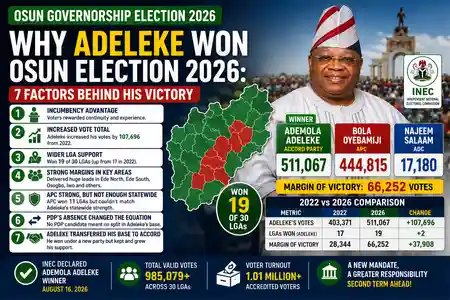
Why Ademola Adeleke Won the Osun Governorship Election 2026: 7 Factors Behind His Victory
The question why Adeleke won the Osun election 2026 has become one of the biggest political questions following the conclusion of the Osun State governorship election.
Ademola Adeleke of the Accord Party was declared the winner after securing 511,067 votes, defeating All Progressives Congress (APC) candidate Bola Oyebamiji, who polled 444,815 votes.
Adeleke’s winning margin was 66,252 votes.
But the significance of the Osun governorship election 2026 goes beyond the headline result.
A closer examination of the numbers shows that Adeleke did not simply retain power by a narrow margin. Compared with his 2022 victory, he increased his vote tally by more than 100,000 votes, expanded the number of Local Government Areas he won from 17 to 19 and more than doubled his winning margin.
So, why did Adeleke win the Osun election 2026?
Several factors help explain the outcome.
1. Adeleke Had the Advantage of Incumbency
One of the clearest factors behind Adeleke’s victory was incumbency.
He entered the 2026 election as the sitting governor of Osun State, meaning voters were not choosing between an unknown challenger and an incumbent.
Osun Governorship Election 2026: Adeleke Wins as INEC Declares Final Results
Adeleke already had an established political identity, a record in office and a statewide network.
That gave his campaign several advantages.
An incumbent can campaign on completed projects, existing government programmes and direct relationships with communities.
The challenger, by comparison, must convince voters that changing government will produce better results.
This does not automatically guarantee re-election. Incumbents can and do lose elections.
But in a competitive election such as Osun’s, familiarity and an existing political organization can become important advantages.
2. Adeleke Increased His Vote Total Dramatically
The numbers provide one of the strongest explanations for Adeleke’s re-election.
In the 2022 Osun governorship election, Adeleke, then running under the Peoples Democratic Party (PDP), received 403,371 votes.
In 2026, he received 511,067 votes under the Accord Party.
That represents an increase of 107,696 votes.
This is significant because Adeleke did not merely retain his previous support base.
He expanded it.
Adeleke’s Vote Growth Between 2022 and 2026
| Election | Party | Adeleke’s votes |
|---|---|---|
| 2022 | PDP | 403,371 |
| 2026 | Accord | 511,067 |
| Increase | — | 107,696 |
The increase suggests that Adeleke was able to attract a considerably larger coalition in 2026 than he did four years earlier.
Osun Governorship Election 2026 Full Results: All 30 LGAs Breakdown
3. Adeleke Expanded His LGA Footprint
Another major factor was geographical expansion.
In 2022, Adeleke won 17 of Osun’s 30 LGAs.
In 2026, he won 19 LGAs.
At the same time, the APC’s LGA tally declined from 13 in 2022 to 11 in 2026.
That two-LGA shift might appear modest, but in a statewide election it can matter significantly.
A candidate needs broad geographical support to build a strong statewide vote.
Adeleke achieved that.
Adeleke’s 2026 LGA Advantage
Adeleke — 19 LGAs
Oyebamiji — 11 LGAs
This was not an overwhelming sweep. The APC remained competitive across the state.
But Adeleke’s broader footprint helped him combine strong support in traditional areas with gains elsewhere.
4. Adeleke’s Strongholds Delivered Large Margins
Winning an LGA matters.
Winning it by a large margin matters even more.
The results show that some of Adeleke’s strongest areas produced substantial vote advantages.
Ede North, for example, was one of the strongest areas for the incumbent.
The reported figures gave Accord 35,427 votes, compared with 10,283 for APC.
Ede South also produced a major Adeleke advantage, with Accord receiving 26,188 votes against 6,219 for APC.
Osogbo, the state capital, was another important Adeleke victory.
The published figures recorded 36,480 votes for Accord and 30,474 for APC.
These large vote-producing centres helped strengthen Adeleke’s statewide total.
5. The Opposition Was Strong but Could Not Match Adeleke Statewide
The APC was not an insignificant opponent.
Oyebamiji won 11 LGAs, including areas where the party produced substantial margins.
Irewole was particularly notable.
The published results show Oyebamiji receiving 29,972 votes there against Adeleke’s 10,934.
Boripe was another strong APC area, where Oyebamiji recorded 19,963 votes compared with Adeleke’s 12,448.
This demonstrates an important feature of the election.
Adeleke’s victory was not based on the APC collapsing everywhere.
Instead, the Accord candidate built enough support across more LGAs and accumulated sufficient margins in key areas to finish ahead statewide.
6. The PDP’s Absence Changed the Political Equation
The 2026 election was fundamentally different from the contest Adeleke won in 2022.
In 2022, Adeleke contested under the PDP.
In 2026, he contested under the Accord Party after leaving the PDP amid the party’s internal crisis in Osun.
The PDP did not field a candidate in the 2026 governorship contest.
That changed the political arithmetic.
Adeleke’s supporters were not divided between an Adeleke-led Accord campaign and a separate PDP governorship candidate.
Instead, the incumbent was able to defend his mandate directly under his new party.
This was particularly important because the 2026 election had a strong two-candidate character between Adeleke and Oyebamiji, with ADC candidate Najeem Salaam finishing a distant third.
7. Adeleke Successfully Took His Political Base Beyond His Previous Party
Perhaps one of the most interesting aspects of the 2026 election is that Adeleke defended a mandate he originally won under a different party.
In 2022, he won as a PDP candidate.
In 2026, he won under Accord.
That means the political support behind Adeleke was not entirely dependent on the PDP label.
His ability to transfer that support to Accord was a major political achievement.
The final result showed that the incumbent could retain statewide support despite the change in party platform.
Adeleke’s Winning Margin More Than Doubled
Perhaps the most important statistic in understanding the 2026 result is the change in Adeleke’s winning margin.
In 2022:
Adeleke: 403,371
Oyetola: 375,027
Margin: 28,344 votes
In 2026:
Adeleke: 511,067
Oyebamiji: 444,815
Margin: 66,252 votes
Adeleke therefore increased his margin by 37,908 votes.
His margin was more than twice the size of his 2022 advantage.
That makes the 2026 result more than a simple repeat of his previous victory.
It represents a stronger electoral performance.
Nigeria 2027 Elections: Key Political Players, Major Challenges, and What Voters Should Expect
What Changed Between 2022 and 2026?
The comparison between the two elections provides a useful picture.
| Metric | 2022 | 2026 |
|---|---|---|
| Adeleke votes | 403,371 | 511,067 |
| APC candidate votes | 375,027 | 444,815 |
| Adeleke margin | 28,344 | 66,252 |
| Adeleke LGAs won | 17 | 19 |
| APC LGAs won | 13 | 11 |
The numbers show that both major candidates increased their vote totals.
Adeleke, however, increased his vote total by more and expanded his geographical reach.
That combination produced the larger winning margin.
Did Adeleke’s Performance Alone Explain the Result?
Not completely.
Election outcomes are rarely explained by one factor.
Candidate popularity, incumbency, party organization, opposition strength, local political alliances, voter turnout, campaign strategy and the distribution of votes can all influence the final outcome.
The 2026 Osun election is therefore better understood as the result of several factors working together.
Adeleke had an existing political base.
He had the advantages of incumbency.
He expanded his vote total.
He increased the number of LGAs he won.
And the opposition did not convert its strong areas into enough statewide votes to overtake him.
The Importance of Voter Turnout
Turnout also matters in interpreting the result.
Before the election, Osun had 2,339,233 registered voters, while more than 1.9 million voters had collected their Permanent Voter Cards and were eligible to vote.
INEC’s final figures reported approximately 1.01 million accredited voters.
That means the election involved only a portion of the state’s registered electorate.
Consequently, the final result represents the choice of participating voters rather than the entire registered electorate.
This distinction is important when evaluating the strength of any political mandate.
Osun Remains a Competitive Political Battleground
The 2026 result should not be interpreted as evidence that Osun has become politically one-sided.
The APC won 11 LGAs.
In some of those councils, its margins were substantial.
The election therefore remains competitive even though Adeleke secured a clear statewide victory.
BusinessDay’s post-election analysis similarly characterized the result as a widening of Adeleke’s advantage rather than an outright elimination of APC competitiveness.
What Adeleke’s Victory Means for the Accord Party
Adeleke’s victory could have consequences beyond Osun.
Defending a governorship mandate under Accord gives the party a significantly higher political profile.
It also demonstrates that an incumbent can potentially carry an established voter coalition across party lines.
For Accord, however, converting the Osun victory into a broader national structure would be a much larger challenge.
A single governorship victory does not automatically create a nationwide political organization.
What the Result Means for the APC
For the APC, the result presents a different lesson.
The party remained competitive and won 11 LGAs, but it could not overcome Adeleke’s broader support.
Oyebamiji’s performance means the APC still has substantial support in Osun.
The question for the party is whether it can consolidate those areas, expand into Adeleke’s strongholds and develop a strategy capable of closing the statewide gap in future elections.
What the Osun Election Could Mean for 2027
The Osun election will inevitably become part of Nigeria’s wider 2027 political conversation.
Several opposition figures have already described the result as significant for democratic participation and the wider opposition movement.
But caution is necessary.
A governorship election in one state cannot by itself predict the outcome of a national election.
What Osun can provide is a useful case study in voter mobilization, party switching, incumbency and opposition strategy.
Political parties will likely study the result closely.
Top 15 Most Influential Politicians in Nigeria Today: The Leaders Shaping Nigeria’s Future
The Bigger Lesson From Adeleke’s Victory
The most important lesson from the Osun governorship election 2026 may be that political loyalty can extend beyond a party label.
Adeleke won in 2022 as a PDP candidate.
Four years later, he returned to the ballot under Accord and increased both his vote total and his winning margin.
That does not mean party structures are irrelevant.
Instead, it suggests that a strong candidate with an established political network can sometimes transfer a significant portion of personal support to a new platform.
Conclusion
The answer to why Adeleke won the Osun election 2026 is not one single political factor.
His victory was built on a combination of incumbency, increased voter support, wider LGA coverage, strong performances in key areas, a changed opposition landscape and the ability to transfer his political base from the PDP to Accord.
The numbers make the change particularly clear.
Adeleke increased his vote total from 403,371 in 2022 to 511,067 in 2026, an increase of 107,696 votes.
He expanded his LGA victories from 17 to 19, while the APC declined from 13 to 11.
Most importantly, his winning margin increased from 28,344 votes in 2022 to 66,252 votes in 2026.
The result therefore represents more than a second-term victory.
It is evidence of a stronger electoral performance by Adeleke than the one that first brought him into office.
But the election also showed that Osun remains politically competitive.
Adeleke has won the mandate.
The next question is whether his second term will deliver enough measurable progress to turn an electoral victory into a lasting political legacy.
FRENOVARA — Beyond The Headline