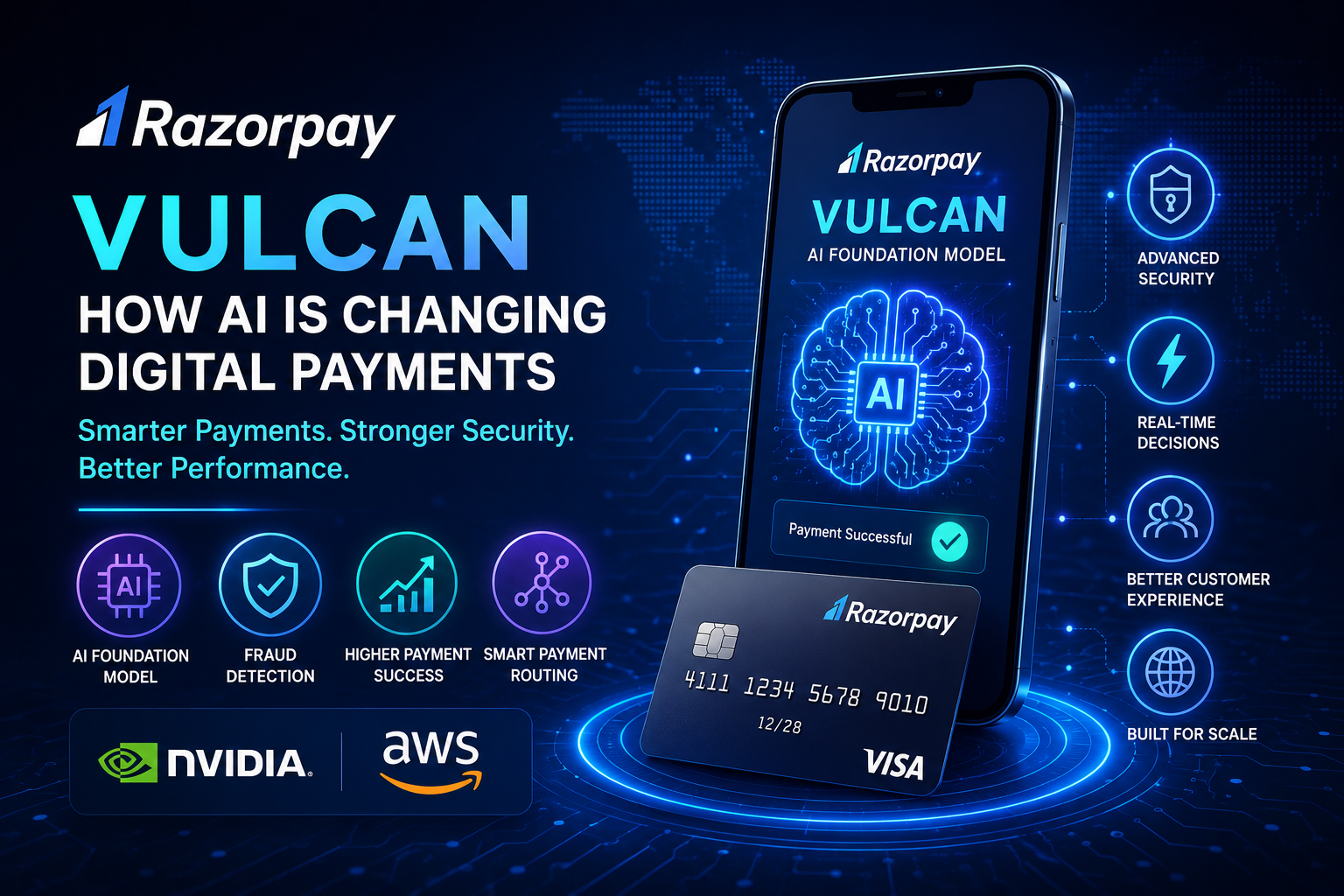

Razorpay Vulcan: How AI Is Changing Digital Payments
Artificial intelligence is moving beyond chatbots, content generation and search. It is now becoming part of the infrastructure that powers how people pay, shop and move money online.
That shift is becoming clearer with the launch of Razorpay Vulcan, a transformer-based AI foundation model designed specifically for payments.
Razorpay says Vulcan was developed with technology from NVIDIA and Amazon Web Services (AWS) and trained on approximately 3 trillion data points across more than 4 billion payments. The model is designed to analyze thousands of signals associated with transactions and help improve payment success, fraud detection, risk assessment and checkout experiences.
The launch is significant because digital payments are no longer simply about moving money from one account to another. Payment platforms must increasingly make decisions in real time about security, routing, fraud, customer behavior and transaction reliability.
So, what exactly is Razorpay Vulcan, and what could it mean for the future of digital payments and e-commerce?
What Is Razorpay Vulcan?
Razorpay Vulcan is an AI foundation model built specifically for digital payments.
Unlike a conventional machine-learning system designed to perform one narrowly defined task, Vulcan is intended to act as a shared intelligence layer across several payment operations.
These include:
- Payment routing
- Fraud detection
- Risk assessment
- Payment optimization
- Checkout personalization
- Transaction analysis
Razorpay says the model analyzes approximately 3,000 signals per transaction. It was trained using data from more than 4 billion payments, giving it a large foundation for identifying patterns across the payments ecosystem.
The idea is relatively simple: instead of treating every payment problem as a separate problem, AI can help payment infrastructure understand a transaction more holistically.
That could make digital payments more reliable for consumers and merchants.
Why Did Razorpay Build an AI Model for Payments?
Digital payments have become increasingly complex.
A customer might attempt to pay using a bank account, credit card, debit card, UPI application or digital wallet. Behind the scenes, the payment platform has to process information quickly while dealing with issues such as fraud, network failures, authentication and transaction risk.
A successful payment is therefore not determined by the checkout button alone.
Razorpay says its internal research involving about 1.5 million shoppers and more than 51,000 businesses identified recurring problems involving failed transactions, payment delays and customer drop-offs across different markets.
AI can potentially help address some of these problems by identifying patterns that traditional systems may not capture as effectively.
Instead of asking only whether a transaction should be approved, intelligent payment infrastructure can consider a much wider range of signals.
That is the broader idea behind Razorpay Vulcan.
How Does Razorpay Vulcan Work?
At a high level, Razorpay Vulcan uses a transformer-based AI architecture to learn patterns from large volumes of payment information.
The model can analyze multiple signals associated with a transaction and use those signals to support decisions across different parts of the payment process.
For example, a payment might involve information related to:
- The payment method
- Transaction history
- Merchant behavior
- Customer behavior
- Device information
- Geographic signals
- Transaction patterns
- Risk indicators
- Payment-network conditions
The system can then use these signals to help determine how a transaction should be handled.
This is particularly important because payment decisions often need to happen in seconds or less.
Razorpay says Vulcan was built to provide a unified intelligence layer rather than relying entirely on separate models for individual payment functions.
How AI Can Improve Digital Payments
The most important question is not simply what Razorpay Vulcan is.
It is what AI can actually do for digital payments.
1. Better Payment Success Rates
One of the biggest frustrations in online shopping is a failed payment.
A customer may have enough money and still experience a failed transaction because of network problems, payment routing issues, authentication failures or other technical factors.
Razorpay says early components of Vulcan have contributed to an 8 to10% improvement in payment success rates. These are company-reported results rather than an independent performance audit.
If intelligent routing can identify the best way to process a transaction, merchants could potentially recover purchases that would otherwise have failed.
For e-commerce businesses, even a small improvement in payment success can matter because every failed transaction represents a potential lost sale.
2. Faster Fraud Detection
Fraud is one of the biggest challenges facing digital payments.
Criminals continuously develop new techniques, which means payment companies must constantly identify unusual patterns.
AI can help by examining enormous amounts of transaction data and looking for relationships that may be difficult to detect using simple rules.
Razorpay says Vulcan has increased detection of international card fraud by eight times in the areas where its components have been deployed. It also reports a fivefold increase in identifying fraudulent or disputed transactions without increasing false positives.
These figures should be understood as Razorpay’s reported results, not a universal guarantee that every transaction will receive the same improvement.
Still, the direction is important: AI is increasingly being used as a real-time defense layer for payment systems.
3. Smarter Payment Routing
Payment routing determines how transactions move through different payment networks and systems.
If one route is more likely to succeed than another, intelligent systems can potentially make better decisions about where to send a transaction.
AI can analyze historical and real-time patterns to support these decisions.
This could become increasingly valuable as merchants accept more payment methods and operate across multiple markets.
4. Better Checkout Experiences
Payment technology is also becoming part of the customer experience.
Razorpay says Vulcan helped increase the number of shoppers seeing their preferred UPI applications by 40%, contributing to an additional 100,000 to 200,000 monthly purchases, according to reported figures.
The broader lesson is important for e-commerce businesses.
A customer does not necessarily care which payment model is operating behind the checkout page. They care whether the payment option they prefer is available and whether the transaction works quickly.
5. Improved Risk Assessment
AI can also help payment platforms evaluate risk.
This can be particularly useful for transactions where traditional rules may not provide enough context.
Razorpay says Vulcan is designed to support risk assessment, including areas such as cash-on-delivery orders.
The objective is not simply to block transactions.
A good risk system must distinguish between legitimate customers and suspicious activity without creating unnecessary friction.
Razorpay Vulcan and Fraud Prevention
Fraud prevention is likely to become one of the most important applications of AI in fintech.
Traditional fraud systems often rely on rules, historical patterns and specialized models.
Those systems remain important, but fraud itself keeps changing.
An attacker who discovers that a particular pattern triggers a security rule may simply change their behavior.
AI can help payment companies respond more dynamically.
Instead of relying only on fixed rules, an AI system can evaluate multiple signals simultaneously and identify unusual relationships across transactions.
This could help payment platforms detect suspicious activity earlier.
However, AI is not a magic solution.
Payment companies still need strong security controls, authentication systems, privacy protections and regulatory compliance.
AI should therefore be viewed as another layer of payment intelligence rather than a replacement for the entire security infrastructure.
Read more: Razorpay Newsroom
Razorpay Vulcan, NVIDIA and AWS
Building a large AI model requires significant computing infrastructure.
Razorpay developed Vulcan with technology from NVIDIA and AWS.
According to reporting on the launch, NVIDIA GPUs were used for training and running the model, while AWS infrastructure, including Amazon SageMaker, supported development, training and deployment.
NVIDIA and AWS have also been expanding their broader collaboration around production-scale AI infrastructure, including accelerated computing and AI deployment.
This partnership highlights an important trend in fintech.
Financial companies increasingly need not only financial infrastructure but also AI infrastructure capable of processing enormous volumes of information.
What Razorpay Vulcan Means for E-commerce
The connection between AI payments and e-commerce is particularly important.
An online store can have excellent products, competitive prices and strong marketing and still lose revenue if customers cannot complete checkout.
Payment failure is therefore an e-commerce problem as much as it is a fintech problem.
AI-powered payment infrastructure could help merchants by:
- Reducing failed transactions
- Improving payment routing
- Detecting fraud
- Reducing unnecessary payment friction
- Personalizing payment options
- Improving checkout reliability
This could ultimately improve the relationship between payments and conversion rates.
For businesses operating online, payment technology is no longer simply a back-end function.
It is becoming part of the customer experience.
This is particularly relevant as the world’s largest e-commerce companies continue investing in artificial intelligence, logistics, personalization and digital payments.
Related: Top 20 Biggest E-commerce Companies in the World
AI Is Changing More Than Payment Processing
Razorpay’s latest move should also be viewed in the context of its broader push into AI-powered commerce.
Earlier in 2026, Razorpay announced initiatives involving AI agents, including agentic payments designed to allow AI systems to participate in shopping and payment experiences with user authorization.
The company’s AI strategy has therefore been moving beyond traditional payment processing.
The emerging model looks more like:
AI discovers → AI recommends → consumer decides → payment infrastructure executes → AI helps secure the transaction.
That could eventually create a completely different online shopping experience.
The Rise of AI-Powered Payments
Razorpay is not alone in exploring artificial intelligence in financial services.
Banks, payment processors, fintech companies and e-commerce platforms are increasingly using AI for:
- Fraud detection
- Customer service
- Credit assessment
- Transaction monitoring
- Personalization
- Risk management
- Financial forecasting
- Payment optimization
The difference with foundation models such as Vulcan is the attempt to create a broader intelligence layer that can support multiple functions.
This represents a shift from AI as a feature to AI as infrastructure.
That distinction could become increasingly important in fintech.
What Does Razorpay Vulcan Mean for Digital Wallets?
Digital wallets are also likely to benefit from improvements in payment intelligence.
A digital wallet must provide more than a place to store payment information.
Users expect:
- Fast transactions
- Secure authentication
- Fraud protection
- Reliable checkout
- Multiple payment options
- Simple user experiences
AI can potentially improve several of these areas.
As wallets become more deeply integrated into e-commerce, payment platforms and financial services, intelligent transaction processing could become an important competitive advantage.
Related: What Is a Digital Wallet? How It Works and Why Millions Use It in the Digital Economy
For consumers who want to understand the difference between wallets and banking applications, see our guide to digital wallets vs mobile banking.
Related: Digital Wallet vs Mobile Banking: What’s the Difference?
Will AI Replace Traditional Payment Systems?
No.
AI is unlikely to replace payment networks, banks, wallets and payment processors by itself.
Instead, AI is more likely to become an intelligence layer operating on top of existing financial infrastructure.
Think of it this way:
Traditional payment infrastructure moves the money.
AI helps decide how that transaction should be processed, assessed, protected and optimized.
This distinction matters because payment systems require reliability, security and regulatory oversight.
AI can make those systems smarter, but it still needs to operate within the financial infrastructure surrounding it.
Razorpay Vulcan vs Traditional Payment AI
The difference can be simplified as follows:
| Feature | Traditional Payment AI | Razorpay Vulcan |
|---|---|---|
| Primary approach | Specialized models | Foundation-model approach |
| Payment routing | AI-assisted | Designed as a shared intelligence layer |
| Fraud detection | Specialized systems | Integrated payment intelligence |
| Risk assessment | Separate models | Part of broader payment intelligence |
| Checkout personalization | Limited or separate | Included in intended applications |
| Data scale | Varies by system | About 3 trillion data points reported by Razorpay |
| Transaction signals | Varies | About 3,000 signals per transaction reported |
This is a conceptual comparison, not a claim that every traditional payment platform uses the same technology.
The important difference is Razorpay’s attempt to use one broader AI foundation to support multiple parts of the payment journey.
What Does Razorpay Vulcan Mean for Businesses?
For merchants, the potential benefits are straightforward.
A more intelligent payment system could mean fewer failed transactions and fewer customers abandoning checkout.
It could also help businesses reduce losses associated with fraudulent transactions.
For large e-commerce companies, improvements can be multiplied across millions of transactions.
For smaller online businesses, payment reliability can be equally important.
A customer who experiences repeated payment failures may simply leave the website and purchase from a competitor.
That means payment infrastructure can directly influence revenue.
What Does Razorpay Vulcan Mean for Consumers?
Consumers may never interact directly with Vulcan.
Instead, its impact could appear through small improvements in everyday payment experiences.
For example:
- A payment succeeds instead of failing.
- The preferred payment application appears automatically.
- Suspicious transactions are detected more quickly.
- Checkout becomes simpler.
- Payment options become more relevant.
- Transactions become more predictable.
These improvements may seem small individually.
At the scale of billions of transactions, however, they could have a significant impact.
The Future of AI and Digital Payments
The next phase of fintech is likely to combine several technologies.
AI will increasingly work alongside:
- Digital wallets
- Instant payments
- Open banking
- Biometric authentication
- Agentic commerce
- Mobile payments
- E-commerce platforms
- Fraud-prevention systems
The result could be a payment environment where much of the complexity happens behind the scenes.
Instead of asking consumers to understand complicated payment infrastructure, technology will increasingly make those decisions automatically.
The customer simply chooses what they want and expects the payment to work.
That sounds simple.
Making it reliable at global scale is anything but simple.
AI Shopping Agents Could Push Payments Even Further
The development of AI shopping agents could make payment intelligence even more important.
AI assistants are increasingly moving from simply recommending products toward helping users complete purchases.
Razorpay has already explored this direction through agentic payments, including work with NPCI and OpenAI around AI-driven commerce using UPI.
Imagine telling an AI assistant:
Find the best smartphone under my budget and buy it.
For that experience to work, the AI needs to understand the product, merchant, price, delivery options and payment process.
The payment system must then determine whether the transaction is legitimate and execute it securely.
This is where AI-powered payment infrastructure could become particularly important.
The future of e-commerce may therefore involve AI agents and payment AI working together.
Frequently Asked Questions About Razorpay Vulcan
What is Razorpay Vulcan?
Razorpay Vulcan is a transformer-based AI foundation model developed specifically for digital payments. Razorpay says it is designed to support payment routing, fraud detection, risk assessment and checkout improvements.
Is Razorpay Vulcan an AI model?
Yes. Razorpay describes Vulcan as an AI foundation model designed specifically for payments. It was developed with technology from NVIDIA and AWS.
How does Razorpay Vulcan improve digital payments?
Razorpay says Vulcan can analyze large amounts of payment information and support functions such as payment routing, fraud detection, risk assessment and checkout personalization.
Does Razorpay Vulcan detect payment fraud?
Yes. Fraud detection is one of the model’s intended applications. Razorpay has also reported significant improvements in detecting international card fraud and fraudulent or disputed transactions in areas where its components have been deployed.
Who developed Razorpay Vulcan?
Razorpay developed Vulcan with technology from NVIDIA and AWS. NVIDIA GPUs and AWS infrastructure were used to support the model’s development and deployment.
How many payments was Razorpay Vulcan trained on?
Razorpay says the model was trained using approximately 3 trillion data points across more than 4 billion payments.
How many signals does Razorpay Vulcan analyze?
Razorpay says Vulcan analyzes approximately 3,000 signals per transaction.
What does Razorpay Vulcan mean for e-commerce?
It could help e-commerce businesses improve payment reliability, reduce failed transactions, detect fraud and create smoother checkout experiences.
Is Razorpay Vulcan available to businesses?
Razorpay has announced the model and described its applications across its payment ecosystem. Businesses should refer to Razorpay’s current product and platform information for details about specific availability and integrations.
Final Thoughts
Razorpay Vulcan represents a significant shift in how artificial intelligence could be used in digital payments.
The important part is not simply that Razorpay has launched another AI model.
The bigger story is that AI is increasingly becoming part of the financial infrastructure itself.
Payment systems must process enormous amounts of information while balancing speed, security, reliability and customer experience.
Foundation models designed specifically for payments could help bring those functions together.
For consumers, the result could be faster and more reliable digital transactions.
For e-commerce businesses, it could mean fewer failed checkouts and better protection against fraud.
And for the fintech industry, it signals a future in which AI is no longer just an additional tool.
AI could become one of the technologies that determines how digital payments work.
As digital wallets, instant payments, e-commerce and AI shopping agents continue converging, the payment systems behind them will need to become increasingly intelligent.
Razorpay Vulcan is one of the latest signs that this transformation is already underway.