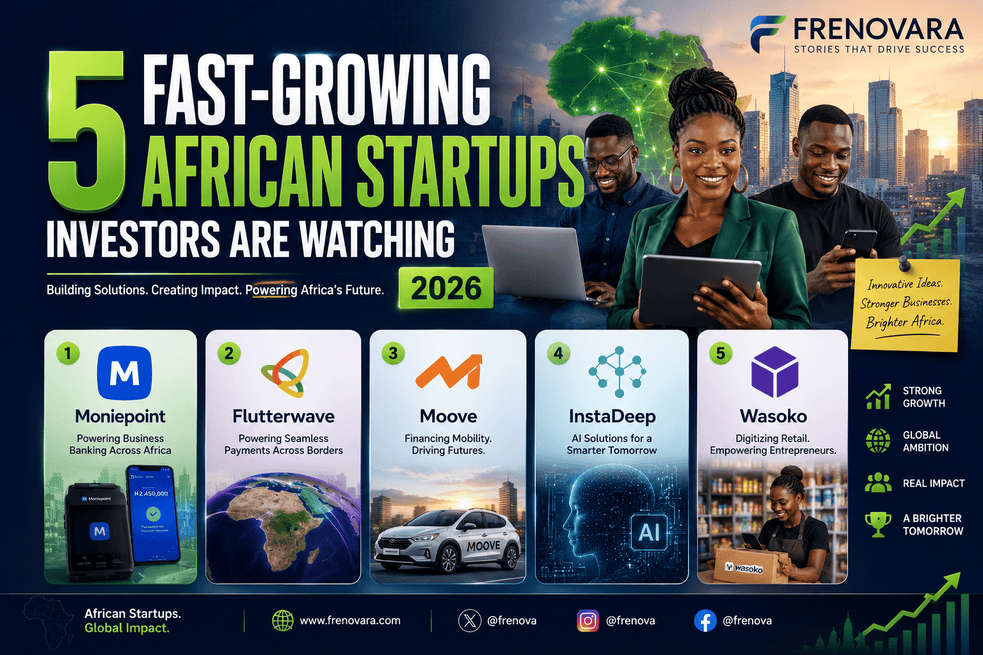
Five Fast-Growing African Startups Investors Are Watching in 2026
Africa is no longer viewed as an emerging technology market.
It is increasingly becoming one of the world’s most exciting destinations for startup investment.
Across the continent, entrepreneurs are building innovative companies that solve uniquely African challenges while creating solutions capable of competing globally.
From financial technology and artificial intelligence to logistics, healthcare, and climate innovation, African startups are attracting billions of dollars in venture capital from international investors.
Despite periods of global economic uncertainty, investor confidence in Africa’s long-term growth story remains remarkably strong.
Several startups have distinguished themselves through rapid expansion, scalable business models, impressive customer growth, and groundbreaking technology.
These companies are not merely transforming local markets—they are redefining Africa’s position within the global innovation economy.
Here are five African startups that investors are watching closely in 2026.
Why Africa’s Startup Ecosystem Is Growing
Africa possesses several characteristics that make it attractive to investors.
These include:
- A young population.
- Rapid smartphone adoption.
- Increasing internet penetration.
- Expanding digital payments.
- Growing middle class.
- Large underserved markets.
Unlike many mature economies, African startups often address problems affecting millions of people who previously lacked reliable solutions.
How Africa’s Space Industry Is Becoming a Multi-Billion-Dollar Opportunity
This creates enormous opportunities for scalable innovation.
What Investors Look For
Venture capital firms rarely invest based solely on ideas.
Instead, they evaluate several key factors.
These include:
- Market size.
- Revenue growth.
- Customer acquisition.
- Strong leadership.
- Technology.
- Scalability.
- Profit potential.
- Competitive advantage.
The startups featured in this article have demonstrated many of these characteristics.
1. Moniepoint (Nigeria)
Few African fintech companies have experienced growth comparable to Moniepoint.
Originally launched as TeamApt before evolving into the Moniepoint brand, the company has become one of Africa’s largest business banking platforms.
How Africa’s Robotics Industry Is Building the Factories of the Future
Its services include:
- Business banking.
- POS terminals.
- Digital payments.
- Money transfers.
- Agency banking.
- Business loans.
Millions of businesses now rely on Moniepoint for daily financial operations.
Its rapid customer growth, transaction volumes, and expanding financial ecosystem continue attracting global investors.
Moniepoint has become one of Nigeria’s strongest fintech success stories.
2. Flutterwave (Nigeria)
Flutterwave remains one of Africa’s most recognized technology companies.
Its payment infrastructure connects African businesses with customers across the globe.
The platform enables companies to:
- Accept international payments.
- Process local transactions.
- Manage cross-border commerce.
- Support multiple currencies.
Its extensive payment network serves thousands of businesses operating across numerous African markets.
Flutterwave continues expanding products while strengthening its position within Africa’s digital economy.
Beyond Fintech
Although fintech continues dominating African startup investment, newer sectors are rapidly emerging.
Investors increasingly focus on:
- Artificial intelligence.
- Climate technology.
- Healthcare.
- Agriculture.
- Logistics.
- Education technology.
Diversification suggests Africa’s innovation ecosystem is becoming increasingly sophisticated.
Why Africa’s Digital Banks Are Winning the Future of Finance
3. Moove (Nigeria)
Moove has emerged as one of Africa’s fastest-growing mobility fintech companies by solving one of the biggest challenges facing drivers and transport entrepreneurs: access to vehicle financing.
Founded in 2020, the company introduced a revenue-based financing model that enables mobility entrepreneurs to acquire vehicles and repay the cost from their earnings rather than through traditional bank loans.
Its services support drivers working with ride-hailing and delivery platforms across multiple markets.
Moove has expanded beyond Nigeria into several African countries and international markets, demonstrating that African startups can successfully scale globally.
Investors have been attracted by:
- Rapid international expansion.
- Strong recurring revenue.
- Technology-driven credit assessment.
- Strategic partnerships with global mobility companies.
- Large addressable market.
The company’s success illustrates how fintech can intersect with transportation to create entirely new business opportunities.
How African SMEs Are Using AI to Compete with Global Businesses
4. InstaDeep (Tunisia)
Artificial Intelligence is becoming one of Africa’s fastest-growing technology sectors, and few companies have attracted more international attention than InstaDeep.
Founded in Tunisia, InstaDeep specializes in advanced AI, machine learning, and decision-making systems used by businesses across multiple industries.
Its technology has applications in:
- Healthcare.
- Logistics.
- Manufacturing.
- Financial services.
- Biotechnology.
- Enterprise optimization.
The company’s international partnerships and acquisition by a global biotechnology leader highlighted the increasing global demand for African AI talent.
For investors, InstaDeep demonstrated that Africa can produce world-class artificial intelligence companies capable of competing internationally.
5. Wasoko (Kenya)
Wasoko has become one of Africa’s leading e-commerce and retail technology companies.
The platform connects manufacturers, wholesalers, and retailers through a digital supply chain that improves efficiency for small businesses.
Instead of relying on traditional distribution systems, retailers can order products directly through mobile technology.
Benefits include:
- Faster deliveries.
- Improved inventory management.
- Better pricing.
- Access to business financing.
- Digital record keeping.
By digitizing informal retail, Wasoko addresses one of Africa’s largest commercial sectors while creating enormous long-term growth potential.
Why Investors Continue Backing African Startups
Several long-term trends continue driving investment into African technology companies.
Digital Transformation
Millions of Africans continue adopting smartphones, mobile banking, and digital commerce.
This expanding customer base creates attractive opportunities for scalable technology businesses.
Financial Inclusion
Large portions of Africa’s population remain underserved by traditional financial institutions.
Fintech companies continue addressing this challenge with innovative products.
Young Population
Africa possesses one of the world’s youngest populations.
Young consumers typically adopt digital technology faster, creating favourable market conditions for startups.
Local Innovation
African entrepreneurs increasingly build products specifically designed for African markets rather than adapting foreign solutions.
This local understanding creates stronger product-market fit.
Africa’s Next Unicorns
Technology investors frequently discuss which African startups could become the continent’s next billion-dollar companies.
Although predicting future unicorns is difficult, sectors receiving significant attention include:
- Artificial intelligence.
- Climate technology.
- Healthcare technology.
- Agricultural technology.
- Logistics.
- Digital infrastructure.
- Cybersecurity.
As investment continues flowing into these industries, Africa’s startup ecosystem is expected to become even more diverse.
Challenges Facing African Startups
Rapid growth does not eliminate challenges.
Many startups continue navigating:
- Limited infrastructure.
- Currency volatility.
- Regulatory uncertainty.
- Access to growth capital.
- Talent competition.
- Cybersecurity risks.
The Future of Venture Capital in Africa
Companies that successfully overcome these obstacles often become stronger businesses capable of expanding internationally.
Africa’s startup ecosystem has matured significantly over the past decade.
While global venture capital funding experienced fluctuations in recent years, long-term investor confidence in Africa remains strong.
Several factors continue driving investment across the continent:
- A rapidly expanding digital economy.
- Increasing smartphone penetration.
- Improved internet infrastructure.
- Financial inclusion opportunities.
- A young, entrepreneurial population.
- Rising demand for AI and digital services.
International investors increasingly view Africa not as a high-risk frontier, but as one of the world’s most promising long-term growth markets.
As local venture capital firms become more active alongside international investors, African founders are gaining greater access to funding, mentorship, and global business networks.
Emerging Industries to Watch
Although fintech continues attracting the largest investments, several other industries are growing rapidly.
These include:
Artificial Intelligence
African startups are increasingly developing AI solutions for healthcare, agriculture, logistics, education, and finance.
Climate Technology
As sustainability becomes a global priority, African companies are innovating in:
- Renewable energy.
- Carbon reduction.
- Clean transportation.
- Sustainable agriculture.
Health Technology
Digital healthcare platforms continue expanding access to medical services, diagnostics, telemedicine, and pharmaceutical delivery.
Agricultural Technology
Agriculture remains one of Africa’s largest industries.
Technology is improving:
- Farm productivity.
- Supply chains.
- Market access.
- Food security.
Logistics and E-commerce
Companies solving transportation and delivery challenges continue attracting significant investment due to Africa’s rapidly growing online commerce sector.
Five Business Lessons Entrepreneurs Can Learn
Africa’s most successful startups share several important characteristics.
1. Solve Real Problems
Every company featured in this article addresses practical challenges affecting millions of people.
Great businesses solve meaningful problems.
2. Build for Scale
These startups were designed to expand beyond individual cities or countries.
Entrepreneurs should create systems capable of supporting long-term growth.
3. Focus on Technology
Technology enables businesses to serve more customers efficiently.
Companies that embrace innovation often outperform traditional competitors.
4. Think Beyond Local Markets
Africa’s strongest startups increasingly operate across multiple countries.
Regional expansion creates larger opportunities than remaining confined to one market.
5. Earn Customer Trust
Trust remains one of the most valuable business assets.
Companies that consistently deliver reliable products and excellent customer service build stronger brands over time.
Frequently Asked Questions (FAQs)
Why Are Investors Interested in African Startups?
Africa offers:
- Large underserved markets.
- Rapid digital adoption.
- Strong population growth.
- Increasing financial inclusion.
- Expanding middle class.
- Significant long-term growth opportunities.
Which African Country Has the Largest Startup Ecosystem?
Nigeria remains Africa’s largest startup ecosystem by funding volume, followed by countries such as Kenya, South Africa, and Egypt.
What Is a Unicorn Startup?
A unicorn is a privately owned startup valued at over $1 billion.
Africa has produced several unicorns across fintech, payments, and technology.
Which Industry Receives the Most Investment?
Fintech continues attracting the highest levels of venture capital across Africa due to the continent’s large financial inclusion opportunities.
Can African Startups Compete Globally?
Absolutely.
Companies such as Flutterwave, Moniepoint, InstaDeep, Moove, and others have demonstrated that African businesses can build globally competitive products while solving local challenges.
Africa’s Innovation Story Is Just Beginning
The rise of these startups reflects a broader transformation taking place across Africa.
The continent is moving from being primarily a consumer of global technology to becoming a creator of world-class innovation.
As infrastructure improves and investment continues growing, more African startups are likely to emerge as global industry leaders.
For entrepreneurs, investors, policymakers, and young professionals, the opportunities have never been greater.
The next billion-dollar African company may already be operating quietly somewhere on the continent today.
Beyond the Headlines
The companies highlighted in this article represent far more than impressive funding rounds or billion-dollar valuations.
They demonstrate the power of African innovation.
Rather than waiting for solutions from elsewhere, these entrepreneurs identified local challenges and built scalable businesses capable of transforming entire industries.
Their success proves that Africa possesses the talent, creativity, and ambition required to compete on the global stage.
As artificial intelligence, digital payments, logistics, healthcare, and climate technology continue evolving, the next generation of African startups will likely shape not only the continent’s future but the world’s.
At Frenovara, we believe Africa’s greatest competitive advantage is its entrepreneurs. Their ideas, resilience, and innovation are building businesses that inspire investment, create jobs, and redefine what’s possible across the continent.