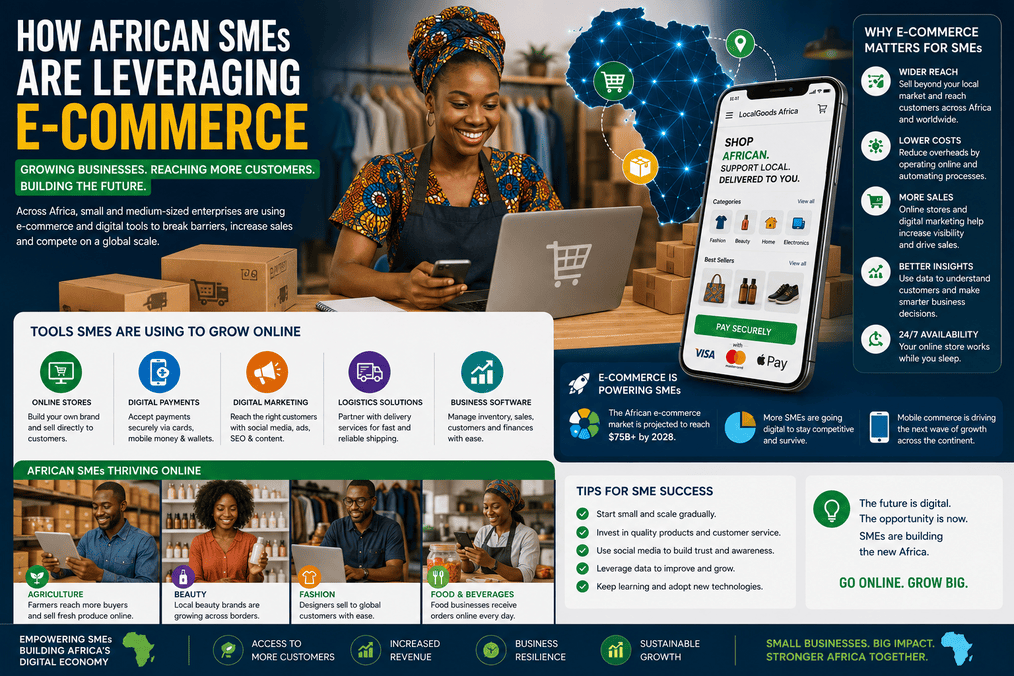
How African SMEs Are Leveraging E-commerce
Small and medium-sized enterprises (SMEs) are the backbone of Africa’s economy.
Across the continent, they account for the overwhelming majority of businesses and provide employment for millions of people.
For decades, however, many SMEs were limited by geography, infrastructure, and access to customers.
Today, that is changing rapidly.
The rise of e-commerce has opened entirely new opportunities for African entrepreneurs. Top African Startups to Watch
Instead of relying solely on physical stores, SMEs can now sell products online, accept digital payments, advertise through social media, and deliver goods across cities, countries, and even continents.
As Africa’s digital economy continues expanding, e-commerce is becoming one of the most powerful tools helping SMEs grow.
Why SMEs Matter to Africa
SMEs play a critical role in economic development.
They contribute to:
- Job creation.
- Innovation.
- Local manufacturing.
- Agricultural value chains.
- Tax revenue.
- Poverty reduction.
Despite their importance, many SMEs still struggle with:
- Limited access to finance.
- Small customer bases.
- High operating costs.
- Poor infrastructure.
- Limited visibility.
E-commerce helps address many of these challenges.
Reaching Customers Beyond Local Markets
Traditionally, many African businesses depended almost entirely on walk-in customers.
E-commerce removes geographical barriers.
Today, a small business in Lagos can sell products to customers in Nairobi, Johannesburg, Accra, or Cairo.
This expanded market creates enormous opportunities for growth.
Selling Through Online Marketplaces
Many SMEs begin their digital journey by selling on established marketplaces.
Popular platforms include:
- Jumia
- Konga
- Takealot
- Kilimall
- Amazon South Africa
These marketplaces provide immediate access to millions of potential customers without requiring businesses to build their own e-commerce infrastructure.
Building Independent Online Stores
Many growing businesses eventually launch their own websites.
Having an independent online store allows SMEs to:
- Build their own brand.
- Control customer relationships.
- Increase profit margins.
- Collect customer data.
- Create loyalty programs.
Platforms such as WooCommerce and Shopify have made online store creation much more affordable.
Digital Payments Have Simplified Business
One of the biggest drivers of SME growth is digital payments.
Instead of relying on cash transactions, businesses now accept:
- Bank transfers.
- Mobile wallets.
- Debit cards.
- Virtual cards.
- QR code payments.
Fintech companies continue making online transactions faster and more secure.
Social Media Is Becoming a Sales Channel
African SMEs increasingly generate sales through:
- TikTok
- WhatsApp Business
- X (formerly Twitter)
Rather than simply advertising, many businesses now complete entire transactions directly through social media.
This trend—known as social commerce—is growing rapidly across Africa.
Affordable Digital Marketing
Unlike traditional advertising, digital marketing allows SMEs to reach highly targeted audiences on relatively small budgets.
Businesses can promote products using:
- Facebook Ads.
- Instagram Ads.
- Google Search.
- SEO.
- Email marketing.
- Influencer partnerships.
This levels the playing field, allowing small businesses to compete with much larger companies.
Artificial Intelligence Is Helping SMEs Compete
Artificial Intelligence (AI) is no longer reserved for large corporations.
Today, affordable AI tools are helping African SMEs improve productivity and customer service.
Businesses now use AI to:
- Recommend products.
- Answer customer enquiries.
- Forecast demand.
- Generate marketing content.
- Analyse customer behaviour.
- Detect fraud.
With generative AI becoming more accessible, even small businesses can automate tasks that previously required dedicated staff.
Data Analytics Improves Decision-Making
Every online transaction produces valuable data.
Successful SMEs use analytics to understand:
- Best-selling products.
- Customer demographics.
- Shopping habits.
- Peak buying periods.
- Marketing performance.
- Revenue trends.
These insights enable business owners to make smarter decisions and reduce unnecessary expenses.
Better Logistics Through Technology
Efficient delivery remains essential for online businesses.
Fortunately, logistics startups are making it easier for SMEs to serve customers.
Businesses now benefit from:
- Real-time delivery tracking.
- Route optimization.
- Same-day delivery options.
- Automated dispatch systems.
- Last-mile delivery solutions.
Reliable logistics help improve customer satisfaction while encouraging repeat purchases.
Customer Relationship Management (CRM)
Retaining existing customers is often more profitable than constantly acquiring new ones.
Many SMEs now use CRM software to:
- Store customer information.
- Track purchase history.
- Send promotional offers.
- Follow up after purchases.
- Build customer loyalty.
Good customer relationships often lead to repeat business and referrals.
Inventory Management Software
Poor inventory management can lead to lost sales or unnecessary storage costs.
Modern inventory systems help SMEs:
- Monitor stock levels.
- Receive low-stock alerts.
- Track fast-moving products.
- Forecast future demand.
- Reduce waste.
Cloud-based inventory solutions have become increasingly affordable for small businesses.
Mobile Commerce Is Driving Sales
Most African consumers access the internet using smartphones.
As a result, SMEs increasingly prioritize mobile-friendly shopping experiences.
Businesses are investing in:
- Mobile-responsive websites.
- Shopping apps.
- WhatsApp ordering.
- Mobile payment integration.
- QR code payments.
A seamless mobile experience can significantly increase sales.
Cross-Border E-commerce Opportunities
The African Continental Free Trade Area (AfCFTA) creates new opportunities for SMEs to expand beyond domestic markets.
Businesses can potentially sell products across Africa more easily as regional trade barriers continue to decrease.
Cross-border e-commerce enables SMEs to:
- Reach larger markets.
- Diversify revenue.
- Increase exports.
- Build stronger brands.
For many businesses, regional expansion may become the next stage of growth.
Cloud Computing Supports Business Growth
Cloud technology allows SMEs to operate more efficiently without investing heavily in expensive infrastructure.
Cloud services support:
- Online stores.
- Accounting software.
- Inventory systems.
- Customer databases.
- Team collaboration.
- Data backups.
This flexibility allows businesses to scale as demand increases.
Digital Skills Are Becoming Essential
Technology alone is not enough.
Business owners and employees also need digital skills.
Important areas include:
- E-commerce management.
- Digital marketing.
- Search Engine Optimization (SEO).
- Social media marketing.
- AI tools.
- Data analysis.
Businesses that invest in digital education are more likely to remain competitive.
Government and Private Sector Support
Across Africa, governments, financial institutions, and technology companies are launching initiatives to help SMEs embrace digital commerce.
Support often includes:
- Business training.
- Startup grants.
- Digital skills programs.
- Low-interest loans.
- Incubators.
- Technology partnerships.
These initiatives are accelerating SME participation in the digital economy.
Artificial Intelligence Is Helping SMEs Compete
Artificial Intelligence (AI) is no longer reserved for large corporations.
Today, affordable AI tools are helping African SMEs improve productivity and customer service.
Businesses now use AI to:
- Recommend products.
- Answer customer enquiries.
- Forecast demand.
- Generate marketing content.
- Analyse customer behaviour.
- Detect fraud.
With generative AI becoming more accessible, even small businesses can automate tasks that previously required dedicated staff.
Data Analytics Improves Decision-Making
Every online transaction produces valuable data.
Successful SMEs use analytics to understand:
- Best-selling products.
- Customer demographics.
- Shopping habits.
- Peak buying periods.
- Marketing performance.
- Revenue trends.
These insights enable business owners to make smarter decisions and reduce unnecessary expenses.
Better Logistics Through Technology
Efficient delivery remains essential for online businesses.
Fortunately, logistics startups are making it easier for SMEs to serve customers.
Businesses now benefit from:
- Real-time delivery tracking.
- Route optimization.
- Same-day delivery options.
- Automated dispatch systems.
- Last-mile delivery solutions.
Reliable logistics help improve customer satisfaction while encouraging repeat purchases.
Customer Relationship Management (CRM)
Retaining existing customers is often more profitable than constantly acquiring new ones.
Many SMEs now use CRM software to:
- Store customer information.
- Track purchase history.
- Send promotional offers.
- Follow up after purchases.
- Build customer loyalty.
Good customer relationships often lead to repeat business and referrals.
Inventory Management Software
Poor inventory management can lead to lost sales or unnecessary storage costs.
Modern inventory systems help SMEs:
- Monitor stock levels.
- Receive low-stock alerts.
- Track fast-moving products.
- Forecast future demand.
- Reduce waste.
Cloud-based inventory solutions have become increasingly affordable for small businesses.
Mobile Commerce Is Driving Sales
Most African consumers access the internet using smartphones.
As a result, SMEs increasingly prioritize mobile-friendly shopping experiences.
Businesses are investing in:
- Mobile-responsive websites.
- Shopping apps.
- WhatsApp ordering.
- Mobile payment integration.
- QR code payments.
A seamless mobile experience can significantly increase sales. How Fintech Is Transforming Africa’s Economy
Cross-Border E-commerce Opportunities
The African Continental Free Trade Area (AfCFTA) creates new opportunities for SMEs to expand beyond domestic markets.
Businesses can potentially sell products across Africa more easily as regional trade barriers continue to decrease.
Cross-border e-commerce enables SMEs to:
- Reach larger markets.
- Diversify revenue.
- Increase exports.
- Build stronger brands.
For many businesses, regional expansion may become the next stage of growth.
Cloud Computing Supports Business Growth
Cloud technology allows SMEs to operate more efficiently without investing heavily in expensive infrastructure.
Cloud services support:
- Online stores.
- Accounting software.
- Inventory systems.
- Customer databases.
- Team collaboration.
- Data backups.
This flexibility allows businesses to scale as demand increases.
Digital Skills Are Becoming Essential
Technology alone is not enough.
Business owners and employees also need digital skills. Best Online Shopping Platforms in Africa
Important areas include:
- E-commerce management.
- Digital marketing.
- Search Engine Optimization (SEO).
- Social media marketing.
- AI tools.
- Data analysis.
Businesses that invest in digital education are more likely to remain competitive.
Government and Private Sector Support
Across Africa, governments, financial institutions, and technology companies are launching initiatives to help SMEs embrace digital commerce.
Support often includes:
- Business training.
- Startup grants.
- Digital skills programs.
- Low-interest loans.
- Incubators.
- Technology partnerships.
These initiatives are accelerating SME participation in the digital economy.
How African SMEs Are Leveraging E-commerce (Part 3)
Challenges African SMEs Still Face
Although e-commerce has created enormous opportunities, African SMEs continue to encounter several obstacles that can limit growth.
Limited Access to Finance
Many small businesses still struggle to obtain affordable financing.
Without sufficient capital, it becomes difficult to:
- Purchase inventory.
- Expand operations.
- Invest in technology.
- Hire skilled employees.
- Improve marketing.
Fortunately, fintech companies are increasingly providing digital lending solutions tailored to SMEs.
Logistics and Delivery Costs
While logistics has improved considerably, delivery costs remain high in certain regions.
Businesses often face challenges such as:
- Poor road infrastructure.
- Long delivery distances.
- High fuel costs.
- Limited courier coverage in rural areas.
As logistics startups continue expanding, these costs are expected to decline. Top E-commerce Startups in Africa
Cybersecurity Risks
As more businesses move online, cybersecurity becomes increasingly important.
SMEs must protect themselves against:
- Payment fraud.
- Phishing attacks.
- Account hacking.
- Data breaches.
- Identity theft.
Investing in secure payment gateways and strong cybersecurity practices is becoming essential. Top Retail Technology Companies in Africa
Digital Skills Gap
Many entrepreneurs are still learning how to operate successful online businesses.
Areas requiring continuous learning include:
- Search Engine Optimization (SEO).
- Social media marketing.
- Paid advertising.
- AI tools.
- E-commerce management.
- Customer analytics.
Businesses that continuously improve their digital skills are more likely to remain competitive.
Success Stories Across Africa
Thousands of African SMEs have already transformed their businesses through digital commerce. AI and Online Shopping in Africa
Examples include:
Fashion Brands
Local designers now sell clothing internationally through online stores and social media.
Agricultural Businesses
Farmers increasingly use digital marketplaces to reach wholesalers, retailers, and consumers directly.
Beauty Businesses
Cosmetics brands leverage Instagram, TikTok, and online stores to reach customers across multiple countries.
Food Businesses
Restaurants and food vendors now generate significant revenue through online ordering and delivery platforms.
These success stories demonstrate that technology can help businesses of every size grow.
The Future for African SMEs
The future looks promising.
Several trends will continue driving SME growth. Top Logistics Startups in Africa
Artificial Intelligence
AI will automate routine tasks while improving customer service and marketing.
Mobile Commerce
Smartphones will remain the primary shopping device across Africa.
Cross-Border Trade
AfCFTA will enable SMEs to expand beyond domestic markets.
Digital Payments
Cashless transactions will continue increasing consumer confidence.
Social Commerce
Businesses will increasingly sell directly through social media platforms.
Cloud Technology
Affordable cloud software will help SMEs scale more efficiently. The Future of E-commerce in Africa
Why SMEs Should Embrace E-commerce Today
Businesses that delay digital transformation risk falling behind competitors.
Early adoption offers advantages including:
- Larger customer base.
- Lower operating costs.
- Better customer engagement.
- Higher sales.
- Stronger brand visibility.
- Greater long-term scalability.
The sooner SMEs invest in digital commerce, the greater their opportunity to benefit from Africa’s rapidly expanding online economy.
Frequently Asked Questions (FAQs)
Can Small Businesses Succeed Online?
Yes.
Thousands of African SMEs have successfully expanded using online stores, marketplaces, and social commerce platforms.
Is Building an Online Store Expensive?
Not anymore.
Platforms like WooCommerce, Shopify, and other affordable website builders allow businesses to launch online stores with relatively low upfront costs.
Which Industries Benefit Most?
Industries seeing strong growth include:
- Fashion
- Agriculture
- Beauty
- Electronics
- Food delivery
- Healthcare
- Home products
What Is the Biggest Advantage of E-commerce?
The ability to reach customers beyond a local geographic area while operating more efficiently.
Final Thoughts
E-commerce has fundamentally changed how African SMEs operate.
Businesses that once depended solely on local customers can now reach regional and international markets through digital platforms.
Combined with fintech innovation, logistics technology, cloud computing, artificial intelligence, and mobile commerce, online retail is becoming one of the most powerful growth engines for African entrepreneurs.
While challenges remain, the opportunities continue to expand.
For SMEs willing to embrace technology, the future is filled with possibilities.
At Frenovara, we’ll continue covering the innovations, startups, and business trends helping African entrepreneurs build globally competitive companies.