Top E-commerce Startups in Africa in 2026: The Companies Revolutionising Online Shopping
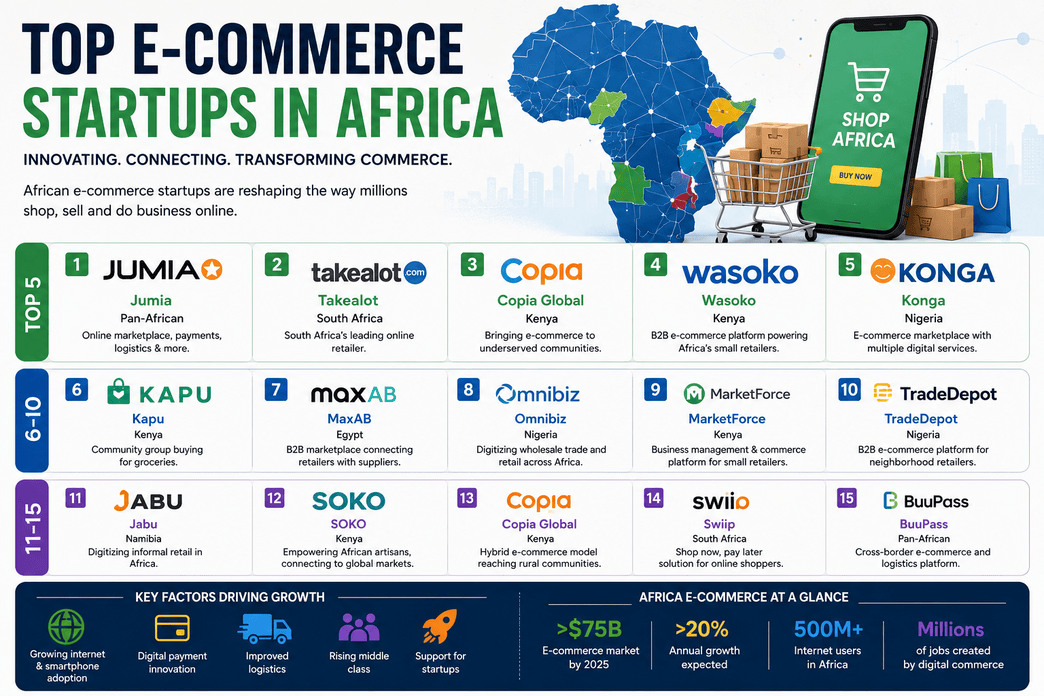
Africa’s digital economy continues to grow at an impressive pace, and one of its biggest success stories is the rapid expansion of e-commerce.
More Africans than ever before are shopping online for groceries, electronics, fashion, household goods, healthcare products, and business supplies.
Behind this transformation are innovative startups building technology platforms that make buying and selling easier, faster, and more secure.
From online marketplaces to B2B commerce platforms and logistics-enabled retailers, African e-commerce startups are reshaping how businesses and consumers interact.
In this article, we explore the Top E-commerce Startups in Africa that are driving innovation and redefining digital commerce across the continent.
Why E-commerce Is Growing in Africa
Several factors have contributed to the rise of online commerce across Africa.
These include:
- Increased smartphone adoption.
- Better internet connectivity.
- Growth of digital payments.
- Expanding middle class.
- Improved logistics networks.
- Fintech innovation.
- Rising consumer confidence in online shopping.
Together, these trends have created enormous opportunities for entrepreneurs and investors.
Industries Benefiting from E-commerce
African e-commerce is no longer limited to fashion and electronics.
The sector now includes:
- Grocery delivery.
- Business-to-business (B2B) commerce.
- Healthcare products.
- Agriculture.
- Consumer electronics.
- Beauty products.
- Food delivery.
- Pharmaceuticals.
- Construction supplies.
- Wholesale distribution.
This diversification continues to drive industry growth.
15. Jabu
Country: Namibia
Jabu is modernising informal retail across Southern Africa by digitising inventory ordering and payments for small retailers.
Its platform connects neighbourhood shops directly with suppliers.
Key Services
- Wholesale ordering.
- Inventory management.
- Digital payments.
- Retail technology.
Jabu continues expanding into additional African markets.
14. SOKO
Country: Kenya
SOKO empowers African artisans by connecting them directly with international buyers through technology.
Its platform removes traditional middlemen while improving income opportunities for local craftspeople.
Services
- Handmade products.
- International marketplace.
- Supply chain management.
- Artisan financing.
13. Copia Global
Country: Kenya
Copia serves consumers in underserved communities by combining digital ordering with physical delivery networks.
Customers can place orders using mobile phones while receiving products through local collection agents.
Products
- Household goods.
- Consumer products.
- Groceries.
- Personal care items.
Its hybrid model has expanded e-commerce access beyond major cities.
12. MarketForce
Country: Kenya
MarketForce provides digital commerce solutions for small retailers across Africa.
Its platform helps merchants:
- Source inventory.
- Process digital payments.
- Access financing.
- Improve sales.
By supporting informal businesses, MarketForce contributes significantly to SME growth.
11. TradeDepot
Country: Nigeria
TradeDepot has become one of Africa’s leading B2B commerce startups.
The platform connects manufacturers directly with neighbourhood retailers, improving supply chain efficiency.
Services
- Wholesale distribution.
- Retail inventory.
- Business financing.
- Supply chain technology.
TradeDepot continues helping thousands of small businesses grow across Africa.
10. Omnibiz
Country: Nigeria
Omnibiz is helping to digitize Africa’s informal retail sector by connecting manufacturers, distributors, and retailers on one platform.
Its technology enables businesses to order inventory efficiently while accessing financial services.
Key Services
- Wholesale ordering
- Retail inventory management
- Business financing
- Supply chain technology
- Digital payments
Omnibiz continues expanding its merchant network across Nigeria and other African markets.
9. MaxAB
Country: Egypt
MaxAB has built one of North Africa’s largest B2B e-commerce platforms.
The company connects small retailers directly with suppliers, reducing supply chain inefficiencies while improving inventory availability.
Products
- Wholesale marketplace
- Inventory procurement
- Logistics
- Retail financing
Its expansion strategy has positioned it as one of Africa’s fastest-growing commerce startups.
8. Kapu
Country: Kenya
Kapu is redefining grocery shopping by allowing communities to buy products in bulk at lower prices.
Using neighborhood collection points, Kapu reduces logistics costs while helping consumers save money.
Services
- Grocery delivery
- Community buying
- Bulk purchasing
- Digital payments
Its innovative community-commerce model continues attracting investor interest.
7. Konga
Country: Nigeria
Konga remains one of Nigeria’s most recognizable e-commerce brands.
Over the years, it has evolved into a diversified digital commerce company offering much more than an online marketplace.
Business Segments
- Online marketplace
- KongaPay
- Konga Logistics
- Konga Travel
- Enterprise commerce
Its integrated ecosystem continues serving millions of Nigerian consumers.
6. Jumia
Country: Pan-African (Founded in Nigeria)
Jumia remains Africa’s largest publicly listed e-commerce company.
Operating across multiple African countries, Jumia offers a broad marketplace connecting merchants and consumers.
Core Services
- Online marketplace
- Grocery delivery
- Food delivery (selected markets)
- Logistics
- JumiaPay
- Consumer electronics
- Fashion
- Household goods
Despite facing industry challenges, Jumia continues investing in digital commerce and logistics infrastructure across Africa.
Trends Driving African E-commerce
Several trends continue accelerating online shopping across the continent.
Mobile Commerce
Most online purchases are now made using smartphones.
Businesses increasingly design platforms with mobile users in mind. Best Investment Apps for Nigerians in 2026
Digital Payments
Fintech innovation has simplified online payments through:
- Mobile wallets
- Bank transfers
- Debit cards
- Buy Now, Pay Later (BNPL)
- Agency banking
This has significantly increased consumer confidence.
Faster Logistics
Delivery networks continue improving.
Many startups now offer:
- Same-day delivery
- Next-day delivery
- Pickup stations
- Real-time order tracking
Improved logistics have become a competitive advantage.
Artificial Intelligence
AI is helping e-commerce businesses:
- Recommend products.
- Detect fraud.
- Forecast demand.
- Improve customer service.
- Optimize inventory.
As AI adoption grows, customer experiences are expected to become even more personalized. Paystack vs Flutterwave: A Complete Comparison
Challenges Facing African E-commerce
Although growth remains impressive, several challenges persist.
Logistics Costs
Delivering products across large geographic areas remains expensive.
Infrastructure
Road networks and transportation systems continue limiting efficient deliveries in some regions.
Digital Trust
Some consumers remain cautious about online transactions due to fraud concerns.
Payment Preferences
Cash-on-delivery still exists in certain markets, increasing operational complexity for merchants.
Despite these obstacles, African e-commerce startups continue developing innovative solutions that improve customer experiences and strengthen the digital economy. How Fintech Is Transforming Africa’s Economy
5. Takealot
Country: South Africa
Takealot has established itself as South Africa’s largest online retailer and one of Africa’s most successful e-commerce companies.
The platform offers millions of products across multiple categories while operating an advanced nationwide logistics network.
Key Services
- Consumer electronics
- Fashion
- Home appliances
- Books
- Grocery (selected locations)
- Marketplace for third-party sellers
Its continued investment in technology and logistics keeps it at the forefront of African e-commerce.
4. Wasoko
Country: Kenya
Wasoko (formerly Sokowatch) has revolutionized business-to-business (B2B) e-commerce across Africa.
Rather than targeting individual consumers, Wasoko focuses on helping neighborhood retailers restock inventory quickly and efficiently.
Products and Services
- Digital wholesale ordering
- Inventory management
- Business financing
- Retail analytics
- Last-mile logistics
Operating in several African countries, Wasoko has become one of the continent’s fastest-growing commerce startups.
3. Konga
Country: Nigeria
Konga continues to play a significant role in Nigeria’s digital commerce ecosystem.
Over the years, it has expanded beyond online shopping into a diversified technology company.
Business Units
- Online marketplace
- Konga Logistics
- KongaPay
- Konga Travel
- Enterprise commerce
Its integrated approach allows businesses and consumers to access multiple digital services from one platform.
2. Copia Global
Country: Kenya
Copia Global has successfully bridged the gap between rural communities and digital commerce.
Its unique business model allows customers without reliable internet access to order products through local agents using mobile phones.
Why Copia Stands Out
- Rural commerce
- Affordable delivery
- Community collection centers
- Consumer goods
- Digital ordering
The company has significantly expanded access to e-commerce beyond major cities. Top 20 Richest Companies in Africa in 2026
1. Jumia
Country: Pan-African
At the top of our list of the Top E-commerce Startups in Africa is Jumia.
Often referred to as “Africa’s Amazon,” Jumia remains one of the continent’s most influential digital commerce platforms. Top 15 Fintech Companies in Africa
Operating across several African countries, Jumia offers an extensive ecosystem that includes:
- Online marketplace
- JumiaPay
- Logistics services
- Seller marketplace
- Consumer electronics
- Fashion
- Beauty products
- Household goods
Despite economic challenges affecting global e-commerce, Jumia continues investing in technology, logistics, and merchant growth.
Its scale, brand recognition, and pan-African presence make it one of the continent’s most important digital commerce companies. How to Build Wealth in Nigeria from Scratch
The Future of E-commerce in Africa
Africa’s online retail industry is expected to continue growing rapidly over the next decade.
Several trends will drive this expansion.
Artificial Intelligence
AI will improve:
- Product recommendations
- Customer support
- Inventory forecasting
- Fraud detection
- Personalized shopping experiences
Digital Payments
Fintech companies will continue simplifying online transactions through:
- Mobile wallets
- Instant bank transfers
- Digital banking
- Buy Now, Pay Later (BNPL)
- Cross-border payments
Logistics Innovation
Delivery companies are investing heavily in:
- Smart warehouses
- Route optimization
- Drone delivery (pilot projects)
- Automated fulfillment
- Real-time package tracking
Cross-Border Commerce
The African Continental Free Trade Area (AfCFTA) is expected to accelerate trade between African countries, creating new opportunities for e-commerce businesses.
Why African E-commerce Matters
E-commerce contributes significantly to Africa’s economy by:
- Creating employment.
- Supporting SMEs.
- Expanding financial inclusion.
- Improving product accessibility.
- Increasing tax revenues.
- Driving technology adoption.
- Encouraging entrepreneurship.
- Attracting international investment.
As internet access continues expanding, online commerce is expected to become an even larger contributor to Africa’s GDP.
Frequently Asked Questions (FAQs)
Which Is the Largest E-commerce Company in Africa?
Jumia remains one of Africa’s largest and most recognizable e-commerce companies, operating across multiple countries.
Which Country Has the Largest E-commerce Market?
Nigeria, South Africa, Kenya, and Egypt currently rank among Africa’s leading e-commerce markets. Top African Startups to Watch in 2026
Why Is African E-commerce Growing?
Growth is driven by:
- Smartphone adoption.
- Digital payments.
- Internet expansion.
- Young population.
- Urbanization.
- Improved logistics.
What Is B2B E-commerce?
B2B (Business-to-Business) e-commerce refers to digital platforms that enable businesses to buy products directly from manufacturers or distributors.
Companies like Wasoko and TradeDepot specialize in this segment.
Final Thoughts
Africa’s e-commerce sector has evolved from a niche industry into one of the continent’s most dynamic economic drivers.
Companies such as Jumia, Konga, Wasoko, Takealot, Copia Global, and several emerging startups are transforming how millions of Africans shop, sell, and conduct business.
As fintech, artificial intelligence, logistics, and digital infrastructure continue advancing, the future of African e-commerce looks exceptionally promising.
For entrepreneurs, investors, merchants, and consumers alike, these startups represent the next generation of companies shaping Africa’s digital economy.
At Frenovara, we remain committed to tracking the businesses, technologies, and innovations that are defining Africa’s future.