AI and Online Shopping in Africa: How Artificial Intelligence Is Transforming E-commerce in 2026
Artificial Intelligence (AI) is no longer a futuristic concept.
It has become one of the most powerful technologies driving Africa’s digital economy.
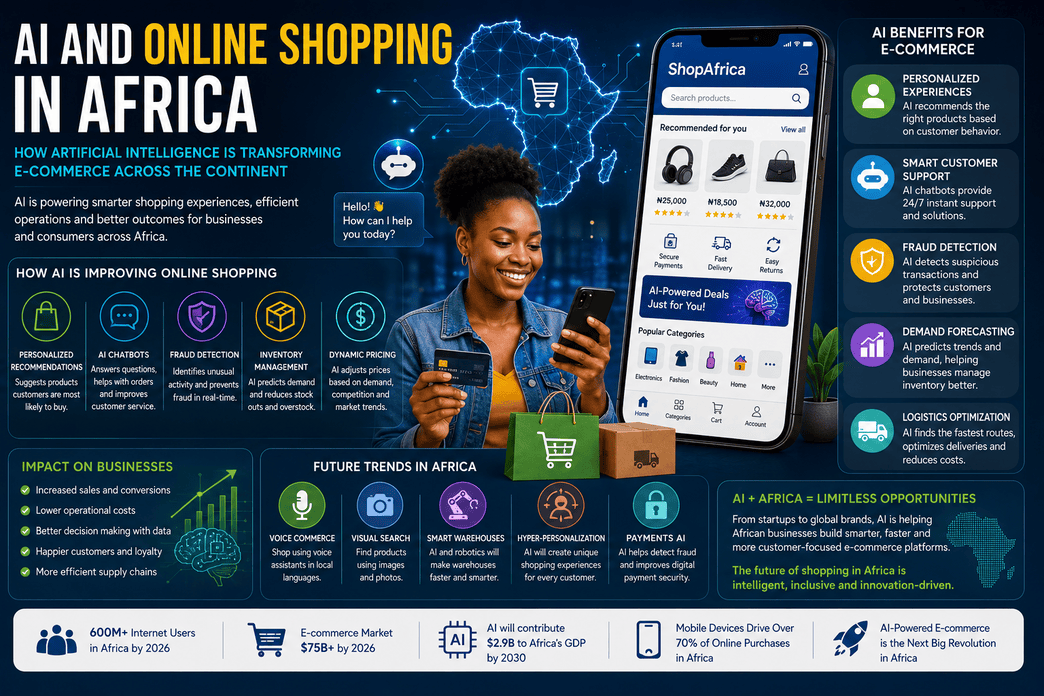
From personalized shopping recommendations to fraud detection, smart logistics, customer support, and inventory management, AI is changing how businesses operate and how consumers shop online.
Across Africa, startups, fintech companies, retailers, and online marketplaces are increasingly adopting AI to improve efficiency while delivering better customer experiences.
As internet access, smartphone adoption, and digital payments continue expanding, AI is expected to become one of the biggest drivers of African e-commerce growth.
In this guide, we explore how AI and Online Shopping in Africa are transforming the continent’s retail industry.
What Is Artificial Intelligence?
Artificial Intelligence refers to computer systems capable of performing tasks that normally require human intelligence.
These include:
- Learning from data.
- Understanding language.
- Recognizing images.
- Making recommendations.
- Predicting customer behaviour.
- Automating decisions.
Modern AI systems improve continuously as they process more information.
Why AI Matters for African E-commerce
Online shopping platforms generate enormous amounts of customer data every day.
Artificial Intelligence helps businesses analyse this data and make smarter decisions.
AI enables companies to:
- Understand customer preferences.
- Improve sales.
- Reduce fraud.
- Lower operating costs.
- Deliver faster services.
For African businesses operating in competitive markets, AI provides a major competitive advantage. Top Logistics Startups in Africa
Personalized Shopping Experiences
One of AI’s biggest contributions to online shopping is personalization.
Instead of showing every visitor the same products, AI recommends items based on:
- Previous purchases.
- Browsing history.
- Search behaviour.
- Budget.
- Favourite brands.
- Product interests.
This makes shopping faster while increasing customer satisfaction.
Consumers are more likely to purchase products that match their preferences.
AI-Powered Product Recommendations
Major online marketplaces increasingly use recommendation engines.
Examples include:
- “Customers also bought…”
- “Recommended for you.”
- “Trending near you.”
- “Frequently purchased together.”
These recommendations increase sales while improving user experience.
African platforms are beginning to implement similar technologies.
Chatbots and Virtual Customer Support
Customer service is another area where AI is making a significant impact.
AI chatbots now answer customer questions instantly.
They can assist with:
- Order tracking.
- Product information.
- Refund requests.
- Delivery updates.
- Frequently asked questions.
Unlike human agents, chatbots operate 24 hours a day.
This significantly improves customer satisfaction while reducing support costs.
Fraud Detection
Online fraud remains a major concern for African businesses.
Artificial Intelligence helps identify suspicious activities by analysing transaction patterns.
AI systems can detect:
- Unusual payment behaviour.
- Fake accounts.
- Suspicious login attempts.
- Payment fraud.
- Identity theft.
This improves security for both customers and businesses.
Inventory Management
Maintaining the right inventory levels can be challenging.
Too much inventory increases storage costs.
Too little inventory results in stock shortages.
AI helps businesses forecast demand more accurately by analysing:
- Historical sales.
- Seasonal demand.
- Consumer trends.
- Market behaviour.
- Economic conditions.
Better forecasting leads to improved inventory management and higher profitability.
AI in Pricing
Some online retailers use AI to adjust prices dynamically.
Pricing decisions may depend on:
- Product demand.
- Competitor pricing.
- Inventory availability.
- Seasonal trends.
This helps businesses remain competitive while maximizing revenue.
AI Is Transforming Logistics and Delivery
One of the biggest challenges facing African e-commerce has always been logistics.
Artificial Intelligence is helping delivery companies solve many of these problems through automation and predictive analytics.
AI can:
- Calculate the fastest delivery routes.
- Predict traffic conditions.
- Reduce fuel consumption.
- Improve delivery schedules.
- Match drivers with nearby deliveries.
These improvements help businesses lower operational costs while ensuring customers receive their orders faster.
Warehouse Automation
Modern warehouses are becoming increasingly intelligent.
Rather than relying entirely on manual inventory management, AI-powered systems help businesses organize products more efficiently.
AI assists with:
- Product placement.
- Inventory counting.
- Stock forecasting.
- Order prioritization.
- Warehouse optimization.
This reduces human error while increasing productivity.
Smarter Digital Marketing
Artificial Intelligence has transformed online advertising.
Instead of showing advertisements to everyone, AI identifies people who are most likely to purchase a product.
It analyzes:
- Search history.
- Shopping behaviour.
- Demographics.
- Interests.
- Purchase patterns.
As a result, businesses spend less on advertising while generating higher sales.
AI-Powered Search
Traditional search engines only match keywords.
AI-powered search goes much further.
Modern shopping platforms can understand what customers actually mean.
For example, instead of searching for:
“Black men’s running shoes size 44”
Customers can simply type:
“Comfortable running shoes for everyday jogging.”
AI understands the intent and returns highly relevant products.
This creates a smoother shopping experience.
Image Recognition Technology
Image search is becoming increasingly popular.
Rather than typing product names, customers can upload photographs.
AI analyzes the image and finds similar products available on the platform.
This technology is particularly useful for:
- Fashion.
- Furniture.
- Electronics.
- Home décor.
- Accessories.
Several African e-commerce platforms are gradually introducing similar capabilities.
Voice Commerce
As voice assistants continue improving, online shopping through voice commands is expected to become more common.
Consumers may eventually order products simply by speaking into their smartphones or smart devices.
Examples include:
- “Order more toothpaste.”
- “Buy a Samsung television.”
- “Find affordable laptops.”
Voice shopping is expected to become increasingly important over the next decade.
AI in Mobile Shopping
Most Africans shop online using smartphones.
Artificial Intelligence helps mobile shopping applications by:
- Personalizing home pages.
- Recommending products.
- Improving navigation.
- Predicting customer needs.
- Simplifying checkout.
This creates a faster and more enjoyable shopping experience.
Business Intelligence
E-commerce companies collect enormous amounts of customer data every day.
Artificial Intelligence transforms this data into actionable insights.
Business leaders can understand:
- Best-selling products.
- Customer preferences.
- Seasonal demand.
- Revenue trends.
- Marketing performance.
- Inventory turnover.
These insights support better decision-making.
AI and Customer Retention
Acquiring new customers is expensive.
Keeping existing customers is often more profitable.
Artificial Intelligence helps improve customer loyalty by:
- Sending personalized offers.
- Recommending complementary products.
- Identifying inactive customers.
- Predicting repeat purchases.
- Rewarding loyal shoppers.
These strategies increase customer lifetime value.
Opportunities for African Startups
Artificial Intelligence creates enormous opportunities for entrepreneurs.
Potential startup ideas include:
AI Chatbots
Helping businesses automate customer support.
AI Marketing Tools
Providing personalized advertising for SMEs.
AI Inventory Systems
Helping retailers forecast demand and manage stock.
AI Fraud Detection
Protecting businesses against payment fraud.
AI Logistics Platforms
Optimizing delivery routes and warehouse operations.
As AI adoption increases, demand for these solutions will continue growing across Africa. How African SMEs Are Leveraging E-commerce
Challenges of AI Adoption in Africa
Although Artificial Intelligence offers enormous opportunities, widespread adoption across Africa still faces several obstacles.
Limited Digital Infrastructure
Many businesses still struggle with:
- Unstable electricity.
- Slow internet connections.
- Limited cloud infrastructure.
As infrastructure improves, AI adoption is expected to accelerate.
High Implementation Costs
Building AI systems requires investment in:
- Software.
- Cloud computing.
- Skilled professionals.
- Data management.
- Cybersecurity.
For many SMEs, these costs remain a significant barrier.
However, affordable AI tools and Software-as-a-Service (SaaS) platforms are making adoption easier.
Data Availability
Artificial Intelligence performs best when trained using high-quality data.
Many African businesses still collect limited customer data, making AI less effective.
Companies that invest in proper data collection today will have a major competitive advantage tomorrow. Top E-commerce Startups in Africa
AI Skills Gap
Africa continues to experience a shortage of AI professionals.
Demand for:
- Data scientists.
- Machine learning engineers.
- AI developers.
- Prompt engineers.
- Cloud architects.
continues growing rapidly.
This presents an enormous opportunity for young Africans interested in technology careers. Top African Startups to Watch
Ethical Considerations
As AI becomes more powerful, businesses must use it responsibly.
Important considerations include:
- Customer privacy.
- Data protection.
- Fair pricing.
- Transparency.
- Responsible automation.
Companies that prioritize ethical AI are more likely to build long-term customer trust.
Will AI Replace Jobs?
One of the most common questions surrounding AI is whether it will eliminate jobs.
The answer is more balanced than many people assume. How Fintech Is Transforming Africa’s Economy
AI will automate repetitive tasks such as:
- Basic customer support.
- Inventory tracking.
- Order processing.
- Fraud detection.
At the same time, AI will create entirely new career opportunities in areas like:
- AI development.
- Data analysis.
- Prompt engineering.
- Digital marketing.
- Robotics.
- Cloud computing.
- AI consulting.
Rather than replacing humans completely, AI is more likely to change the nature of work.
AI Will Empower African SMEs
Small and medium-sized enterprises (SMEs) stand to benefit enormously from affordable AI solutions.
AI can help SMEs:
- Compete with larger companies.
- Improve customer service.
- Reduce operating costs.
- Automate repetitive tasks.
- Increase sales.
- Make smarter business decisions.
As AI tools become cheaper, adoption among African SMEs is expected to grow rapidly.
Predictions for AI and Online Shopping by 2030
Experts expect Artificial Intelligence to become central to African e-commerce. Top Retail Technology Companies in Africa
Some likely developments include:
Hyper-Personalized Shopping
Every customer will receive product recommendations tailored specifically to their interests.
Smarter Delivery Networks
AI will continue optimizing:
- Delivery routes.
- Warehouse operations.
- Driver scheduling.
- Inventory distribution.
Voice and Visual Shopping
Customers will increasingly search using:
- Voice commands.
- Images.
- Natural language.
Shopping will become faster and more intuitive.
AI Shopping Assistants
Virtual assistants will help customers:
- Compare products.
- Find discounts.
- Answer questions.
- Recommend alternatives.
- Complete purchases.
Fully Automated Business Operations
Many routine processes—from inventory management to customer support—will become highly automated, allowing businesses to scale more efficiently. Best Online Shopping Platforms in Africa
Frequently Asked Questions (FAQs)
Is AI Already Being Used by African E-commerce Companies?
Yes.
Leading African platforms already use AI for recommendations, fraud detection, customer support, marketing, and logistics optimization.
Will AI Make Online Shopping Safer?
Yes.
AI improves fraud detection by identifying suspicious payment behaviour and reducing fraudulent transactions. The Future of E-commerce in Africa
Can Small Businesses Use AI?
Absolutely.
Many affordable AI tools now help SMEs with:
- Marketing.
- Customer support.
- Inventory management.
- Content creation.
- Sales analysis.
Which Industries Will Benefit Most?
Industries expected to benefit include:
- E-commerce.
- Fintech.
- Logistics.
- Healthcare.
- Agriculture.
- Manufacturing.
- Education.
Final Thoughts
Artificial Intelligence is no longer a luxury reserved for global technology companies.
It is becoming an essential tool for businesses of every size across Africa.
From personalized shopping experiences and smarter logistics to fraud prevention, inventory management, and digital marketing, AI is fundamentally changing how African consumers buy and how businesses sell.
Companies that embrace AI today will be better positioned to compete in tomorrow’s increasingly digital economy.
For entrepreneurs, investors, developers, and retailers, Artificial Intelligence represents one of the greatest business opportunities of the decade.
At Frenovara, we’ll continue tracking the innovations shaping Africa’s digital transformation and helping readers understand the technologies driving the continent’s future.