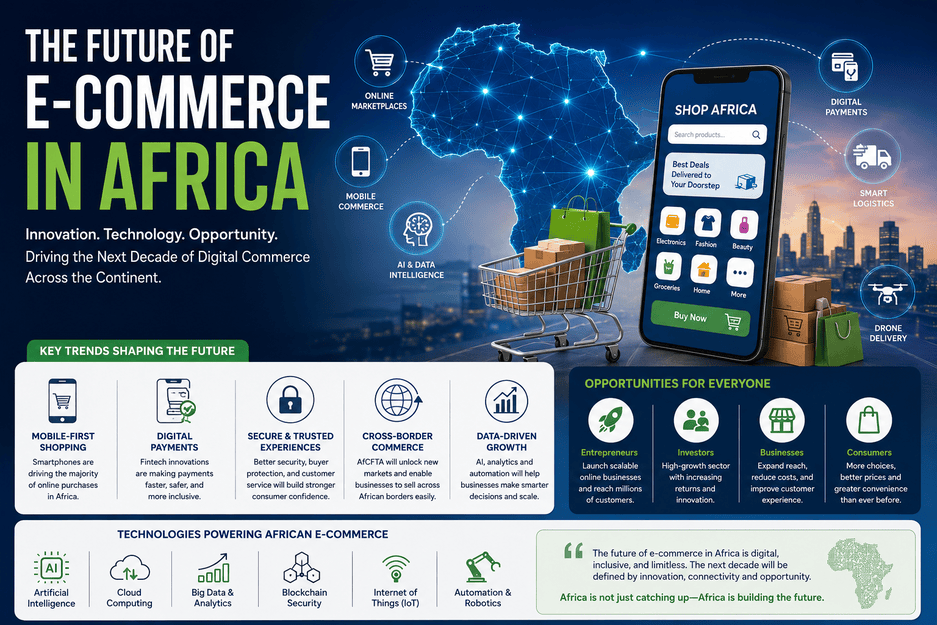
The Future of E-commerce in Africa: Trends, Opportunities and Challenges
Africa’s e-commerce industry has experienced remarkable growth over the past decade.
What began as a niche market serving a relatively small number of internet users has evolved into one of the continent’s fastest-growing economic sectors.
Millions of Africans now purchase products online every day, while thousands of businesses rely on digital platforms to reach customers across cities, countries, and even continents.
With continued improvements in internet connectivity, digital payments, artificial intelligence, and logistics, Africa’s e-commerce sector is expected to expand significantly over the coming years.
In this comprehensive guide, we examine The Future of E-commerce in Africa, highlighting the technologies, innovations, and market trends that will shape digital commerce in 2026 and beyond.
The Growth of African E-commerce
Africa’s digital commerce market has become increasingly attractive to investors.
Several factors continue driving this rapid expansion.
Internet Expansion
Internet penetration continues to improve across many African countries.
As more households gain access to affordable internet, online shopping becomes increasingly accessible.
Smartphone Adoption
Affordable Android devices have introduced millions of Africans to digital commerce.
Today, smartphones are the primary tool for online shopping across much of the continent.
Digital Payments
Financial technology companies have simplified online transactions through:
- Mobile wallets
- Bank transfers
- Virtual cards
- Agency banking
- Buy Now, Pay Later (BNPL)
These innovations have significantly increased consumer confidence.
Young Population
Africa has one of the youngest populations globally.
Young consumers are generally more comfortable adopting digital technologies, making them the driving force behind online shopping growth.
Emerging Technologies Transforming E-commerce
Technology will continue reshaping how Africans shop online.
Several innovations are expected to have a major impact.
Artificial Intelligence (AI)
Artificial Intelligence is already changing online shopping experiences worldwide.
African e-commerce companies are increasingly adopting AI to improve customer satisfaction.
AI applications include:
- Personalized product recommendations.
- Chatbots.
- Fraud detection.
- Inventory forecasting.
- Dynamic pricing.
- Customer behaviour analysis.
As AI tools become more affordable, adoption across African businesses is expected to accelerate.
Machine Learning
Machine learning enables retailers to understand customer preferences by analysing shopping patterns.
This helps businesses:
- Predict demand.
- Recommend products.
- Reduce stock shortages.
- Improve customer retention.
Retailers using machine learning often deliver more personalized shopping experiences.
Mobile Commerce Will Continue Dominating
More than ever before, Africans are shopping using smartphones instead of desktop computers.
Mobile-first shopping will continue dominating because:
- Smartphones are affordable.
- Mobile internet is improving.
- Apps provide better user experiences.
- Mobile payments are becoming easier.
Businesses that prioritize mobile optimization are expected to outperform competitors.
Digital Payments Will Become Even Simpler
The future of African e-commerce depends heavily on seamless payments.
Consumers increasingly expect:
- One-click checkout.
- Instant transfers.
- Mobile wallets.
- QR code payments.
- Contactless payments.
Fintech companies will continue removing friction from online transactions.
Cross-Border Shopping Will Increase
The African Continental Free Trade Area (AfCFTA) is expected to significantly boost regional commerce.
Consumers will gain easier access to products from neighbouring countries, while businesses will expand into new markets.
Cross-border e-commerce is likely to become one of Africa’s fastest-growing business segments.
Smarter Logistics Will Drive Growth
One of the biggest barriers to African e-commerce has traditionally been logistics.
Delivering products across vast geographic regions with varying road infrastructure has often been expensive and time-consuming.
Fortunately, this is changing.
Logistics startups are investing heavily in technology that improves delivery efficiency while reducing costs.
Emerging Logistics Innovations
- AI-powered route optimization.
- Smart delivery tracking.
- Automated dispatch systems.
- Digital warehouse management.
- Last-mile delivery solutions.
These innovations will significantly improve customer satisfaction over the coming years.
Drone Deliveries Could Become More Common
Drone technology is gradually becoming a reality in parts of Africa.
Countries such as Rwanda have already demonstrated the potential of drone deliveries for healthcare and emergency supplies.
As regulations mature, drones may also be used for:
- Small parcel delivery.
- Rural deliveries.
- Same-day shipping.
- Medical supplies.
- High-priority orders.
Although widespread commercial adoption may still take time, drone logistics could transform African e-commerce.
Smart Warehouses
Warehouse technology is evolving rapidly.
Future warehouses will increasingly use automation to improve efficiency.
Technologies expected to become more common include:
- Automated inventory management.
- Barcode scanning.
- Robotics.
- AI inventory forecasting.
- Smart shelving systems.
These innovations will reduce order processing times while minimizing inventory errors.
Social Commerce Will Continue Expanding
Africans increasingly discover products through social media rather than traditional online stores.
Platforms such as:
- TikTok
- X (formerly Twitter)
have become major sales channels for businesses.
Social commerce enables merchants to interact directly with customers while shortening the buying process.
Many businesses now generate substantial revenue without operating standalone e-commerce websites. Top African Startups to Watch
Live Shopping Will Gain Popularity
Live shopping—where businesses demonstrate products through live video while customers purchase instantly—is expected to become increasingly popular.
This model combines:
- Entertainment.
- Product demonstrations.
- Customer engagement.
- Instant purchasing.
Influencers and content creators will play an even greater role in driving online sales.
Personalised Shopping Experiences
Artificial Intelligence will make shopping far more personalised.
Instead of displaying the same products to every customer, platforms will increasingly recommend products based on:
- Previous purchases.
- Browsing history.
- Interests.
- Budget.
- Shopping habits.
- Location.
This improves customer satisfaction while increasing conversion rates. AI and Online Shopping in Africa
Sustainability Will Become More Important
Consumers are becoming more environmentally conscious.
Many African e-commerce companies are already exploring:
- Eco-friendly packaging.
- Electric delivery vehicles.
- Carbon reduction initiatives.
- Recyclable materials.
- Sustainable sourcing.
Businesses that prioritize sustainability may gain stronger customer loyalty. How Fintech Is Transforming Africa’s Economy
Opportunities for Entrepreneurs
Africa’s growing e-commerce industry creates enormous opportunities for entrepreneurs.
Promising areas include:
Logistics
Delivery companies remain in high demand.
Payment Solutions
Fintech continues creating opportunities around digital payments.
Online Retail
Specialized online stores serving niche markets continue emerging.
Software Development
Businesses increasingly require:
- E-commerce websites.
- Mobile applications.
- AI tools.
- Inventory software.
- Customer management systems.
Digital Marketing
As online competition increases, businesses need professionals who can generate traffic and sales.
Challenges That Still Need Solving
Despite remarkable progress, several obstacles remain.
Logistics Costs
Delivering products across large distances continues to increase operational expenses.
Infrastructure
Reliable electricity and internet access remain inconsistent in certain regions.
Fraud
Online fraud continues to affect both consumers and businesses.
Companies are investing heavily in fraud detection technologies.
Consumer Trust
Although confidence continues improving, some consumers remain cautious about shopping online.
Transparent return policies and secure payment systems will remain essential. Top Retail Technology Companies in Africa
Industries That Will Benefit the Most
As Africa’s digital economy continues to mature, several industries are expected to experience significant growth due to e-commerce expansion.
Fintech
Digital payments will remain the backbone of online commerce.
Companies offering:
- Mobile wallets
- Payment gateways
- Cross-border payments
- Buy Now, Pay Later (BNPL)
will continue experiencing rapid growth.
Logistics
Every online purchase depends on efficient delivery.
Logistics companies will benefit from increasing demand for:
- Last-mile delivery
- Same-day delivery
- Smart warehousing
- Route optimization
- Automated fulfilment
Artificial Intelligence
AI will become central to African e-commerce.
Retailers will increasingly rely on AI for:
- Customer support
- Fraud prevention
- Product recommendations
- Inventory forecasting
- Dynamic pricing
Cloud Computing
Cloud technology enables businesses to scale quickly while reducing infrastructure costs.
As more retailers move online, demand for cloud-based commerce solutions will continue increasing. How African SMEs Are Leveraging E-commerce
Digital Marketing
Businesses require visibility to generate sales.
This creates opportunities for professionals specializing in:
- SEO
- Social media marketing
- Content marketing
- Influencer marketing
- Email marketing
- Paid advertising
How AfCFTA Will Transform African E-commerce
The African Continental Free Trade Area (AfCFTA) is expected to become one of the biggest catalysts for digital commerce.
The agreement aims to reduce trade barriers between African countries, making it easier for businesses to sell products across borders.
Potential benefits include:
- Larger customer markets.
- Lower trade costs.
- Increased competition.
- More product variety.
- Faster regional expansion.
- Improved economic integration.
For e-commerce startups, AfCFTA represents one of the greatest growth opportunities in Africa’s history.
Predictions for African E-commerce by 2030
Industry experts expect several major developments over the coming years.
Greater AI Adoption
Nearly every major retailer is expected to integrate AI into customer experience and operations. Top Logistics Startups in Africa
Cashless Commerce
Digital payments are expected to dominate, reducing reliance on cash transactions.
Faster Deliveries
Same-day and next-day deliveries will become standard in many major African cities.
Increased Foreign Investment
International investors are likely to continue funding African startups as the digital economy expands.
More African Unicorns
Several e-commerce companies are expected to achieve billion-dollar valuations over the next decade. Top E-commerce Startups in Africa
Frequently Asked Questions (FAQs)
Is Africa’s E-commerce Industry Still Growing?
Yes.
Africa remains one of the fastest-growing e-commerce markets globally due to increasing internet access, smartphone adoption, and fintech innovation.
Which Countries Lead African E-commerce?
Current leaders include:
- Nigeria
- South Africa
- Kenya
- Egypt
- Morocco
These markets continue attracting the largest investments. Best Online Shopping Platforms in Africa
What Technologies Will Shape African E-commerce?
Key technologies include:
- Artificial Intelligence
- Cloud computing
- Digital payments
- Blockchain
- Smart logistics
- Data analytics
Is Africa Attractive for E-commerce Investors?
Absolutely.
Africa’s young population, growing middle class, and expanding digital infrastructure make it one of the world’s most promising long-term investment destinations.
Final Thoughts
The future of African e-commerce has never looked brighter.
Driven by rapid technological innovation, expanding internet access, improved logistics, and financial technology, online shopping is becoming an increasingly important part of everyday life across the continent.
Companies investing in AI, fintech, logistics, cloud computing, and digital marketing are likely to shape the next generation of African commerce.
While challenges remain, the opportunities far outweigh the obstacles.
For entrepreneurs, investors, policymakers, and consumers, the coming decade promises to be one of the most exciting periods in Africa’s digital transformation.
At Frenovara, we’ll continue covering the innovations, businesses, and technologies shaping Africa’s future.