
The Business Model Behind Bolt’s Success in Africa: How the Ride-Hailing Giant Built a Multi-Million Dollar Empire
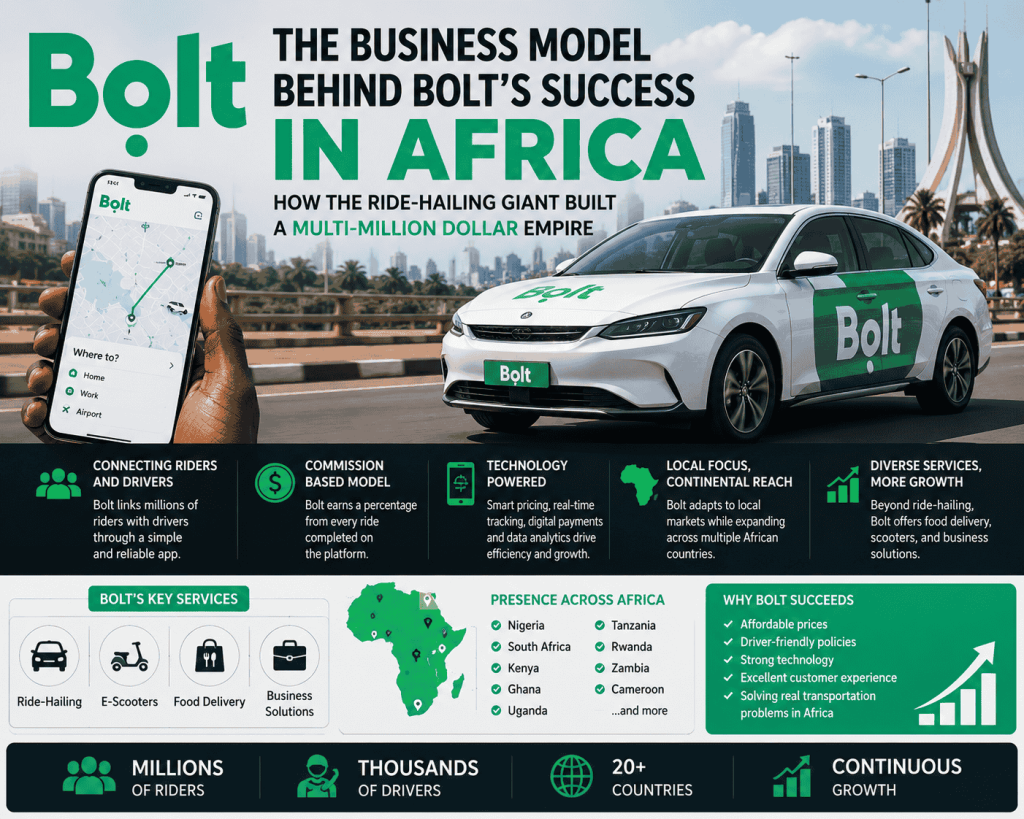
Over the last decade, Africa’s transportation industry has undergone a dramatic transformation. What was once dominated by traditional taxis, informal transport operators, and unreliable booking systems has increasingly shifted toward digital ride-hailing platforms. Among the companies leading this revolution is Bolt.
Today, Bolt operates in numerous African countries and serves millions of passengers through a mobile app that connects riders with drivers quickly and efficiently. The company has become a household name in cities such as Lagos, Abuja, Nairobi, Johannesburg, Accra, and Kampala.
But Bolt’s growth did not happen by accident. Behind its success lies a carefully designed business model focused on affordability, scalability, technology, and local market adaptation.
This article explores the business model behind Bolt’s success in Africa, the strategies that fueled its expansion, the challenges it faces, and the lessons entrepreneurs can learn from one of the continent’s most influential technology companies.
The Rise of Ride-Hailing in Africa
Before ride-hailing apps became popular, many commuters across Africa relied on traditional taxi services.
Common challenges included:
- Unpredictable pricing
- Difficulty finding available drivers
- Limited safety measures
- Lack of transparency
- Poor customer experience
The widespread adoption of smartphones and mobile internet created an opportunity for technology-driven transportation solutions.
Companies like Bolt recognized that millions of people needed a more convenient way to move around rapidly growing cities.
By connecting drivers and passengers through a mobile application, Bolt solved several transportation problems at once.
What Is Bolt?
Bolt is a technology company that provides mobility services through digital platforms.
Its services include:
- Ride-hailing
- Food delivery
- Scooter rentals (in some markets)
- Business transportation solutions
Unlike traditional taxi companies, Bolt does not own fleets of vehicles.
Instead, it operates a platform that connects independent drivers with customers seeking transportation.
This asset-light approach has become one of the company’s biggest strengths.
Understanding Bolt’s Core Business Model
At its heart, Bolt operates a marketplace business model.
The platform creates value by bringing together two groups:
Drivers
Individuals who own or have access to vehicles and want to earn income.
Passengers
Customers who need transportation services.
Bolt facilitates the interaction between these groups while earning revenue from each completed trip.
The more drivers and passengers join the platform, the stronger the network becomes.
This creates what economists call a network effect.
As more users join, the platform becomes increasingly valuable for everyone involved.
How Bolt Makes Money
One of the most important aspects of any business model is revenue generation.
Bolt primarily earns money through commissions.
When a passenger books a ride:
- The customer pays for the trip.
- The driver receives most of the fare.
- Bolt takes a percentage as commission.
Because Bolt does not employ drivers as traditional staff members, its operational costs remain significantly lower than those of transportation companies that own vehicles or hire full-time drivers.
Additional revenue streams may include:
- Corporate transportation services
- Delivery commissions
- Advertising partnerships
- Premium mobility services
This diversified revenue structure helps support long-term growth.
Why Bolt Succeeded in Africa
Several factors explain Bolt’s remarkable success across African markets.
Affordability
One of Bolt’s biggest competitive advantages has been pricing.
Many African consumers are highly price-sensitive.
Bolt often entered markets with lower commission rates and more affordable ride prices than competitors.
This attracted both passengers and drivers.
Lower prices encouraged adoption and helped the company build market share rapidly.
Local Market Adaptation
Unlike many global companies that apply identical strategies everywhere, Bolt adapts its operations to local conditions.
African cities often have unique transportation challenges, including:
- Traffic congestion
- Road quality issues
- Informal transport systems
- Economic differences
By understanding these realities, Bolt has been able to customize its services to meet local needs.
Technology and Convenience
The mobile application simplifies transportation.
Passengers can:
- Request rides instantly
- View estimated fares
- Track drivers in real time
- Make digital payments
- Rate service quality
This level of convenience has significantly improved the customer experience.
The Asset-Light Advantage
One of the smartest aspects of Bolt’s business model is its asset-light structure.
Traditional transportation companies often require massive investments in:
- Vehicles
- Maintenance facilities
- Fuel infrastructure
- Employee management
Bolt avoids many of these costs because drivers provide their own vehicles.
This allows the company to scale much faster than conventional transportation businesses.
As demand grows, Bolt can expand without purchasing thousands of cars.
This model significantly improves profitability and operational flexibility.
The Power of the Gig Economy
Bolt is part of the broader gig economy.
Rather than hiring drivers as permanent employees, the company enables individuals to earn income independently.
For many drivers, Bolt provides:
- Flexible work schedules
- Additional income opportunities
- Entrepreneurial independence
This arrangement benefits both the company and drivers.
Bolt gains access to a large workforce without traditional employment expenses, while drivers enjoy greater flexibility.
Expansion Across African Markets
Bolt’s expansion strategy has been aggressive yet calculated.
Instead of focusing solely on one country, the company expanded into multiple African markets.
Key expansion factors included:
Rapid Urbanization
Africa’s cities continue to grow quickly.
Larger urban populations create increased demand for transportation services.
Smartphone Adoption
The growing use of smartphones makes app-based services more accessible.
Limited Transportation Infrastructure
In many cities, public transportation struggles to meet demand.
Ride-hailing platforms help fill this gap.
Young Population
Africa has one of the youngest populations in the world, creating strong demand for digital services.
These factors created favorable conditions for Bolt’s growth.
Competing Against Larger Rivals
Bolt’s rise has often been compared to that of larger international competitors.
Instead of attempting to outspend competitors, Bolt focused on strategic differentiation.
Its approach included:
- Lower commission rates
- Competitive pricing
- Faster market adaptation
- Driver-friendly policies
- Strong local partnerships
This allowed the company to build loyalty among both drivers and passengers.
In many African cities, Bolt became known as the more affordable alternative.
Challenges Facing Bolt
Despite its success, Bolt faces several ongoing challenges.
Regulatory Issues
Governments continue to develop rules governing ride-hailing services.
Compliance requirements can vary significantly between countries.
Driver Satisfaction
Maintaining strong relationships with drivers is essential.
Concerns about commissions, fuel costs, and earnings can impact driver retention.
Safety Concerns
Passenger and driver safety remain critical priorities.
Technology, verification systems, and customer support play important roles in maintaining trust.
Competition
The ride-hailing industry remains highly competitive.
New entrants and existing rivals continually seek to capture market share.
Managing these challenges effectively will be important for Bolt’s future growth.
Bolt Beyond Ride-Hailing
Bolt’s ambitions extend beyond transportation.
The company has expanded into additional services including:
Food Delivery
The rise of online food ordering presents significant growth opportunities.
Business Mobility
Corporate transportation solutions help serve business clients.
Micromobility
In some regions, Bolt offers scooters and alternative transportation options.
By diversifying its offerings, Bolt reduces dependence on a single revenue stream.
This strategy strengthens long-term sustainability.
Lessons Entrepreneurs Can Learn from Bolt
Bolt’s journey offers valuable lessons for entrepreneurs.
Solve Real Problems
Successful businesses address genuine customer pain points.
Use Technology to Scale
Technology enables rapid growth and operational efficiency.
Focus on Customer Experience
Convenience and reliability encourage customer loyalty.
Adapt to Local Markets
Understanding local conditions improves competitiveness.
Build Network Effects
Platforms become stronger as more users join.
Stay Lean
Asset-light models can accelerate growth while reducing risk.
These principles apply far beyond the transportation industry.
The Future of Mobility in Africa
The future of transportation in Africa is likely to be increasingly digital.
Several trends are expected to shape the industry:
- Increased smartphone penetration
- Cashless payments
- Electric vehicles
- Artificial intelligence integration
- Smart city development
- Improved logistics systems
Companies that successfully adapt to these changes will be well-positioned for continued growth.
Bolt appears determined to remain a major player in this evolving landscape.
Conclusion
Bolt’s success in Africa is a powerful example of how technology can transform traditional industries.
By creating a platform that connects drivers and passengers efficiently, the company solved major transportation challenges while building a scalable and profitable business model.
Its focus on affordability, local adaptation, technology, and operational efficiency enabled rapid expansion across multiple African markets.
For entrepreneurs, Bolt’s story demonstrates the importance of solving real problems, leveraging technology, and creating systems that can scale efficiently.
As Africa’s cities continue to grow and digital adoption accelerates, Bolt’s influence on transportation and mobility is likely to remain significant for years to come. Its journey serves as a blueprint for businesses seeking to build sustainable, technology-driven solutions in emerging markets.
1 thought on “The Business Model Behind Bolt’s Success in Africa”