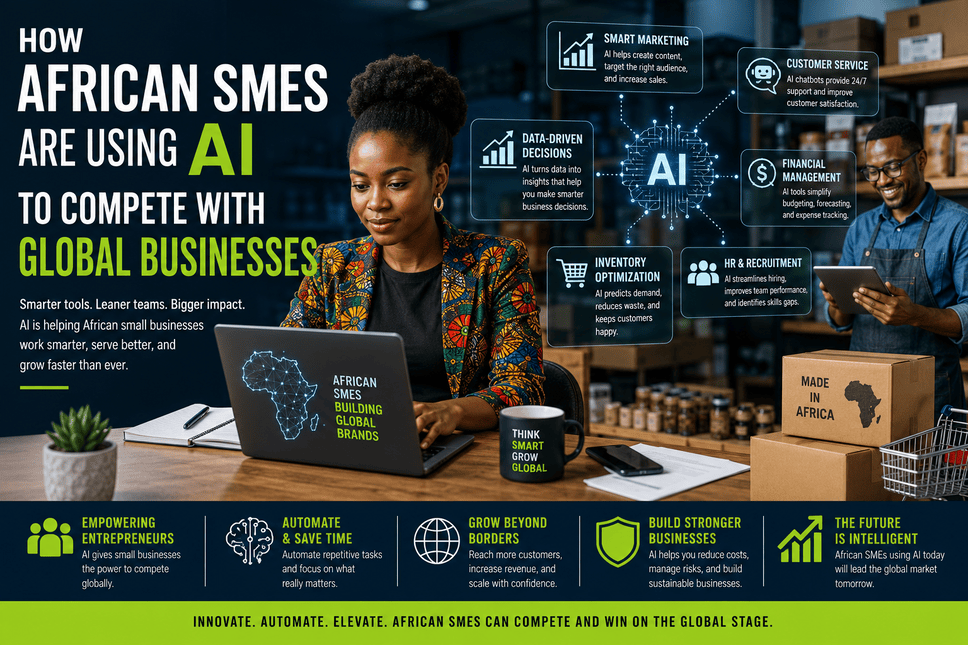
How African SMEs Are Using AI to Compete with Global Businesses
Across Africa, a quiet revolution is taking place.
It isn’t happening inside billion-dollar corporations alone.
It is happening in neighbourhood stores.
Small manufacturing companies.
Fashion brands.
Digital agencies.
Agricultural businesses.
Restaurants.
Online retailers.
These businesses have one thing in common—they are embracing Artificial Intelligence.
For many African SMEs, AI is no longer a luxury reserved for global corporations.
It has become an affordable business tool capable of improving productivity, reducing costs, and unlocking new opportunities.
The rapid adoption of AI for African SMEs could become one of the biggest drivers of economic growth across the continent. How Artificial Intelligence Is Transforming Healthcare in Africa
Why Small Businesses Need AI More Than Ever
Small businesses often operate with limited resources.
Owners frequently perform multiple roles at once:
- Managing staff.
- Handling marketing.
- Serving customers.
- Tracking finances.
- Managing inventory.
- Negotiating with suppliers.
This creates enormous pressure.
Artificial Intelligence helps automate many of these repetitive tasks, allowing entrepreneurs to focus on growing their businesses.
Rather than replacing workers, AI enables small teams to accomplish far more with the same resources.
AI Is Leveling the Playing Field
For decades, large corporations enjoyed significant advantages.
They could afford:
- Bigger marketing budgets.
- Dedicated customer service teams.
- Professional analysts.
- Expensive software.
- Advanced business intelligence tools.
Today, many of these capabilities are available through affordable AI platforms.
This means a startup in Lagos or Nairobi can now access technologies that were once reserved for Fortune 500 companies.
That shift is redefining Small Business Technology across Africa.
Customer Service Is Becoming Smarter
Excellent customer service often determines whether businesses succeed or fail.
AI-powered chatbots now allow businesses to:
- Respond instantly to customers.
- Answer common questions.
- Process orders.
- Schedule appointments.
- Handle enquiries 24 hours a day.
Customers receive faster support while business owners save valuable time.
For growing companies, this represents one of the biggest advantages of Business Automation Africa.
AI Is Improving Marketing Results
Marketing remains one of the biggest challenges facing entrepreneurs.
Artificial Intelligence helps businesses create:
- Social media content.
- Email campaigns.
- Product descriptions.
- Advertising copy.
- Video scripts.
- SEO-optimized blog articles.
AI also analyses customer behaviour, helping businesses understand:
- Which products sell best.
- When customers buy.
- Which advertisements perform better.
- What content generates engagement.
This allows entrepreneurs to make better marketing decisions while spending less money. How African Startups Are Attracting Billions in Global Investment
Financial Management Is Becoming Easier
Many small businesses struggle with bookkeeping and financial planning.
Modern AI-powered accounting tools assist with:
- Expense tracking.
- Cash-flow analysis.
- Budget forecasting.
- Invoice generation.
- Tax preparation.
- Profitability analysis.
Better financial visibility helps entrepreneurs make smarter business decisions.
This strengthens Digital Transformation Africa by encouraging more efficient business operations.
Inventory Management Is Becoming More Efficient
Retailers frequently experience either:
- Overstocking.
- Running out of products.
Artificial Intelligence analyses historical sales data to predict future demand.
Businesses can therefore:
- Reduce waste.
- Improve stock management.
- Lower storage costs.
- Increase customer satisfaction.
This is particularly valuable for African retailers operating within competitive markets.
AI Is Helping Entrepreneurs Make Better Decisions
Business owners constantly make important decisions. Africa 2030: The Technologies That Will Create the Continent’s Next Billion-Dollar Companies
Artificial Intelligence provides insights by analysing:
- Sales trends.
- Customer behaviour.
- Market conditions.
- Financial performance.
- Operational efficiency.
Rather than relying entirely on instinct, entrepreneurs gain access to data-driven recommendations. Why Africa’s Digital Banks Are Winning the Future of Finance
This represents one of the most powerful benefits of AI in Business Africa.
AI Is Helping African SMEs Increase Sales
Growing revenue remains the top priority for every business.
Artificial Intelligence is helping African SMEs increase sales by providing better insights into customer behaviour.
Modern AI platforms can identify:
- Products customers are most likely to purchase.
- The best time to launch promotions.
- Customer buying patterns.
- High-value customer segments.
- Products frequently purchased together.
Instead of relying on guesswork, business owners can make smarter sales decisions backed by data.
This is one reason AI Business Tools Africa are becoming increasingly valuable for small enterprises.
Human Resources Are Becoming More Efficient
Hiring the right employees can determine whether a business succeeds or struggles.
Artificial Intelligence is simplifying recruitment by helping companies:
- Screen job applications.
- Match candidates with job requirements.
- Schedule interviews.
- Analyse employee performance.
- Identify training needs.
Although final hiring decisions remain with business owners, AI reduces the time spent on repetitive administrative work.
For growing companies with limited HR departments, this significantly improves productivity.
Manufacturing Businesses Are Becoming Smarter
Artificial Intelligence is no longer limited to software companies.
Manufacturing businesses across Africa are beginning to use AI to improve production through:
- Predictive equipment maintenance.
- Quality control.
- Supply chain optimisation.
- Production forecasting.
- Waste reduction.
By identifying inefficiencies early, manufacturers lower operating costs while increasing output.
These improvements contribute to the broader Digital Transformation Africa movement.
Agriculture Is Becoming More Productive Through AI
Agriculture remains one of Africa’s largest industries.
Small farming businesses are increasingly adopting AI technologies that assist with:
- Crop monitoring.
- Soil analysis.
- Weather forecasting.
- Pest detection.
- Irrigation planning.
- Yield prediction.
These technologies allow farmers to make better decisions while reducing losses caused by unpredictable weather and disease.
For agricultural entrepreneurs, AI is becoming a powerful competitive advantage.
Logistics Businesses Are Reducing Costs
Transport and logistics remain essential to Africa’s growing economy.
Artificial Intelligence helps logistics companies improve efficiency by:
- Planning optimal delivery routes.
- Predicting vehicle maintenance.
- Managing fuel consumption.
- Tracking shipments.
- Forecasting delivery times.
- Reducing operational delays.
These improvements lower costs while providing better customer experiences.
As e-commerce continues expanding, Business Automation Africa will play an increasingly important role in logistics.
AI Productivity Tools Are Empowering Entrepreneurs
Business owners wear many hats.
Fortunately, numerous AI Productivity Tools now help entrepreneurs save time every day. The Creator Economy in Africa
Popular uses include:
- Writing business emails.
- Creating presentations.
- Designing marketing materials.
- Scheduling meetings.
- Summarising reports.
- Translating documents.
- Managing daily tasks.
Rather than replacing creativity, these tools allow entrepreneurs to focus on strategic growth.
Challenges Slowing AI Adoption Among SMEs
Despite its enormous potential, several barriers still limit AI adoption. How Mobile Money Is Powering African E-commerce
These include:
- Limited awareness.
- High-quality internet costs.
- Digital skills shortages.
- Concerns about data privacy.
- Fear of automation replacing jobs.
- Budget limitations for advanced software.
Fortunately, many AI platforms now offer affordable subscription plans designed specifically for small businesses.
As education improves, adoption is expected to accelerate across the continent.
Why Governments Are Supporting SME Digitalization
Many African governments recognise that small businesses drive employment and economic growth.
As a result, several countries are investing in programmes that encourage:
- Digital literacy.
- AI training.
- Business innovation.
- Startup incubation.
- Technology grants.
- SME financing.
These initiatives strengthen Entrepreneurship Africa while preparing businesses for an increasingly digital economy. Top African AI Startups Revolutionizing Retail
Africa 2035 – Small Businesses Will Drive the AI Revolution
Over the next decade, the relationship between Artificial Intelligence and African entrepreneurship is expected to grow stronger.
By 2035, experts believe that AI will no longer be an optional business tool—it will become a standard part of running a successful company.
Future African SMEs are likely to use AI for:
- Customer relationship management.
- Financial forecasting.
- Supply chain optimization.
- Personalized marketing.
- Product development.
- Human resource management.
- Business intelligence.
- Cross-border trade.
The businesses that adopt AI early will be better positioned to compete not only within Africa but also in global markets. The Green Economy in Africa
AI Will Create More Jobs Than It Replaces
One of the biggest fears surrounding Artificial Intelligence is job displacement.
However, history shows that technological revolutions often create new industries and employment opportunities.
Across Africa, AI is expected to generate demand for professionals such as:
- AI consultants.
- Prompt engineers.
- Data analysts.
- Automation specialists.
- Digital marketers.
- Cybersecurity experts.
- Machine learning developers.
- AI trainers.
Rather than eliminating entrepreneurship, AI is creating entirely new business opportunities.
For many young Africans, this represents an exciting future.
Lessons Every Business Owner Can Learn
Whether running a fashion brand, restaurant, logistics company, or online store, several lessons emerge from the AI revolution.
Start Small
Business owners do not need expensive software to begin using AI.
Many affordable tools already automate writing, marketing, scheduling, customer support, and financial planning.
Solve Customer Problems
Technology should improve customer experiences rather than simply introducing complexity.
Businesses that solve real problems will always outperform competitors chasing trends.
Keep Learning
Artificial Intelligence evolves rapidly.
Entrepreneurs who continuously learn new tools will remain competitive.
Combine Human Creativity with AI
AI works best when combined with human judgment, creativity, and emotional intelligence.
Technology should support decision-making—not replace leadership.
Frequently Asked Questions (FAQs)
Can Small Businesses Afford Artificial Intelligence?
Yes.
Many AI Business Tools Africa now offer affordable monthly subscriptions, while several high-quality AI platforms also provide free versions suitable for small businesses.
Which Businesses Benefit Most from AI?
Almost every industry can benefit, including:
- Retail.
- Agriculture.
- Manufacturing.
- Healthcare.
- Education.
- Logistics.
- Hospitality.
- Financial services.
- Professional consulting.
Will AI Replace Entrepreneurs?
No.
Artificial Intelligence supports entrepreneurs by improving productivity and decision-making.
Business vision, leadership, innovation, and customer relationships remain human responsibilities.
How Can African SMEs Start Using AI Today?
Business owners can begin by using AI for:
- Content creation.
- Customer service.
- Marketing.
- Financial management.
- Scheduling.
- Data analysis.
- Sales forecasting.
Starting with one or two tools often delivers immediate productivity improvements.
Why Frenovara Believes SMEs Will Shape Africa’s Future
Large corporations often receive most of the attention.
Yet across Africa, millions of small businesses create the majority of employment opportunities.
They power local economies.
Support families.
Drive innovation.
Strengthen communities.
Artificial Intelligence gives these businesses something they have rarely possessed before:
The ability to compete with organizations many times their size.
For this reason, Future of African Business depends not only on governments and multinational corporations, but also on entrepreneurs willing to embrace technology.
Beyond the Headlines
Every generation experiences a technological breakthrough that changes business forever.
For previous generations, it was electricity.
Then computers.
Then the internet.
Today, it is Artificial Intelligence.
Across Africa, thousands of entrepreneurs are discovering that success is no longer determined solely by the size of their workforce or the amount of capital they possess.
Knowledge.
Innovation.
Adaptability.
And technology now matter just as much.
The small business owner using AI to reach customers across continents is no longer competing only within their city.
They are participating in the global economy.
That shift is extraordinary.
The future of African entrepreneurship will not be defined by limitations.
It will be defined by possibility.
Every entrepreneur who embraces intelligent technology today is building a business capable of competing tomorrow.
Africa’s next billion-dollar companies may begin as today’s small enterprises.
And the entrepreneurs who understand Artificial Intelligence early will have one significant advantage:
They will spend less time managing routine tasks—and more time building businesses that change industries.
That’s the Frenovara perspective—looking beyond the headlines to uncover the ideas, innovations, and entrepreneurs shaping Africa’s business future.