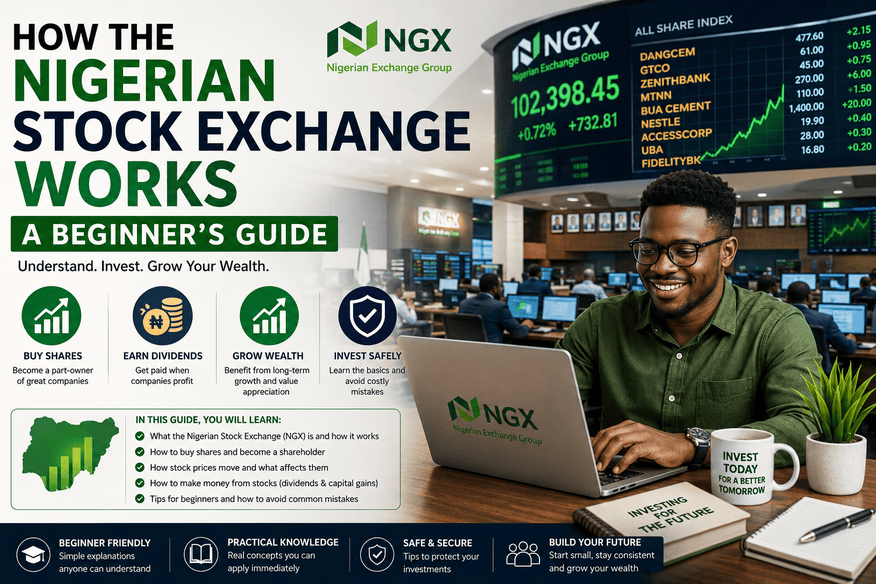
How the Nigerian Stock Exchange Works: A Beginner’s Guide
For many Nigerians, investing in the stock market sounds complicated.
Words like shares, dividends, market capitalization, bull market, and stockbroker often make the Nigerian stock market seem like something only financial experts understand.
The truth is quite different.
Thousands of ordinary Nigerians—including students, civil servants, entrepreneurs, professionals, and retirees—invest in the stock market to grow their wealth over time.
Whether you’re saving for retirement, building long-term wealth, or simply looking for an alternative to keeping your money in a savings account, understanding how the Nigerian Stock Exchange works is an important financial skill.
Today, investing has become easier than ever.
Thanks to technology, you no longer need to visit a physical stockbroker’s office before buying shares. Many licensed stockbrokers now provide secure online trading platforms, making it possible to invest from almost anywhere.
However, before investing your hard-earned money, you should first understand how the Nigerian stock market operates.
In this comprehensive beginner’s guide, Frenovara explains everything you need to know—from what the Nigerian Exchange is and how stocks are traded to how beginners can start investing with confidence.
What Is the Nigerian Stock Exchange?
The Nigerian Stock Exchange (NSE) was the country’s main securities exchange for decades. In 2021, following a major corporate restructuring, it became part of the Nigerian Exchange Group (NGX Group), with the trading platform now operating as Nigerian Exchange Limited (NGX).
Although many people still casually refer to it as the “Nigerian Stock Exchange,” the official market where shares are traded today is the NGX.
The exchange serves as a marketplace where investors buy and sell shares of publicly listed companies.
Think of it like a modern digital marketplace.
Instead of buying clothes or electronics, investors buy ownership stakes in businesses.
When you purchase shares of a listed company, you become one of its shareholders.
Why Was the Nigerian Exchange Created?
The stock market exists for two major reasons.
To Help Companies Raise Money
Businesses often need additional capital to:
- Expand operations.
- Build new factories.
- Invest in technology.
- Launch new products.
- Create jobs.
Instead of borrowing all the money from banks, companies can raise funds by selling shares to the public.
To Help Investors Build Wealth
Investors buy shares hoping that:
- The company’s value increases.
- Share prices rise.
- Dividends are paid.
- Long-term returns outperform inflation.
This creates a mutually beneficial relationship between businesses seeking growth and investors seeking returns.
What Is a Share?
A share represents a small ownership interest in a company.
Imagine a company divided into one million equal pieces.
Each piece is called a share.
If you purchase one or more shares, you become a part-owner of that business.
The more shares you own, the larger your ownership stake.
However, owning shares also means sharing in the company’s risks as well as its potential rewards.
What Companies Are Listed on the NGX?
Many of Nigeria’s biggest companies are listed on the exchange.
Examples include businesses operating in:
Banking
Major banks such as:
- GTCO
- Zenith Bank
- Access Holdings
- UBA
- Fidelity Bank
Telecommunications
Leading telecom companies.
Consumer Goods
Manufacturers of food, beverages, and household products.
Cement and Construction
Large industrial companies involved in infrastructure development.
Oil and Gas
Energy companies participating in Nigeria’s petroleum sector.
Insurance
Several insurance firms also trade on the exchange.
Each listed company must meet regulatory requirements before its shares can be traded publicly.
Who Regulates the Nigerian Stock Market?
The Nigerian capital market operates under strict regulations designed to protect investors.
Several institutions play important roles.
Securities and Exchange Commission (SEC)
The SEC regulates Nigeria’s capital market, protects investors, and oversees market participants.
Nigerian Exchange Limited (NGX)
The NGX provides the marketplace where buyers and sellers trade listed securities.
Central Securities Clearing System (CSCS)
The CSCS maintains electronic records of share ownership and helps ensure transactions are settled securely.
Stockbroking Firms
Licensed stockbrokers act as intermediaries between investors and the exchange.
Individual investors cannot buy shares directly from the exchange—they place orders through licensed brokers.
How Does the Nigerian Stock Exchange Work?
The process is simpler than many people imagine. Moniepoint vs OPay vs PalmPay: Which Fintech Is Leading Nigeria’s Digital Banking Revolution in 2026?
Step 1 – Open an Investment Account
Choose a licensed stockbroker and complete the account opening process.
Step 2 – Fund Your Account
Deposit money into your investment account.
Step 3 – Choose a Company
Research companies before investing.
Consider factors such as:
- Revenue growth.
- Profitability.
- Dividend history.
- Industry outlook.
- Financial strength.
Step 4 – Place a Buy Order
Your broker submits your order to the exchange.
If another investor is willing to sell at the agreed price, the transaction is completed.
Step 5 – Become a Shareholder
Once the transaction settles, the shares are recorded electronically in your investment account through the CSCS.
From that point onward, you officially own part of the company.
Why Do Share Prices Go Up and Down?
One of the most common questions beginners ask is:
“Why does a stock price change every day?”
The answer is simple:
Prices are determined largely by supply and demand.
If more investors want to buy a company’s shares than sell them, demand increases and the price generally rises.
If more investors want to sell than buy, supply outweighs demand and the price may fall.
Other factors that influence prices include:
- Company earnings.
- Dividend announcements.
- Economic conditions.
- Interest rates.
- Inflation.
- Government policies.
- Investor confidence.
- Global financial markets.
Understanding these factors helps investors make more informed decisions rather than reacting emotionally to short-term price movements.
Types of Shares You Can Buy on the Nigerian Exchange (NGX)
Now that you understand how the Nigerian Stock Exchange works, the next step is learning about the different types of shares available to investors.
Although there are several categories of securities on the Nigerian Exchange, beginners will most commonly encounter ordinary shares and preference shares.
Ordinary Shares
Ordinary shares are the most widely traded securities on the NGX.
When you buy ordinary shares, you become a part-owner of the company.
As a shareholder, you may enjoy several benefits, including:
- Voting rights during company meetings.
- Eligibility for dividend payments (when declared).
- Potential capital appreciation if the share price increases.
- The opportunity to benefit from the company’s long-term growth.
Most first-time investors begin with ordinary shares.
Preference Shares
Preference shareholders generally receive dividend payments before ordinary shareholders.
However, they usually have limited or no voting rights.
Preference shares are often chosen by investors who prioritize more predictable income over voting privileges.
How Investors Make Money from Stocks
One of the biggest misconceptions about investing is that profits only come from selling shares at higher prices.
In reality, there are two major ways investors make money in the Nigerian stock market.
1. Capital Appreciation
Capital appreciation occurs when the value of your shares increases over time.
Example
Imagine you purchase shares worth ₦100 each.
A year later, the company’s strong financial performance attracts more investors, pushing the share price to ₦160.
If you decide to sell at that point, your investment has gained value.
This difference between your purchase price and selling price is known as capital gain.
2. Dividend Payments
Many listed companies distribute part of their annual profits to shareholders.
These payments are called dividends.
Dividend-paying companies are particularly attractive to long-term investors because they provide income while investors continue holding their shares.
Some Nigerian companies have built strong reputations for paying dividends consistently over many years.
What Is a Dividend?
A dividend is a portion of a company’s profit shared with its shareholders.
Not every company pays dividends every year.
Some businesses choose to reinvest profits into expansion instead of distributing cash.
Companies that regularly generate healthy profits are generally more likely to reward shareholders through dividend payments.
For income-focused investors, dividends can become an important source of passive income over time.
Bull Market vs Bear Market
You’ll frequently hear these two terms when following financial news.
Understanding them is essential for anyone learning how the Nigerian Stock Exchange works.
Bull Market
A bull market describes a period during which stock prices generally rise.
Investor confidence is strong.
Businesses perform well.
Economic conditions are often favourable.
During bull markets, optimism encourages more people to invest.
Bear Market
A bear market is the opposite.
Share prices decline for an extended period.
Investor confidence weakens.
Economic uncertainty increases.
Although bear markets can be unsettling, experienced investors often view them as opportunities to buy quality companies at lower prices.
Who Can Invest in the Nigerian Stock Market?
One of the greatest myths surrounding investing is that only wealthy individuals can participate.
The truth is that almost any adult Nigerian can begin investing after opening an account with a licensed stockbroker.
Potential investors include:
- Students.
- Salary earners.
- Entrepreneurs.
- Civil servants.
- Business owners.
- Retirees.
- Freelancers.
The most important requirement is having money available to invest and a long-term mindset.
Risks Every Beginner Should Understand
While investing offers excellent long-term opportunities, it also carries risks.
Understanding these risks helps investors make informed decisions instead of acting emotionally.
Market Risk
Share prices fluctuate daily.
Even excellent companies experience temporary declines.
Company Risk
A company’s financial performance may deteriorate because of poor management, increased competition, or changing market conditions.
Economic Risk
Inflation, exchange rate movements, interest rates, and government policies can influence the entire stock market.
Liquidity Risk
Some shares are traded less frequently than others.
Selling these shares quickly at your preferred price may sometimes be difficult.
Common Mistakes New Investors Make
Many beginners lose money not because investing is bad, but because they make avoidable mistakes.
Here are some of the most common ones.
Investing Without Research
Buying shares simply because friends recommend them can lead to poor investment decisions.
Always study the company’s financial performance and business model.
Chasing Quick Profits
Successful investing is usually a long-term journey.
Attempting to get rich overnight often leads to disappointment.
Investing Money Needed for Daily Expenses
Only invest funds you won’t need immediately.
Emergency savings should remain separate from investment capital.
Panic Selling
Temporary market declines are normal.
Selling quality investments during periods of fear can lock in unnecessary losses.
Lack of Diversification
Putting all your money into one company increases risk.
Diversifying across different industries helps reduce potential losses.
Tips for First-Time Nigerian Investors
If you’re just beginning your investment journey, consider these practical tips.
Start Small
You don’t need millions of naira to begin investing.
Consistent investing is often more important than starting with a large amount.
Invest Regularly
Rather than waiting for the “perfect” time, consider investing consistently over time.
This approach can reduce the impact of market fluctuations.
Think Long-Term
Some of the world’s most successful investors built wealth over years—not weeks.
Patience remains one of the greatest advantages an investor can have.
Keep Learning
Financial markets constantly evolve.
Continue reading investment books, annual reports, company earnings, and trusted financial news.
Knowledge remains one of your best investments.
Why More Nigerians Are Investing Today
Several developments have made stock market investing more accessible than ever before.
These include:
- Improved online trading platforms.
- Better financial education.
- Mobile investment apps.
- Greater awareness of wealth creation.
- Easier access to company information.
- Growing interest in long-term financial planning.
As technology continues to improve, investing is becoming increasingly convenient for ordinary Nigerians.
How to Choose Your First Stock on the Nigerian Exchange (NGX)
One of the biggest questions beginners ask is:
“Which stock should I buy first?”
The answer depends on your financial goals, risk tolerance, and investment horizon.
Rather than buying shares based on rumours or social media recommendations, successful investors carefully evaluate companies before investing.
Look for Companies with Strong Financial Performance
Start by reviewing the company’s:
- Revenue growth
- Net profit
- Earnings per share (EPS)
- Debt levels
- Cash flow
- Return on equity (ROE)
Companies with consistent financial performance are generally better positioned for long-term growth.
Study the Company’s Dividend History
If your goal is passive income, focus on companies with a strong record of paying dividends consistently.
Although past dividends do not guarantee future payments, they often indicate financial stability.
Understand the Business
Never invest in a company you don’t understand.
Ask yourself:
- How does the company make money?
- Does it have a competitive advantage?
- Will demand for its products or services continue to grow?
- Is management experienced and trustworthy?
If you cannot explain the business model in simple terms, spend more time researching before investing.
Important Investment Ratios Every Beginner Should Know
You don’t need to become a financial analyst overnight, but understanding a few basic ratios can help you make better investment decisions.
Price-to-Earnings (P/E) Ratio
The P/E ratio compares a company’s share price with its earnings.
It helps investors determine whether a stock appears relatively expensive or inexpensive compared to its earnings.
Dividend Yield
Dividend yield measures how much dividend income you receive relative to the current share price.
Income-focused investors often pay close attention to this ratio.
Earnings Per Share (EPS)
EPS shows how much profit a company generates for each outstanding share.
Growing EPS over time often indicates improving business performance.
Market Capitalization
Market capitalization (market cap) represents the total value of a company’s outstanding shares.
Companies are often grouped into:
- Large-cap companies.
- Mid-cap companies.
- Small-cap companies.
Larger companies are generally more stable, while smaller companies may offer higher growth potential but often come with greater risk. How to Use the GTBank Mobile App and USSD Code
How to Avoid Stock Market Scams in Nigeria
Unfortunately, scammers often target new investors.
Protecting your investments should always be a priority.
Use Only Licensed Stockbrokers
Always verify that your stockbroker is licensed by the Securities and Exchange Commission (SEC) and authorized to operate on the Nigerian Exchange.
Ignore “Guaranteed Profit” Promises
No legitimate investment guarantees extremely high returns without risk.
Be cautious of anyone promising to double your money within days or weeks.
Verify Investment Opportunities
Before investing, confirm that the company and investment platform are legitimate.
Take time to research independently rather than relying solely on social media posts or unsolicited messages. GTCO: How Nigeria’s Banking Giant Became a Financial Powerhouse
H3: Protect Your Personal Information
Keep your investment account credentials secure.
Avoid sharing sensitive financial information with unknown individuals or websites.
Long-Term Investing vs Short-Term Trading
Many beginners confuse investing with trading.
Although both involve buying and selling shares, they require different approaches.
Long-Term Investing
Long-term investors:
- Hold quality stocks for years.
- Focus on company growth.
- Benefit from dividends.
- Ignore short-term market fluctuations.
This approach is often suitable for beginners.
Short-Term Trading
Short-term traders attempt to profit from frequent price movements.
This strategy requires:
- Extensive market knowledge.
- Technical analysis.
- Strong risk management.
- Significant time commitment.
For most new investors, building a diversified long-term portfolio is generally a more practical starting point.
Frequently Asked Questions (FAQs)
Can students invest in the Nigerian stock market?
Yes. Students who meet the account-opening requirements and have access to a licensed stockbroker can begin investing. However, they should only invest money they can afford to leave invested for the long term.
How much money do I need to start investing?
The amount varies depending on the stockbroker and the price of the shares you want to buy. Many investors begin with relatively modest amounts and increase their investments gradually over time.
Is investing in stocks risky?
Yes. All investments carry risk. However, careful research, diversification, and a long-term perspective can help manage those risks.
Can I lose money in the stock market?
Yes. Share prices can rise or fall depending on company performance and market conditions. Investing should always be approached with realistic expectations.
How do I receive dividends?
When a listed company declares a dividend and you qualify as a shareholder, the payment is typically credited to your registered bank account through the e-dividend system.
Is the Nigerian stock market a good investment?
For investors with long-term goals, the Nigerian stock market can be an effective way to build wealth. Success depends on choosing quality companies, staying informed, and remaining patient. Top 15 Richest Banks in Africa in 2026
Final Thoughts
Understanding how the Nigerian Stock Exchange works is one of the first steps toward becoming a confident investor.
While the stock market may appear intimidating initially, its basic principles are straightforward. Companies raise capital by selling shares, investors purchase those shares in the hope of benefiting from business growth, dividends, and long-term capital appreciation.
Like every investment, the Nigerian stock market involves risk, but those risks can be managed through education, diversification, disciplined investing, and patience.
The most successful investors rarely rely on luck. Instead, they build knowledge, invest consistently, and remain focused on long-term financial goals rather than short-term market fluctuations.
Whether you’re a student, salary earner, entrepreneur, or retiree, learning how the NGX operates can help you make more informed financial decisions and create opportunities to grow your wealth over time.
At Frenovara, we’re committed to helping readers understand finance, investing, business, and wealth creation through practical, well-researched, and beginner-friendly guides. Continue exploring our finance section for more insights into investing, banking, personal finance, and the Nigerian economy.