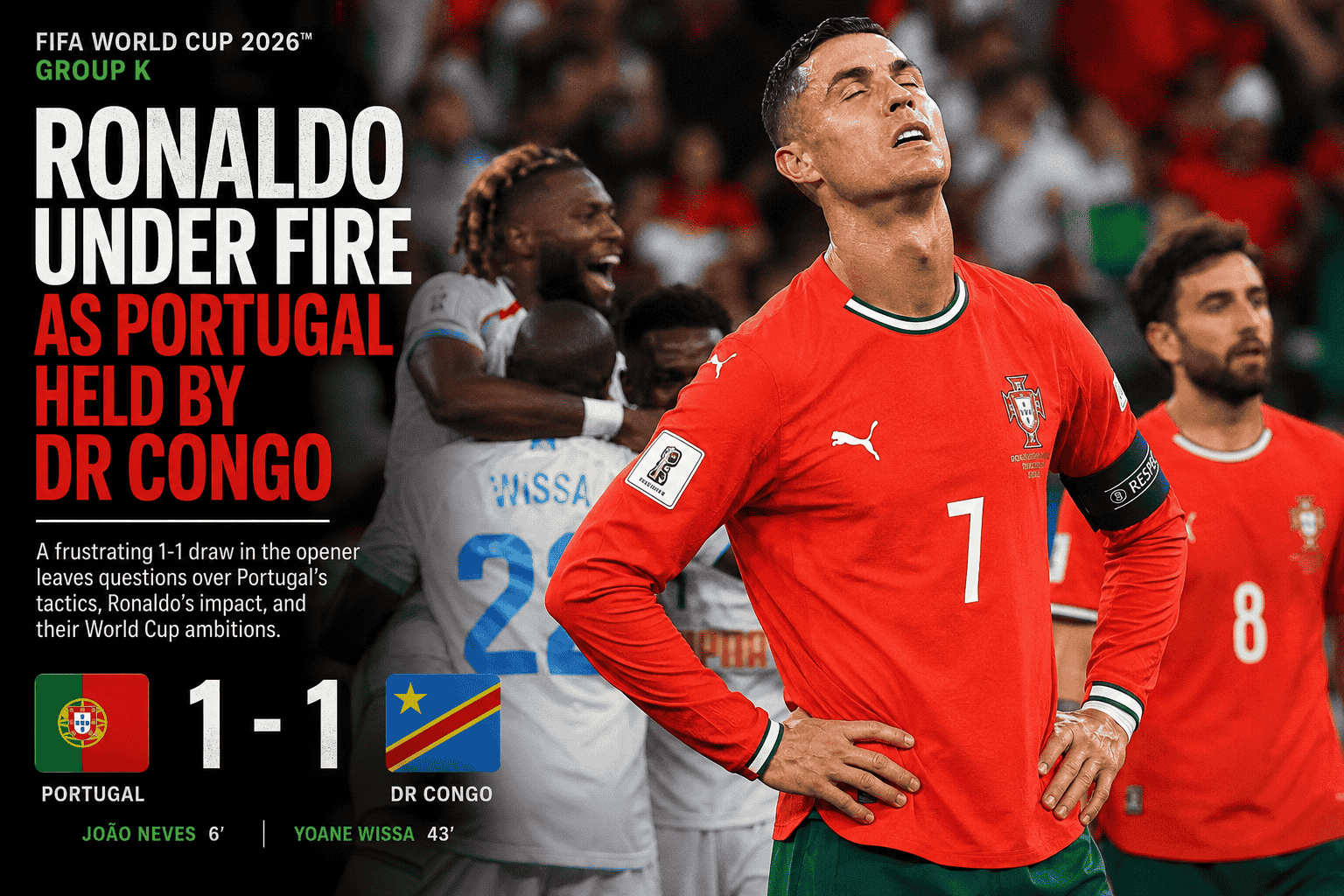
Portugal arrived at the FIFA World Cup 2026 carrying the weight of expectation. Armed with one of the tournament’s most talented squads and led by football legend Cristiano Ronaldo, the Seleção were widely tipped to begin their Group K campaign with a convincing victory over DR Congo.
Instead, they left the pitch with more questions than answers.
A frustrating 1-1 draw against the African underdogs has immediately complicated Portugal’s path through the group stage and reignited debate surrounding the team’s tactical identity. While Portugal controlled large portions of the match, they failed to translate possession into meaningful opportunities, allowing a disciplined DR Congo side to earn a historic point.
For a nation dreaming of lifting its first World Cup trophy, the result served as an early reminder that reputation alone wins nothing at football’s biggest tournament.
A Perfect Start That Failed to Deliver
Portugal could hardly have asked for a better opening.
Within the first ten minutes, their attacking pressure paid off as João Neves found the breakthrough, finishing a well-constructed move that appeared to set the tone for the afternoon. At that moment, many expected Portugal to tighten their grip on the contest and gradually overwhelm their opponents.
Yet the opposite happened.
Rather than increasing the tempo and searching for a decisive second goal, Portugal appeared content to manage the game. Their possession remained high, but their attacking play became increasingly predictable. The movement that had characterized the opening stages slowly disappeared, and DR Congo began to grow into the match.
The warning signs were there long before the equalizer arrived.
Portugal enjoyed territorial dominance but struggled to penetrate a compact Congolese defensive structure. Crosses were comfortably dealt with, central passing lanes were blocked, and the final ball repeatedly lacked precision.
As the first half progressed, confidence began shifting from one side to the other.
DR Congo’s Historic Response
Much of the post-match discussion has centered on Portugal’s shortcomings, but that should not overshadow the achievement of DR Congo.
Making one of the most significant appearances in the nation’s footballing history, the Leopards approached the match with remarkable discipline and belief. Despite facing a squad packed with Champions League stars, they refused to be intimidated.
Their equalizer was a reward for patience and organization.
When the opportunity arrived, DR Congo capitalized. The goal not only silenced sections of the Portuguese support but also represented a landmark moment for Congolese football on the world stage.
What impressed most was not simply the goal itself but the response afterward.
Many underdog teams retreat into survival mode after finding an equalizer against elite opposition. DR Congo continued to compete, maintaining defensive shape while remaining capable of launching dangerous counterattacks.
Their midfield battled tirelessly, while the defensive unit demonstrated the concentration required to withstand prolonged Portuguese pressure.
By full-time, the draw felt thoroughly deserved.
Cristiano Ronaldo’s Difficult Afternoon
Whenever Portugal plays, attention inevitably gravitates toward Cristiano Ronaldo.
Now competing in the twilight years of an extraordinary career, Ronaldo remains one of football’s most influential figures. His achievements are unmatched by most players in history, and his presence continues to command enormous respect from teammates and opponents alike.
However, football’s biggest tournaments are ultimately judged by current performances rather than past accomplishments.
Against DR Congo, Ronaldo endured a difficult evening.
The Portuguese captain found himself closely marked throughout the match and struggled to receive the ball in dangerous positions. Service into the penalty area was limited, and when opportunities did emerge, they lacked the sharpness supporters have come to expect from one of the game’s greatest finishers.
The issue extended beyond Ronaldo himself.
Portugal frequently appeared determined to funnel attacks through their veteran striker, even when alternative options were available. Several promising moves slowed as players searched for Ronaldo rather than exploiting space elsewhere.
This has become an increasingly common discussion surrounding the national team.
Portugal possesses an abundance of attacking talent, including Bruno Fernandes, Bernardo Silva, Rafael Leão, João Félix, Pedro Neto, and Gonçalo Ramos. Each offers different qualities capable of unsettling opposing defenses.
Yet there are moments when the team’s natural rhythm appears constrained by its commitment to ensuring Ronaldo remains the focal point.
Against DR Congo, that debate intensified.
The Tactical Questions Facing Roberto Martínez
Portugal manager Roberto Martínez now faces a challenge that could define the remainder of the tournament.
The draw exposed several tactical concerns that opponents will undoubtedly study in the coming days.
Firstly, Portugal lacked urgency after taking the lead. Rather than maintaining aggressive pressure, they allowed the game to settle into a slower rhythm that suited DR Congo.
Secondly, there was a noticeable absence of creativity in the final third. Despite dominating possession statistics, Portugal rarely produced the kind of clear-cut opportunities expected from a squad containing so many elite attacking players.
Thirdly, the team struggled to adapt once DR Congo established defensive control.
The world’s most successful international sides possess multiple solutions when Plan A stops working. Portugal looked short of ideas whenever their initial approach failed to generate openings.
Martínez must now decide whether tactical adjustments are necessary before the team’s next group-stage fixture.
The pressure is already mounting.
Why This Result Matters Beyond One Match
Some supporters may dismiss the draw as a minor setback in a long tournament.
History suggests otherwise.
World Cups are often shaped by moments that appear insignificant at first glance. A dropped point in the opening match can dramatically alter qualification scenarios, increase pressure on subsequent fixtures, and affect confidence within the squad.
Portugal entered the tournament expecting to establish immediate control of Group K.
Instead, they now face a more complicated path.
Every remaining match will carry greater significance, and every tactical decision will attract increased scrutiny.
For DR Congo, meanwhile, the draw could become a turning point.
The result sends a powerful message to the rest of the group that they are capable of competing with football’s established powers. Confidence can transform underdogs into dangerous opponents, and the Congolese squad now possesses a result that validates its belief.
The Bigger Picture for Ronaldo
The conversation surrounding Cristiano Ronaldo is unlikely to disappear anytime soon.
At 41, he remains one of the most recognizable athletes on the planet. His leadership, experience, and mentality continue to offer value to Portugal.
Yet elite football remains relentlessly demanding.
Every performance is analyzed in real time, and every missed opportunity becomes part of a larger narrative.
The reality is that Portugal’s ambitions extend beyond sentiment and legacy. Their objective is to win matches and challenge for the World Cup title.
If tactical changes become necessary, Martínez will need to make decisions based solely on what gives Portugal the best chance of success.
That may prove to be one of the defining stories of this World Cup campaign.
Conclusion
Portugal’s opening draw against DR Congo cannot be blamed on a single player.
The result was the consequence of collective shortcomings, tactical inefficiencies, and an inability to capitalize on early dominance. Nevertheless, Cristiano Ronaldo’s performance will inevitably attract attention because of his stature within the game.
For DR Congo, the match represented a historic achievement and a statement of intent.
For Portugal, it served as an early warning. According to some football fans, Spain and Portugal don’t normally start on a very good footing when it comes to international competitions, saying the two countries didn’t start well at the last Euro competition.
The talent remains undeniable. The ambition remains unchanged. But if the Seleção are serious about competing for football’s ultimate prize, significant improvements will be required in the matches ahead.
The World Cup journey is far from over, but Portugal’s margin for error has already become considerably smaller.