Corporate Bonds vs Government Bonds: Which Investment Is Better?
We are going to be discussing about the corporate bonds and the government bonds to see which investment is better. For investors looking to build wealth while earning predictable income, bonds remain one of the most reliable investment options available.
However, beginners are often confused by the different types of bonds in the market.
Two of the most common are Corporate Bonds and Government Bonds.
Although both belong to the fixed-income investment category, they differ significantly in terms of risk, returns, issuers, and suitability for different investors.
Understanding the difference between Corporate Bonds vs Government Bonds can help Nigerians make smarter investment decisions, especially during periods of inflation, high interest rates, and economic uncertainty.
In this guide, we’ll explain both investment options in simple language, compare their advantages and disadvantages, and help you determine which one best aligns with your financial goals.
What Are Bonds?
A bond is a financial instrument through which an investor lends money to an organization in exchange for regular interest payments and repayment of the original investment at maturity.
In simple terms:
- You lend money.
- The issuer promises to pay you interest.
- Your capital is returned when the bond expires.
Because of their predictable returns, bonds are widely regarded as one of the most important fixed-income investments.
What Are Government Bonds?
Government bonds are debt securities issued by a country’s government to raise money for public spending.
Governments issue bonds to finance:
- Infrastructure projects.
- Roads and bridges.
- Healthcare.
- Education.
- Budget deficits.
- National development programmes.
In Nigeria, the Federal Government issues bonds through the Debt Management Office (DMO).
Since these bonds are backed by the government, they are generally considered among the safest investments available.
What Are Corporate Bonds?
Corporate bonds are issued by private companies rather than governments.
Businesses issue these bonds to raise capital for purposes such as:
- Business expansion.
- Building factories.
- Purchasing equipment.
- Acquiring other companies.
- Refinancing existing debt.
Instead of borrowing from banks, companies borrow directly from investors.
In return, investors receive periodic interest payments until the bond matures.
How Do Government Bonds Work?
The process is relatively straightforward.
Step 1
The government announces a bond issuance.
Step 2
Investors purchase the bonds.
Step 3
The government pays regular interest (coupon payments).
Step 4
At maturity, investors receive their original capital.
Government bonds usually have fixed interest rates, making future income easier to predict.
How Do Corporate Bonds Work?
Corporate bonds follow a similar structure.
Company Issues the Bond
The company determines:
- Interest rate.
- Maturity period.
- Amount to be raised.
Investors Purchase the Bond
Investors lend money to the company.
Coupon Payments
The company pays interest periodically.
Maturity
At the agreed date, investors receive back their original investment.
Unlike government bonds, however, repayment depends on the financial strength of the issuing company.
Why Nigerians Invest in Bonds
Many Nigerians choose bonds because they offer:
- Predictable income.
- Lower volatility than stocks.
- Capital preservation.
- Portfolio diversification.
- Long-term wealth creation.
For investors who prefer relatively stable returns, bonds can play an important role in a balanced investment portfolio. How to Build Wealth in Nigeria from Scratch: A Practical Beginner’s Guide (2026)
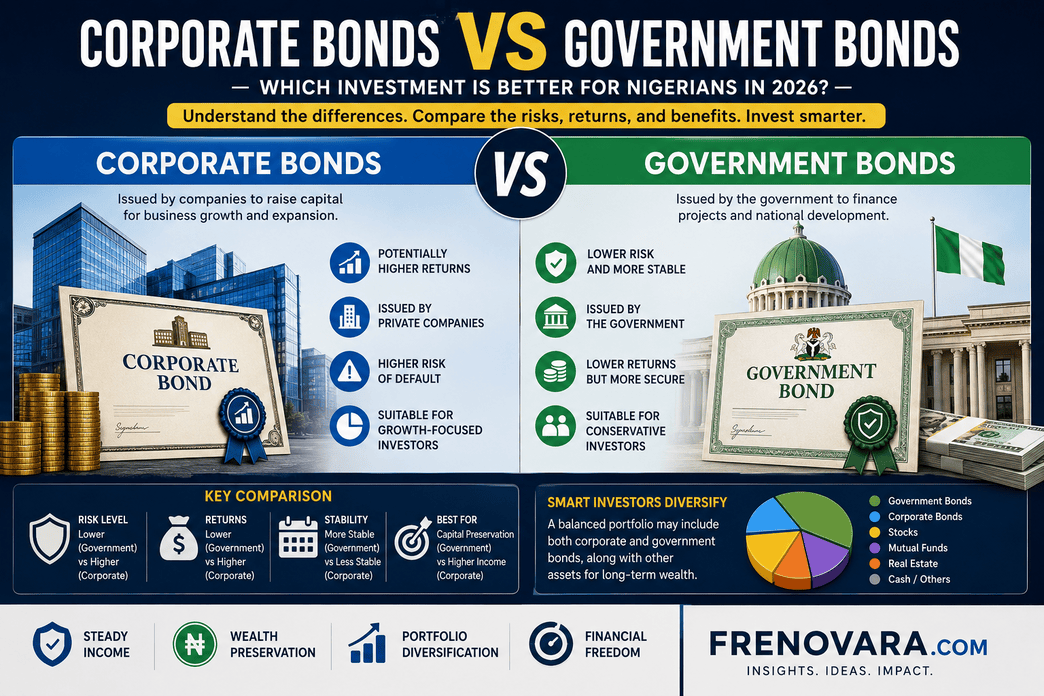
Key Difference Between Corporate Bonds and Government Bonds
Although both are fixed-income investments, the primary distinction lies in who issues the bond.
- Government Bonds are issued by the government and are generally considered lower-risk.
- Corporate Bonds are issued by companies and typically offer higher interest rates to compensate for the additional risk.
Understanding this distinction forms the foundation for choosing the investment that best matches your financial objectives.
Advantages of Government Bonds
Government bonds are often considered the foundation of a conservative investment portfolio.
Because they are backed by the government, they generally offer greater security than many other fixed-income investments.
1. Lower Risk
One of the biggest advantages of government bonds is their relatively low default risk.
Since governments have taxation powers and multiple sources of revenue, they are generally more capable of meeting their debt obligations than private companies.
For risk-averse investors, this makes government bonds an attractive option.
2. Predictable Income
Government bonds usually pay fixed coupon interest at regular intervals.
This predictable cash flow makes them suitable for:
- Retirees.
- Income-focused investors.
- Long-term savers.
- Conservative portfolios.
3. Capital Preservation
Many investors buy government bonds primarily to preserve wealth rather than chase high returns.
During periods of economic uncertainty, government bonds are often viewed as relatively stable investments.
4. Long-Term Stability
Government bonds are less affected by company-specific problems such as poor management or declining profits.
Although market prices may fluctuate, the government backing generally provides investors with greater confidence.
Advantages of Corporate Bonds
Corporate bonds usually offer higher returns because investors are taking on additional risk.
For many experienced investors, this higher income potential is attractive.
1. Higher Interest Rates
Companies often pay higher coupon rates than governments to encourage investors to purchase their bonds. Best Investment Apps for Nigerians in 2026
This means investors may receive:
- Higher passive income.
- Better long-term returns.
- Greater cash flow.
2. Business Growth Potential
Companies experiencing strong financial performance are often able to meet their debt obligations comfortably.
Investing in bonds issued by financially healthy companies can provide attractive risk-adjusted returns.
3. Diversification
Corporate bonds provide exposure to different industries such as:
- Banking.
- Telecommunications.
- Manufacturing.
- Energy.
- Consumer goods.
This helps investors diversify beyond government-issued securities.
4. Wide Range of Investment Choices
Corporate bonds come in various maturity periods, industries, and credit ratings, allowing investors to choose products that align with their financial objectives.
Risks of Government Bonds
Although government bonds are generally safer than corporate bonds, they are not completely risk-free.Inflation Risk
If inflation rises significantly, the purchasing power of fixed coupon payments may decline.
This is especially relevant during periods of persistent inflation. Dollar Investments for Nigerians in 2026
Interest Rate Risk
When market interest rates rise, existing bond prices often fall.
Investors planning to sell before maturity may receive less than the original purchase price.
Currency Risk
For investors holding naira-denominated government bonds, exchange-rate depreciation may reduce international purchasing power.
This is one reason many Nigerians also diversify into dollar-denominated investments.
Risks of Corporate Bonds
Corporate bonds carry additional risks because repayment depends on the financial health of the issuing company.
Credit Risk
If a company experiences financial difficulties, it may struggle to make interest payments or repay investors.
This is known as default risk.
Business Risk
Poor management decisions, declining sales, increased competition, or economic downturns can negatively affect a company’s ability to honour its obligations.
Market Risk
Corporate bond prices fluctuate based on investor confidence, company performance, and overall market conditions.
Which Investment Offers Higher Returns?
Generally speaking:
- Corporate Bonds usually provide higher interest rates because they involve greater risk.
- Government Bonds typically offer lower but more stable returns due to their stronger credit profile.
Higher returns almost always come with higher levels of risk.
Investors should balance return expectations with their personal risk tolerance.
Corporate Bonds vs Government Bonds Comparison
| Feature | Government Bonds | Corporate Bonds |
|---|---|---|
| Issuer | Government | Private Companies |
| Risk Level | Lower | Moderate to Higher |
| Interest Rate | Usually Lower | Usually Higher |
| Income Stability | High | Depends on Issuer |
| Default Risk | Generally Lower | Higher |
| Suitable For | Conservative Investors | Investors Seeking Higher Returns |
| Diversification | Limited | Broad Industry Exposure |
Who Should Invest in Government Bonds?
Government bonds are generally suitable for:
Conservative Investors
People who prioritize capital preservation over aggressive growth. How the Nigerian Stock Exchange Works: A Beginner’s Guide
Retirees
Investors seeking predictable income during retirement.
First-Time Investors
Beginners who want relatively stable investment products while learning about financial markets.
Who Should Invest in Corporate Bonds?
Corporate bonds may be appropriate for:
Experienced Investors
Individuals comfortable evaluating business performance and investment risks.
Income Investors
Those seeking higher coupon payments than many government bonds provide.
Diversified Portfolios
Investors looking to balance government securities with higher-yield corporate debt.
Can You Invest in Both?
Absolutely.
Many financial advisers recommend combining both government and corporate bonds within a diversified portfolio. Treasury Bills vs Stocks vs Mutual Funds: Where Should Nigerians Invest?
For example:
- Government Bonds provide stability.
- Corporate Bonds improve income potential.
- Stocks provide long-term growth.
- Mutual Funds add diversification.
- Dollar Investments help protect against currency depreciation.
A balanced portfolio reduces dependence on any single investment type.
Corporate Bonds vs Government Bonds: Which Investment Is Better for Nigerians in 2026? (Part 3)
How Nigerians Can Invest in Government Bonds
Government bonds are relatively accessible to individual investors in Nigeria.
You can invest through:
Commercial Banks
Many commercial banks provide investment services that allow customers to subscribe to Federal Government Bonds during public offers.
Licensed Stockbrokers
Registered stockbrokers can facilitate the purchase and sale of government bonds in both the primary and secondary markets.
Asset Management Companies
Professional fund managers often invest in government bonds on behalf of clients through fixed-income mutual funds.
This option is particularly suitable for beginners who prefer professionally managed portfolios.
How Nigerians Can Invest in Corporate Bonds
Corporate bonds are also available through regulated financial institutions.
Investors can gain exposure by using:
Stockbrokers
Licensed brokers provide access to qualifying corporate bond offerings.
Wealth Management Firms
Many investment firms include high-quality corporate bonds within diversified fixed-income portfolios.
Mutual Funds
Some bond funds invest in both government and corporate bonds, offering diversification without requiring investors to select individual bonds.
Factors to Consider Before Choosing Between Corporate Bonds and Government Bonds
Before investing, ask yourself these important questions.
What Is My Investment Goal?
Are you investing to:
- Preserve capital?
- Earn passive income?
- Build long-term wealth?
- Diversify your portfolio?
Your objective should determine the type of bond you choose.
What Is My Risk Tolerance?
If you are uncomfortable with higher investment risk, government bonds may be more appropriate.
If you can tolerate moderate risk in exchange for potentially higher returns, corporate bonds may deserve consideration.
What Is My Investment Timeline?
Government and corporate bonds are generally better suited for medium- to long-term investors.
If you may need your money soon, shorter-term investments such as Treasury Bills or Money Market Funds could be more suitable. Eurobonds Explained for Beginners
Have I Diversified My Portfolio?
Avoid concentrating all your investments in one asset class.
A balanced portfolio may include:
- Government Bonds.
- Corporate Bonds.
- Treasury Bills.
- Stocks.
- Mutual Funds.
- Dollar Investments.
- Real Estate.
Diversification helps reduce overall investment risk.
Common Mistakes Beginners Should Avoid
Many first-time bond investors make avoidable errors.
Investing Only Because of High Interest Rates
Higher coupon payments usually come with higher risk.
Always evaluate the financial strength of the issuer rather than focusing only on returns.
Ignoring Credit Ratings
Credit ratings provide insight into an issuer’s ability to repay investors.
Higher-rated issuers generally present lower default risk.
Forgetting About Inflation
Even stable investments can lose purchasing power if inflation rises faster than investment returns.
This is why diversification remains important.
Not Understanding Maturity Periods
Some bonds lock your money away for several years.
Always choose an investment that matches your financial plans and liquidity needs.
Frequently Asked Questions (FAQs)
Which Is Safer: Corporate Bonds or Government Bonds?
Government bonds are generally considered safer because they are backed by the government.
Corporate bonds usually involve greater credit risk but often compensate investors with higher interest rates.
Which Offers Better Returns?
Corporate bonds typically provide higher coupon payments than government bonds.
However, these higher returns come with increased investment risk.
Can Beginners Invest in Bonds?
Yes.
Many beginners start through professionally managed bond mutual funds before investing directly in individual bonds.
Can I Lose Money Investing in Bonds?
Yes.
Bond prices can fluctuate, and corporate bond issuers may experience financial difficulties.
Although government bonds are generally more stable, no investment is completely risk-free.
Should I Choose One or Both?
Many financial experts recommend combining both.
Government bonds provide stability, while corporate bonds can enhance income and improve overall portfolio diversification.
Final Verdict
Understanding the differences between Corporate Bonds vs Government Bonds is essential for building a well-balanced investment portfolio.
Government bonds remain an excellent choice for conservative investors seeking stability, predictable income, and lower risk.
Corporate bonds, on the other hand, may suit investors who are comfortable accepting additional risk in exchange for potentially higher returns.
Rather than viewing these investments as competitors, many successful investors use them together.
A diversified portfolio that combines government bonds, corporate bonds, stocks, mutual funds, Treasury Bills, and dollar-denominated investments can help improve long-term financial resilience while reducing overall risk.
At Frenovara, our mission is to simplify investing by providing practical, research-driven financial education that empowers Nigerians to make smarter wealth-building decisions.