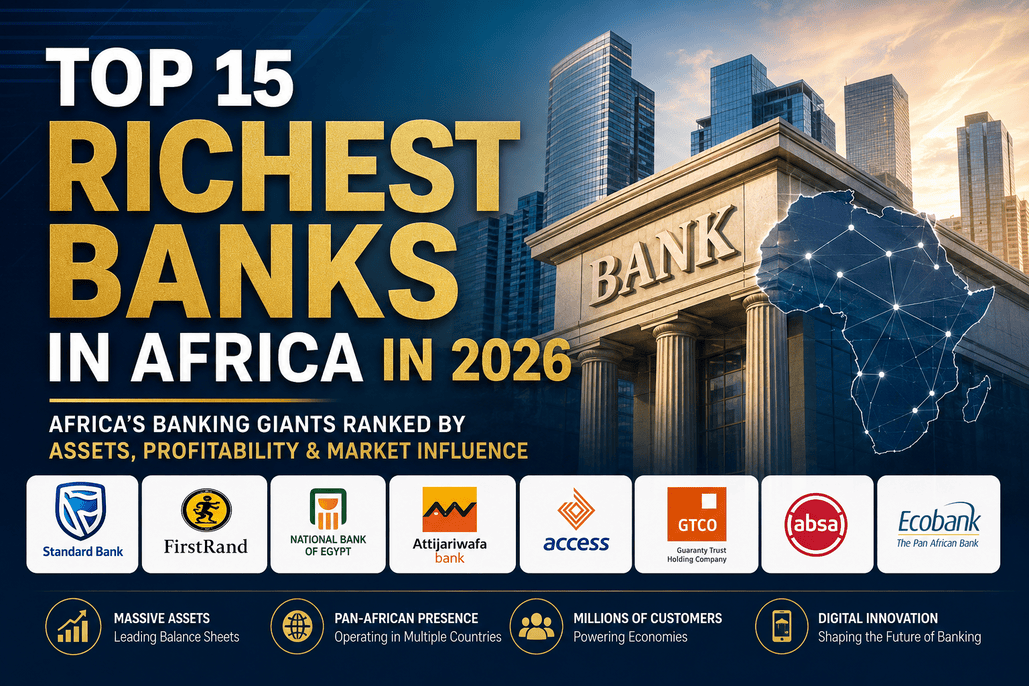
Top 15 Richest Banks in Africa in 2026: Africa’s Banking Giants Ranked by Assets, Profitability, and Market Influence
Africa’s banking industry has never been more dynamic. Across the continent, leading financial institutions are recording stronger balance sheets, expanding into new markets, investing billions in digital transformation, and playing a critical role in financing economic development.
From Johannesburg and Lagos to Cairo, Casablanca, and Lomé, Africa’s biggest banks are funding infrastructure projects, supporting businesses, facilitating cross-border trade, and driving financial inclusion for millions of people.
Despite global economic challenges including inflation, currency fluctuations, and geopolitical uncertainty—many African banks have continued to post solid financial results. Improved digital banking adoption, stronger capital positions, and regional expansion strategies have helped them remain resilient.
According to recent audited financial statements and respected industry rankings, South African institutions continue to dominate the continent by total assets, while banks from Egypt, Morocco, Nigeria, and Togo are strengthening their regional influence through innovation and strategic expansion.
This comprehensive Frenovara report ranks the Top 15 Richest Banks in Africa in 2026, using publicly available audited financial statements, industry rankings, profitability, asset size, regional presence, and long-term strategic influence.
Whether you’re an investor, entrepreneur, student, or simply interested in Africa’s financial sector, this guide offers a detailed look at the institutions shaping the future of banking on the continent.
How This Ranking Was Compiled
To ensure credibility, this ranking is based primarily on the latest publicly available audited financial statements and respected banking industry rankings.
Several key factors were considered:
- Total assets
- Annual profitability
- Capital strength
- Geographic presence
- Customer base
- Digital banking capabilities
- Corporate governance
- Regional influence
- Long-term growth strategy
While total assets remain the primary ranking factor, profitability and strategic importance were also considered to provide readers with a more complete picture of each institution.
Snapshot: Africa’s Biggest Banks
| Rank | Bank | Headquarters | Key Strength |
|---|---|---|---|
| 15 | Ecobank Transnational | Togo | Largest pan-African network |
| 14 | Nedbank Group | South Africa | Sustainable finance |
| 13 | Banque Centrale Populaire | Morocco | Regional expansion |
| 12 | GTCO | Nigeria | Digital banking leadership |
| 11 | Access Holdings | Nigeria | Rapid international expansion |
Why Africa’s Banking Sector Matters
Banks remain the backbone of Africa’s economy.
Every day, these institutions finance businesses, process millions of digital transactions, provide mortgages, fund governments, facilitate international trade, and support infrastructure projects that create jobs and stimulate economic growth.
The introduction of the African Continental Free Trade Area (AfCFTA) is expected to further increase demand for cross-border banking services, creating new opportunities for Africa’s largest financial institutions.
At the same time, fintech companies have changed customer expectations. Consumers now expect instant transfers, mobile banking, online lending, digital wallets, and seamless payment solutions.
Rather than losing relevance, Africa’s leading banks have embraced technology, investing heavily in artificial intelligence, cybersecurity, cloud computing, and mobile-first banking platforms.
15. Ecobank Transnational Incorporated (Togo)
Founded with the vision of creating a truly pan-African bank, Ecobank has successfully built one of the continent’s largest banking networks.
Unlike many competitors that focus primarily on one domestic market, Ecobank operates in more than 30 African countries, making it one of the most geographically diversified financial institutions on the continent.
Its extensive footprint enables businesses to move money across borders efficiently while supporting the objectives of the African Continental Free Trade Area.
Bank Profile
Headquarters: Lomé, Togo
Countries of Operation: More than 30
Primary Business:
- Retail Banking
- Corporate Banking
- SME Finance
- Treasury Services
- Trade Finance
- Digital Payments
Why Ecobank Makes This List
Ecobank’s strength lies in its regional connectivity. Few banks can match its ability to provide cross-border financial services across so many African markets.
The bank has also invested significantly in mobile banking and digital payment platforms, enabling millions of customers to access banking services without visiting physical branches.
14. Nedbank Group (South Africa)
Established in 1888, Nedbank is one of South Africa’s oldest and most respected financial institutions.
Over the years, the bank has built a reputation for financial discipline, innovation, and sustainable banking practices.
Its operations extend beyond retail banking into investment banking, corporate finance, wealth management, and insurance.
Key Business Segments
- Retail Banking
- Business Banking
- Corporate & Investment Banking
- Wealth Management
- Asset Finance
Why Nedbank Continues to Grow
Nedbank has become one of Africa’s leading financiers of renewable energy and sustainable infrastructure.
Its disciplined lending practices and strong capital position continue to support steady long-term growth despite global economic uncertainty.
13. Banque Centrale Populaire (Morocco)
Morocco’s Banque Centrale Populaire (BCP) has transformed itself into one of Africa’s leading banking groups.
Originally focused on the Moroccan market, the institution has expanded aggressively into West and Central Africa through strategic acquisitions and partnerships.
Competitive Advantages
- Strong agricultural financing
- SME support
- Housing finance
- Regional banking network
- Digital banking expansion
The bank continues to strengthen Morocco’s influence within Africa’s rapidly evolving financial sector.
12. Guaranty Trust Holding Company (GTCO) – Nigeria
GTCO has evolved from one of Nigeria’s most respected commercial banks into a diversified financial holding company.
Its transformation allows the group to operate across banking, asset management, pensions, and payment services while maintaining its reputation for excellent customer service and profitability.
What Makes GTCO Stand Out?
- Strong return on equity
- Award-winning digital banking platform
- Conservative risk management
- High customer satisfaction
- Expansion into broader financial services
GTCO’s mobile banking application, internet banking services, and USSD platform remain among the most widely used in Nigeria, helping the bank compete effectively in an increasingly digital financial landscape.
11. Access Holdings Plc (Nigeria)
Access Holdings has emerged as one of Africa’s fastest-growing financial groups through a combination of strategic acquisitions, regional expansion, and digital innovation.
Following its merger with Diamond Bank and continued expansion across Africa and international markets, Access has become one of the continent’s largest banking networks.
Today, the group serves tens of millions of customers through operations spanning Africa, Europe, and the Middle East.
Growth Drivers
- Pan-African expansion strategy
- Large retail customer base
- Strong corporate banking division
- Continuous investment in technology
- Diversified holding company structure
Its ambition to become Africa’s gateway to the world’s financial markets continues to position Access Holdings as one of the continent’s most influential banking groups.
Key Takeaways
Several trends emerge from the first five banks in our ranking:
- Regional expansion is becoming increasingly important.
- Digital banking has become a major competitive advantage.
- Diversified financial services are driving long-term profitability.
- Strategic acquisitions continue to reshape Africa’s banking landscape.
- Banks investing in technology are attracting more customers and improving operational efficiency.
These trends set the stage for the banks ranked inside the top ten, where larger balance sheets, stronger profitability, and wider international influence become even more apparent.
10. Banque Misr (Egypt)
Headquarters: Cairo, Egypt
Founded: 1920
Core Businesses:
- Retail Banking
- Corporate Banking
- Investment Banking
- Islamic Banking
- SME Finance
- Trade Finance
For more than a century, Banque Misr has remained one of Egypt’s most influential financial institutions.
Established by renowned economist Mohamed Talaat Harb, the bank was created to promote Egyptian economic independence. Today, it has evolved into one of Africa’s largest commercial banks, serving millions of individuals, businesses, and government agencies.
The institution continues to finance strategic sectors of Egypt’s economy, including manufacturing, tourism, agriculture, construction, telecommunications, and infrastructure.
Why Banque Misr Is Among Africa’s Richest Banks
One of its biggest strengths is diversification. Rather than depending on a single source of income, the bank earns revenue from corporate lending, retail banking, investment banking, treasury operations, and wealth management.
In recent years, Banque Misr has accelerated its digital transformation through:
- Mobile banking
- Digital wallets
- QR-code payments
- Contactless banking
- AI-powered customer service
These innovations have helped improve efficiency while attracting a younger generation of customers.
9. Absa Group Limited (South Africa)
Headquarters: Johannesburg, South Africa
Founded: 1991 (current group structure)
Countries of Operation: 10+
Absa Group has transformed itself into one of Africa’s most respected financial institutions.
After separating from Barclays PLC, the company successfully repositioned itself as an independent African banking giant with operations spanning Southern, Eastern, and Western Africa.
Today, Absa offers:
- Personal Banking
- Business Banking
- Corporate Banking
- Investment Banking
- Wealth Management
- Insurance
Financial Strength
Absa continues to maintain a strong capital position while reporting healthy profitability.
Its corporate and investment banking division finances billion-dollar infrastructure, energy, telecommunications, mining, and transportation projects across Africa.
Digital Banking Leadership
Absa has invested heavily in:
- Artificial Intelligence
- Cloud Computing
- Fraud Detection
- Digital Lending
- Contactless Payments
- Mobile Banking
These investments continue to strengthen customer confidence while improving operational efficiency.
8. National Bank of Egypt (NBE)
Headquarters: Cairo, Egypt
Founded: 1898
The National Bank of Egypt is widely regarded as one of the strongest financial institutions on the African continent.
As Egypt’s oldest commercial bank, NBE has played a pivotal role in financing the country’s economic development for more than 125 years.
Today, the bank provides virtually every major financial service, including:
- Retail Banking
- Corporate Banking
- Investment Banking
- SME Financing
- Trade Finance
- Islamic Banking
- Treasury Services
Massive Asset Base
NBE manages one of Africa’s largest asset portfolios.
Its enormous customer deposit base provides the liquidity required to finance national infrastructure projects while supporting businesses of every size.
Technology Investments
To remain competitive, NBE has invested in:
- Mobile Banking
- Digital Payments
- Contactless Banking
- Internet Banking
- AI-powered Customer Support
- Advanced Cybersecurity
Its commitment to innovation continues to strengthen its position within Africa’s banking industry.
7. FirstRand Limited (South Africa)
Headquarters: Johannesburg, South Africa
Founded: 1998
Unlike many competitors, FirstRand operates through several highly successful financial brands.
These include:
- First National Bank (FNB)
- Rand Merchant Bank (RMB)
- WesBank
- Ashburton Investments
This diversified structure enables the company to generate income across multiple financial sectors.
Why Investors Admire FirstRand
FirstRand consistently delivers some of the strongest returns on equity in African banking.
Its success is driven by:
- Excellent cost management
- Diversified revenue
- Strong corporate governance
- Continuous innovation
- Conservative lending strategy
Technology Leadership
Few African banks have embraced technology as aggressively as FirstRand.
The company has invested significantly in:
- Artificial Intelligence
- Machine Learning
- Big Data Analytics
- Digital Lending
- Cloud Infrastructure
- Cybersecurity
These investments have improved customer experience while supporting long-term profitability.
6. Standard Bank Group (South Africa)
Headquarters: Johannesburg, South Africa
Founded: 1862
Countries Served: More than 20 African countries
Standard Bank Group has become synonymous with African banking excellence.
With operations spanning more than twenty African countries, the institution serves millions of retail customers while also supporting multinational corporations, governments, and institutional investors.
Its business covers nearly every segment of modern banking.
Business Segments
- Personal Banking
- Commercial Banking
- Corporate Banking
- Investment Banking
- Asset Management
- Insurance
- Treasury Services
- International Trade Finance
Why Standard Bank Continues to Lead
Standard Bank remains one of Africa’s largest financiers of:
- Infrastructure
- Mining
- Renewable Energy
- Telecommunications
- Transportation
- Manufacturing
Its significant investments in digital banking, artificial intelligence, cybersecurity, and cloud technology continue to strengthen its leadership position.
The bank also plays a critical role in facilitating trade between Africa and global markets, making it one of the continent’s most strategically important financial institutions.
What Makes These Banks Different?
Although each institution follows a unique strategy, they all share several characteristics that distinguish them from smaller competitors.
Strong Capital Position
Large capital reserves enable these banks to finance billion-dollar projects while remaining financially resilient during economic downturns.
Regional Expansion
Most of the banks in the top ten now operate across multiple African countries, reducing dependence on a single domestic market.
Digital Innovation
Artificial intelligence, mobile banking, cloud computing, cybersecurity, and digital lending have become essential drivers of growth.
Diversified Revenue
Rather than relying solely on traditional banking, these institutions generate income from:
- Insurance
- Asset Management
- Wealth Management
- Investment Banking
- Treasury Operations
- Capital Markets
This diversified business model provides greater stability and long-term profitability.
Key Takeaways;
The banks ranked 10th to 6th demonstrate that Africa’s financial sector is becoming more sophisticated, technology-driven, and internationally connected.
Their continued investment in innovation, regional expansion, and corporate governance has enabled them to remain competitive despite increasing pressure from fintech companies and global economic uncertainty.
Now we arrive at the continent’s financial heavyweight; the institutions that manage hundreds of billions of dollars in assets, finance major infrastructure projects, facilitate international trade, and influence economic policy across Africa.
Africa’s Top Five Richest Banks at a Glance
| Rank | Bank | Headquarters | Why It Stands Out |
|---|---|---|---|
| 5 | Attijariwafa Bank | Morocco | North and West African expansion |
| 4 | Banque Centrale Populaire | Morocco | Strong regional banking network |
| 3 | National Bank of Egypt | Egypt | Massive domestic market and asset base |
| 2 | FirstRand Limited | South Africa | Innovation and profitability |
| 1 | Standard Bank Group | South Africa | Africa’s largest banking group by assets |
5. Attijariwafa Bank (Morocco)
Headquarters: Casablanca, Morocco
Founded: 2004 (through the merger of Banque Commerciale du Maroc and Wafabank)
Attijariwafa Bank has become one of Africa’s fastest-growing banking groups.
Its operations extend beyond Morocco into numerous African countries, making it one of the continent’s most influential cross-border financial institutions.
The bank provides:
- Retail Banking
- Corporate Banking
- Investment Banking
- Insurance
- Wealth Management
- International Trade Finance
Why It Is Among Africa’s Largest Banks
Attijariwafa has successfully combined aggressive regional expansion with disciplined financial management.
Its investments in digital banking, mobile applications, and SME financing continue to strengthen its competitive position across North and West Africa.
4. Banque Centrale Populaire (Morocco)
Banque Centrale Populaire (BCP) has developed into one of Africa’s most respected banking groups.
Its cooperative banking model has enabled it to maintain a strong domestic presence while expanding rapidly into West and Central Africa.
Competitive Advantages
- Strong agricultural financing
- SME lending
- Housing finance
- Pan-African expansion
- Digital banking innovation
The bank has also invested significantly in financial inclusion, helping millions of customers gain access to formal banking services.
3. National Bank of Egypt (NBE)
Founded more than 125 years ago, the National Bank of Egypt remains one of the pillars of African banking.
Its enormous customer base and extensive branch network make it one of the largest financial institutions on the continent.
Key Strengths
- Strong government partnerships
- Extensive branch network
- Massive customer deposits
- Corporate banking leadership
- Trade finance expertise
Digital Transformation
NBE continues modernising through:
- Mobile banking
- Contactless payments
- Artificial intelligence
- Internet banking
- Enhanced cybersecurity
Its commitment to innovation ensures that it remains competitive in an increasingly digital financial environment.
2. FirstRand Limited (South Africa)
FirstRand is widely regarded as one of Africa’s most innovative banking groups.
Through brands such as First National Bank (FNB) and Rand Merchant Bank (RMB), the company has built a diversified financial ecosystem serving retail customers, businesses, and institutional investors.
What Makes FirstRand Exceptional?
Unlike many traditional banks, FirstRand has consistently embraced technology as a driver of growth.
Major investments include:
- Artificial intelligence
- Machine learning
- Big data analytics
- Digital lending
- Cloud infrastructure
- Fraud detection systems
The group’s ability to combine innovation with strong profitability continues to attract investors and customers alike.
1. Standard Bank Group (South Africa)
Africa’s Richest Bank in 2026
Standard Bank Group retains its position as Africa’s largest banking institution by assets.
Founded in 1862, the bank has evolved into a financial powerhouse with operations in more than 20 African countries.
Its services include:
- Retail Banking
- Commercial Banking
- Corporate Banking
- Investment Banking
- Wealth Management
- Insurance
- Treasury Services
- International Trade Finance
Why Standard Bank Leads Africa
Several factors explain its leadership:
- The continent’s largest audited asset base
- Strong profitability
- Wide geographic footprint
- Leadership in infrastructure finance
- Advanced digital banking capabilities
- Significant investment in AI and cybersecurity
Standard Bank also plays a leading role in facilitating international trade, particularly between Africa and major global markets.
For multinational corporations and institutional investors, it remains one of the continent’s preferred financial partners.
Why South African Banks Continue to Dominate
One question often asked is why South African banks consistently occupy the top positions.
Several factors contribute to this success:
Mature Financial Markets
South Africa has one of Africa’s most developed capital markets, providing banks with easier access to funding and investment.
Strong Regulation
The country’s banking regulations are widely regarded as among the strongest on the continent, promoting stability and investor confidence.
Diversified Economies
South African banks generate revenue from retail banking, corporate finance, insurance, investment banking, and wealth management.
International Partnerships
Many of these institutions maintain strategic relationships with global financial organisations, strengthening their international reach.
Nigerian Banks Are Closing the Gap
While South Africa currently dominates by total assets, Nigerian banks are expanding rapidly.
Institutions such as:
- Access Holdings
- GTCO
- Zenith Bank
- FirstBank
- United Bank for Africa (UBA)
have significantly increased their regional presence through acquisitions, digital banking, and cross-border expansion.
Nigeria’s large population, entrepreneurial culture, and vibrant fintech ecosystem position its banking sector for continued growth.
The Future of African Banking
The next decade will likely redefine banking across the continent.
Key trends include:
- Greater adoption of Artificial Intelligence
- Expansion of cross-border payments under AfCFTA
- Growth in green and sustainable finance
- Stronger cybersecurity investments
- Wider financial inclusion through mobile banking
- Increased collaboration between traditional banks and fintech companies
Institutions that embrace innovation while maintaining financial discipline will be best positioned to lead Africa’s financial future. Moniepoint vs OPay vs PalmPay
Frequently Asked Questions
Which is the richest bank in Africa in 2026?
Standard Bank Group remains the largest bank in Africa by total assets and regional influence.
Which country has the strongest banking industry in Africa?
South Africa continues to lead the continent, with several of Africa’s largest banks headquartered there.
Which Nigerian banks rank among Africa’s biggest?
Access Holdings, GTCO, Zenith Bank, FirstBank, and UBA are among the continent’s leading banking institutions.
Are fintech companies replacing traditional banks?
No. Increasingly, banks and fintech firms are collaborating to improve digital payments, lending, and customer experience.
Why are African banks investing heavily in AI?
Artificial intelligence helps banks detect fraud, automate customer service, improve credit assessments, and reduce operating costs.
Final Thoughts
Africa’s banking industry is undergoing one of the most significant transformations in its history. Rapid technological advancement, stronger regional integration, and increasing demand for digital financial services are reshaping how banks operate and serve their customers.
The institutions featured in this ranking are more than financial service providers—they are catalysts for economic growth. By financing businesses, supporting infrastructure projects, promoting financial inclusion, and enabling international trade, they continue to play a central role in Africa’s development.
As the continent’s economies become more connected through initiatives such as the African Continental Free Trade Area (AfCFTA), the importance of strong, innovative, and well-capitalised banks will only increase.
For investors, entrepreneurs, policymakers, and consumers, keeping a close eye on these banking giants offers valuable insight into the future direction of Africa’s economy. Those institutions that continue to innovate, expand responsibly, and maintain sound financial management are likely to remain leaders for many years to come.