Nigeria’s political landscape is rapidly evolving as preparations for the 2027 general elections begin.
Nigeria remains Africa’s largest democracy and one of the continent’s most politically significant nations. With a population exceeding 230 million people and an economy that influences much of West Africa, political decisions made in Abuja often have consequences that extend beyond Nigeria’s borders.
As the country approaches the 2027 general elections, the political atmosphere is becoming increasingly active. Economic reforms, security challenges, constitutional debates, party realignments, and governance issues continue to dominate national discussions.
While political influence is not measured solely by the office someone occupies, it is reflected in a leader’s ability to shape national policies, mobilize public opinion, influence political parties, and determine the direction of governance.
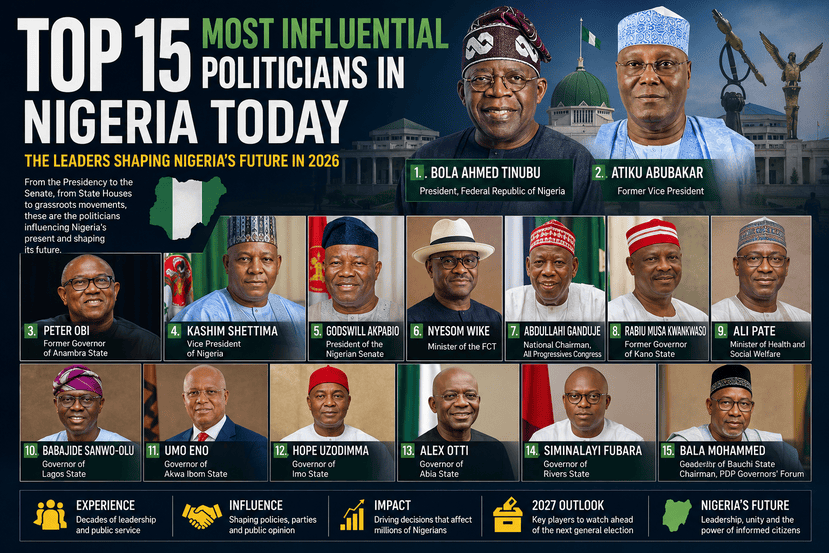
This article examines fifteen of the most influential politicians in Nigeria today, highlighting their careers, accomplishments, political relevance, and the roles they are likely to play in the country’s future.
1. Bola Ahmed Tinubu
No politician currently holds more formal political influence in Nigeria than President Bola Ahmed Tinubu.
Since assuming office in May 2023, Tinubu has introduced sweeping economic reforms, including the removal of the petrol subsidy and reforms affecting the foreign exchange market. Supporters argue these measures are necessary for long-term economic stability, while critics point to the resulting inflation and rising cost of living.
Before becoming president, Tinubu served as Governor of Lagos State from 1999 to 2007. He is widely credited with helping transform Lagos into Nigeria’s commercial powerhouse through tax reforms, infrastructure development, and institutional restructuring.
Beyond public office, Tinubu has built one of the country’s strongest political networks. Many governors, ministers, lawmakers, and influential party leaders have emerged from his political structure, making him a central figure in Nigerian politics.
2. Atiku Abubakar
Former Vice President Atiku Abubakar remains one of Nigeria’s most prominent opposition figures.
Having contested multiple presidential elections, Atiku continues to command significant influence within the People’s Democratic Party (PDP). He is known for advocating economic liberalization, private-sector investment, and constitutional restructuring.
Although he did not win the 2023 presidential election, Atiku remains an important voice in national political debates and is expected to influence discussions leading into the 2027 elections.
3. Peter Obi
Peter Obi has become one of the most influential politicians among Nigerian youths and urban voters.
The former Governor of Anambra State gained national prominence during the 2023 presidential election, where his campaign energized millions of first-time voters.
Known for emphasizing prudent public spending, transparency, education, and healthcare, Obi continues to enjoy strong grassroots support.
Whether or not he contests again in 2027, his political influence remains substantial.
4. Kashim Shettima
As Nigeria’s Vice President, Kashim Shettima plays an important role in the current administration.
A former Governor of Borno State and former Senator, Shettima brings extensive experience in governance, security, and regional politics.
His influence extends across northern Nigeria, making him a key figure within the ruling All Progressives Congress (APC).
5. Godswill Akpabio
Serving as President of the Nigerian Senate, Godswill Akpabio occupies one of the country’s most powerful constitutional offices.
He previously served as Governor of Akwa Ibom State and later as Minister of Niger Delta Affairs.
His ability to coordinate legislative support for government policies places him among Nigeria’s most influential politicians.
6. Nyesom Wike
Although he currently serves in the federal government, Nyesom Wike remains one of Nigeria’s most influential political strategists.
As former Governor of Rivers State, Wike built an extensive political network that continues to shape politics in the South-South region.
His outspoken style and strategic alliances ensure he remains one of the country’s most closely watched politicians.
7. Abdullahi Ganduje
The National Chairman of the APC, Abdullahi Ganduje, oversees the affairs of Nigeria’s ruling political party.
His leadership will be critical in preparing the APC for the 2027 elections, including candidate selection, party unity, and campaign strategy.
8. Rabiu Musa Kwankwaso
Rabiu Musa Kwankwaso remains one of northern Nigeria’s most influential political figures.
The former Governor of Kano State commands a loyal political movement known as the Kwankwasiyya Movement, which continues to influence politics in Kano and neighboring states.
His future political decisions could significantly affect the balance of power ahead of 2027.
9. Ali Pate
Although more widely known for his work in public health, Professor Muhammad Ali Pate has become an influential figure within the current administration due to his leadership in healthcare reform.
His role demonstrates that policy influence can extend beyond traditional political campaigning.
10. Babajide Sanwo-Olu
As Governor of Lagos State, Babajide Sanwo-Olu leads Nigeria’s largest economy.
Decisions made in Lagos often influence national discussions on transportation, infrastructure, technology, and urban development.
His administration continues to oversee major projects, including the Lagos Rail Mass Transit system and road expansion initiatives.
11. Umo Eno
Governor Umo Eno has emerged as an important political figure in the South-South region.
His administration focuses on agriculture, tourism, and economic development while strengthening his influence within the PDP.
12. Hope Uzodimma
The Governor of Imo State has become an influential voice within the APC in the South-East.
He continues to play a key role in expanding the party’s presence in a region traditionally dominated by opposition parties.
13. Alex Otti
Governor Alex Otti has attracted national attention through his emphasis on infrastructure, public financial management, and governance reforms in Abia State.
His performance is being closely watched as an example of opposition-led governance.
14. Siminalayi Fubara
The Governor of Rivers State remains one of Nigeria’s most discussed political figures due to the ongoing political developments in Rivers State.
His leadership and relationship with political stakeholders continue to shape events in one of Nigeria’s most economically important states.
15. Bala Mohammed
Governor Bala Mohammed of Bauchi State remains an influential leader within the PDP.
As Chairman of the PDP Governors’ Forum, he plays a major role in coordinating opposition politics and shaping the party’s national strategy.
Key Issues Shaping Nigerian Politics in 2026
Several major issues continue to define Nigeria’s political landscape.
Economic Reforms
Inflation, exchange rate stability, job creation, and public debt remain central issues affecting governance.
Security
Addressing insecurity, including terrorism, banditry, kidnapping, and communal conflicts, remains a top priority.
Electoral Reforms
Calls for improvements in election management and greater transparency continue ahead of the 2027 polls.
Youth Participation
Young Nigerians are playing an increasingly active role in politics through advocacy, voter registration, and civic engagement.
Infrastructure and Development
Citizens continue to demand improvements in roads, electricity, education, healthcare, and digital infrastructure.
Who Could Shape the 2027 Elections?
The 2027 general elections are expected to be one of the most competitive in Nigeria’s democratic history.
The decisions made by leaders such as Bola Ahmed Tinubu, Atiku Abubakar, Peter Obi, Rabiu Musa Kwankwaso, and other influential politicians will likely determine the alliances, campaign narratives, and policy debates that shape the election.
Political parties are already reviewing strategies, while citizens continue to assess government performance and opposition alternatives.
Conclusion
Nigeria’s democracy continues to evolve, driven by leaders with different ideologies, experiences, and visions for the country’s future.
The politicians highlighted in this article wield influence through elected office, party leadership, public support, or policy expertise. Their decisions affect governance, economic development, security, and the daily lives of millions of Nigerians.
As the country moves closer to the 2027 general elections, these figures will remain at the center of national conversations. For voters, staying informed about their policies, records, and leadership styles will be essential to making informed democratic choices.
Ultimately, Nigeria’s future will be shaped not only by its political leaders but also by the active participation of its citizens in strengthening democratic institutions and holding public officials accountable.