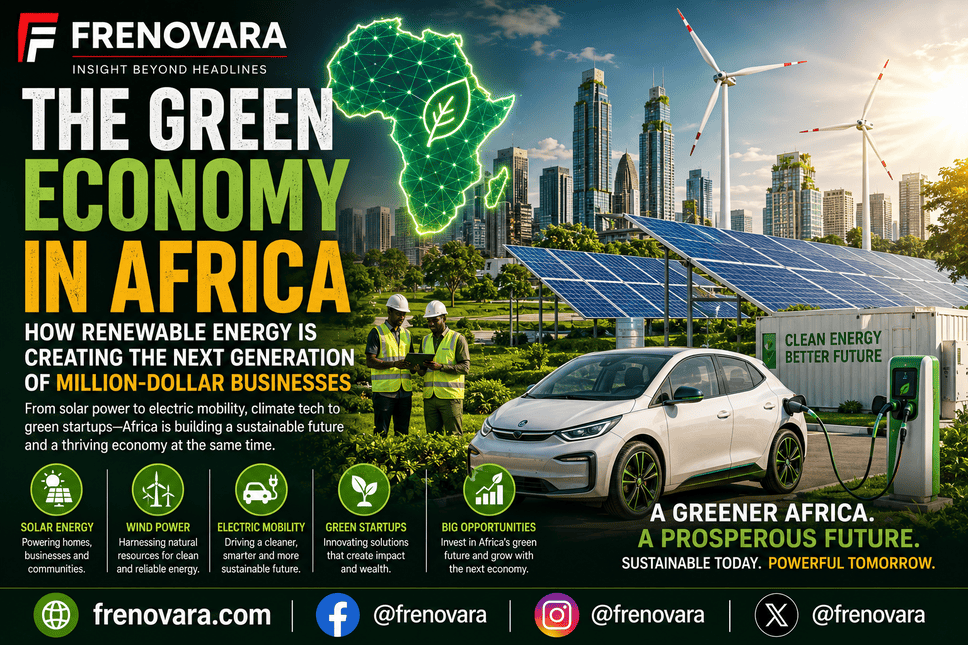
The Green Economy in Africa: How Renewable Energy Is Creating the Next Generation of Million-Dollar Businesses
For decades, discussions about Africa’s economy have focused on oil, gas, mining, and agriculture.
Today, another economic revolution is quietly gaining momentum.
It is called the Green Economy in Africa.
Driven by climate innovation, renewable energy, sustainable technology, and environmental responsibility, this new economy is creating entirely new industries capable of generating billions of dollars while improving the lives of millions.
Across the continent, entrepreneurs are building companies that install solar panels, manufacture clean energy products, develop electric vehicles, recycle waste, and create climate-smart technologies.
At the same time, governments and global investors are pouring billions of dollars into Africa’s clean energy transition.
For business owners, investors, and young entrepreneurs, this represents one of the biggest African Business Opportunities of the next decade.
What Is the Green Economy?
The green economy refers to economic activities that improve human well-being while reducing environmental risks.
Instead of depending heavily on fossil fuels, green businesses focus on sustainable growth through:
- Renewable energy.
- Energy efficiency.
- Green transportation.
- Recycling.
- Sustainable agriculture.
- Water conservation.
- Climate technology.
- Environmental innovation.
Unlike traditional industries that often consume natural resources without replacing them, green businesses aim to create long-term economic value while protecting the environment.
This balance makes the Green Economy in Africa increasingly attractive to governments, businesses, and investors.
Why Africa Is Perfectly Positioned for Renewable Energy
Few regions possess renewable energy resources as abundant as Africa.
The continent enjoys:
- Year-round sunshine across vast regions.
- Strong wind corridors.
- Large hydroelectric potential.
- Geothermal resources.
- Growing investment in green hydrogen.
These natural advantages provide Africa with enormous opportunities to become a global leader in Renewable Energy Africa.
Rather than importing expensive fossil fuels, many countries can generate clean electricity locally.
This reduces energy costs while creating employment and attracting foreign investment.
The Energy Challenge Is Becoming a Business Opportunity
More than half a billion Africans still experience unreliable electricity or lack access altogether.
For entrepreneurs, this challenge represents opportunity.
Businesses are increasingly providing:
- Solar home systems.
- Mini-grids.
- Battery storage.
- Commercial solar installations.
- Clean cooking solutions.
- Energy financing.
Companies solving Africa’s electricity problems are not simply providing power.
They are building scalable businesses capable of serving millions of customers.
Solar Energy Is Leading the Revolution
Among all renewable energy sources, Solar Energy Africa continues leading the transformation.
Solar technology has become:
- More affordable.
- More efficient.
- Easier to install.
- More accessible for households and businesses.
Across Africa, solar companies now serve:
- Homes.
- Schools.
- Hospitals.
- Farms.
- Factories.
- Shopping centres.
The falling cost of solar equipment continues opening new opportunities for startups across the continent.
Governments Are Supporting the Green Transition
Many African governments have introduced policies encouraging renewable energy investment.
These include:
- Tax incentives.
- Green financing.
- Renewable energy targets.
- Public-private partnerships.
- Infrastructure development.
- Climate investment programmes.
These initiatives encourage private companies to invest confidently in Green Technology Africa.
Investors Are Paying Attention
Global investors increasingly recognise Africa’s renewable energy potential.
International organisations, development banks, and venture capital firms continue investing billions of dollars into:
- Solar energy.
- Wind power.
- Battery technology.
- Climate startups.
- Electric mobility.
- Green infrastructure.
This growing interest demonstrates confidence in the continent’s long-term future.
As the African Energy Transition accelerates, investment opportunities continue expanding.
Renewable Energy Is Creating Jobs
Beyond protecting the environment, renewable energy creates employment.
Growing industries require professionals such as:
- Solar engineers.
- Electricians.
- Energy consultants.
- Climate scientists.
- Software developers.
- Project managers.
- Sustainability experts.
Young Africans entering these industries are building careers that combine technology with environmental impact.
This makes renewable energy one of the fastest-growing sectors within Sustainable Business Africa.
Wind Energy Is Becoming Africa’s Next Renewable Powerhouse
While Solar Energy Africa often dominates headlines, wind energy is quietly becoming another pillar of the continent’s clean energy revolution.
Several African countries possess world-class wind resources capable of generating affordable electricity on a massive scale.
Countries such as:
- Kenya
- South Africa
- Morocco
- Egypt
- Ethiopia
have invested heavily in wind farms that now supply electricity to millions of homes and businesses.
Modern wind turbines are more efficient than ever, allowing governments to reduce dependence on fossil fuels while creating new employment opportunities.
As the African Energy Transition accelerates, wind energy is expected to play an increasingly important role alongside solar power.
Electric Vehicles Are Creating New Business Opportunities
The global shift toward electric mobility is beginning to reshape transportation across Africa.
Although adoption remains in its early stages, entrepreneurs are already investing in:
- Electric motorcycles.
- Electric buses.
- Charging stations.
- Battery manufacturing.
- Fleet electrification.
- Smart mobility platforms.
Electric vehicles reduce fuel costs while lowering carbon emissions.
Several startups are building innovative solutions specifically designed for African roads and urban environments.
This rapidly expanding industry represents one of the strongest Green Business Africa opportunities over the next decade.
Climate Technology Is Attracting Global Investment
Climate technology—often called ClimateTech—is one of the fastest-growing investment sectors worldwide.
Across Africa, startups are developing solutions that address environmental challenges through innovation.
Examples include:
- Carbon monitoring systems.
- Smart irrigation.
- Water purification.
- Waste recycling.
- Clean cooking technologies.
- Energy management software.
- Climate data analytics.
As Climate Innovation Africa gains momentum, investors increasingly view African startups as global competitors capable of solving some of humanity’s biggest environmental challenges.
Green Startups Are Solving Local Problems
One of Africa’s greatest strengths is its entrepreneurial mindset.
Rather than waiting for foreign solutions, local founders are building businesses tailored to African realities.
Emerging Green Technology Africa startups are helping communities by:
- Installing affordable solar systems.
- Financing renewable energy projects.
- Recycling electronic waste.
- Converting agricultural waste into clean fuel.
- Building energy-efficient housing.
- Developing AI-powered environmental monitoring tools.
These companies demonstrate that sustainability and profitability can grow together.
Countries Leading Renewable Energy Africa
Several nations continue setting the pace for Renewable Energy Africa.
Kenya
Kenya remains one of Africa’s leaders in geothermal and wind energy while expanding solar investment.
Its renewable energy mix continues attracting international recognition.
Morocco
Morocco has invested billions in large-scale solar and wind projects.
The country now operates some of the world’s largest solar energy facilities, positioning itself as a leader in clean energy innovation.
South Africa
South Africa continues expanding renewable energy through independent power producers while modernising its electricity infrastructure.
The country is becoming a major destination for renewable energy investment.
Egypt
Egypt’s renewable energy ambitions continue growing through major solar and wind developments designed to meet rising electricity demand.
Nigeria
Although traditionally associated with oil and gas, Nigeria’s rapidly growing solar industry is opening enormous opportunities for entrepreneurs and investors.
With millions lacking reliable electricity, distributed renewable energy remains one of Nigeria’s most promising business sectors.
Renewable Energy Investment Africa Is Accelerating
Global institutions increasingly recognise Africa as one of the world’s most promising renewable energy markets.
Funding now comes from:
- Development banks.
- Climate investment funds.
- Venture capital firms.
- Private equity.
- International energy companies.
- Government partnerships.
These investments support projects involving:
- Solar farms.
- Battery storage.
- Green hydrogen.
- Smart electricity grids.
- Rural electrification.
For investors seeking long-term growth, Renewable Energy Investment Africa continues presenting compelling opportunities.
Challenges Facing the Green Economy
Despite significant progress, several obstacles remain.
These include:
- Limited financing.
- High import costs for equipment.
- Inconsistent government policies.
- Electricity infrastructure gaps.
- Skills shortages.
- Limited local manufacturing capacity.
Addressing these challenges will be essential if Africa is to realise the full potential of its green economy.
Fortunately, public-private partnerships and technological innovation continue helping overcome many of these barriers.
Africa 2035 – The Green Economy Could Become a Trillion-Dollar Opportunity
The next decade will determine whether Africa merely participates in the global green transition or leads it.
By 2035, renewable energy is expected to power a much larger share of Africa’s industries, homes, transportation systems, and digital infrastructure.
If governments continue investing in Renewable Energy Africa, and private investors maintain their confidence, the continent could become one of the world’s fastest-growing green economies.
Imagine an Africa where:
- Most households generate electricity through rooftop solar systems.
- Electric buses dominate public transportation.
- Smart energy grids reduce nationwide blackouts.
- AI manages electricity distribution efficiently.
- Green manufacturing creates millions of jobs.
- Climate technology startups export African innovations worldwide.
This future is no longer unrealistic—it is increasingly achievable.
Which Industries Will Create the Next Million-Dollar Businesses?
The Green Economy in Africa extends far beyond solar panels.
Entrepreneurs who recognise emerging trends early could build highly successful companies in several sectors.
Solar Installation and Maintenance
Demand for residential, commercial, and industrial solar systems continues rising across the continent.
Companies specialising in installation, maintenance, financing, and after-sales support are expected to grow rapidly.
Battery Storage
Renewable energy depends heavily on efficient energy storage.
Businesses producing or distributing battery technologies will become increasingly important.
Electric Mobility
Electric motorcycles, buses, charging stations, and fleet management systems represent enormous African Business Opportunities.
Urban transportation is expected to become significantly greener over the next decade.
Climate Technology
Climate-focused startups developing AI, software, monitoring systems, and environmental analytics will continue attracting international investment.
Green Construction
Energy-efficient buildings, smart homes, sustainable construction materials, and eco-friendly architecture will become increasingly valuable as cities modernise.
Renewable Energy Financing
Many businesses and households cannot afford large upfront installation costs.
Companies providing innovative financing solutions will play a critical role in accelerating adoption.
Frequently Asked Questions (FAQs)
What Is the Green Economy?
The green economy focuses on sustainable economic growth while reducing environmental risks through renewable energy, clean technology, efficient resource management, and climate innovation.
Why Is Renewable Energy Important for Africa?
Africa possesses some of the world’s richest renewable energy resources.
Expanding clean energy improves electricity access, reduces dependence on fossil fuels, creates jobs, and supports long-term economic growth.
Which Renewable Energy Source Has the Greatest Potential?
While several renewable technologies are important, Solar Energy Africa currently offers the largest immediate opportunity due to abundant sunshine across much of the continent.
However, wind, geothermal, hydroelectric power, and green hydrogen are also expected to grow significantly.
Is the Green Economy Good for Investors?
Yes.
Many investors now view Renewable Energy Investment Africa as one of the continent’s strongest long-term opportunities because demand continues increasing across governments, businesses, and households.
Why Entrepreneurs Should Pay Attention Now
History consistently rewards entrepreneurs who identify major economic shifts before they become mainstream.
The internet created global technology companies.
Mobile money transformed financial services.
Artificial Intelligence is reshaping nearly every industry.
The Green Economy in Africa could become the next great entrepreneurial opportunity.
Young founders entering renewable energy, climate technology, sustainable manufacturing, and clean mobility today may build tomorrow’s most valuable African companies.
Waiting until these industries become saturated could mean missing one of the continent’s biggest business opportunities.
Beyond the Headlines
For decades, Africa’s economic story has often been written around the resources buried beneath its soil.
Oil.
Gas.
Coal.
Minerals.
But the next chapter may be powered by something entirely different.
Sunlight.
Wind.
Innovation.
The Green Economy in Africa is not simply about replacing fossil fuels.
It is about creating an economy that grows without exhausting the very resources future generations depend on.
It is about entrepreneurs building profitable companies while solving real problems.
It is about investors recognising that sustainability is becoming one of the strongest drivers of long-term economic value.
Most importantly, it is about Africa defining its own future rather than following someone else’s path.
The countries that embrace Green Technology Africa today will likely become tomorrow’s leaders in energy, manufacturing, transportation, and innovation.
The businesses that act early will not simply benefit from the transition.
They will help shape it.
That’s the Frenovara perspective—looking beyond the headlines to uncover the opportunities driving Africa’s future.
WordPress Categories
- Business
- Technology
- Renewable Energy
- Innovation
- Sustainability
- African Economy
WordPress Tags
Green Economy in Africa, Renewable Energy Africa, Green Business Africa, Solar Energy Africa, Clean Energy Africa, Sustainable Business Africa, Climate Innovation Africa, African Energy Transition, Green Technology Africa, Renewable Energy Investment Africa, Future of Energy Africa, African Business Opportunities.
- Africa 2030: The Technologies That Will Create the Continent’s Next Billion-Dollar Companies
- How 5G Will Transform African Businesses
- The Rise of Smart Cities in Africa
- Quantum Computing in Africa: Could It Shape the Continent’s Future?
- Top African AI Startups Revolutionizing Retail
- How Logistics Technology Is Changing African Retail
- The Future of Cashless Shopping in Africa
- How Mobile Money Is Powering African E-commerce
Image SEO
Image File Name
green-economy-africa-renewable-energy-business.jpg
Image Alt Text
Update this feature annually with major renewable energy investments, new climate technology startups, policy reforms, green infrastructure projects, and breakthrough innovations. This will keep the article authoritative, improve search rankings, and establish Frenovara as a trusted voice on Africa’s sustainable economic f